[논문리뷰] Geometry-Aware Image Flow Matching
링크: 논문 PDF로 바로 열기
저자: Junho Lee, Kwanseok Kim, Joonseok Lee, et al.
1. Key Terms & Definitions (핵심 용어 및 정의)
본 논문은 Geometry-Aware Image Flow Matching 연구를 위해 다음과 같은 핵심 용어 및 개념을 정의하고 활용합니다.
- Flow Matching (FM): 데이터 차원 ℝᵈ에서 정의되는 생성 모델링 프레임워크로, 시간 의존적인 velocity field를 통해 source distribution을 target data distribution으로 변환합니다.
- Conditional Flow Matching (CFM): Marginal velocity field 계산의 intractability를 해결하기 위해 conditional probability path를 구성하고 conditional velocity field에 맞춰 학습하는 FM의 변형입니다.
- Spherical Optimal Transport Conditional Flow Matching (SOT-CFM): 기존 OT-CFM의 Euclidean transport cost를 angular metric으로 대체하여 directional component 기반의 semantic similarity를 우선시하는 제안 방법론입니다.
- Spherical Flow Matching (SFM): source 및 target distribution을 hypersphere manifold로 제한하고 manifold 상의 geodesic path를 flow trajectory로 사용하는, 완전히 Riemannian geometry에 기반한 제안 프레임워크입니다.
- Hyperspherical Projection: 자연 이미지의 semantic information이 주로 directional component에 인코딩되어 있다는 관찰을 바탕으로, 이미지 데이터를 hypersphere 위에 투영하는 과정입니다.
2. Motivation & Problem Statement (연구 배경 및 문제 정의)
기존의 Continuous Normalizing Flows (CNF), Diffusion models (DM), Flow Matching (FM)과 같은 발전된 생성 모델들은 이미지 데이터를 고차원 Euclidean space의 벡터로 간주하는 Euclidean geometry 가정을 기반으로 합니다. 이러한 접근 방식은 성공적이었지만, 자연 이미지의 intrinsic geometric structure를 완전히 포착하지 못하는 한계점을 가집니다. 데이터 manifold가 알려진 다른 도메인(예: 주기적 결정 구조)에서는 Riemannian CNF, Riemannian Score-based models (RSGM), Riemannian Diffusion models (RDM), Riemannian Flow Matching (RFM)과 같은 Geometry-Aware 모델링이 높은 품질의 샘플, 빠른 수렴, 그리고 더 원칙적인 학습을 달성했습니다.
그러나, 자연 이미지의 경우 그 intrinsic manifold structure가 알려져 있지 않아 기존 Geometry-Aware 방법론들을 직접 적용하기 어렵다는 근본적인 문제가 존재했습니다. 본 연구는 이러한 간극을 해소하기 위해 자연 이미지의 intrinsic geometry를 directional decomposition analysis를 통해 탐구합니다. 핵심 발견은 semantic information이 주로 directional component (unit vector)에 인코딩되어 있으며, magnitude (norm)는 perceptual quality에 최소한으로 기여한다는 점입니다. 이러한 특성은 RGB space와 latent space 모두에서 유효하며, 자연 이미지가 hypersphere 상에서 효과적으로 모델링될 수 있음을 시사합니다. 이 hyperspherical projection은 이미지의 semantic 및 visual integrity를 보존하며, 심지어 L2 norms에 상당한 변화가 있음에도 불구하고 원본과 거의 구별할 수 없는 수준을 유지합니다 [cite: 1, Figure 1].
3. Method & Key Results (제안 방법론 및 핵심 결과)
본 연구는 자연 이미지가 intrinsic하게 hyperspherical manifold structure를 가지며, semantic information이 주로 directional component에 인코딩된다는 핵심 발견을 기반으로 합니다. 이 관찰을 통해 저자들은 두 가지 Geometry-Aware Flow Matching 프레임워크인 Spherical Optimal Transport Conditional Flow Matching (SOT-CFM)과 Spherical Flow Matching (SFM)을 제안합니다.
SOT-CFM은 기존 OT-CFM의 Euclidean transport cost를 angular metric인 arccos(<x0, x1> / (||x0||2 ||x1||2))으로 대체합니다 [cite: 1, Eq. 14]. 이 angular cost는 magnitude 차이에 불변하므로, optimal transport plan이 semantic similarity를 우선시하여 Geometry-consistent coupling을 생성하도록 합니다 [cite: 1, Figure 3b]. 이를 통해 모델은 semantically 중요한 directional manifold에 최적화를 집중하게 됩니다.
SFM은 더욱 직접적으로 hyperspherical manifold 𝕊ᵈ⁻¹에서 작동하도록 설계되었습니다. source Gaussian distribution과 target image data 모두 동일한 반지름 r을 가진 hypersphere에 투영되며, flow path는 manifold 상의 geodesic (spherical linear interpolation, slerp)으로 정의됩니다 [cite: 1, Eq. 15, Figure 3c]. 모델은 이 geodesic을 따르는 conditional vector field, 즉 tangent vector를 예측하도록 학습됩니다. SFM은 Riemannian inner product를 사용하여 loss를 측정하며, 생성 과정 전체를 hypersphere에 제약함으로써 semantically 중요한 directional variations 학습에 집중하게 합니다.
핵심 정량적 결과는 다음과 같습니다.
- Hyperspherical Projection의 효과: 데이터를 hypersphere에 투영하는 것만으로도 모델 아키텍처나 학습 목표를 변경하지 않고도 일관된 성능 향상을 보였습니다. I-CFM (ours) (target
𝒟̃사용)은 CIFAR-10에서 gFID 4.10을 달성하여 baseline의 4.29 대비, ImageNet-256에서는 gFID 5.02를 달성하여 baseline의 5.29 대비 향상되었습니다 [cite: 1, Table 2]. 이는 norm variability를 제거하여 학습 난이도를 낮춘 결과입니다. - SOT-CFM의 성능: SOT-CFM (ours)은 Euclidean transport cost를 angular distance로 대체하여 OT-CFM 대비 꾸준한 개선을 보였습니다. CIFAR-10에서 gFID 4.11 (OT-CFM: 4.30), ImageNet-256에서 gFID 5.15 (OT-CFM: 5.22)를 기록했습니다 [cite: 1, Table 2].
- SFM의 우수성: 본 연구의 SFM (ours)은 모든 평가된 baseline 대비 우수한 성능을 달성했습니다. CIFAR-10에서 가장 낮은 gFID 3.79를, ImageNet-256에서는 gFID 4.62를 기록하며 다른 모든 Euclidean baseline을 능가했습니다 [cite: 1, Table 2]. 이는 Riemannian manifold에서 직접 작동하는 것이 Euclidean 방식에 비해 명확한 이점을 제공함을 입증합니다.
- Downstream Classification: ImageNet-256에서 생성된 이미지에 대한 ResNet-50 분류 정확도 평가에서 SFM은 Top-1 accuracy 87.13%를 달성하여 원본 이미지의 정확도 (80.35%)와 I-CFM (61.83%)을 크게 뛰어넘었습니다 [cite: 1, Table IV]. 이는 SFM이 단순히 클래스 구조를 보존하는 것을 넘어 클래스 판별력을 향상시킨다는 것을 시사합니다.
4. Conclusion & Impact (결론 및 시사점)
본 연구는 자연 이미지가 hypersphere 위에서 효과적으로 모델링될 수 있으며, semantic information이 주로 directional component에 인코딩된다는 중요한 기하학적 통찰을 제공합니다. 이러한 발견을 바탕으로 제안된 SOT-CFM과 SFM은 angular metric과 geodesic dynamics를 활용하여 geometrically consistent한 생성 경로를 보장합니다. CIFAR-10 및 ImageNet-256 데이터셋에 대한 실험 결과는 RGB 및 다양한 autoencoder latent spaces를 포함한 여러 representation space에서 이러한 spherical 접근 방식이 Euclidean baseline을 지속적으로 능가함을 입증했습니다.
궁극적으로, 본 연구는 자연 이미지의 intrinsic spherical geometry를 활용하는 것이 실질적인 이점을 제공하며, Geometry-Aware 이미지 생성을 위한 견고한 토대를 마련했습니다. 이는 미분 기하학의 기하학적 도구들이 단순히 이론적인 구성물이 아니라 표준 Euclidean 방법론을 능가할 수 있는 실용적인 대안임을 보여주며, Geometry-Aware 생성 모델링 분야의 추가 연구를 위한 길을 열었습니다.
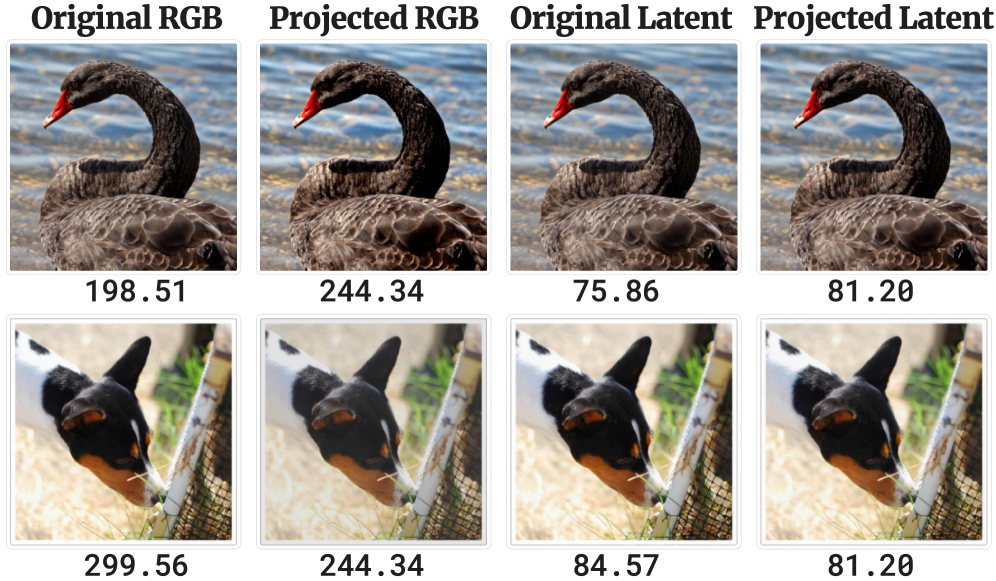
Figure 1 — 하이퍼스페리컬 투영 효과
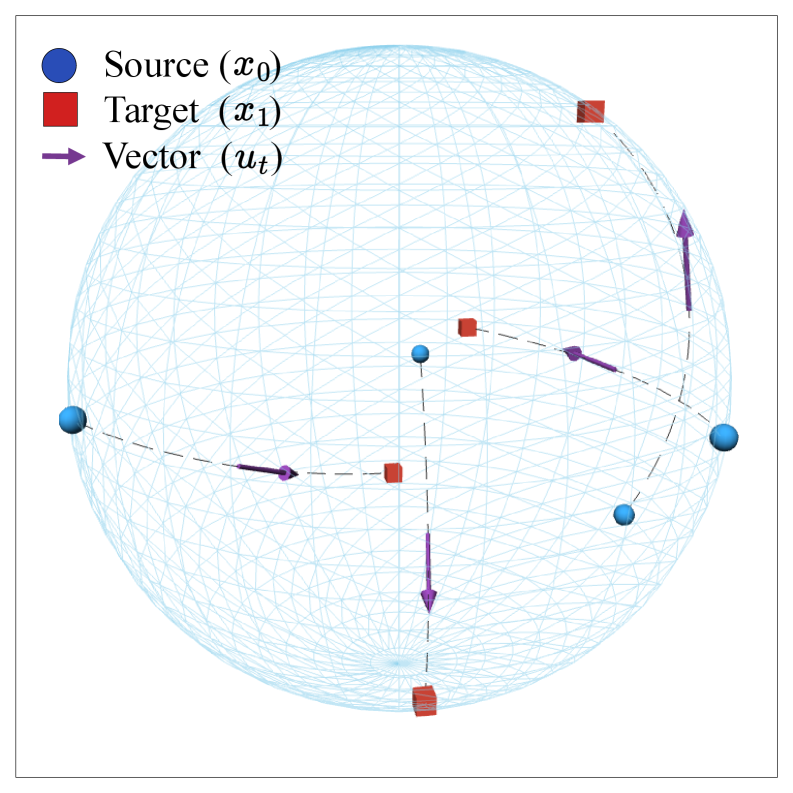
Figure 3 — SFM 방법론 개요
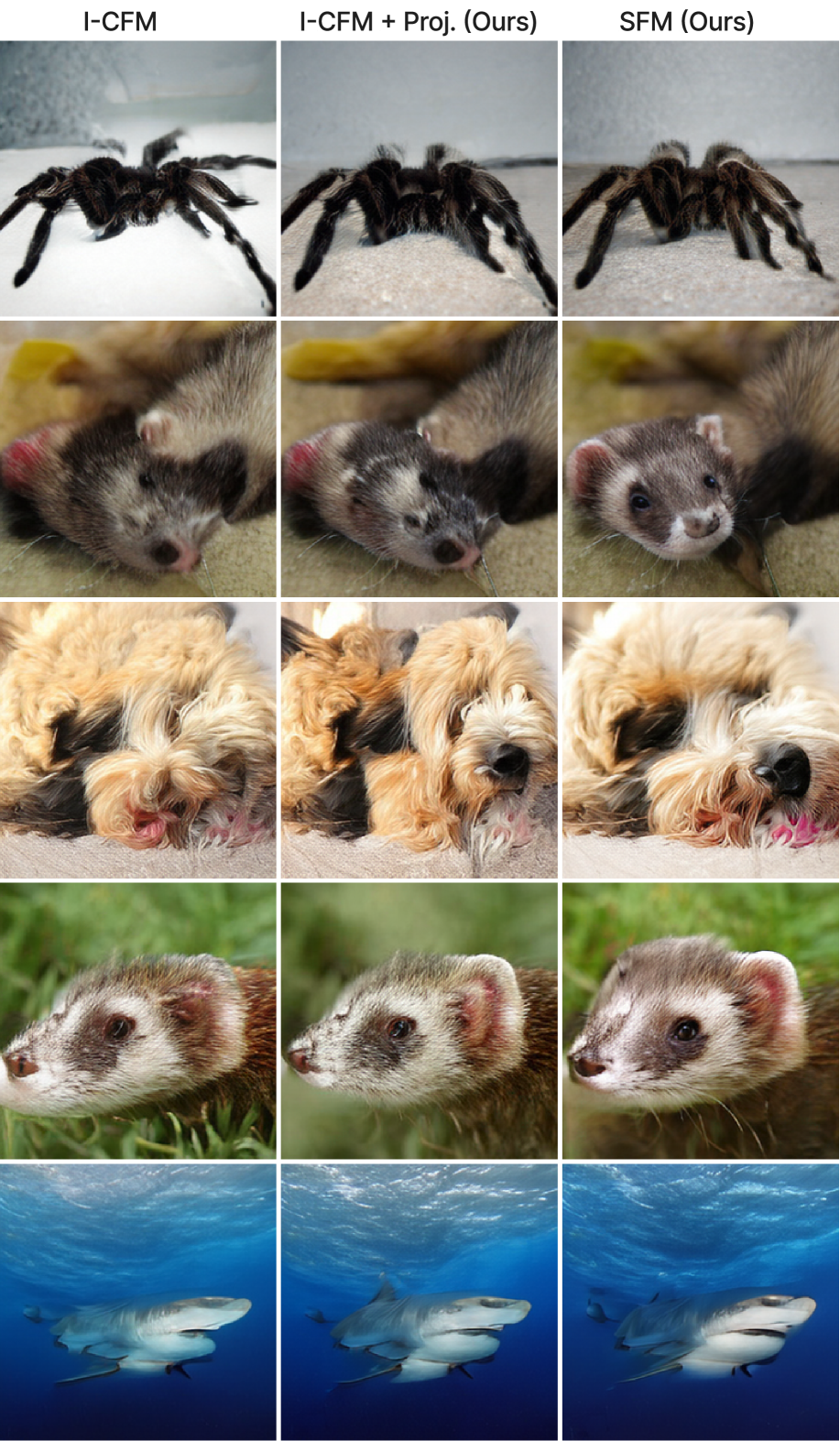
Figure 4 — 생성 이미지 정성적 비교
⚠️ 알림: 이 리뷰는 AI로 작성되었습니다.
관련 포스트
- [논문리뷰] Adversarial Flow Models
- [논문리뷰] Distilled Decoding 2: One-step Sampling of Image Auto-regressive Models with Conditional Score Distillation
- [논문리뷰] AlphaFlow: Understanding and Improving MeanFlow Models
- [논문리뷰] Equilibrium Matching: Generative Modeling with Implicit Energy-Based Models
- [논문리뷰] Data Unlearning via Inverse Distillation
Review 의 다른글
- 이전글 [논문리뷰] Foundation Protocol: A Coordination Layer for Agentic Society
- 현재글 : [논문리뷰] Geometry-Aware Image Flow Matching
- 다음글 [논문리뷰] Helix4D: Complex 4D Mesh Generation
댓글