[논문리뷰] Learning to Evaluate Before Improving: Automatic Rubric Induction for Automatic Research Agents
링크: 논문 PDF로 바로 열기
저자: Xuehai Wang, Haowei Qin, Tongxin Liu, Junkai Li, Buqiang Xu, et al.
1. Key Terms & Definitions (핵심 용어 및 정의)
- AutoSciRub: Task-specific executable rubric을 자동으로 생성하고, 이를 기반으로 연구 실행, 기준 수준 검증 및 반복적인 수정을 가이드하는 evaluation-first 프레임워크입니다.
- Rubric Skeleton Induction: High-level 연구 instruction을 atomic scientific goals의 compact set으로 구성하는 과정입니다.
- Scientific Literature Grounding: Rubric skeleton의 각 goal을 관련 문헌, 웹 증거, task-visible data, 환경 제약에 기반하여 과학적 관행에 grounding하는 과정입니다.
- Task-specific Executable Rubric: Rubric skeleton, literature-grounded knowledge, task-data profile을 결합하여 실행 가능한 실험, 분석, 그리고 필요한 증거를 명세하는 구체적인 평가 기준입니다 [cite: 1, Figure 2].
- Criterion-Level Verification: 연구 artifact가 task-specific executable rubric의 각 criterion을 충족하는지 여부를 확인하고, 충족되지 않은 부분에 대한 feedback을 제공하는 과정입니다.
2. Motivation & Problem Statement (연구 배경 및 문제 정의)
Autonomous scientific research agents는 literature review, data analysis, experimentation, report generation 등 end-to-end scientific workflows에 점차 적용되고 있습니다. 그러나 open-ended research tasks는 필요한 analyses, methods, success criteria를 명확히 명시하지 않아, agents가 중요한 분석을 놓치거나, 부적절한 methods를 사용하거나, evidence가 불충분한 결론을 내릴 수 있습니다 [cite: 1, Figure 1]. 기존 scientific-agent benchmarks는 executable metrics나 expert-authored rubrics를 사용하여 연구 결과물을 평가하지만, expert-authored rubrics는 구축에 상당한 도메인 전문성과 수동적 노력이 필요하여 새로운 연구 tasks에 확장하기 어렵습니다. 또한, 기존 rubrics는 주로 post-hoc evaluation instrument로 사용되어 agent가 어떤 evidence를 생성해야 하거나 불완전한 artifact를 어떻게 개선해야 하는지에 대한 guidance를 제공하지 못하는 한계가 있습니다.
3. Method & Key Results (제안 방법론 및 핵심 결과)
본 논문은 underspecified research instruction을 task-specific executable rubric으로 변환하고, 이를 연구 실행, 검증, 그리고 반복적인 수정에 활용하는 AutoSciRub 프레임워크를 제안합니다 [cite: 1, Figure 2]. AutoSciRub는 두 가지 주요 단계로 구성됩니다: 첫째, Automatic Rubric Induction은 instruction-derived rubric skeleton을 구축한 후, Scientific Literature Grounding, Task-Data Exploration, 그리고 Criterion Synthesis를 통해 task-specific executable rubric으로 변환합니다 [cite: 1, Figure 2]. 둘째, Rubric-Guided Iterative Revision은 생성된 연구 artifact를 Criterion-Level Verification하여 충족되지 않은 scientific requirements를 식별하고, 이를 바탕으로 targeted feedback을 제공하여 artifact를 개선합니다 [cite: 1, Figure 2].
ResearchClawBench에서 AutoSciRub는 모든 테스트된 configurations에서 consistent하게 성능을 향상시켰습니다 [cite: 1, Table 1]. 특히, 고정된 Codex harness 하에서 세 가지 backbone LLM (GPT-5.4, GLM-5.2, MiniMax-M3)에 대해 평균 2.08점의 gain을, 고정된 DeepSeek-V4-Flash backbone을 사용하는 세 가지 agent harness에 대해 평균 2.95점의 gain을 보였습니다. AstaBench E2E Discovery의 20개 task subset에서는 세 가지 agent 시스템에 걸쳐 평균 16.8점의 significant한 개선을 달성했으며, 동시에 성공적으로 완료된 task의 수를 유지하거나 증가시켰습니다 [cite: 1, Figure 3]. Ablation study 결과, Rubric Skeleton Induction만 적용했을 때는 0.36점의 modest한 gain을 보였고, 여기에 Grounded Rubric (Scientific Literature Grounding, Task-Data Exploration, Criterion Synthesis 포함)을 추가했을 때는 베이스라인 대비 1.06점 증가를, 그리고 Rubric-Guided Iterative Revision까지 포함한 Full 시스템은 베이스라인 대비 3.11점 증가를 달성하여 각 단계가 상호보완적인 역할을 수행함을 입증했습니다 [cite: 1, Table 2].
4. Conclusion & Impact (결론 및 시사점)
본 연구는 task-specific scientific rubrics를 자동으로 생성하고, 이를 autonomous research agents의 execution-time guidance로 활용하는 AutoSciRub 프레임워크를 성공적으로 제안했습니다. AutoSciRub는 underspecified research instructions를 scientific goals로 분해하고, external evidence에 기반하여 evaluation criteria를 grounding하며, 생성된 연구 artifact의 criterion-level verification 및 revision을 가이드합니다. 이 연구는 autonomous scientific research 분야에서 agents가 open-ended research tasks의 내재된 요구사항을 명확히 이해하고, 증거 기반의 반복적인 개선을 통해 더 높은 품질의 연구 결과를 생성할 수 있도록 하는 효과적이고 일반화 가능한 control mechanism을 제공합니다. 특히, 다양한 backbone models 및 agent harnesses에 걸쳐 consistent한 성능 향상을 보여주어, AutoSciRub가 기존 시스템에 대한 강력하고 확장 가능한 plugin layer로 기능할 수 있음을 시사합니다.
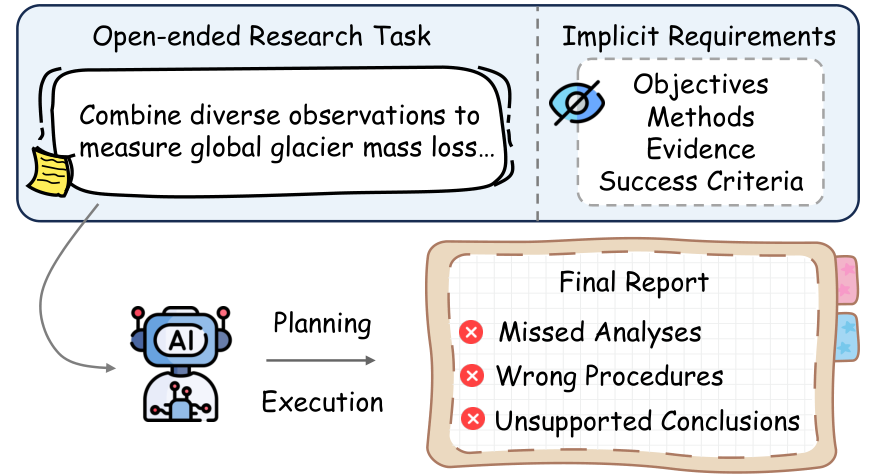
Figure 1 — 자율 연구 에이전트의 어려움
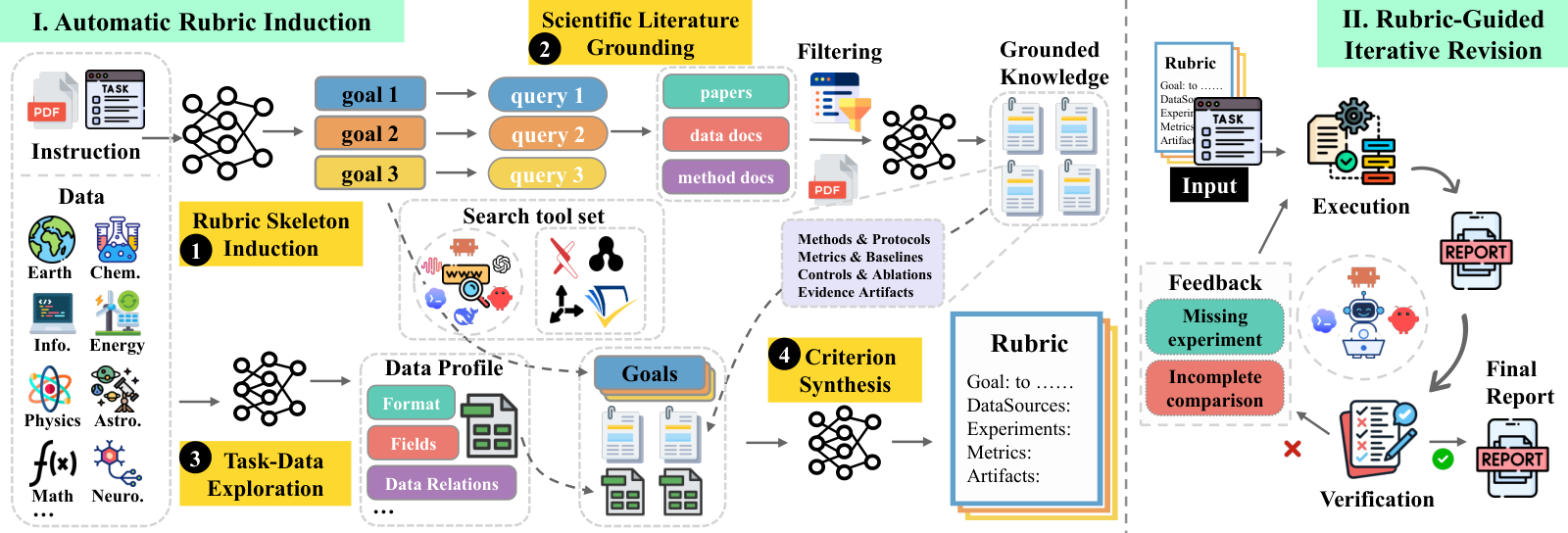
Figure 2 — AutoSciRub 개요
⚠️ 알림: 이 리뷰는 AI로 작성되었습니다.
관련 포스트
- [논문리뷰] EpiQAL: Benchmarking Large Language Models in Epidemiological Question Answering for Enhanced Alignment and Reasoning
- [논문리뷰] AstaBench: Rigorous Benchmarking of AI Agents with a Scientific Research Suite
- [논문리뷰] Into the Unknown: Benchmarking AI agents on open scientific research problems
- [논문리뷰] Are We Testing Too Much? A Survey of Benchmark Compression for Efficient Evaluation of Large Language Models
- [논문리뷰] AMLworld-Compact: Importance-Weighted Downsampling for Cost-Effective LLM Evaluation and Error Diagnosis
Review 의 다른글
- 이전글 [논문리뷰] Keep-or-Drop? Adaptive Tokenizer for Compact Video Representation
- 현재글 : [논문리뷰] Learning to Evaluate Before Improving: Automatic Rubric Induction for Automatic Research Agents
- 다음글 [논문리뷰] Lies We Can See: Joint Verbal and Non-Verbal Deception by VLM Agents in Embodied Social Interactions
댓글