[논문리뷰] Building AI Research Teams for Autonomous Discovery of Linear Attention Architectures
링크: 논문 PDF로 바로 열기
The browsing was successful. Now I will extract the information and generate the summary and JSON output.
Authors: Yujian Liu, Li An, Zelin He, Jacob Helwig, Jiabao Ji, Rohit Jain, Siyu Zhu, Shiyu Chang Title: Building AI Research Teams for Autonomous Discovery of Linear Attention Architectures
Keywords will be extracted after reading the full paper.
Figures to identify:
- Figure 1: Illustration of collaborative autoresearch.
src="2610.28887v1/intro-fig-v3.png"->https://arxiv.org/html/2610.28887v1/intro-fig-v3.png
- Figure 2: Organization of the autonomous research team.
src="2610.28887v1/method-v2.png"->https://arxiv.org/html/2610.28887v1/method-v2.png
- Figure 3: Candidate utility throughout the search. (Graph showing performance over iterations)
src="2610.28887v1/fig-utility-v2.png"->https://arxiv.org/html/2610.28887v1/fig-utility-v2.png
I will use these three figures as they represent the overall architecture, methodology, and key results (progress of discovery).
Now I will proceed to write the summary based on the browsed content, adhering to all specified constraints.
Keywords brainstorm: Autonomous Research, AI Agents, Linear Attention, Architecture Search, Collaborative AI, Deep Learning, Reinforcement Learning (UCB selection resembles this), Generative Models (LLM agents). I'll pick 5-8 strong ones.
Autonomous Research, AI Teams, Linear Attention, Architecture Discovery, Adaptive Allocation, Disciplinary Profiles, LLM Agents, Context-First DeltaNet저자: Yujian Liu, Li An, Zelin He, Jacob Helwig, et al.
1. Key Terms & Definitions (핵심 용어 및 정의)
- Autonomous Research Team: 다양한 전문성을 가진 AI 연구자 에이전트들이 협력하여 가설 생성, 코드 수정, 실험 실행을 통해 과학적 발견을 가속화하는 시스템입니다.
- Linear Attention Architectures: 고정된 크기의 recurrent state를 통해 시퀀스 정보를 유지 및 활용하며 모델 품질과 효율적인 연산을 제공하는 Transformer의 대안적인 Attention 메커니즘 아키텍처입니다.
- Context-First DeltaNet (CFDN): 본 연구에서 발견된 새로운 Linear Attention 아키텍처로, GDN2의 recurrent matrix memory에 recurrent vector를 추가하여 context 정보를 먼저 업데이트한 후 나머지 오류를 matrix가 학습하도록 설계되었습니다.
- Disciplinary Profiles: 각 AI 연구자 에이전트에게 할당된 특정 분야의 도메인 지식, 수학적 도구, 과학적 통찰력 및 연구 접근 방식을 포함하는 초기화 정보입니다.
- Adaptive Allocation: 제한된 실험 예산 하에서 Strong empirical contribution을 보인 연구자와 잠재력이 덜 탐색된 연구자에게 연구 기회를 균형 있게 배분하는 전략으로, discounted Upper Confidence Bound (UCB) selection을 사용합니다.
2. Motivation & Problem Statement (연구 배경 및 문제 정의)
본 논문은 AI 연구자 팀이 제한된 실험 예산 하에서 어떻게 서로의 발견을 기반으로 지속적인 발전을 이루고 open-ended research problem을 해결할 수 있는지 탐구합니다. 기존의 Autonomous research agents는 가설 생성, 구현 및 실험 평가를 반복적인 발견 프로세스로 연결하고 있지만, 잘 발전된 분야에서는 탐색 공간이 제한되어 local minima에 갇히는 경향이 있습니다. 또한, 실험 비용이 높을 경우 제한된 수의 아이디어만 테스트할 수 있어, exploration과 exploitation 사이의 균형이 중요하며, 각 실험 결과가 팀의 다음 시도에 영향을 미쳐야 하는 과제가 존재합니다. 기존 연구들은 다양한 배경을 가진 에이전트의 필요성이나, 개인적인 경험과 공유된 증거가 연구에 미치는 영향, 그리고 연구 기회를 할당하는 방법에 대해 충분히 다루지 못했습니다. 저자들은 이러한 한계를 극복하기 위해 GDN2와 같은 baseline에 갇히지 않고 새로운 Linear Attention 아키텍처를 자율적으로 발견할 수 있는 heterogeneous team organization이 필요함을 강조합니다 [Figure 1].
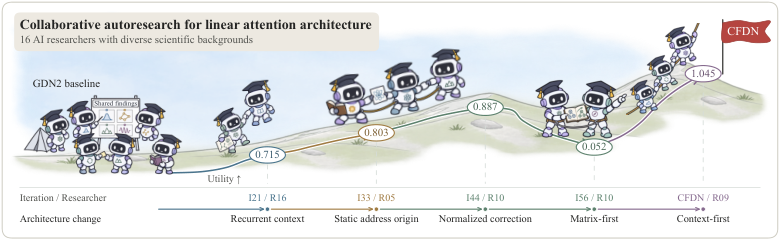
Figure 1 — 협력적 자동 연구 개요
3. Method & Key Results (제안 방법론 및 핵심 결과)
저자들은 다양한 과학적 관점을 가진 AI 연구자들로 구성된 persistent team을 제안하며, 이 팀은 개별 연구 이력을 유지하고 실험적 증거를 공유하며 Adaptive Allocation을 통해 연구 기회를 받습니다 [Figure 2]. 각 연구자는 domain knowledge, mathematical tools, scientific insights 및 research habits을 포함하는 Disciplinary Profiles로 초기화됩니다. 팀은 GDN2를 baseline으로 삼아 150M parameter 규모에서 Linear Attention Architecture를 탐색합니다. 연구 과정에서 Context-First DeltaNet (CFDN)이라는 아키텍처가 발견되었으며, 이는 GDN2의 recurrent matrix memory에 recurrent vector를 추가하고 context vector를 먼저 업데이트하여 query-independent한 정보를 처리한 후, 나머지 오류를 matrix가 학습하도록 설계되었습니다.
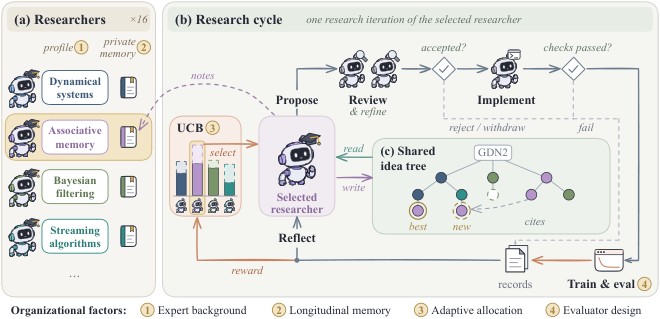
Figure 2 — 자율 연구팀 조직도
실험 결과, CFDN은 150M parameter 규모에서 baseline인 GDN2 대비 모든 검색 목표에서 우수한 성능을 보였습니다. 예를 들어, Language Modeling (LM) perplexity는 12.21에서 11.90으로 감소했고, Common-Sense Reasoning (CSR) accuracy는 44.48%에서 44.63%로 상승했으며, Retrieval 성능은 28.91%에서 50.00%로 크게 향상되었습니다 [Table 1]. 또한, CFDN을 1.3B parameter 규모로 확장했을 때도 GDN2 대비 모든 평가 카테고리에서 가장 좋은 성능을 달성하여, LM perplexity, CSR accuracy, NIAH accuracy, Real-World Retrieval (RWR) accuracy에서 모두 가장 높은 수치를 기록했습니다 [Table 2]. controlled comparison 결과, Disciplinary Profiles가 없으면 검색이 일찍 정체되고, Private Histories가 없으면 동일한 공유 증거에도 불구하고 발전이 미미하며, Uniform Selection은 Adaptive Allocation 대비 더 약한 발견을 보였습니다 [Figure 3]. 이는 제안된 조직 구성 요소들이 Autonomous Discovery의 sustained progress에 필수적임을 시사합니다.
4. Conclusion & Impact (결론 및 시사점)
본 연구는 제한된 실험 예산 하에서 Autonomous Research Team의 cumulative discovery를 위한 효과적인 조직 프레임워크를 제시합니다. 제안된 프레임워크는 Diverse scientific backgrounds, persistent memory, shared evidence, 그리고 adaptive allocation of research opportunities를 결합합니다. 이를 통해 팀은 Context-First DeltaNet (CFDN)이라는 개선된 Linear Attention 아키텍처를 발견했으며, 이 아키텍처는 두 가지 규모에서 baseline인 GDN2를 뛰어넘는 성능을 보였습니다. 조직 구성 요소에 대한 controlled comparison과 연구 궤적 분석은 heterogeneous agents, adaptive allocation, 그리고 shared experimental records의 중요성을 강조합니다. 이 연구는 Autonomous Discovery가 단순히 강력한 에이전트에 의존하는 것이 아니라, 팀이 실험에서 학습하고 어떤 아이디어를 추구할지 결정하는 방식에 따라 지속적인 발전이 좌우됨을 보여주며, 향후 AI 기반 과학 연구 시스템 설계에 중요한 지침을 제공합니다.
⚠️ 알림: 이 리뷰는 AI로 작성되었습니다.
관련 포스트
- [논문리뷰] OmniScientist: An Omni-Modal Omni-Discipline AI Scientist
- [논문리뷰] OmniScientist: An Omni-Modal Omni-Discipline AI Scientist
- [논문리뷰] Why LLMs Aren't Scientists Yet: Lessons from Four Autonomous Research Attempts
- [논문리뷰] Socratic Skill Learning: Interleaving Teaching and Practice for Transferable Agent Skills
- [논문리뷰] Quant-Arena: Benchmarking LLM Agents for Quantitative Trading Research
Review 의 다른글
- 이전글 [논문리뷰] Automating ML for Science: Can Frontier Agents Climb Scientific Hills in the Wild?
- 현재글 : [논문리뷰] Building AI Research Teams for Autonomous Discovery of Linear Attention Architectures
- 다음글 [논문리뷰] Cache Engineering for Agents
댓글