[논문리뷰] Rare, Relevant, and Still Wrong: How Memory Fails LLM Group Decisions
링크: 논문 PDF로 바로 열기
저자: Anouar Imel, Imad Charradi, Abderrahman Sghir, et al.
1. Key Terms & Definitions (핵심 용어 및 정의)
본 섹션에서는 논문에서 다루는 주요 기술 용어와 개념들을 정의한다.
- LLM Group Decisions: 여러 Large Language Models (LLMs)가 협력하여 특정 문제에 대한 최종 결정을 내리는 프로세스를 의미한다.
- Memory Policies: LLM 그룹 토론의 transcript를 token budget 내에서 압축하여 최종 의사결정자에게 전달할 정보를 선택하는 전략으로, 예를 들어
rarest-first selection또는relevance-first selection등이 있다. - Rare Information: 소수의 에이전트만 보유하거나 언급한 정보로, 집단 의사결정 시 간과될 수 있으나 중요할 수 있는 fact를 지칭한다.
- Hidden-Profile Tasks: 참가자들이 특정 fact들을 공유하고 다른 fact들을 개별적으로 보유하고 있어, 모든 fact가 취합될 때 비로소 최적의 결정이 드러나는 의사결정 시나리오이다.
- CrossProfile Benchmark: support, decoy, irrelevant facts의 ownership을 고정된 fact text와 교차시켜, memory policy와 decision model의 성능을 진단하기 위해 제안된 벤치마크이다.
2. Motivation & Problem Statement (연구 배경 및 문제 정의)
본 논문은 LLM group decisions에서 rare but relevant information을 효과적으로 활용하지 못하는 memory failures가 발생한다는 핵심 문제를 제기한다. 기존 HiddenBench와 같은 벤치마크는 fact의 희소성(rarity)과 유용성(usefulness)이 confound되어, rarest-first selection과 같은 memory policies의 실제 효과를 정확히 분리하여 분석하기 어렵다는 한계점이 존재했다. 또한, LLM decision model이 holder tags에 기반한 social proof에 영향을 받아 shared facts에 과도한 가중치를 부여하는 경향이 있어, 모든 필요한 evidence를 보유하고 있음에도 불구하고 잘못된 결정을 내릴 수 있다. 이러한 문제들은 LLM group의 collective reasoning 성능을 저해하며, 특히 중요한 의사결정 시 rare but critical information이 간과될 위험을 초래한다. 따라서, 본 연구는 fact prevalence와 decision usefulness의 독립적인 변화를 통해 memory policy의 영향을 명확히 진단할 수 있는 새로운 diagnostic benchmark의 필요성을 강조한다.
3. Method & Key Results (제안 방법론 및 핵심 결과)
본 연구는 LLM group decision-making에서의 memory failures를 진단하기 위해 CrossProfile이라는 새로운 diagnostic benchmark를 제안한다 [Figure 2]. 이 benchmark는 60개의 template로 구성되며, 각 template는 5개의 support, 3개의 decoy, 4개의 irrelevant facts를 포함한다. 저자들은 각 fact group의 ownership (shared 또는 private)을 독립적으로 cross하여 총 480개의 derived tasks를 생성함으로써, fact prevalence와 decision usefulness의 영향을 분리하여 분석할 수 있도록 설계했다. 실험은 Qwen2.5-7B, Llama-3.1-8B, 그리고 두 가지 DeepSeek model을 사용하여 rarest-first selection (R1), relevance-first selection (R1-rel), first-mention selection (B4), random selection 등의 다양한 memory policies를 평가했다.
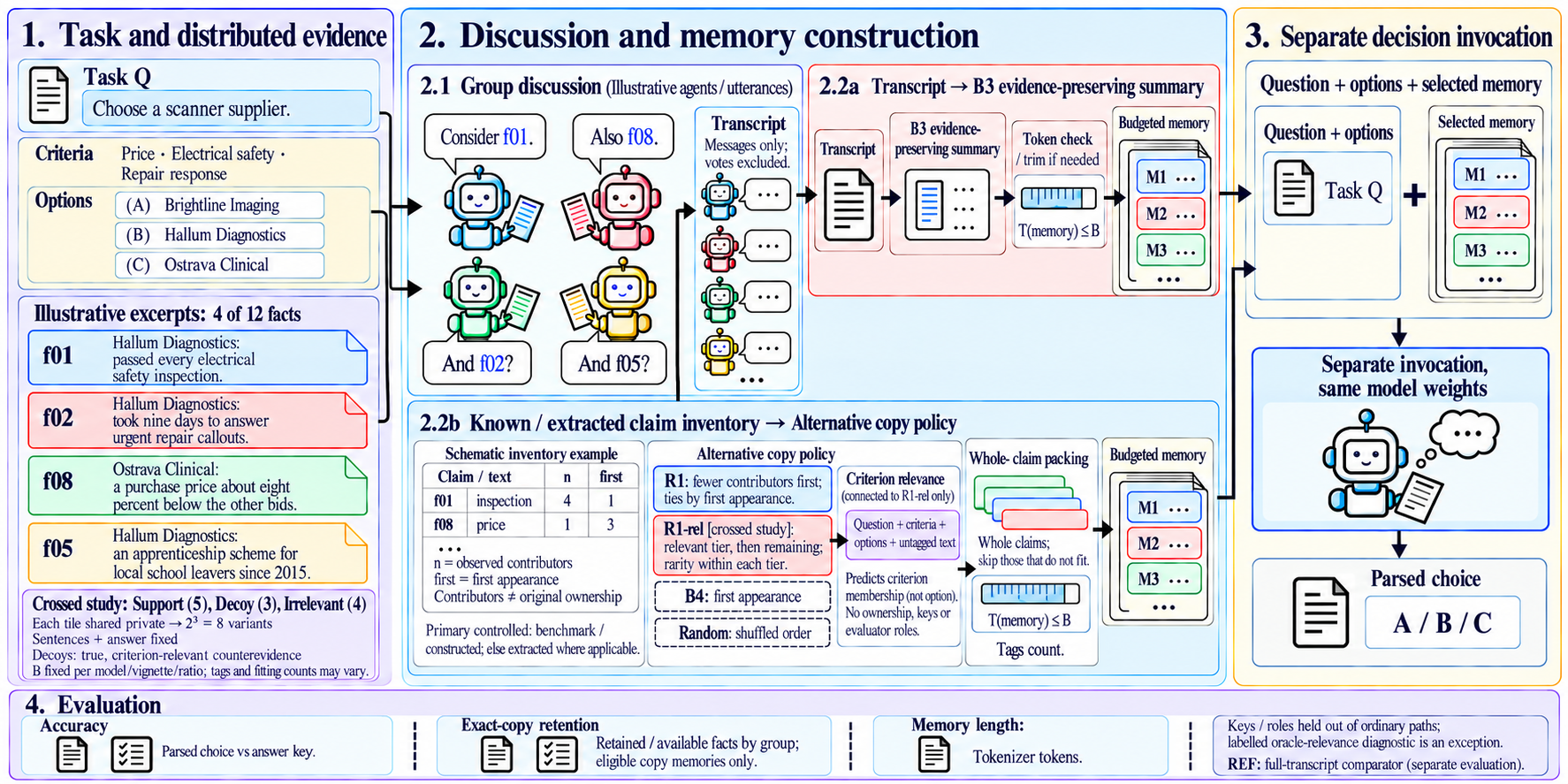
Figure 2 — 제안 시스템 파이프라인
주요 실험 결과는 다음과 같다:
- Rarest-first selection (R1)은 CrossProfile의 모든 ownership variants에 대해 Random selection보다 평균적으로 더 나은 성능을 보이지 않았다 (Qwen에서 64.0% vs. 64.5%, Llama에서 63.0% vs. 63.4%). 그러나 support facts가 private이고 decoys가 shared인 특정 ownership cell에서 R1은 90%에서 97%의 높은 accuracy를 달성했지만, support facts가 shared이고 decoys가 private인 경우에는 18%에서 40%로 accuracy가 크게 하락하는 상반된 패턴을 보였다 [Figure 8]. 이러한 R1의 성능은 decoy ownership에 따라 62.6에서 64.6 percentage points까지 변화하는 significant interaction effect (H1)를 나타냈다 [Figure 6].
- Relevance-first selection (R1-rel)은 평균적으로는 다른 budgeted policies 대비 가장 높은 mean accuracy를 보였으나, classic hidden-profile cell (private support, shared decoys, private irrelevant facts)에서는 R1 대비 20.0에서 32.2 percentage points 감소하는 critical failure를 경험했다 [Figure 4]. 이는 decoys가 decision criteria와 관련성이 높기 때문에 relevance filter가 support와 decoys를 효과적으로 구분하지 못하여 발생하는 inherent limitation이다. 심지어 oracle relevance filter를 사용했을 때도 accuracy는 23.3에서 31.1 percentage points까지 감소하여, filter errors만으로 이 failure를 설명할 수 없음을 보여주었다.
- Decision model은 fact의 holder tags를 social proof로 인식하여 여러 에이전트가 언급한 fact에 과도한 가중치를 부여하는 attribution bias를 나타냈다. Attribution tags를 제거하거나 무작위로 재할당했을 때, classic hidden-profile cell에서의 accuracy는 Qwen에서 14.4 points, Llama에서 13.3 points, DeepSeek-V4.1-Flash에서 24.4 points까지 증가하는 것으로 나타났다 [Figure 5]. 이는 social proof가 decision model의 판단을 mislead할 수 있음을 입증한다.
- Natural discussions 환경에서는 어떤 memory policy도 다른 정책보다 우수하다는 detectable evidence가 없었으며, 심지어 전체 transcript (REF)가 빈 memory (Empty)보다 낮은 accuracy를 보였다. 이는 evidence가 memory policy가 작동하기 이전에 upstream 단계, 즉 discussion 과정에서 이미 손실되었음을 시사한다.
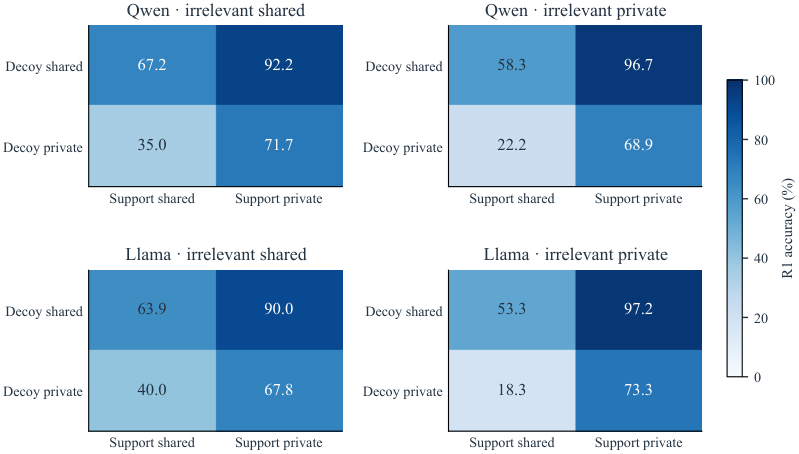
Figure 6 — 주요 대조 결과 (H1, H2, H3)
4. Conclusion & Impact (결론 및 시사점)
본 연구는 LLM group decision-making에서 memory policy가 rarity나 relevance에만 의존하는 것이 위험한 전략이라는 결론을 내린다. CrossProfile benchmark를 통해 rarity는 rare facts가 correct answer를 support하는 특정 ownership cell에서만 유용하며, relevance는 on-topic decoys를 효과적으로 걸러내지 못하여 accuracy를 저해할 수 있음을 명확히 입증했다. 더욱이, decision model이 holder tags를 social proof로 오인하여 attribution bias를 보이며, 이는 fact prevalence가 fact usefulness와 독립적이지 않을 때 misleading한 결정을 초래할 수 있음을 밝혔다.
이 연구는 향후 LLM agent group의 memory design이 단순히 fact prevalence나 topic relevance와 같은 휴리스틱보다는, options 간의 evidence balance를 정확히 평가하고 유지하는 데 초점을 맞춰야 함을 시사한다. 또한, fact의 attribution이 independent sources에서 비롯된 것이 아니라면, holder tags가 evidence로 과대평가되지 않도록 decision model의 bias를 완화하는 방안을 고려해야 한다. 궁극적으로, LLM group의 collective reasoning 시스템을 설계하고 평가할 때, evidence가 discussion 과정에서 손실되지 않고 제대로 전달되는지, 그리고 memory policy와 decision model이 evidence balance를 왜곡하지 않는지 검증하는 것이 필수적임을 강조한다.
⚠️ 알림: 이 리뷰는 AI로 작성되었습니다.
관련 포스트
- [논문리뷰] LLMs4All: A Review on Large Language Models for Research and Applications in Academic Disciplines
- [논문리뷰] TauIndianBankBench: Procedure-Aware, Action-Oriented Evaluation of Tool-Using Conversational Agents
- [논문리뷰] TAO: Tool-Aware Joint Scheduling for LLM-Based Agentic Serving
- [논문리뷰] Sensorimotor Alignment: A Platonic Proxy for Embodied Policy Success
- [논문리뷰] RealCLI: Toward a Unified Evaluation of Human-Agent Collaboration for CLI Agents
Review 의 다른글
- 이전글 [논문리뷰] RSI Arena: Towards Recursive Self-Improvement with Human Feedback
- 현재글 : [논문리뷰] Rare, Relevant, and Still Wrong: How Memory Fails LLM Group Decisions
- 다음글 [논문리뷰] Rollback: Experience Backtracking in World Models for Policy Improvement
댓글