[논문리뷰] Puffin-World: Scaling a Unified Multimodal Model with Native 3D World States
링크: 논문 PDF로 바로 열기
저자: Kang Liao, Yihang Luo, Xiao-Ming Wu, Linyi Jin, Size Wu, Chunyu Lin, Yao Zhao, Fei Wang, Wei Li, Chen Change Loy
1. Key Terms & Definitions (핵심 용어 및 정의)
- Native 3D World States: Puffin-World가 stable generation, spatially consistent simulation, 그리고 grounded world interaction을 위해 jointly modeling하는 세 가지 핵심 세계 상태를 지칭합니다. 여기에는 absolute physical cues를 포착하는
Physics(gravity field, latitude), underlying 3D spatial structure를 묘사하는Geometry(depth), 그리고 observable visual content를 나타내는Appearance(image)가 포함됩니다. - Omni-Camera Representation:
absolute camera field(pixel-wise up-vector 및 latitude angle)와relative ray field(ray origin 및 direction)를 channel dimension을 따라 결합한 dense action signal입니다. 이는 global physical grounding과 continuous spatial modeling을 통합하여 다양한 task 및 flexible motion을 지원합니다. - Physics Propagation: reference view에서 perceived된 absolute spatial knowledge를 future frames의 relative control signals에 걸쳐
propagation하는 전략입니다. 이를 통해 complex motions 하에서도 physically consistent하고 visually stable한 world generation을 가능하게 합니다. - Puffin-16M: Puffin-World의 scaling을 위해 구축된 대규모 데이터셋으로, 15 million
vision–language–camera triplets으로 구성된Puffin-Cam-15M과 diverse하고 challenging motion을 특징으로 하는 1 milliontrajectories인Puffin-Traj-1M으로 이루어져 있습니다 [cite: 1, Figure 4]. - Flow-Matching Objective:
multimodal diffusion transformer (MMDiT)에서 target latent를 denoising하는 데 사용되는 objective function으로,joint appearance-geometry modeling에 필수적인 역할을 합니다.
2. Motivation & Problem Statement (연구 배경 및 문제 정의)
본 논문은 arbitrary visual observations으로부터 세계를 인식(perceive), 생성(generate), 그리고 재구성(reconstruct)할 수 있는 unified model이 부족하다는 핵심 문제를 해결하고자 한다. 기존의 generative world models는 주로 2D appearance level에서의 예측에 집중하며, camera의 물리적 orientation이나 underlying scene geometry에 대한 명시적인 개념이 부재하다. 또한 unified multimodal models는 2D semantics에 국한되어 understanding과 generation을 결합하는 데 한계가 있었다. 이러한 분리된 접근 방식은 holistic modalities와 tasks를 위한 3D world modeling을 통합하는 데 있어서 근본적인 결함을 야기한다. 구체적으로, 기존 연구들은 (i) gravity, uprightness, orientation과 같은 absolute physical concepts에 grounded된 unified action representation의 부재, (ii) unseen viewpoints에서의 consistent 3D world modeling을 위한 physically persistent frame 유지의 어려움, (iii) absolute camera grounding과 diverse, challenging motion을 제공하는 데이터로 이러한 capabilities를 scaling하는 문제라는 세 가지 상호 연결된 도전에 직면해 있었다. 특히, 기존 relative camera representations는 global physical anchor가 부족하고, 3D datasets는 rotational diversity가 제한적이며 absolute camera orientation을 거의 제공하지 않았다.
3. Method & Key Results (제안 방법론 및 핵심 결과)
Puffin-World는 external offline modules 없이 물리적 이해, 공간 시뮬레이션, 3D world generation 및 reconstruction을 통합하는 unified multimodal architecture를 제안한다 [cite: 1, Figure 3]. 이 프레임워크는 physics (gravity field 및 latitude), geometry (depth), appearance (image) 세 가지 native 3D world states와 Omni-Camera representation을 jointly modeling한다. Omni-Camera representation은 pixel-wise up-vector 및 latitude angle을 포함하는 absolute camera field와 ray origin 및 direction으로 구성된 relative ray field를 결합하여 global physical grounding과 continuous spatial modeling을 가능하게 한다. 또한, 저자들은 physics propagation 전략을 도입하여 reference view에서 perceived된 absolute spatial knowledge를 future frames의 relative control signals에 걸쳐 propagation하며, 이를 통해 physically consistent하고 visually stable한 world generation을 가능하게 한다. Puffin-World는 appearance와 geometry를 단일 generative process 내에서 coupling하여 각 future view를 jointly synthesizing하고 underlying geometry를 reconstruction한다.
Camera-to-World Understanding 결과, Puffin-World는 Stanford2D3D, MegaDepth, TartanAir, LaMAR 네 가지 public benchmark에서 모든 median error metric에서 경쟁 방법론들을 일관되게 능가했으며, 대부분의 AUC metric에서 최고의 성능을 달성했다 [cite: 1, Table 3]. 특히, Stanford2D3D 데이터셋에서 Roll median error는 0.29 degrees를 기록하여 이전 최고 성능인 GeoCalib의 0.40 degrees를 능가했다 [cite: 1, Table 3]. Camera-Controllable Generation 측면에서는 Puffin-Cam-Bench에서 up vector, latitude, gravity의 mean error 및 median error, 그리고 FID (Fréchet Inception Distance) 모두에서 state-of-the-art 성능을 보였다 [cite: 1, Table 4]. 특히 gravity median error는 0.79 degrees로 Puffin의 2.87 degrees 대비 크게 개선되어, 지정된 camera configuration 하에서 spatially consistent한 scene geometry를 유지하는 능력이 크게 향상되었음을 입증했다 [cite: 1, Table 4, Figure 5]. Puffin-World는 15M vision–language–camera triplets과 1M challenging motions trajectories로 구성된 Puffin-16M 데이터셋을 구축하여 complex scenarios로 scaling되었다 [cite: 1, Figure 4]. Ablation study 결과, physics propagation은 Roll 및 Pitch trajectories에서 visual fidelity (예: PSNR, SSIM, LPIPS)와 physical world grounding (예: Error_R, Error_P)을 일관되게 개선하여, 평균적으로 PSNR 20.54, SSIM 0.67, LPIPS 0.21을 달성하며 baseline 대비 성능 향상을 보였다 [cite: 1, Table 6].
4. Conclusion & Impact (결론 및 시사점)
Puffin-World는 physics, geometry, appearance 세 가지 native 3D world states를 통해 물리 세계를 인식, 시뮬레이션 및 생성하는 unified multimodal model을 제시한다. Omni-Camera representation과 physics propagation 메커니즘을 통해 모델은 physically consistent하고 visually stable한 world generation을 달성하며, 단일 framework 내에서 physical-world perception, free-viewpoint spatial simulation, 3D world generation 및 reconstruction을 지원한다. 이 연구는 Puffin-16M과 같은 대규모 vision–language–camera supervision 데이터셋을 제공하여 해당 분야의 scaling capabilities를 크게 확장했다. Puffin-World는 mimic world exploration 및 self-calibrated world exploration과 같은 closed-loop applications에서 multi-task synergy를 시연하며 [cite: 1, Figure 7], 이는 virtual reality 및 embodied intelligence 분야에 대한 중요한 시사점을 가진다. 궁극적으로, physically anchored world representation에 grounded된 multimodal tasks는 versatile spatial intelligence 및 physical AI를 향한 유망한 경로를 제시한다.
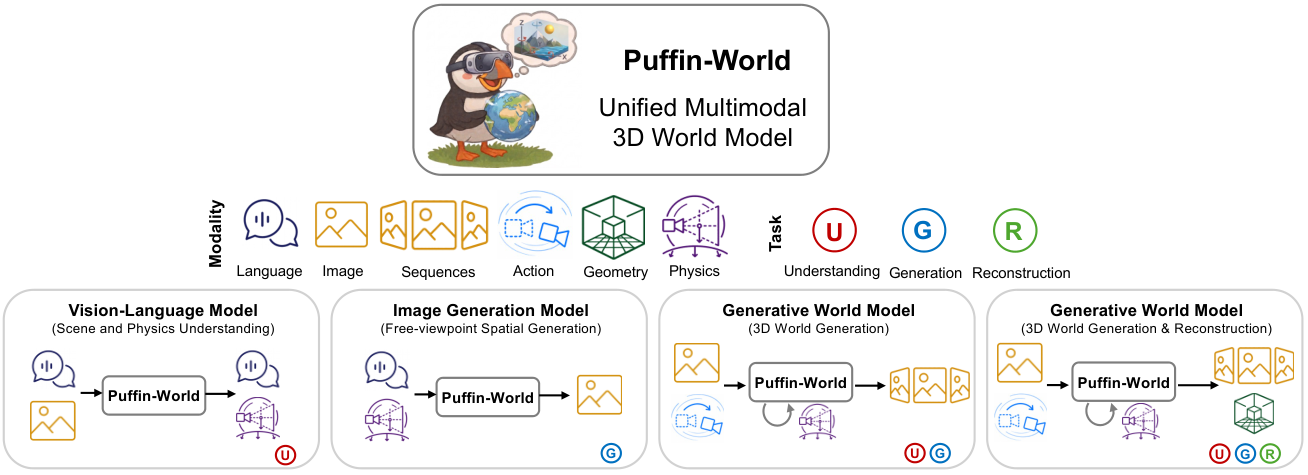
Figure 1 — 제안 모델 Puffin-World의 전체 개요
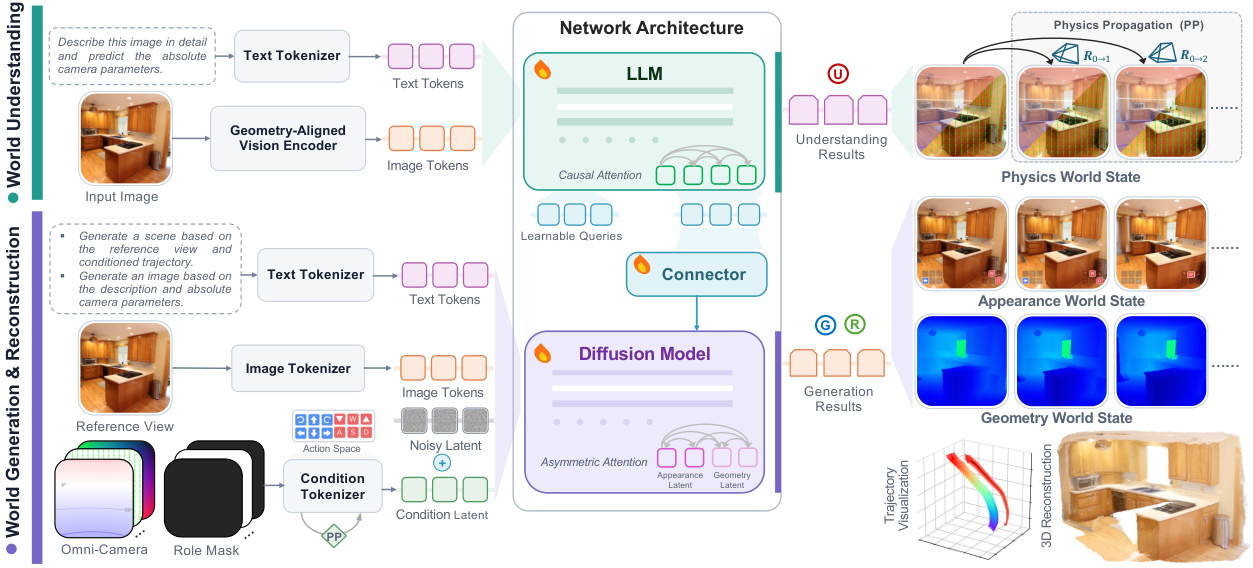
Figure 3 — Puffin-World의 네트워크 아키텍처
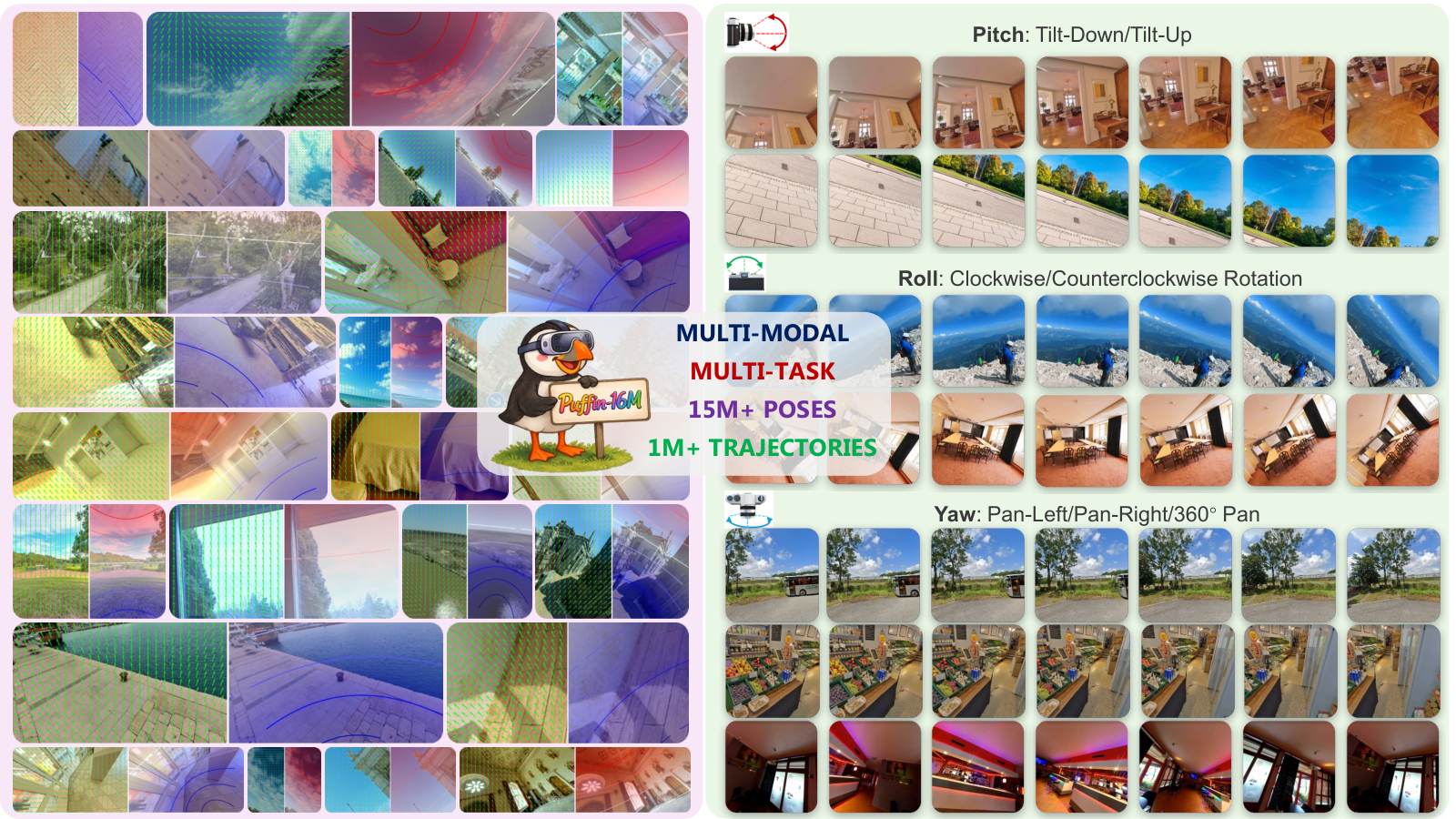
Figure 4 — 구축된 Puffin-16M 데이터셋 개요
⚠️ 알림: 이 리뷰는 AI로 작성되었습니다.
관련 포스트
- [논문리뷰] Stepping VLMs onto the Court: Benchmarking Spatial Intelligence in Sports
- [논문리뷰] MJev-Spatial: System One Spatial Intelligence via Native Attention Matching
- [논문리뷰] WorldRecon: Generative Multi-View Mesh Reconstruction for Large-Scale 3D World
- [논문리뷰] UniForge3D: Joint 3D Reconstruction and Generation in a Shared Anchor-Guided Space
- [논문리뷰] ThinkDrag: Semantic Drag-Based Image Editing with Visual Reasoning
Review 의 다른글
- 이전글 [논문리뷰] Principia: Relational Physics Tests for Video Models
- 현재글 : [논문리뷰] Puffin-World: Scaling a Unified Multimodal Model with Native 3D World States
- 다음글 [논문리뷰] QCell: Recombining and Aligning Cell Queries for Overlapping Instance Segmentation
댓글