[논문리뷰] Reason Through the Latent! Making Latent Visual Reasoning Necessary
링크: 논문 PDF로 바로 열기
The paper "Reason Through the Latent! Making Latent Visual Reasoning Necessary" by Suhyeong Park, Junha Jung, and Jaewoo Kang addresses a critical issue in latent visual reasoning. The core problem is that while latent states in multimodal models may contain relevant visual information, models don't always actually rely on this information for prediction, especially when alternative image-conditioned paths exist.
The authors propose Causal Visual Recurrent Reasoning (CVRR) to ensure that recurrent computation is the required image-conditioned path to prediction, thereby making latent visual reasoning necessary. CVRR achieves this by:
- Causal Visual-Read Boundary: Initializing the recurrent state (
h1) from the question-token hidden state after the pretrained vision-language model (VLM) has processed the image. This ensures pretrained visual competence is preserved. - Persistent Visual Recurrence: Repeatedly updating this recurrent state while re-reading the same fixed visual evidence (
v). A single decoder layer is reused as a shared recurrent transition. - Strict Causal Decoder Interface: Crucially, before decoding the answer, all visual states and the original multimodal KV cache are removed. This ensures that only the final recurrent state (
hT) carries image-conditioned information to the answer, forcing the model to rely on the latent computation.
Experiments across several VQA benchmarks (V*, MMVP, BLINK, MME-RealWorld-Lite) show that CVRR retains strong performance under this strict interface. For instance, CVRR achieves 81.2% on V* and 52.7% MMVP pair accuracy. In contrast, existing latent visual reasoners, when retrained under the same strict no-bypass constraint, largely fail to recover comparable visual competence, with V* accuracy dropping significantly (e.g., LVR-7B to 35.6%).
Causal interventions further demonstrate that CVRR's predictions are sensitive to recurrent content and that persistent visual evidence causally revises the recurrent trajectory. Analysis reveals that the role of h1 is to carry the pretrained model’s native image-conditioned representation into the required path, and recurrent computation actively refines this state through learned updates and persistent visual re-reading. The study also shows that causally influential image regions shift across recurrent steps, indicating dynamic interaction with visual evidence during reasoning.
The paper highlights the distinction between a latent state being informative and being causally necessary for prediction. CVRR's design addresses this by architecturally enforcing the necessity of latent computation, pushing the field towards more reliable and interpretable latent reasoning mechanisms.
저자: Suhyeong Park, Junha Jung, Jaewoo Kang, et al.
1. Key Terms & Definitions (핵심 용어 및 정의)
- Latent Visual Reasoning: 명시적인 CoT(Chain-of-Thought) 없이 hidden-state 연산을 통해 multimodal reasoning을 수행하는 접근 방식.
- Causal Visual Recurrent Reasoning (CVRR): 미리 학습된(pretrained) visual competence를 보존하면서, recurrent 연산을 예측에 필요한 image-conditioned 경로로 만드는 제안 방법론.
- Causal Visual-Read Boundary: 미리 학습된 VLM(Vision-Language Model) 내에서 visual information이 question representation에 통합된 후, visual states가 recurrence를 통해 재독립적으로 영향을 미칠 수 있는 계층 경계.
- Multimodal KV Cache: VLM에서 visual 및 text token에 대한 Key-Value pair를 저장하는 캐시로, decoder가 예측 시 이전에 처리된 정보에 접근할 수 있도록 함.
- Persistent Visual Evidence: Recurrence 과정 전반에 걸쳐 지속적으로 사용되는 고정된 visual 정보로, recurrent state를 업데이트하는 데 활용됨.
2. Motivation & Problem Statement (연구 배경 및 문제 정의)
본 논문은 기존 Latent Visual Reasoning 방법론들이 latent state에 task-relevant visual information을 포함하더라도, 모델이 실제로 해당 state에 의존하여 예측을 수행하는지에 대한 근본적인 모호성을 해결하고자 한다. 기존 latent visual reasoner들은 대안적인 image-conditioned 경로가 남아있는 경우, 제안된 latent content가 행동적으로(behaviorally) 필수적이지 않음을 Preliminary Experiments를 통해 보여준다. 예를 들어, 여러 방법론에서 latent state에 상당한 변경을 가해도 예측 정확도가 거의 변하지 않으며 [Figure 1(a)], 이는 latent informativeness가 path necessity를 의미하지 않음을 시사한다. 이러한 한계점은 latent visual reasoning의 과학적 주장이 특정 latent 연산에 의존한다고 주장할 때, 단순히 latent state가 유용한 정보를 담고 있다는 것만으로는 충분한 증거가 되지 못함을 드러낸다. 따라서 저자들은 미리 학습된 visual competence를 희생하지 않으면서도, 예측이 제안된 latent 연산을 통해 이루어지도록 만드는 새로운 접근 방식의 필요성을 제기한다.
3. Method & Key Results (제안 방법론 및 핵심 결과)
저자들은 Latent Visual Reasoning에서 path necessity를 보장하기 위해 Causal Visual Recurrent Reasoning (CVRR)을 제안한다. CVRR은 미리 학습된 VLM이 이미지를 통합한 후의 question-token hidden state로부터 latent state를 초기화하여 pretrained visual competence를 보존한다 [Figure 2, cite: 1]. 이후, 단일 decoder layer를 공유 recurrent transition으로 재사용하여, 고정된 visual evidence(v)를 반복적으로 re-reading하면서 question state를 업데이트한다. 이 과정에서, CVRR은 Causal Visual-Read Boundary를 사용하여 visual information이 question representation에 통합되고 visual states가 재독립적으로 영향을 미칠 수 있는 최적의 계층(ℓ*=20)을 식별한다. 가장 중요한 점은 answer decoding 전에 visual states와 original multimodal KV cache를 모두 제거하여, 최종 recurrent state(hT)만이 answer 예측에 필요한 image-conditioned 정보를 전달하도록 한다는 것이다.
실험 결과, CVRR은 V∗V^{*}에서 81.2%, MMVP pair accuracy에서 52.7%, BLINK overall에서 55.2%의 강력한 성능을 달성하며 [Table 1, cite: 1], 이는 엄격한 no-bypass interface 하에서도 visual competence를 성공적으로 유지함을 보여준다. 반면, 동일한 제약 조건 하에서 재학습된 기존 latent reasoning baseline들은 V∗V^{*}에서 최대 39.8%, MMVP pair accuracy에서 최대 2.7% 등으로 현저히 낮은 성능을 기록했다 [Table 1, cite: 1]. 이러한 결과는 단순히 latent state를 강제로 사용하게 하는 것만으로는 부족하며, CVRR의 native multimodal initialization을 통한 pretrained competence 보존이 중요함을 입증한다. Ablation study에 따르면, visual re-reading이 없으면 V∗V^{*} accuracy가 12.0 points, MMVP pair accuracy가 34.7 points 감소하며, 이는 persistent visual evidence가 recurrent computation에서 예측 관련 정보를 제공함을 의미한다 [Table 2, cite: 1]. 또한, Causal interventions은 hT가 image-conditioned content에 민감하며, persistent visual evidence가 recurrent trajectory를 causally하게 수정함을 보여준다 [Figure 3(b), cite: 1].
4. Conclusion & Impact (결론 및 시사점)
본 논문은 latent visual reasoning에서 latent state의 informativeness와 예측에 대한 필요성(path necessity)을 일치시키는 CVRR(Causal Visual Recurrent Reasoning)을 성공적으로 제시하였다. CVRR은 미리 학습된 visual competence를 보존하면서, recurrent latent 연산이 image-conditioned 예측을 위한 필수 경로가 되도록 설계되었다. 이 연구는 기존 방법론들의 한계점인 "informative하지만 필요하지 않은" latent state 문제를 해결하며, 모델이 실제로 제안된 latent 연산을 통해 추론하도록 강제하는 아키텍처적 제약을 통해 강력한 성능을 유지할 수 있음을 입증하였다.
이 연구는 학계 및 산업계에 다음과 같은 중요한 시사점을 제공한다. 첫째, latent reasoning 시스템의 신뢰성과 해석 가능성을 높이는 데 기여한다. 모델이 특정 내부 연산에 의존한다고 주장할 때, 단순히 그 연산이 유용한 정보를 포함하는 것 이상으로, 예측에 필수적인 경로임을 검증할 수 있는 방법론을 제시한다. 둘째, multimodal LLM의 설계 원칙에 있어 새로운 방향을 제시한다. 미래 연구에서는 보다 adaptive하고 open-ended multimodal reasoning으로 Causal Path Necessity를 확장하는 것이 중요한 과제가 될 것이다.
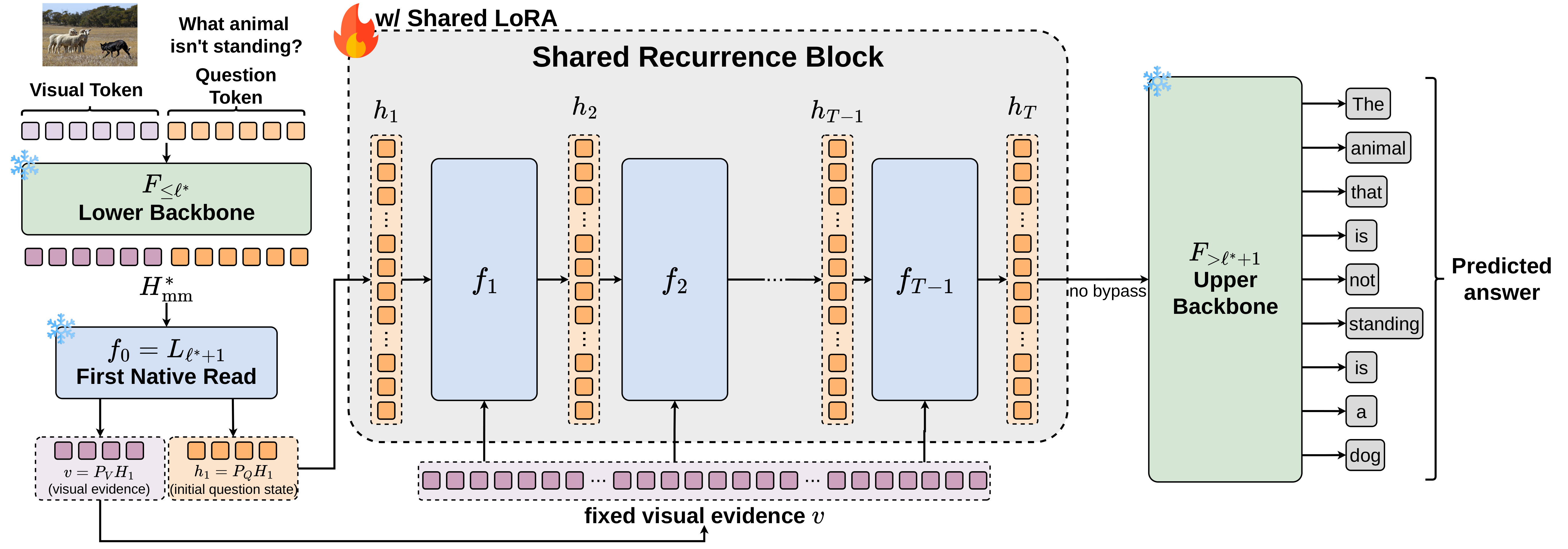
Figure 2 — CVRR 아키텍처 개요
⚠️ 알림: 이 리뷰는 AI로 작성되었습니다.
관련 포스트
- [논문리뷰] Cosine Misleads: Auxiliary Losses Reshape Vision Language Models, Not Their Latents
- [논문리뷰] Brain-IT-VQA: From Brain Signals to Answers
- [논문리뷰] Structural Graph Probing of Vision-Language Models
- [논문리뷰] Less Detail, Better Answers: Degradation-Driven Prompting for VQA
- [논문리뷰] Phi-4-reasoning-vision-15B Technical Report
Review 의 다른글
- 이전글 [논문리뷰] ReactVAU: A Slow-Fast Decoupled Framework for Streaming Video Anomaly Understanding
- 현재글 : [논문리뷰] Reason Through the Latent! Making Latent Visual Reasoning Necessary
- 다음글 [논문리뷰] Recognition-Refusal Misalignment in LLMs: Why Models Answer Structurally Unanswerable Questions
댓글