[논문리뷰] WorldCast: Exploring Intelligent Visual Generation in World State Prediction
링크: 논문 PDF로 바로 열기
저자: Wenhao Yan, Haodong Li, Xiaotong Li, et al.
키워: World State Prediction, Multimodal Generative Systems, Visual Generation, Benchmark, Agentic AI, Interleaved Generation, LMM-as-a-Judge
1. Key Terms & Definitions
- World State Prediction: Multimodal generative systems가 heterogeneous context를 활용하여 real-world process의 evolution을 시각적으로 가이드하는 task.
- WorldCast: Multi-step world state prediction task에서 multimodal generative systems의 L3-L4 level intelligence를 평가하기 위해 320개의 manually designed cases와 8개 카테고리로 구성된 comprehensive benchmark.
- Generative Capability Hierarchy (L1-L4): Visual generative capabilities를 real-world simulation을 향한 4단계 계층으로 조직화한 것으로, L1은 basic Text-to-Image (T2I), L2는 editing 및 video generation, L3는 complex dynamic transitions 및 physical plausibility, L4는 goals, physical properties, logic, rules 등 heterogeneous references 통합을 요구한다.
- Interleaved Generation: Language model이 successive visual steps를 가이드할 수 있도록 text와 visual content를 혼합하여 생성하는 방식.
- LMM-as-a-Judge: WorldCast 벤치마크에서 모델의 성능을 자동적으로 평가하기 위해 사용되는 GPT-5.5와 같은 Large Multimodal Model 기반의 평가 시스템. Task Completion (TC), Causal Plausibility (CP), Visual Consistency (VC)의 세 가지 차원에서 평가한다.
2. Motivation & Problem Statement
본 논문은 Multimodal Generative Systems의 World State Prediction capabilities에 대한 체계적인 탐색이 부족하다는 문제 의식을 제기한다. 기존의 Multimodal Generative Systems는 rich inputs를 이해하고 expressive visual outputs를 생성하는 데 rapid progress를 보여왔으며, language와 visual context를 결합하고 multi-stage changes를 렌더링하는 능력을 시연했다. 그러나 이러한 발전에도 불구하고, understanding과 generation을 tightly integrate해야 하는 higher-level model capabilities는 충분히 탐구되지 않았다. 이전 연구들은 주로 models가 static appearance anchors로부터 world를 simulate할 수 있는지 여부를 탐구했지만, real-world events는 대부분 dynamic하며 그 progression을 예측하기 위해서는 different temporal steps에서 intervene하는 references가 필요하다. 이러한 references는 observed state, goal, rules, patterns, object properties, 또는 relevant prior experience를 지정할 수 있다. 저자들은 이러한 격차를 해소하고 L3-L4 level intelligence를 측정하기 위해 WorldCast 벤치마크를 제안한다 [Figure 1].
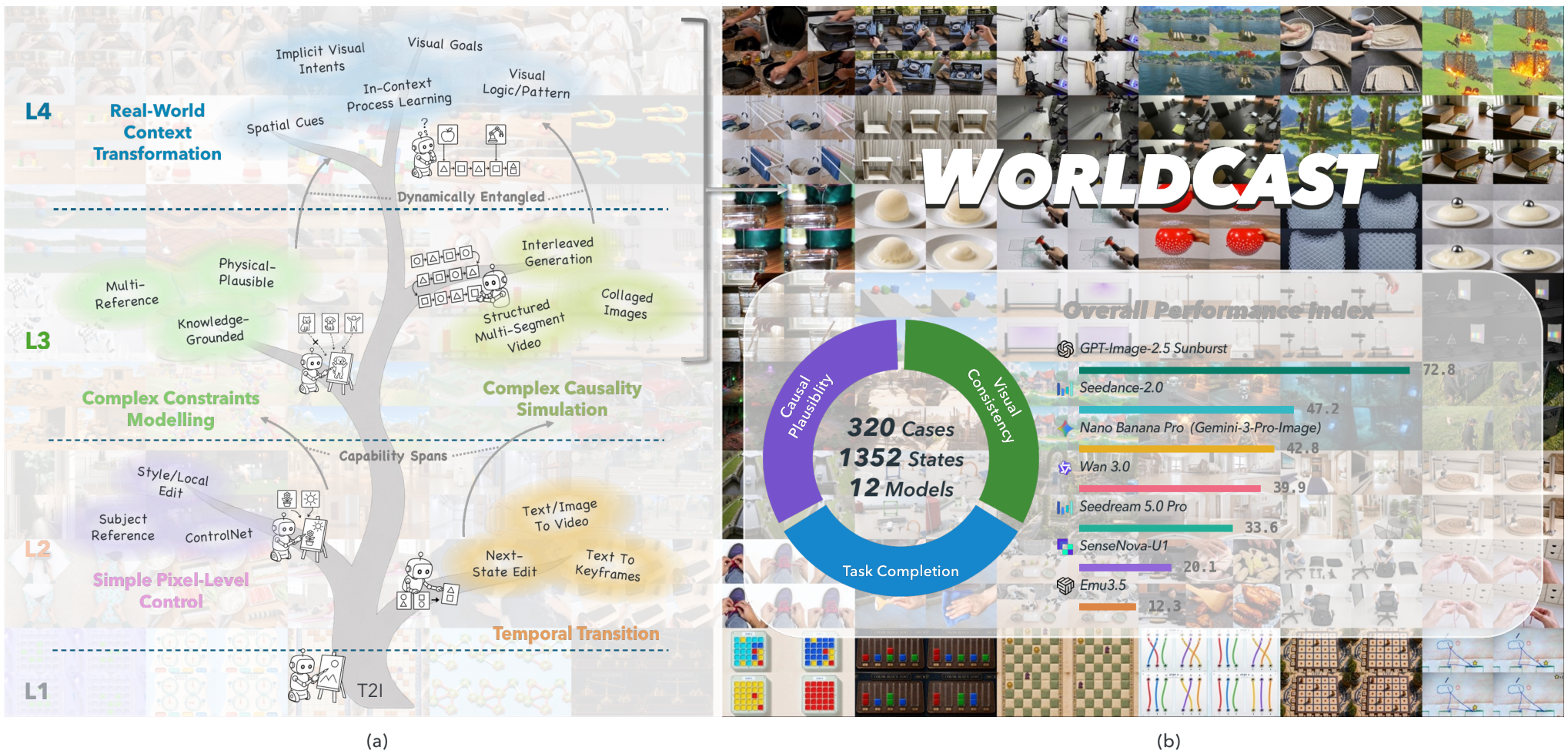
Figure 1 — 제안 모델 및 벤치마크 계층
3. Method & Key Results
저자들은 World State Prediction task를 위해 WorldCast 벤치마크를 제안하며, 이는 320개의 manually designed cases와 8개의 task categories로 구성되어 있다. WorldCast는 Instruction p와 Context Images 𝒳로부터 ordered visual sequence 𝒴^를 예측하도록 요구한다. 이 벤치마크는 Observation-Conditioned Transitions, Physical Simulation, Adaptive Task Completion (L3)과 Visual Cues, Physical Properties, Visual Goal Realization, Logic and Rules, In-Context Procedural Learning (L4)과 같은 다양한 시나리오를 포함한다 [Figure 3]. 평가 metric으로는 Task Completion (TC), Causal Plausibility (CP), Visual Consistency (VC)의 세 가지 dimension을 사용하며, 각 metrics는 0-3 scale로 평가된 후 100점 척도로 Rescale된다. 또한, image 및 video models를 동일한 sequence-level protocol로 평가하기 위해 Agentic Video Adapter를 도입하고, GPT-5.5를 기반으로 한 LMM-as-a-Judge를 사용하여 자동화된 평가를 수행한다.
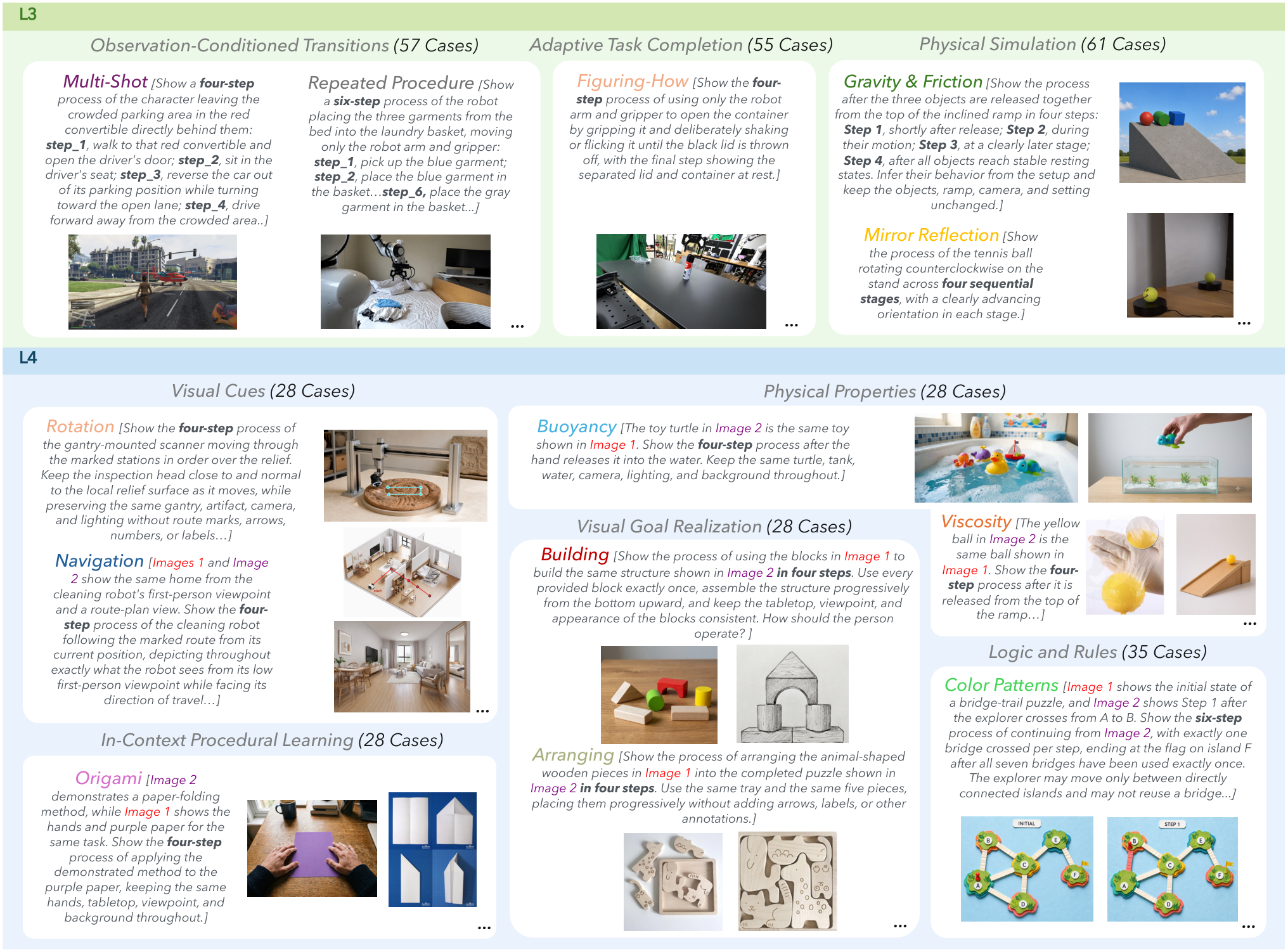
Figure 3 — WorldCast 8가지 카테고리 예시
실험 결과, frontier unified systems, 특히 GPT-Image-2.5 System은 72.8점의 Overall Score를 기록하며 L3 및 L4 task에서 early-stage visual state prediction capabilities를 보여주었다. 특히, GPT-Image-2.5는 L3 Task에서 73.8점, L4 Task에서 71.6점을 달성하며 모든 카테고리에서 60점 이상을 기록했다 [Table 1]. 반면, Nano Banana Pro는 42.8점, best open-source model인 SenseNova-U1은 20.1점에 그쳐 models 간 상당한 성능 격차를 드러냈다 [Table 1]. 이러한 격차는 complex context, entangled references, reasoning-heavy tasks 처리 능력의 deficits와 관련이 있다. Interleaved generation은 frontier image models의 성능을 향상시켜 video architectures에 의존하지 않고도 critical temporal transitions를 포착하게 했다. Language model enhancer의 기여도 분석 결과, GPT-6와 결합된 Nano Banana Pro는 상당한 성능 향상을 보였으나, GPT-Image 계열에는 미치지 못하여 strong visual generator와 closely matched enhancer의 중요성을 시사했다. 더 나아가, Agentic Inspection-Revision Loops와 Coding Tools를 활용한 에이전트적 접근 방식은 성능을 더욱 향상시켜, GPT-Image-2.5의 Overall Score를 72.8에서 82.4로 끌어올렸으며, 특히 L4 Visual Goal Realization 및 Logic & Rules, 그리고 L3 Physical Simulation에서 큰 개선을 보였다 [Table 3, Figure 8].
4. Conclusion & Impact
본 연구는 WorldCast 벤치마크를 통해 visual generative models의 emerging capability인 World State Prediction을 체계적으로 탐구했다. Frontier unified models가 real-world tasks에서 early-stage world state prediction 능력을 보였지만, heterogeneous context와 tightly coupled reasoning 및 generation이 요구되는 task에서 모델 간 상당한 성능 격차가 존재함을 확인했다. Interleaved generation, stronger language-model reasoning, 그리고 iterative agentic refinement가 이 task의 성능 향상에 잠재적인 기여를 할 수 있음을 분석했으며, 동시에 이러한 방향으로 모델이 발전함에 따라 발생하는 도전 과제들을 강조했다. WorldCast는 heterogeneous context, agentic reasoning, 그리고 visual generation을 통합하여 coherent world evolution을 예측할 수 있는 unified generative models 개발을 위한 유용한 테스트베드로서 해당 분야에 기여할 것으로 기대된다.
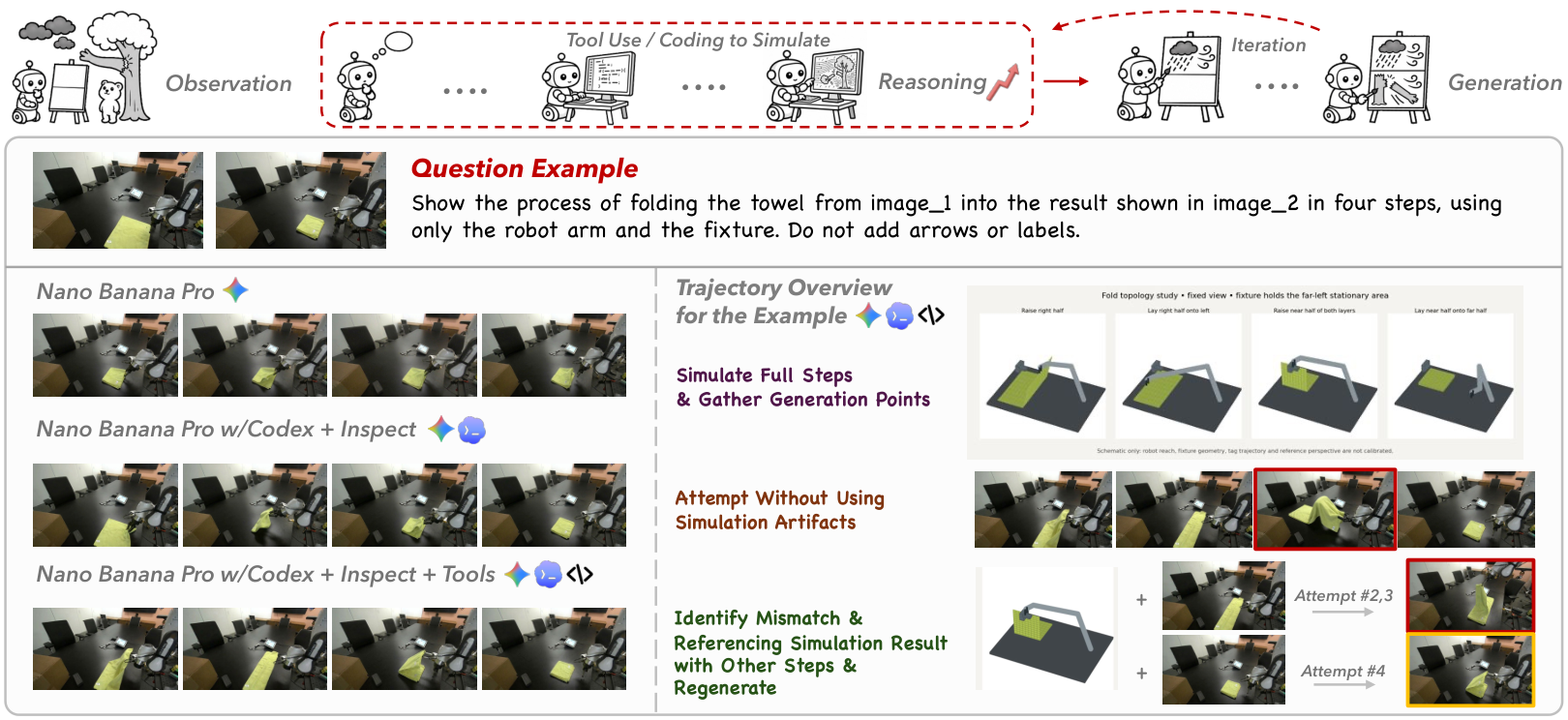
Figure 8 — 에이전트적 시각 생성
⚠️ 알림: 이 리뷰는 AI로 작성되었습니다.
관련 포스트
- [논문리뷰] LLMs4All: A Review on Large Language Models for Research and Applications in Academic Disciplines
- [논문리뷰] Waypoint-OPD: Transferring RL-Induced Policy Shifts via Gated On-Policy Distillation
- [논문리뷰] Virtual Head Attention
- [논문리뷰] VLA-Δ: Learning Physical State Transition for Vision-Language-Action Models
- [논문리뷰] Speculative Forcing for Efficient Autoregressive Video Generation
Review 의 다른글
- 이전글 [논문리뷰] Waypoint-OPD: Transferring RL-Induced Policy Shifts via Gated On-Policy Distillation
- 현재글 : [논문리뷰] WorldCast: Exploring Intelligent Visual Generation in World State Prediction
- 다음글 없음
댓글