[논문리뷰] Words Caught in the Heart: Simulating Person-Specific Expression for Self-Opaque Clients in Psychotherapy
링크: 논문 PDF로 바로 열기
Now I have the content of the paper. I will proceed with summarizing it according to the specified format.
Part 1: Markdown Summary
- Authors: From the paper: Mengxi Xiao, Jingjing Chen, Ziyan Kuang, Jiarong Song, Wenhao Zhao, Zuchen Han, Yihuai Xu, Xiyang Huang, Jie Gong, Yuechen Jiang, Xueqing Peng, Yankai Chen, Xiaoyan Qu, Min Peng, Qianqian Xie. I will use the first two and "et al."
- Keywords: From abstract/intro: psychotherapy client simulation, large language model, psychological experience, individual expression, expression planning, disclosure alignment, expression fidelity, AI-like expression. I need 5-8. Let's pick:
Psychotherapy Client Simulation,Large Language Models,Individual Expression,Expression Planning,Disclosure Alignment,Expression Fidelity,AI-like Expression.
Section 1: Key Terms & Definitions I will identify 3-5 key terms and define them.
- Self-Opaque Clients: Clients in psychotherapy who struggle to coherently describe their distress or have an incomplete understanding of their psychological difficulties, often expressing concerns tentatively or through concrete incidents rather than clear explanations.
- Expression Planning: A distinct module in the proposed framework that translates a semantic response plan into specific linguistic realization guidance, incorporating individual language patterns (e.g., hedging, emotional explicitness, utterance length) and current psychological/conversational conditions.
- Disclosure Alignment: An evaluation metric that assesses how faithfully a client simulator reproduces the timing and structural dependencies of how clients disclose information (memory cards) in reference dialogues, including timing, prerequisite satisfaction, and bundling behavior.
- Expression Fidelity: An evaluation metric using stylometric similarity (e.g., character 4-gram TF-IDF cosine similarity) to measure how closely the generated client speech matches the individual expression patterns of a client in reference dialogues, distinguishing from shared subject matter.
- AI-like Expression: A human evaluation metric where human annotators (counselors and researchers) judge whether a client simulator's utterance sounds like it was generated by an AI, looking for cues such as formulaic summaries, excessive completeness, or generic psychological explanations.
Section 2: Motivation & Problem Statement The core problem is that existing LLM-based psychotherapy client simulators often generate responses that are too articulate or coherent, explaining client difficulties more clearly than the client's actual current understanding or emotional state would warrant. This discrepancy arises because these simulators frequently rely on clinically organized case descriptions (e.g., CBT case formulations), which reflect a clinician's explanatory account rather than the client's evolving, often self-opaque, subjective experience. Consequently, simulated clients may prematurely articulate underlying psychological patterns, leading to less realistic interactions that can hinder effective therapist training and evaluation. The paper highlights the critical need to model how a client's evolving psychological experience and perceived safety influence their momentary expression, bridging the gap between internal states and situated speech. [Figure 1] illustrates this issue, showing how existing simulators might over-articulate compared to Pandora's more tentative, context-aware response.
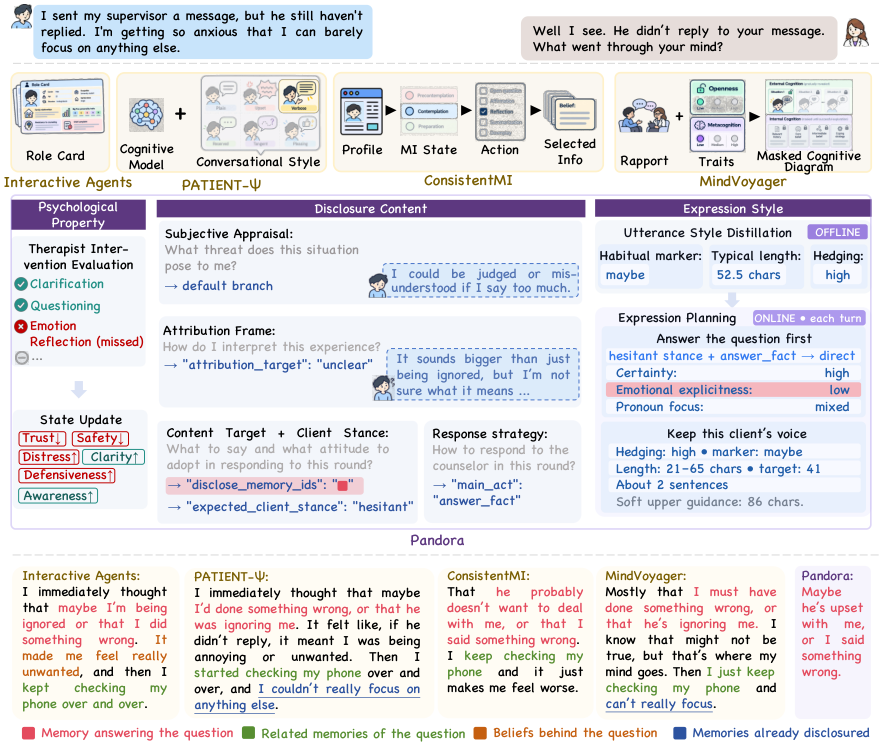
Figure 1 — 제안 모델 Pandora의 개요
Section 3: Method & Key Results
본 논문은 심리 치료 클라이언트의 심리적 경험이 상황에 맞는 개별적인 발화로 전환되는 과정을 모델링하는 프레임워크인 Pandora를 제안한다. Pandora는 개념적 준비(conceptual preparation)와 언어적 공식화(linguistic formulation)의 구분을 바탕으로, 클라이언트의 상호작용 경험을 나타내는 Therapist Intervention Evaluation and State Update 모듈, 클라이언트의 주관적인 관점에서 반응을 계획하는 Subjective Appraisal and Attribution, Content Target, Client Stance, and Response Strategy 모듈, 그리고 해당 반응을 클라이언트의 개별적인 목소리로 구현하는 Individual Expression Planning 모듈로 구성된다. 특히, Individual Expression Planning은 오프라인에서 추출된 클라이언트의 발화 스타일 프로파일(예: discourse markers, hedging, emotional explicitness, utterance length distributions)과 현재 심리적 및 대화적 조건을 결합하여 언어적 실현(linguistic realization)을 안내한다.
실험 결과, Pandora는 Core115 데이터셋에서 Disclosure Alignment 및 Expression Fidelity 측면에서 뛰어난 성능을 보였다. Pandora는 content-reduced similarity에서 0.566, raw similarity에서 0.385를 달성하여, 가장 강력한 baseline인 Consistent MI의 0.512/0.352를 0.053/0.032p 앞섰다. 또한, disclosure timing을 요약하는 LDDA에서 0.852, prerequisite satisfaction을 측정하는 DS에서 0.875를 기록하며, 전반적인 gradual-disclosure score (GDS)에서 0.871로 모든 baseline (최고 Consistent MI의 0.664) 및 expression planning이 제거된 Pandora w/o EP (0.828)보다 우수했다. [Figure 2]는 LDDA 점수가 모든 memory level (L1, L2, L3)에서 Pandora가 가장 높음을 보여준다.
Human evaluation에서는 Pandora가 AI-like judgment rate (AIR)에서 7.2%라는 가장 낮은 수치를 기록했으며, 이는 baseline들의 43.3-67.2% 및 expression planning이 없는 버전의 35.6%와 비교하여 현저히 낮다. 이는 expression planning 모듈이 클라이언트 시뮬레이션의 individual language patterns에 대한 fidelity를 향상시키고 perceived AI-like expression을 줄이는 데 결정적인 역할을 함을 시사한다.
Section 4: Conclusion & Impact
본 논문은 심리 치료 클라이언트 시뮬레이션에서 클라이언트의 심리적 경험이 상황에 맞는 개별적인 언어 표현으로 전환되는 과정을 모델링하는 Pandora 프레임워크를 성공적으로 제시한다. Pandora는 주관적 평가 및 귀인(subjective appraisal and attribution), 내용 및 반응 전략 계획, 그리고 언어적 실현(linguistic realization)을 명시적으로 분리하여, 클라이언트의 현재 관점과 습관적인 언어 패턴을 최종 발화에 반영시킨다. 이 연구는 기존 LLM 기반 시뮬레이터의 over-articulation 문제를 해결하고, disclosure alignment 및 expression fidelity를 크게 향상시켰을 뿐만 아니라, perceived AI-like expression을 현저히 감소시켰다. 이는 심리 치료 클라이언트 시뮬레이션 분야에서 주관적 이해와 개별적 언어 표현 간의 관계를 구체적인 연구 목표로 설정하며, 향후 치료사 훈련 및 평가를 위한 더욱 사실적인 시뮬레이션 환경 구축에 중요한 시사점을 제공한다.
Part 2: Important Figure Information
I will look for <img> tags for Figure 1 and Figure 2.
- Figure 1 is present:
src="2611.00617v1/pandora_main.png" - Figure 2 is present:
src="2611.00617v1/ldda_layered.png"(The HTML saysFigure 2: Layer-wise LDDA averaged over cases with reference-observed cards (L1: n=113n=113; L2: n=115n=115; L3: n=88n=88). Pandora leads at every layer. Lines connect layer means; EP denotes expression planning.) - There is also a Table 1, Table 2 and Table 3. The request specifies to only select
<img>tags, so tables which are rendered as HTML tables should not be included. Checking the HTML, tables 1, 2, 3 are indeed HTML tables, not images. So only Figure 1 and Figure 2 will be selected.
Figure 1: https://arxiv.org/html/2611.00617v1/pandora_main.png
Caption: 제안 모델 Pandora의 개요.
Figure 2: https://arxiv.org/html/2611.00617v1/ldda_layered.png
Caption: 메모리 수준별 LDDA 비교.저자: Mengxi Xiao, Jingjing Chen, et al.
1. Key Terms & Definitions (핵심 용어 및 정의)
- Self-Opaque Clients: 심리 치료 과정에서 자신의 고통을 명확하게 설명하거나 심리적 어려움에 대한 이해가 불완전하여, 종종 모호하거나 구체적인 사건 위주로 우려를 표현하는 클라이언트들을 지칭합니다.
- Expression Planning: 제안된 프레임워크 내에서 의미론적 반응 계획(semantic response plan)을 특정 언어적 실현(linguistic realization) 지침으로 변환하는 독립적인 모듈로, 클라이언트의 개별적인 언어 패턴(예:
hedging,emotional explicitness,utterance length) 및 현재의 심리적/대화적 조건을 통합합니다. - Disclosure Alignment: 클라이언트 시뮬레이터가 참조 대화(reference dialogues)에서 클라이언트가 정보를 공개하는 방식(메모리 카드)의 시기 및 구조적 종속성(예:
timing,prerequisite satisfaction,bundling behavior)을 얼마나 충실하게 재현하는지 평가하는 지표입니다. - Expression Fidelity: 생성된 클라이언트 발화가 참조 대화에서 클라이언트의 개별적인 표현 패턴과 얼마나 밀접하게 일치하는지 측정하는 평가 지표로, 공유된 주제와 구별되는 stylometric 유사성(예:
character 4-gram TF-IDF cosine similarity)을 사용합니다. - AI-like Expression: 인간 평가자(상담사 및 연구원)가 클라이언트 시뮬레이터의 발화가 인공지능에 의해 생성된 것처럼 들리는지 여부를 판단하는 인간 평가 지표입니다.
formulaic summaries,excessive completeness, 또는generic psychological explanations와 같은 단서들을 탐지합니다.
2. Motivation & Problem Statement (연구 배경 및 문제 정의)
기존 LLM 기반 심리 치료 클라이언트 시뮬레이터들은 종종 클라이언트의 실제 현재 이해도나 감정 상태가 허용하는 것보다 더 명확하게 어려움을 설명하는, 과도하게 논리적이거나 유창한 반응을 생성하는 핵심적인 문제에 직면해 있다. 이러한 불일치는 시뮬레이터들이 임상적으로 조직된 사례 설명(예: CBT case formulations)에 의존하는 경향이 있기 때문에 발생하며, 이는 클라이언트의 진화하는 주관적 경험보다는 임상가의 설명적 해석을 반영한다. 결과적으로, 시뮬레이션된 클라이언트는 심리적 패턴을 조기에 명확하게 표현할 수 있어, 치료사 훈련 및 평가의 현실감을 떨어뜨릴 수 있다. 본 논문은 클라이언트의 심리적 경험 변화와 인지된 안전감이 순간적인 표현에 어떻게 영향을 미치는지를 모델링하여, 내부 상태와 상황에 맞는 발화 간의 간극을 메우는 것이 중요하다고 강조한다. [Figure 1]은 이러한 문제를 예시하며, 기존 시뮬레이터들이 과도하게 명확하게 표현할 수 있는 반면, Pandora는 더 주저하고 맥락을 인지하는 반응을 생성함을 보여준다.
3. Method & Key Results (제안 방법론 및 핵심 결과)
본 논문은 심리 치료 클라이언트의 심리적 경험이 상황에 맞는 개별적인 발화로 전환되는 과정을 모델링하는 프레임워크인 Pandora를 제안한다. Pandora는 개념적 준비(conceptual preparation)와 언어적 공식화(linguistic formulation)의 구분을 바탕으로, 클라이언트의 상호작용 경험을 나타내는 Therapist Intervention Evaluation and State Update 모듈, 클라이언트의 주관적인 관점에서 반응을 계획하는 Subjective Appraisal and Attribution, Content Target, Client Stance, and Response Strategy 모듈, 그리고 해당 반응을 클라이언트의 개별적인 목소리로 구현하는 Individual Expression Planning 모듈로 구성된다. 특히, Individual Expression Planning은 오프라인에서 추출된 클라이언트의 발화 스타일 프로파일(예: discourse markers, hedging, emotional explicitness, utterance length distributions)과 현재 심리적 및 대화적 조건을 결합하여 언어적 실현(linguistic realization)을 안내한다.
실험 결과, Pandora는 Core115 데이터셋에서 Disclosure Alignment 및 Expression Fidelity 측면에서 뛰어난 성능을 보였다. Pandora는 content-reduced similarity에서 0.566, raw similarity에서 0.385를 달성하여, 가장 강력한 baseline인 Consistent MI의 0.512/0.352를 각각 0.053/0.032p 앞섰다. 또한, disclosure timing을 요약하는 LDDA에서 0.852, prerequisite satisfaction을 측정하는 DS에서 0.875를 기록하며, 전반적인 gradual-disclosure score (GDS)에서 0.871로 모든 baseline (최고 Consistent MI의 0.664) 및 expression planning이 제거된 Pandora w/o EP (0.828)보다 우수했다. [Figure 2]는 LDDA 점수가 모든 memory level (L1, L2, L3)에서 Pandora가 가장 높음을 보여준다.
Human evaluation에서는 Pandora가 AI-like judgment rate (AIR)에서 7.2%라는 가장 낮은 수치를 기록했으며, 이는 baseline들의 43.3-67.2% 및 expression planning이 없는 버전의 35.6%와 비교하여 현저히 낮다. 이는 expression planning 모듈이 클라이언트 시뮬레이션의 individual language patterns에 대한 fidelity를 향상시키고 perceived AI-like expression을 줄이는 데 결정적인 역할을 함을 시사한다.
4. Conclusion & Impact (결론 및 시사점)
본 논문은 심리 치료 클라이언트 시뮬레이션에서 클라이언트의 심리적 경험이 상황에 맞는 개별적인 언어 표현으로 전환되는 과정을 모델링하는 Pandora 프레임워크를 성공적으로 제시한다. Pandora는 주관적 평가 및 귀인(subjective appraisal and attribution), 내용 및 반응 전략 계획, 그리고 언어적 실현(linguistic realization)을 명시적으로 분리하여, 클라이언트의 현재 관점과 습관적인 언어 패턴을 최종 발화에 반영시킨다. 이 연구는 기존 LLM 기반 시뮬레이터의 over-articulation 문제를 해결하고, disclosure alignment 및 expression fidelity를 크게 향상시켰을 뿐만 아니라, perceived AI-like expression을 현저히 감소시켰다. 이는 심리 치료 클라이언트 시뮬레이션 분야에서 주관적 이해와 개별적 언어 표현 간의 관계를 구체적인 연구 목표로 설정하며, 향후 치료사 훈련 및 평가를 위한 더욱 사실적인 시뮬레이션 환경 구축에 중요한 시사점을 제공한다.
⚠️ 알림: 이 리뷰는 AI로 작성되었습니다.
관련 포스트
- [논문리뷰] LLMs4All: A Review on Large Language Models for Research and Applications in Academic Disciplines
- [논문리뷰] You don't need long context
- [논문리뷰] Enhancing Stock Market Information Retrieval with Retrieval-Augmented Generation
- [논문리뷰] Order-Only On-Policy Distillation
- [논문리뷰] On-Policy Self-Distillation with Teacher Evolution
Review 의 다른글
- 이전글 [논문리뷰] Where to Learn and How Far to Roll Out: Efficient Adaptive Training for GUI Agents
- 현재글 : [논문리뷰] Words Caught in the Heart: Simulating Person-Specific Expression for Self-Opaque Clients in Psychotherapy
- 다음글 [논문리뷰] YANAMI: A Large-Scale Multimodal Dataset and Benchmark for Multiturn Stateful Interaction
댓글