[논문리뷰] VisualArtifactSpec 1.0: Evaluating Visual Artifacts under Task Specifications
링크: 논문 PDF로 바로 열기
저자: Shuyi Ouyang, Xiaojun Tang, Zijian Zou, Xintong Zhang, Mingli Song, Guannan Zhang, Hongwei Xue
1. Key Terms & Definitions (핵심 용어 및 정의)
- VisualArtifactSpec 1.0 (VAS): 이 논문이 제안하는 benchmark입니다. 211개의 source-grounded creation/modification task로 구성되며, presentations, static graphics, animations/videos, web interfaces의 4개 artifact family를 다룹니다. 각 task에는 authoring objective, source materials, constraints, deliverables가 명시되어 있습니다.
- Task Fulfillment (TF): 명시적 요구사항을 binary로 검증하는 평가 축입니다. Compliance (CP)는 필수 사실, 포맷, 수정 범위, native editability를 확인합니다. Functionality (FN)는 web interface task 60개에만 적용되며 interaction 이후의 상태 전이를 확인합니다. Acceptance group 안의 모든 item이 통과해야 해당 group 점수를 받는 AND 방식이며, 이 점수가 fulfillment base B (최대 50점)가 됩니다.
- Artifact Performance (AP): authoring 품질을 평가하는 축으로, Content, Organization, Visuals, Delivery (C/O/V/D) 4개 dimension 아래 18개 shared criteria로 구성됩니다. 각 criterion은 −3~+3 정수 rating을 받고, 이 rating을 비선형 mapping(−50~+50)으로 변환한 뒤 가중 평균하여 signed adjustment Δ ∈ [−50, 50]를 계산합니다.
- Task-specific Rating Anchors: 공통 criterion을 각 task의 intended audience, purpose, medium에 맞는 관찰 가능한 기준으로 구체화한 것입니다. 예를 들어 V8(scanning/temporal rhythm)은 연구 그룹 발표용 slides와 mobile carousel에서 서로 다른 observation target을 갖습니다.
- Total Score S = B + Δ: 전체 범위는 [−50, 100]이며 clipping은 없습니다. 요구사항을 모두 충족하고 품질이 평범하면 50점이고, 100점을 받으려면 완전한 fulfillment와 최고 수준의 performance가 모두 필요합니다.
2. Motivation & Problem Statement (연구 배경 및 문제 정의)
이 논문은 기존 benchmark로는 artifact family 전반에서 authoring choice가 audience, purpose, medium에 적합한지를 체계적으로 평가할 수 없다는 문제를 다룹니다. PresentBench, Code2Video, Vision2Web은 각각 presentation, 교육용 video, website라는 단일 medium에 한정된 protocol을 제공합니다. ArtifactsBench는 여러 executable artifact로 범위를 넓혔지만 Audience alignment와 Medium adaptation은 정기적으로 평가하지 않습니다. 저자들은 broad coverage, requirement satisfaction, content accuracy만으로는 선택된 content, structure, presentation이 의도된 맥락에 적절한지 판단할 수 없다고 지적합니다. 같은 필수 정보를 유지하더라도 content emphasis, information organization, visual presentation은 기술 분석용인지 제품 홍보용인지 등 맥락에 따라 달라질 수 있습니다 [Figure 2]. 따라서 "요구사항 미충족"과 "authoring choice의 약점"을 구분해서 진단할 수 있는 evidence 기반 공통 framework가 필요합니다.
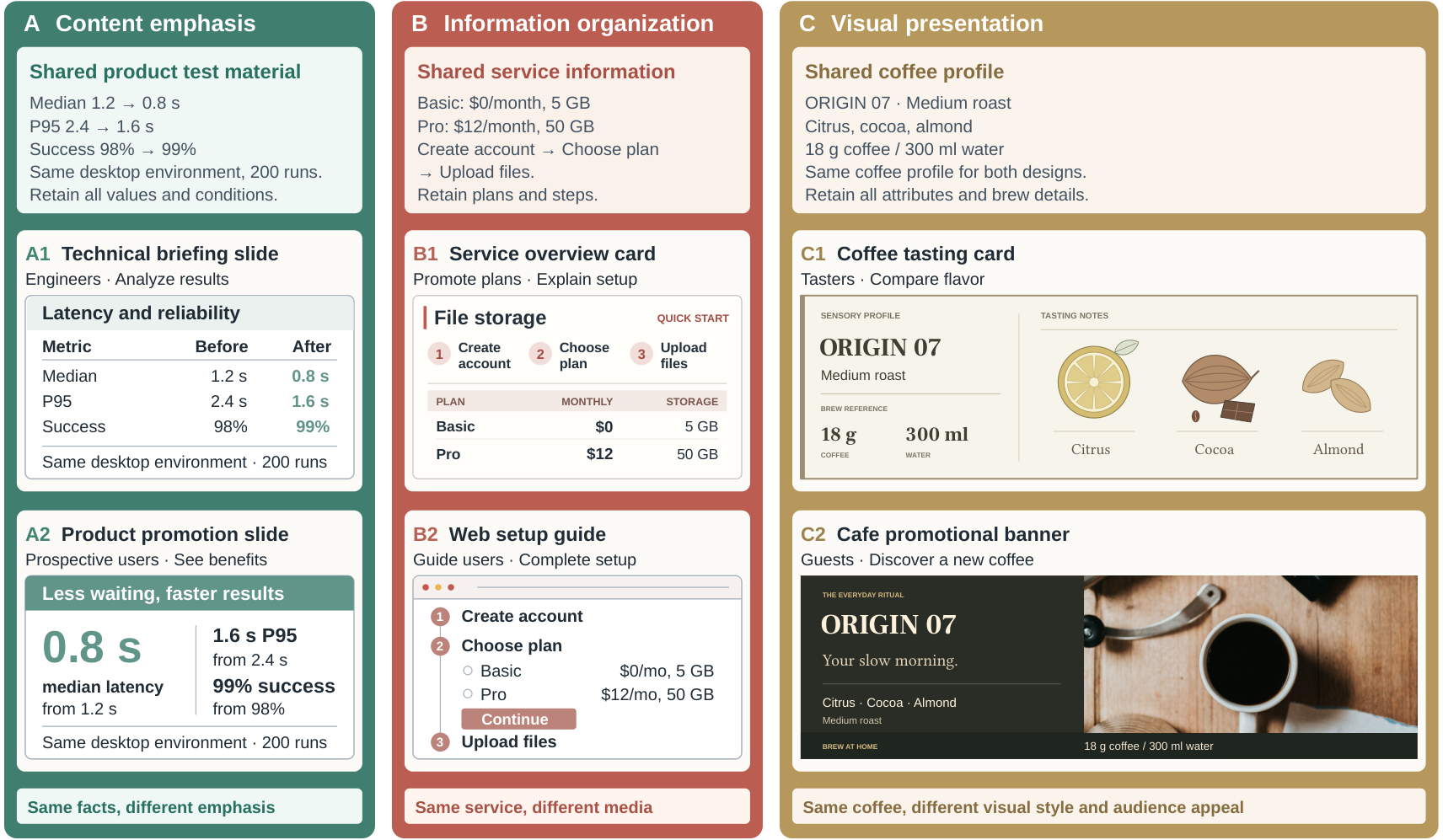
Figure 2 — 맥락별 authoring 차이
3. Method & Key Results (제안 방법론 및 핵심 결과)
VAS는 3단계 파이프라인으로 구축되었으며, 322개 candidate 중 211개 task를 최종 선정했습니다 [Figure 5].
- Stage 1 (Sources and feasibility): 공개 논문, 보고서, dataset, manual 등을 수집합니다. 이후 rendering, native-file inspection, 재현 가능한 계산 등으로 feasibility를 확인합니다.
- Stage 2 (Task and reference construction): instruction, input contract, reference fact, task-specific rubric을 구성합니다.
- Stage 3 (Execution and selection): agent trial을 실행해 모호한 instruction과 결함을 찾아냅니다. 그 결과를 바탕으로 coverage, evaluability, source diversity를 고려해 최종 task를 선별합니다.
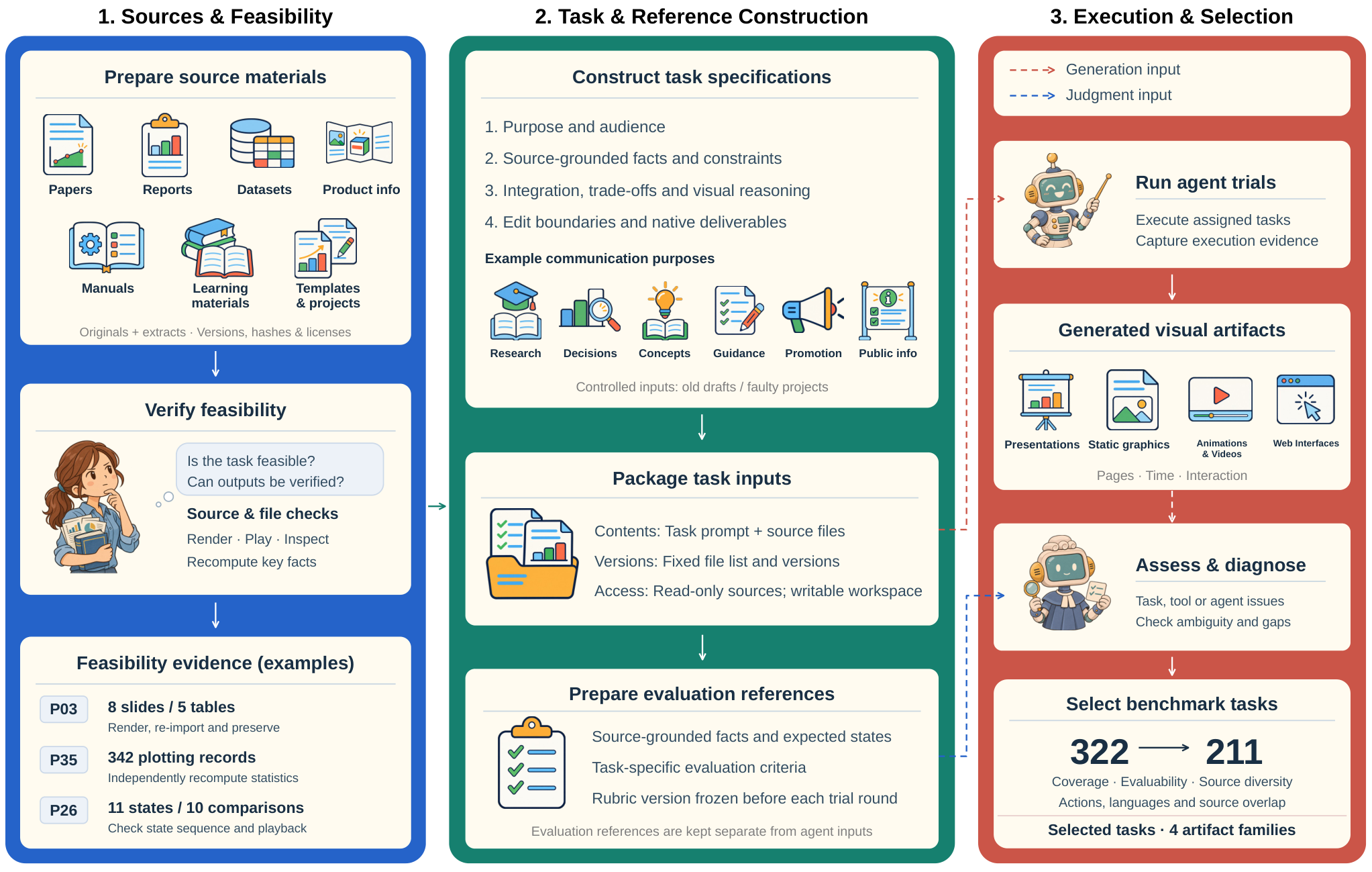
Figure 5 — 3단계 벤치마크 구축
Task 구성은 다음과 같습니다.
- Presentations 47개 (22.3%)
- Static graphics 72개 (34.1%)
- Animations/videos 32개 (15.2%)
- Web interfaces 60개 (28.4%)
- 전체 task는 8개 application purpose로 분류됩니다.
평가 방식은 다음과 같습니다.
- Artifact를 freeze한 뒤 source materials, rendered view, native-file inspection, temporal sample, interaction record를 함께 사용합니다.
- Website는 1440×900과 390×844 두 viewport에서 검사합니다.
- Judge는 multimodal judge인 GPT-6 Astra(medium reasoning, 별도 session)입니다. Item 단위 판단마다 근거가 되는 page, region, timestamp를 기록합니다.
- AP dimension 가중치는 (C, O, V, D) = (0.25, 0.15, 0.50, 0.10)입니다.
주요 정량 결과
- 전체 성능: 9개 model–harness configuration의 Overall score는 42.12 (Claude Sonnet 5)부터 70.52 (GPT-6 Astra)까지 분포합니다. 그 다음은 GPT-6.1 Sol 69.37, Claude Opus 5.5 65.03 순입니다. 평균 B는 41.96~49.51로 좁은 범위에 모인 반면, 평균 Δ는 0.16~21.01로 크게 벌어졌습니다. 최고 configuration과 최저 configuration의 격차 28.40점 중 20.85점 (73.4%)이 AP에서 나왔습니다.
- TF와 AP의 분리: B=50(요구사항 완전 충족)인 output들 사이에서도 AP adjustment는 −5.55~25.00까지 차이가 났습니다.
- Family별 profile: Overall ranking만으로는 family별 차이가 드러나지 않습니다 [Figure 9].
- Claude Opus 5.5: static graphics 69.53, web interfaces 57.05
- DeepSeek: 4개 family에서 58.32~61.68로 편차가 작음
- GPT-6 Astra: presentations, static graphics, animations/videos에서 모두 71점 이상, web interfaces는 67.20
- Dimension별 profile: Gemini 4 Argon은 Delivery가 9.94이지만 Content 0.33, Visuals 0.09에 그쳤습니다. 즉 접근성 좋은 deliverable이라도 content나 visual 품질은 약할 수 있습니다.
- Sensitivity analysis: 세 가지 대안 aggregation(linear AP map, equal C/O/V/D weights, itemwise TF)을 적용해도 configuration 순위는 유지되었습니다.
- 가장 빈번한 negative rating: Typography and legibility (V3)였고, 그 다음은 D3, V6, C2 순이었습니다.
- Case studies (세 사례 모두 두 artifact가 B=50으로 동일):
- P99 (mobile 교육 카드): Sol의 Δ는 21.65, Sonnet의 Δ는 −5.55였습니다. Sonnet의 필수 본문 text가 약 5–8 pixel까지 작아졌기 때문입니다.
- P121 (standing-wave animation): Kimi K3에서 marker와 curve의 주기가 맞지 않았고, V4와 V8 모두 −2를 받았습니다.
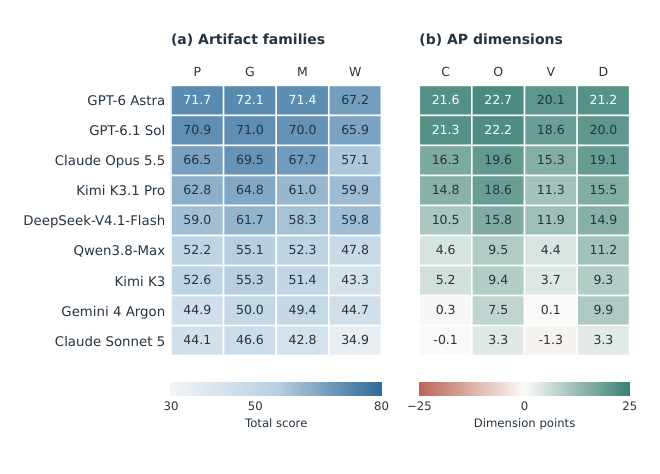
Figure 9 — Family·AP별 성능
4. Conclusion & Impact (결론 및 시사점)
이 논문은 Task Fulfillment만으로는 포착되지 않는 큰 Artifact Performance 차이가 존재하며, model 간 격차의 대부분이 이 차이에서 나온다는 것을 보여줍니다. VAS는 TF와 AP를 분리하고, 공통 C/O/V/D criteria를 task-specific anchor로 구체화합니다. 이를 통해 artifact family에 상관없이 authoring capability를 비교할 수 있는 공통 framework를 제공합니다. 또한 family별·purpose별 profile과 artifact 기반 case study를 통해 점수 차이를 evidence organization, mobile readability, temporal consistency 같은 구체적 결함과 연결합니다.
산업계에는 slide, poster, video, web 생성 agent를 개발할 때 "요구사항 충족" 이상의 맥락 적합성을 측정할 진단 도구를 제공한다는 의미가 있습니다. 다만 한계도 있습니다. 평가가 단일 LLM judge(GPT-6 Astra)에 의존하며, 저자들도 human assessment와 independent judge를 통한 judge reliability 검증을 향후 과제로 남겨 두었습니다.
⚠️ 알림: 이 리뷰는 AI로 작성되었습니다.
관련 포스트
- [논문리뷰] VibeVideoBench: Evaluating Multimodal Agents on Code-Driven Video Generation
- [논문리뷰] PerceptionRubrics: Calibrating Multimodal Evaluation to Human Perception
- [논문리뷰] Think Before You Score: Thinking Reward Model for Visual Generation
- [논문리뷰] Sci-VBench: Evaluating Knowledge- and Reasoning-Intensive Video Generation in Science Domains
- [논문리뷰] Scoring Higher, Answering Worse: Mitigating Reward Hacking in Rubric-Based RL via Protocol-Level Rubrics
Review 의 다른글
- 이전글 [논문리뷰] VideoNexus: Video Perception Beyond the Reasoning Context
- 현재글 : [논문리뷰] VisualArtifactSpec 1.0: Evaluating Visual Artifacts under Task Specifications
- 다음글 [논문리뷰] Weight-Space Programming Doesn't Need Transformers
댓글