[논문리뷰] Hunyuan3D-Buffalo 1.0: A Unified Multimodal Model for Scalable 3D Generation, Understanding, and Editing
링크: 논문 PDF로 바로 열기
저자: Junliang Ye, Kenkun Liu, Guocun Wang, et al.
1. Key Terms & Definitions (핵심 용어 및 정의)
- Hunyuan3D-Buffalo 1.0: 3D understanding, text-to-3D generation, instruction-guided 3D editing, 그리고 text-grounded part generation을 단일 아키텍처 내에서 지원하는 unified multimodal framework이다.
- Nano3D-v2: 대규모의 geometrically consistent 3D editing data를 구축하기 위해 개발된 agent-based 3D editing data construction algorithm으로, 기존 Nano3D를 확장한 버전이다.
- Hunyuan3D-VLM: 3D objects의 fine-grained semantic, structural, spatial understanding을 위해 설계된 3D Vision-Language Model로, geometric structure와 appearance cues를 encoding한다.
- 3D-DiT (3D Diffusion Transformer): Hunyuan3D-2.1로부터 초기화된 generative module로, Hunyuan3D-VLM의 hidden states를 조건부 정보로 활용하여 high-fidelity 3D synthesis를 수행한다.
- Flow-matching objective: Gaussian prior를 target 3D latent distribution으로 이동시키는 velocity field를 예측하도록 generative stages에서 최적화되는 training objective이다.
2. Motivation & Problem Statement (연구 배경 및 문제 정의)
Unified 3D modeling은 scarce multimodal data, 특히 large-scale이고 geometrically consistent한 editing data의 부족으로 인해 여전히 제한적이다. 2D vision models은 understanding, generation, editing을 통합하는 unified multimodal system으로 발전했지만, 3D domain에서의 유사한 발전은 3D assets의 수집, 주석 처리, editing의 어려움 때문에 더디다. 결과적으로, 기존 3D understanding, 3D generation, 그리고 3D editing models은 대부분 개별적인 시스템으로 개발되어, unified semantic–visual–geometric representation 학습 및 task 간 상호 강화를 저해한다. 또한, 기존 3D editing 방법들은 costly한 per-instance optimization, projection 및 reconstruction consistency 문제, identity drift, geometric hallucinations, 또는 수동적인 bounding box 지정을 요구하는 한계가 있었다.
3. Method & Key Results (제안 방법론 및 핵심 결과)
본 논문은 3D understanding, text-to-3D generation, instruction-guided 3D editing, 그리고 text-grounded part generation을 단일 아키텍처에서 가능하게 하는 unified 3D multimodal framework인 Hunyuan3D-Buffalo 1.0을 제안한다. 이 framework는 multimodal understanding 및 part-level reasoning을 위한 Hunyuan3D-VLM과 high-fidelity 3D synthesis를 위한 3D-DiT를 결합한다. Hunyuan3D-VLM은 3D assets의 geometric structure와 RGB appearance cues를 모두 encoding하며, 이를 VecSet encoder와 Q-Former를 통해 latent tokens로 압축한 후, Qwen-VL 기반의 decoder-only Transformer로 3D grounding과 part-level reasoning을 수행한다 [cite: 1, Figure 6]. 3D-DiT는 Hunyuan3D-2.1로부터 초기화되며, MLP-Connector를 통해 Hunyuan3D-VLM의 hidden states를 조건부 정보로 받아 high-level multimodal reasoning을 3D synthesis로 안내한다 [cite: 1, Figure 6]. 특히, 3D editing 및 part generation의 경우, source 3D representation을 diffusion process에 추가로 conditioning하여 original object의 structural consistency 및 unedited regions의 보존을 강화한다. 이 연구는 또한 Nano3D-v2 파이프라인을 통해 87M 규모의 대규모 3D multimodal corpus를 구축했으며, 여기에는 25M의 understanding samples, 50M의 text-to-3D pairs, 그리고 12M의 editing pairs가 포함된다 [cite: 1, Figure 3]. 훈련은 3D-VLM pre-training, text-to-3D pre-training, omni pre-training, 그리고 continued pre-training의 4단계로 진행되며, 모든 generative stage는 flow-matching objective를 최적화한다.
실험 결과, Hunyuan3D-Buffalo 1.0은 다양한 3D task에서 탁월한 성능을 입증했다. 3D understanding 측면에서, UniPart-Bench 평가에서 Hunyuan3D-VLM은 part-level Q&A에서 85.47 SBERT와 89.06 SimCSE를, holistic object captioning에서 72.94 SBERT와 52.84 ROUGE-L을 달성하여 이전 SOTA 모델들을 일관되게 능가했다 [cite: 1, Table 3]. text-to-3D generation에서는 인간 평가(human evaluation)에서 text alignment 55.2%, geometry quality 57.1%, overall preference 56.6%의 선호도를 얻어, 가장 강력한 baseline인 Omni123 대비 두 배 이상의 성능을 보였다 [cite: 1, Table 5]. 3D editing 분야에서는 Edit3D-Bench 벤치마크에서 Hunyuan3D-Buffalo 1.0 (w/ 3D-VLM)이 평균 Chamfer Distance (CD)를 0.0091로, 평균 F1 score를 0.6515로 달성하며, Omni123 (CD 0.0684) 대비 86.7%의 CD 감소와 Steer3D (F1 0.2729) 대비 2.39배의 F1 향상을 기록했다 [cite: 1, Table 7]. 또한, stronger text-to-3D generation이 3D editing을 향상시키고, stronger 3D understanding 또한 3D editing 성능을 개선한다는 두 가지 명확한 cross-task synergies를 확인했다 [cite: 1, Figure 9].
4. Conclusion & Impact (결론 및 시사점)
본 논문은 3D understanding, 3D generation, 그리고 3D editing을 단일 framework 내에서 jointly address하는 Hunyuan3D-Buffalo 1.0을 제안하며, 모든 세 가지 task에서 state-of-the-art 성능을 달성했음을 보여준다. 특히, 3D generation과 3D editing 분야에서 기존 방법론들을 크게 능가하는 성능을 입증했으며, 이는 unified 3D multimodal training을 통해 understanding, generation, editing task 간 meaningful capability transfer가 가능하다는 것을 시사한다. 이 연구는 scarce multimodal data의 한계를 극복하기 위해 Nano3D-v2를 활용한 87M 규모의 대규모 3D multimodal corpus를 구축하여, scalable training의 기반을 마련했다는 점에서 중요성을 갖는다. 또한, 3D understanding, generation, editing, 그리고 part generation이 상호 강화될 수 있음을 실험적으로 증명함으로써, 3D multimodal modeling의 새로운 연구 방향을 제시한다. 향후에는 single-stage high-quality geometry representation, end-to-end texture editing, 그리고 더욱 robust한 editing data construction pipeline 개발 등의 과제를 해결하여 3D creation 분야에 더 큰 발전을 가져올 것으로 기대된다.
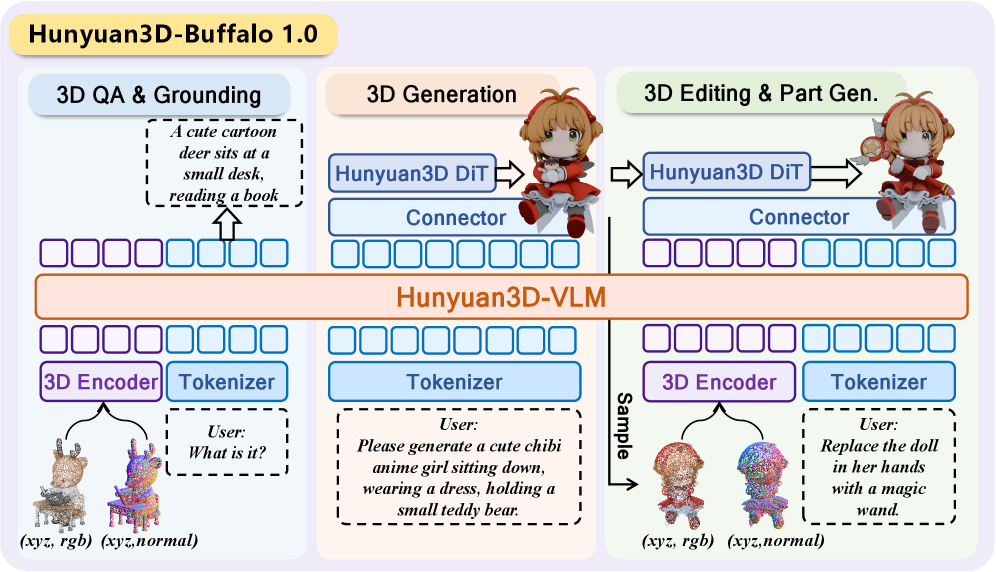
Figure 6 — 제안 모델의 전체 아키텍처
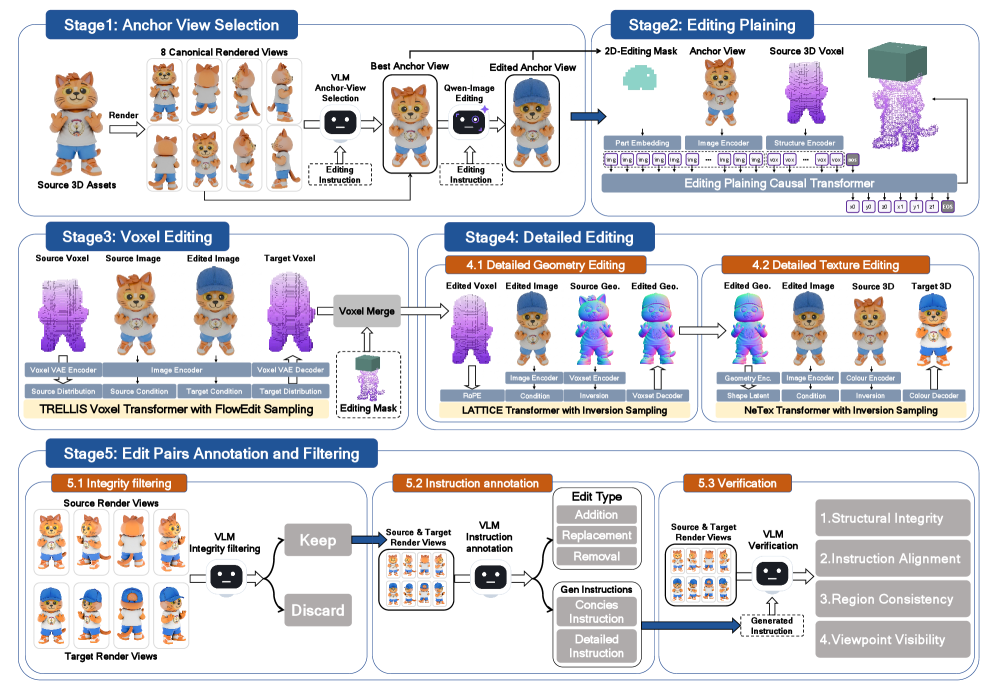
Figure 3 — Nano3D-v2 데이터 구축 파이프라인
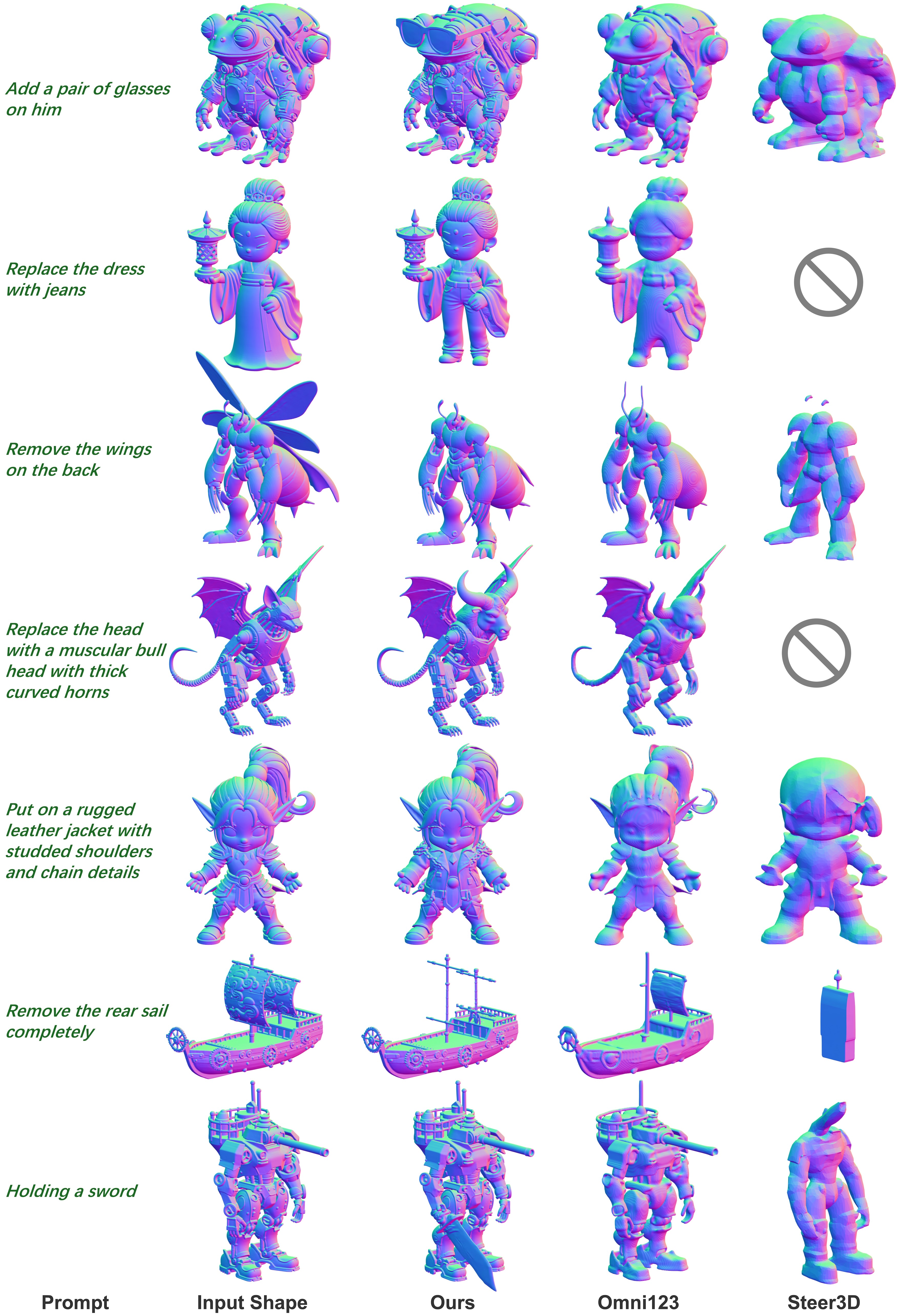
Figure 9 — 3D 편집 정성적 결과
⚠️ 알림: 이 리뷰는 AI로 작성되었습니다.
관련 포스트
- [논문리뷰] Part-X-MLLM: Part-aware 3D Multimodal Large Language Model
- [논문리뷰] Learning 3D Editing without Paired Supervision via Generative Prior Distillation
- [논문리뷰] Hallo4D: Multi-Modal Hallucination Mitigation for Consistent Spatio-Temporal Generation
- [논문리뷰] PhysX-Omni: Unified Simulation-Ready Physical 3D Generation for Rigid, Deformable, and Articulated Objects
- [논문리뷰] Realiz3D: 3D Generation Made Photorealistic via Domain-Aware Learning
Review 의 다른글
- 이전글 [논문리뷰] GROVE: Growing and Reasoning over Temporally Stratified Memory from Streaming Video Experience
- 현재글 : [논문리뷰] Hunyuan3D-Buffalo 1.0: A Unified Multimodal Model for Scalable 3D Generation, Understanding, and Editing
- 다음글 [논문리뷰] JoyAI-Video-Edit: Real-Time Open-Ended Video Editing with Autoregressive Diffusion
댓글