[논문리뷰] NOLLI: A Difficulty-Calibrated Puzzle Benchmark for Diagnosing the English-Korean Performance Gap
링크: 논문 PDF로 바로 열기
저자: Dasol Choi, Joonyong Park, Daegon Yu, Soo Yong Kim, Youngsook Song, Seunghyeok Hong
1. Key Terms & Definitions (핵심 용어 및 정의)
- NOLLI:
Large Language Models (LLMs)의Korean performance gap이 발생하는 원인을 진단하기 위해 고안된procedurally generated English–Korean puzzle benchmark이다. - Difficulty Calibration:
task difficulty를structural size대신behaviorally정의하는 방식으로, 고정된reference model이 특정target accuracy bands(Easy, Medium, Hard)에 도달하도록 각generator의parameters를 튜닝하는 프로토콜이다. - Hangul Jamo: 한글 음절을 구성하는
sub-syllabic letters로, 초성(initial consonant), 중성(vowel), 종성(optional final consonant)으로 이루어진다. - Direct Translations:
puzzle type의 기본structure와solution이surface language와 독립적인task를 지칭한다. 영어 및 한국어 버전은 동일한generation algorithm과parameters를 사용하며presentation-language effects를 측정하는 데 활용된다. - Script Adaptations: 영어와 한국어 모두 존재하는
puzzle type이지만, 한국어 버전은Hangul jamo의compositional structure에 맞춰 특별히adapted되어 있어translation-equivalent하지 않은task를 의미한다.
2. Motivation & Problem Statement (연구 배경 및 문제 정의)
본 논문은 LLM이 단순 pattern matching을 넘어 진정한 logical reasoning 능력을 갖추고 있는지에 대한 불확실성과 multilingual evaluation에서 language-specific failure가 단일 performance gap으로 뭉뚱그려지는 문제를 해결하고자 한다. 기존 static benchmarks는 data contamination의 위험이 크며, 대부분 procedurally generated benchmarks는 task difficulty를 structural parameters로만 정의하여 모델의 실제 성능을 반영하지 못하는 한계가 있다. 특히 한국어 LLM 성능이 저조할 때, 그 실패의 정확한 원인(what exactly is it failing at?)을 진단할 수 있는 체계적인 benchmark의 부재가 핵심 문제로 지적된다. 이러한 배경에서 연구자들은 English–Korean performance gap의 구체적인 원인을 diagnostic하고 heterogeneous tasks를 단일 behavioral scale에 놓기 위한 새로운 benchmark의 필요성을 제기한다.
3. Method & Key Results (제안 방법론 및 핵심 결과)
본 연구는 English–Korean performance gap 진단을 위해 15개 puzzle type (25개 task, 7,500개 instance)으로 구성된 procedurally generated benchmark인 NOLLI를 제안한다. 각 instance는 seed-regenerable하며 unique solution을 가지며 deterministically 채점된다. task difficulty는 structural size가 아닌 behavioral 방식으로 calibration된다: Gemini 3 Flash를 reference model로 사용하여 Easy (75±10%), Medium (50±10%), Hard (25±10%)의 target accuracy bands에 맞도록 각 generator의 parameters를 튜닝한다 [Figure 2, cite: 1]. NOLLI는 presentation-language 효과를 측정하는 Direct Translations, 한글 jamo에 adapted된 Script Adaptations, 그리고 한국 문화 및 철자를 기반으로 하는 Korean-only tasks의 세 가지 cross-lingual design을 가진다 [Figure 1, cite: 1].
주요 실험 결과에 따르면, presentation language 자체는 LLM 성능에 미미한 영향을 미친다. Direct-translation tasks에서는 English–Korean accuracy gap이 −2.7에서 +5.0 pp 사이로 나타났으며, ±10 pp의 calibration margin 내에서 통계적으로 equivalent함이 Holm-corrected TOST를 통해 확인되었다. 반면, writing-system-intensive tasks에서는 뚜렷한 performance gap이 관찰되었다. 한국어 Cipher는 영어 Cipher 대비 최대 68.7 pp까지 성능이 하락했지만, 동일한 jamo를 사용하는 Cryptarithmetic에서는 체계적인 penalty가 나타나지 않았다. 또한, Jamo Composition accuracy는 한국어 Cipher accuracy를 R²=0.91로 강력하게 예측하여, multi-step sub-syllabic execution에서의 어려움이 bottleneck일 가능성을 시사한다. Korean-only tasks는 rule-application deficits와 모든 non-floor models에서 positive하게 나타난 Kinship deficit으로 구분된다. 특히, GPT-5.5와 같은 일부 frontier model에서도 +36.7 pp의 Kinship deficit이 지속되는 것으로 나타났다. 마지막으로, input size가 empirical difficulty의 신뢰할 수 없는 proxy임이 밝혀졌다. 전체 puzzle type의 절반 가까이인 7개 type에서 salient size measure가 Easy에서 Hard로 갈수록 증가하지 않았으며, constraint density, distractor density, procedural depth와 같은 요인이 difficulty levers로 작용했다. Difficulty ordering은 reference model에 anchored되었음에도 불구하고, Easy→Hard로 감소하는 accuracy 추세가 non-floor models의 85%에서 일관되게 나타났다 [Figure 3, cite: 1].
4. Conclusion & Impact (결론 및 시사점)
본 연구는 LLM의 English–Korean performance gap의 diagnostic을 위한 difficulty-calibrated procedural benchmark인 NOLLI를 성공적으로 제시했다. Presentation language 자체는 LLM의 한국어 성능에 유의미한 cost를 유발하지 않지만, writing-system-intensive tasks, 특히 Hangul jamo의 multi-step sub-syllabic execution과 관련된 task에서는 심각한 bottleneck이 존재함을 명확히 보여주었다. 또한, 한국 문화 및 정서에 기반한 Korean-specific knowledge (특히 Kinship task) 처리 능력 부족이 LLM 성능 저하의 또 다른 중요한 원인임을 진단했다. 이 연구는 LLM evaluation에서 structural size에만 의존하는 difficulty 정의의 한계를 지적하고, behavioral calibration의 중요성을 강조한다. NOLLI는 Korean NLP 분야에서 LLM의 reasoning abilities를 fine-grained하게 분석하고 향상시키기 위한 새로운 표준 benchmark를 제공하며, sub-syllabic processing 및 cultural lexicon understanding과 관련된 미래 연구의 방향성을 제시하는 데 크게 기여할 것이다.
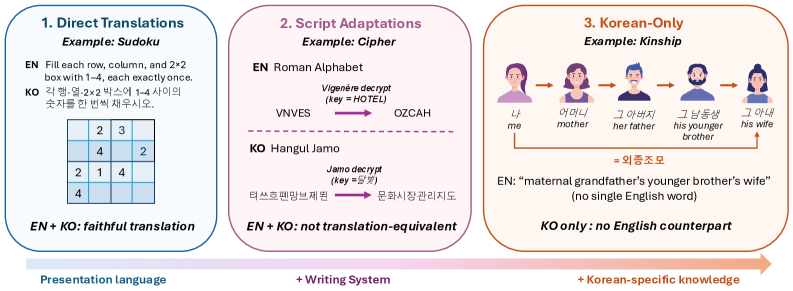
Figure 1 — NOLLI의 교차 언어 스펙트럼
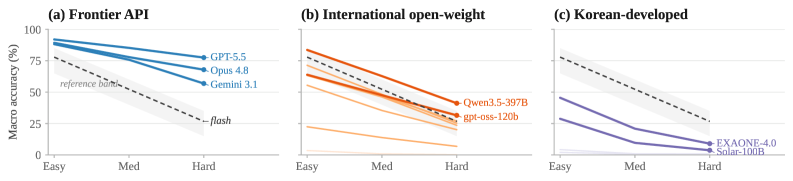
Figure 2 — 벤치마크 생성 및 보정 파이프라인
⚠️ 알림: 이 리뷰는 AI로 작성되었습니다.
관련 포스트
- [논문리뷰] Recursive Code World Models: Building Complex Worlds through Recursive Scene Programs
- [논문리뷰] Negative Self-Distillation: Learning to Reason by Avoiding Flaws
- [논문리뷰] Understanding Evolution Strategies for LLM Reasoning: Broader Reasoning Coverage than GRPO
- [논문리뷰] Trace: A Taxonomy-Guided Environment for Multidomain Visual Reasoning
- [논문리뷰] H^2SD: Hybrid Hindsight Self-Distillation
Review 의 다른글
- 이전글 [논문리뷰] Lossless Tensor Compression as Program Synthesis
- 현재글 : [논문리뷰] NOLLI: A Difficulty-Calibrated Puzzle Benchmark for Diagnosing the English-Korean Performance Gap
- 다음글 [논문리뷰] OPD-V: Visual On-Policy Self-Distillation with Modality Balance
댓글