[논문리뷰] Chat-Edit-3D++: Interactive 3D and 4D Scene Editing via Large Language Models
링크: 논문 PDF로 바로 열기
I have browsed the paper. Now I will proceed with extracting information and summarizing it according to the specified format and constraints.
Metadata Extraction:
- Authors: Shuangkang Fang, Yufeng Wang, Yi-Hsuan Tsai, Wenrui Ding, Yi Yang, Shuchang Zhou, Ming-Hsuan Yang
- Keywords: From the "Index Terms" section:
3D scene editing,4D scene editing,Large language models,Vision-Language models. I need 1-4 more. Looking at the abstract and introduction,Hash-Atlas,Workflow Decoupling,Trajectory-tuningandDialogue Systemseem appropriate.
Part 1: Summary Body
I will go section by section.
-
1. Key Terms & Definitions: I'll pick 3-5 crucial terms.
Hash-Atlas: A neural network that maps 3D/4D scene views to 2D foreground and background atlases for editing.Workflow Decoupling: Separating the 2D editing stage from the 3D/4D reconstruction pipeline, allowing flexible integration of diverse visual models.CE3D++: The proposed dialogue-based 3D/4D scene editing approach centered on an LLM, integratingHash-Atlasand managing multiple visual models.Trajectory-tuning dataset: A custom dataset created to fine-tune LLMs, enhancing their ability to accurately interpret complex user instructions and schedule numerous visual tools for editing tasks.Atlas Space: The 2D plane representation where 3D/4D scene editing operations are performed after mapping.
-
2. Motivation & Problem Statement:
- Existing text-driven 3D scene editing methods suffer from fixed input patterns and limited editing capabilities due to reliance on a single or few 2D visual models.
- These methods often involve intricate pipeline designs to integrate 2D models into 3D reconstruction processes (e.g., NeRF or Gaussian-splatting based iterative, supervised, or denoised approaches), hindering the flexible integration of diverse visual models and LLMs.
- The core problem is the coupled design between 2D editing and 3D/4D representation, which limits scalability and interactive flexibility for complex user queries.
-
3. Method & Key Results:
- Methodology: The paper proposes Chat-Edit-3D++ (CE3D++), a dialogue-based interactive 3D and 4D scene editing framework that employs workflow decoupling. This is achieved through the Hash-Atlas network, which maps multi-view 3D/4D scenes to 2D foreground and background atlases. Editing operations are then performed in this 2D
Atlas Space, allowing compatibility with a wide array of 2D visual models. A merge-split strategy is used for editing, where foreground and background atlases are combined for editing and then separated. The system leverages a Large Language Model (LLM) as a central hub, interpreting user text queries, managing multiple visual models (up to 30+), and orchestrating scene file operations. For dynamic 4D scenes, a pivot motion loss is introduced to mitigate distortion caused by object movement and ensure temporal consistency in the atlas. To enhance LLM reliability, especially for lightweight models and complex multi-step tasks, a specialized trajectory-tuning dataset with 1,000 dialogue samples is developed to fine-tune the LLM agent. - Key Results:
- The Hash-Atlas model significantly outperforms LNA in atlas reconstruction, achieving 1.1~5.1dB improvement in PSNR, 14.2~18.6x acceleration in training time, and 7.6~9.0x increase in inference FPS across various 3D and 4D datasets.
- CE3D++ demonstrates superior editing capabilities and comprehensiveness compared to state-of-the-art 3D methods (e.g., DN2N, RoMaP, EditSplat) and 4D methods (e.g., CTRL-D, Instruct-4DGS, Dynamic-eDiTor), achieving higher CLIP Similarity and CLIP Directional Score. For instance, on the LLFF dataset, CE3D++ achieved a CLIP Similarity of 0.304 and a CLIP Directional Score of 0.192, significantly higher than baselines. It also achieved competitive or better editing efficiency, with editing times as low as 5.6 minutes for 3D scenes and 8.2 minutes for 4D scenes, and managed VRAM peak efficiently.
- The trajectory-tuning strategy substantially improves the success rate of tool invocation for smaller LLMs like Qwen-14B and LLaMA-8B, particularly for complex, multi-step instructions, reducing failure rates from 21% to 10% for hard complexity tasks in Qwen-14B. This enhances the system's robustness in handling diverse text queries and multi-round dialogues.
- Methodology: The paper proposes Chat-Edit-3D++ (CE3D++), a dialogue-based interactive 3D and 4D scene editing framework that employs workflow decoupling. This is achieved through the Hash-Atlas network, which maps multi-view 3D/4D scenes to 2D foreground and background atlases. Editing operations are then performed in this 2D
-
4. Conclusion & Impact:
- 본 논문은 3D 및 4D 장면 표현과 2D 이미지 편집 모델 간의 coupled design이 가지는 한계를 극복하기 위해 **CE3D++**를 제안한다.
- 핵심적으로 Hash-Atlas를 통해 장면을 2D atlases로 표현함으로써, 광범위한 2D visual models과의 호환성을 달성하고, LLMs를 활용하여 visual tools 및 scene files을 관리함으로써 풍부한 편집 효과와 지속 가능한 conversational editing capabilities를 제공한다.
- 이 연구는 기존의 제한적인 visual models를 넘어 더욱 적응성 있는 편집 프레임워크를 가능하게 하여, 실세계 장면의 interactive editing 발전에 기여한다. 특히, trajectory-tuning을 통해 LLMs의 안정성을 강화하여 multi-round dialogue 기반의 복잡한 편집 작업을 가능하게 한 점은 학계 및 산업계에서 interactive design tools 개발에 중요한 시사점을 제공한다.
Part 2: Important Figure Information
I need to select up to 3 figures.
- Figure 3: Overall framework (most important)
- Figure 4: Hash-Atlas detail (important for methodology)
- Figure 1: Examples of chatting with CE3D++ (good for demonstrating capabilities)
Let's get the URLs.
- Figure 1:
2608.29137v1/shocking.png->https://arxiv.org/html/2608.29137v1/shocking.png - Figure 3:
2608.29137v1/overview_pipeline.png->https://arxiv.org/html/2608.29137v1/overview_pipeline.png - Figure 4:
2608.29137v1/hash_atlas.png->https://arxiv.org/html/2608.29137v1/hash_atlas.png
Now I'll construct the final output.저자: Shuangkang Fang, Yufeng Wang, Yi-Hsuan Tsai, Wenrui Ding, Yi Yang, Shuchang Zhou, Ming-Hsuan Yang, et al.
1. Key Terms & Definitions (핵심 용어 및 정의)
- Hash-Atlas: 3D 및 4D 장면의 다양한 뷰를 2D foreground 및 background atlases로 매핑하는 신경망으로, 3D/4D scene editing을 2D 공간에서의 operation으로 전환한다.
- Workflow Decoupling: 2D editing stage를 3D/4D reconstruction pipeline으로부터 분리하는 접근 방식으로, 다양한 visual models의 유연한 통합을 가능하게 한다.
- CE3D++: 본 논문에서 제안하는 dialogue-based 3D 및 4D scene editing 접근 방식으로, Large Language Model (LLM)을 중심으로 사용자의 임의적인 텍스트 입력을 해석하고 해당 visual models를 자율적으로 호출한다.
- Trajectory-tuning dataset: LLM이 복잡한 지시를 정확하게 해석하고 다수의 visual tools를 효과적으로 스케줄링할 수 있도록 fine-tuning하기 위해 특별히 제작된 dataset이다.
- Atlas Space: 3D 및 4D 장면이 2D atlases로 매핑된 후, 실제 editing operation이 수행되는 2D 평면 공간을 지칭한다.
2. Motivation & Problem Statement (연구 배경 및 문제 정의)
기존의 text-driven 3D scene editing 방식들은 고정된 input patterns에 의존하며, 단일 또는 소수의 2D visual models에 의해 editing capabilities가 제한되는 단점을 가지고 있다. 이러한 방법론들은 2D models를 3D reconstruction process에 통합하기 위해 NeRF나 Gaussian-splatting 기반의 iterative, supervised, 또는 denoised approaches와 같은 복잡한 pipeline design을 요구하여, 다양한 visual models의 유연한 통합과 LLMs의 활용을 저해한다. 본 연구의 핵심 문제는 2D editing과 3D/4D representation 간의 coupled design에서 비롯되는 scalability 및 interactive flexibility의 한계를 해결하는 것이다. 이는 사용자의 복잡하고 다양한 텍스트 쿼리에 효율적으로 대응할 수 있는 시스템 구축을 어렵게 한다.
3. Method & Key Results (제안 방법론 및 핵심 결과)
본 논문은 workflow decoupling 기반의 dialogue-based interactive 3D 및 4D scene editing framework인 Chat-Edit-3D++ (CE3D++)를 제안한다. 이 시스템은 Hash-Atlas 네트워크를 활용하여 multi-view 3D/4D 장면을 2D foreground 및 background atlases로 매핑함으로써, 2D editing process와 3D/4D reconstruction process를 분리한다 [Figure 3]. 이 Atlas Space에서 editing operation이 수행되며, 이는 광범위한 2D visual models와의 호환성을 보장한다. 편집 시에는 merge-split strategy를 사용하여 foreground atlas와 background atlas를 결합하여 편집하고 이후 분리한다. Large Language Model (LLM)은 사용자의 텍스트 쿼리를 해석하고, 최대 30개 이상의 visual models를 관리하며, scene files을 조율하는 핵심 hub 역할을 수행한다 [Figure 5]. 특히, 4D dynamic scenes의 경우, 객체 움직임으로 인한 왜곡을 완화하고 temporal consistency를 유지하기 위해 pivot motion loss가 도입된다. LLM의 신뢰성을 향상시키기 위해, 1,000개의 dialogue samples로 구성된 특화된 trajectory-tuning dataset을 구축하여 LLM agent를 fine-tuning한다.
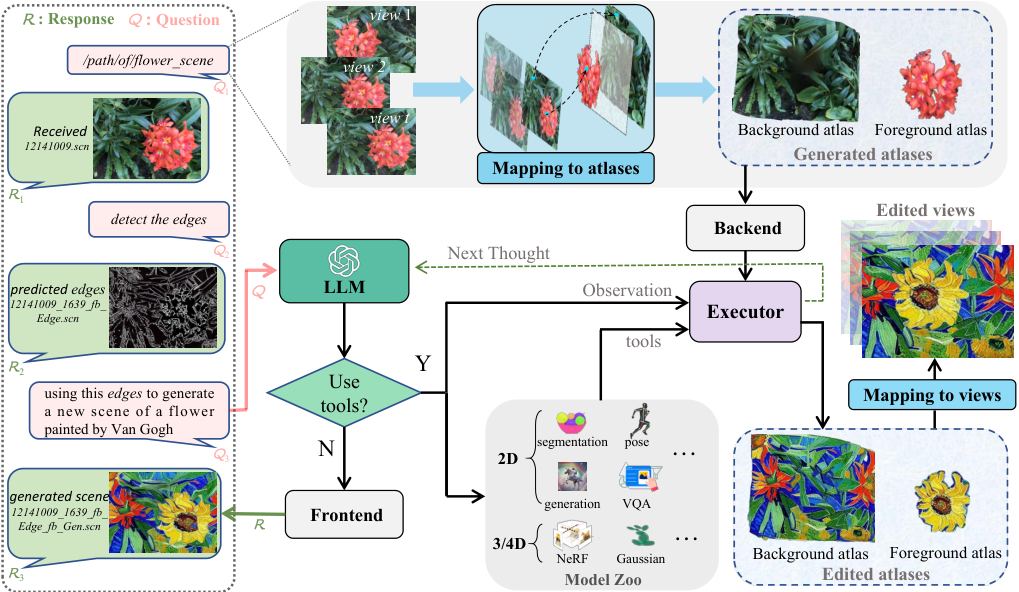
Figure 3 — CE3D++ 프레임워크 개요
실험 결과, Hash-Atlas 모델은 기존의 LNA 방식 대비 atlas reconstruction에서 현저히 우수한 성능을 보였다. PSNR에서 1.1~5.1dB 향상, training time에서 14.2~18.6배 단축, inference FPS에서 7.6~9.0배 증가를 달성했다. **CE3D++**는 최신 3D (예: DN2N, RoMaP, EditSplat) 및 4D (예: CTRL-D, Instruct-4DGS, Dynamic-eDiTor) scene editing 방법들과 비교하여 뛰어난 editing capabilities와 포괄성을 입증했다 [Figure 9]. 예를 들어, LLFF 데이터셋에서 **CE3D++**는 CLIP Similarity 0.304 및 CLIP Directional Score 0.192를 기록하며 baseline 모델들을 능가했다. 또한, 3D 장면의 경우 5.6분, 4D 장면의 경우 8.2분의 editing time으로 효율적인 편집 성능을 보여주었다. Trajectory-tuning 전략은 Qwen-14B 및 LLaMA-8B와 같은 경량 LLM의 tool invocation 성공률을 크게 개선했으며, 특히 hard complexity 작업의 failure rate를 21%에서 10%로 감소시켜 multi-round dialogue 및 다양한 텍스트 쿼리 처리의 견고성을 강화했다.
4. Conclusion & Impact (결론 및 시사점)
본 논문은 3D 및 4D 장면 표현과 2D 이미지 편집 모델 간의 coupled design이 가지는 한계를 극복하기 위해 **CE3D++**를 제안한다. 핵심적으로 Hash-Atlas를 통해 장면을 2D atlases로 표현함으로써, 광범위한 2D visual models와의 호환성을 달성하고, LLMs를 활용하여 visual tools 및 scene files을 관리함으로써 풍부한 편집 효과와 지속 가능한 conversational editing capabilities를 제공한다. 이 연구는 기존의 제한적인 visual models를 넘어 더욱 적응성 있는 편집 프레임워크를 가능하게 하여, 실세계 장면의 interactive editing 발전에 기여한다. 특히, trajectory-tuning을 통해 LLMs의 안정성을 강화하여 multi-round dialogue 기반의 복잡한 편집 작업을 가능하게 한 점은 학계 및 산업계에서 interactive design tools 개발에 중요한 시사점을 제공한다.
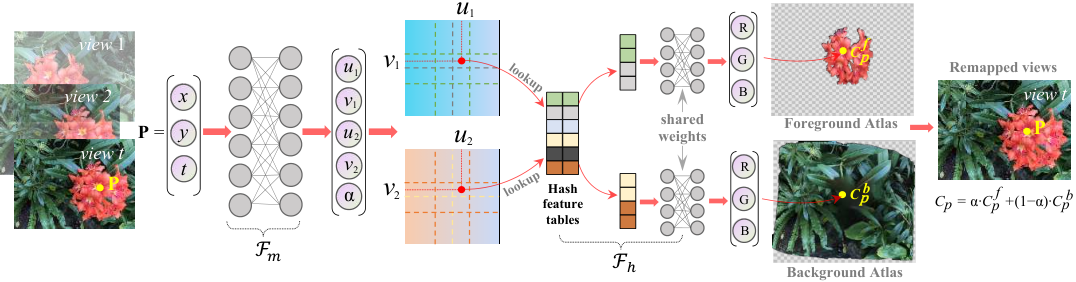
Figure 4 — Hash-Atlas 설명
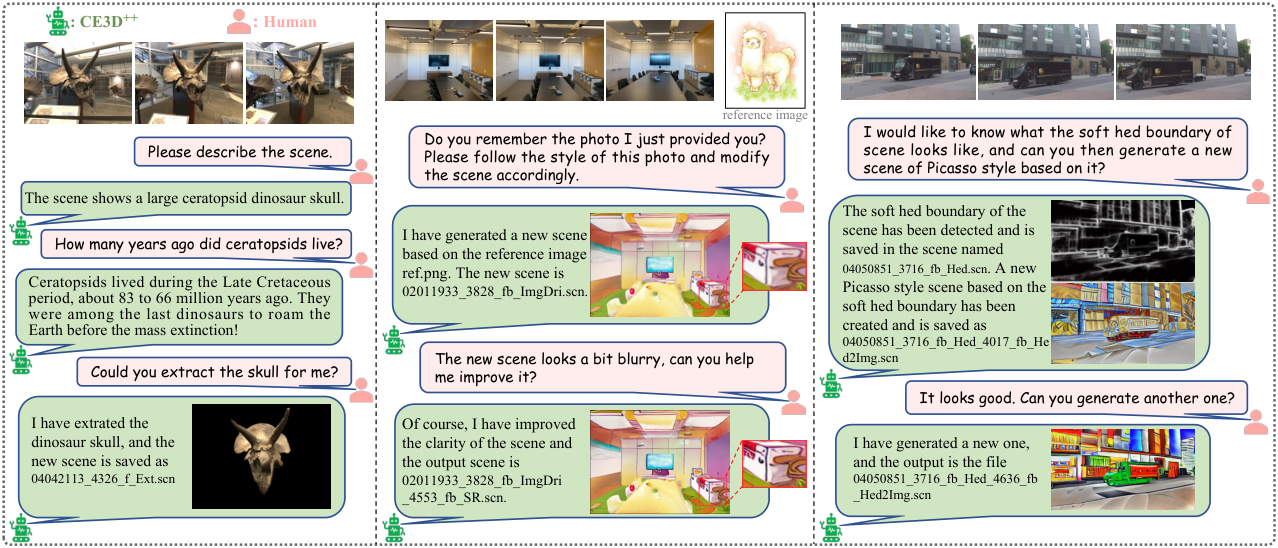
Figure 1 — CE3D++ 대화 예시
⚠️ 알림: 이 리뷰는 AI로 작성되었습니다.
관련 포스트
- [논문리뷰] Scaling Creative Writing Beyond Story-Centric Data with Attribute-Guided Genre Expansion
- [논문리뷰] Graph-Native Reinforcement Learning Enables Traceable Scientific Hypothesis Generation through Conceptual Recombination
- [논문리뷰] AgentProcessBench: Diagnosing Step-Level Process Quality in Tool-Using Agents
- [논문리뷰] LLMs4All: A Review on Large Language Models for Research and Applications in Academic Disciplines
- [논문리뷰] World Model Interpretability: From Decoding Representations to Understanding Latent Worlds
Review 의 다른글
- 이전글 [논문리뷰] Chain-of-Thought Faithfulness of Reasoning Models Varies with Where and How Preference Cues Are Delivered
- 현재글 : [논문리뷰] Chat-Edit-3D++: Interactive 3D and 4D Scene Editing via Large Language Models
- 다음글 [논문리뷰] CogEvol: Towards Efficient and Reliable Learning Environment Generation
댓글