[논문리뷰] FlowTool: Controlling Tool Parameter in Image Retouching via Flow Matching
링크: 논문 PDF로 바로 열기
저자: Thanh-Long V. Le, Steven Walton, Seunghyun Yoon, Branislav Kveton, Trung Bui, Eunho Yang, Viet Lai
키워: Flow Matching, Image Retouching, Conditional Generative Modeling, Diffusion Transformer, MLLM, Tool Parameter Generation, Reward-based Training
1. Key Terms & Definitions
- Image Retouching (IR): 사용자의 high-level 편집 의도에 따라 적절한 툴을 선택하고 해당 parameter values를 결정하여 이미지를 수정하는 tool-based image editing task.
- Multimodal Large Language Models (MLLMs): Image retouching에서 reasoning, tool selection, 그리고 discrete numerical parameter를 토큰 시퀀스로 autoregressively 생성하는 모델.
- Flow Matching: Data distribution과 standard Gaussian prior 사이에서 sample을 transport하는 time-dependent vector field를 학습하여 continuous parameter generation을 가능하게 하는 generative modeling 기법.
- Diffusion Transformer (DiT): Diffusion model에 적용된 Transformer 기반 아키텍처로, FlowTool에서는 continuous parameter value를 예측하는 parameter generator로 사용됨.
- Tool-Presence Mask: 편집 계획의 일환으로 특정 툴(및 해당 parameter)이 활성화되었는지 여부를 나타내는 binary mask.
2. Motivation & Problem Statement
현재 tool-based image editing의 주류인 autoregressive MLLMs 접근 방식은 Image Retouching (IR) 문제와 근본적인 불일치를 보입니다. 기존 MLLMs는 editing plan을 discrete token 시퀀스로 생성하지만, IR 툴 parameter의 smooth하고 continuous하며 precision-sensitive한 특성을 제대로 처리하지 못하여 numerical understanding 및 generation 성능이 저조합니다. 이러한 token-by-token autoregressive formulation은 long prediction trajectory에서 초기 오류가 전파되어 cascading error를 유발할 수 있습니다. 더욱이, autoregressive MLLMs는 불필요하게 긴 reasoning 및 tool-call trajectory를 생성하여 높은 latency와 memory overhead를 초래하며, 이는 interactive editing 및 resource-constrained devices에 배포하기에 비실용적입니다.
3. Method & Key Results
본 논문은 IR 문제를 conditional generative modeling으로 재구성하고, conditional rectified flow를 사용하여 input image 및 user instruction에 조건화된 high-quality tool parameters의 분포를 직접 모델링하는 FlowTool 프레임워크를 제안합니다. FlowTool은 multimodal understanding을 위한 Vision-Language Model (VLM) backbone과 Gaussian noise를 editing plan으로 변환하는 Diffusion Transformer (DiT) 기반의 parameter generator, 그리고 tool selection을 위한 tool-presence head를 결합합니다 [Figure 2]. 모델은 two-stage supervised flow-matching curriculum과 reward-based post-training을 통해 학습되며, 후자는 rendered edits의 quality를 직접 최적화합니다.
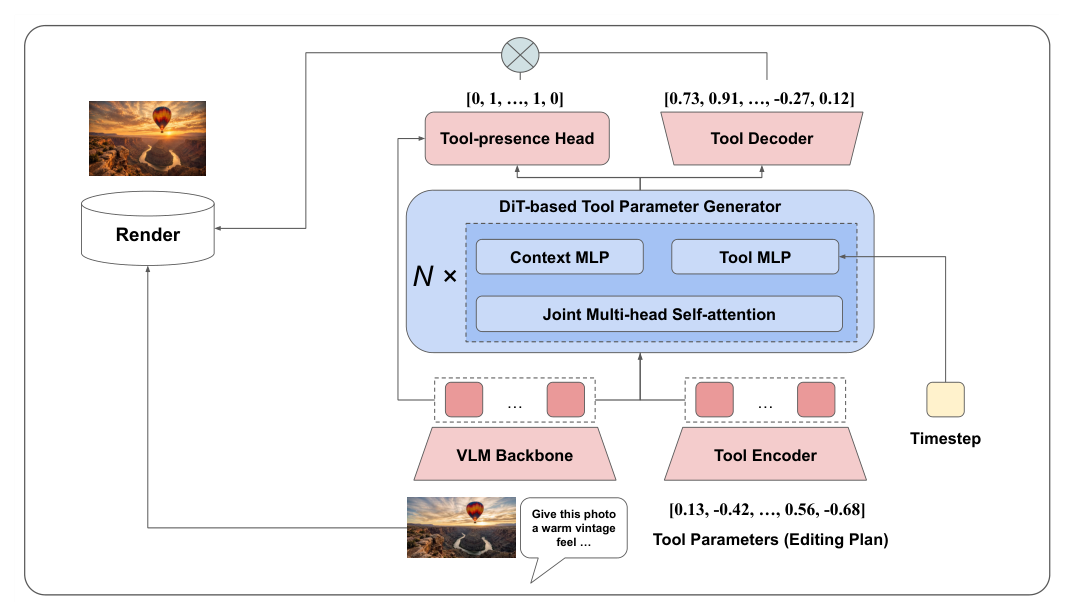
Figure 2 — FlowTool의 전체 아키텍처와 주요 구성 요소를 설명하는 핵심 다이어그램.
실험 결과, FlowTool은 MMArt-Bench, FlowTool-Eval, ArtEdit-Bench, MIT-Adobe5K 등 4가지 벤치마크에서 reference-based metrics 측면에서 기존 specialized MLLM editing agents 및 proprietary MLLMs를 상당히 능가하는 성능을 보였습니다. 특히, FlowTool-RL은 specialized baseline 대비 L1 지표에서 최대 28.8%, L2 지표에서 최대 47.4%까지 감소시켰으며, frontier proprietary models 대비 L1과 L2를 각각 최대 13.0% 및 21.7% 감소시켰습니다 [Table 1]. 또한, FlowTool은 추론 latency를 50배 이상 단축하고, 필요한 peak GPU memory는 비교 대상 baseline 대비 약 2배 적게 요구하여, 효율성 면에서도 탁월함을 입증했습니다 [Figure 4].
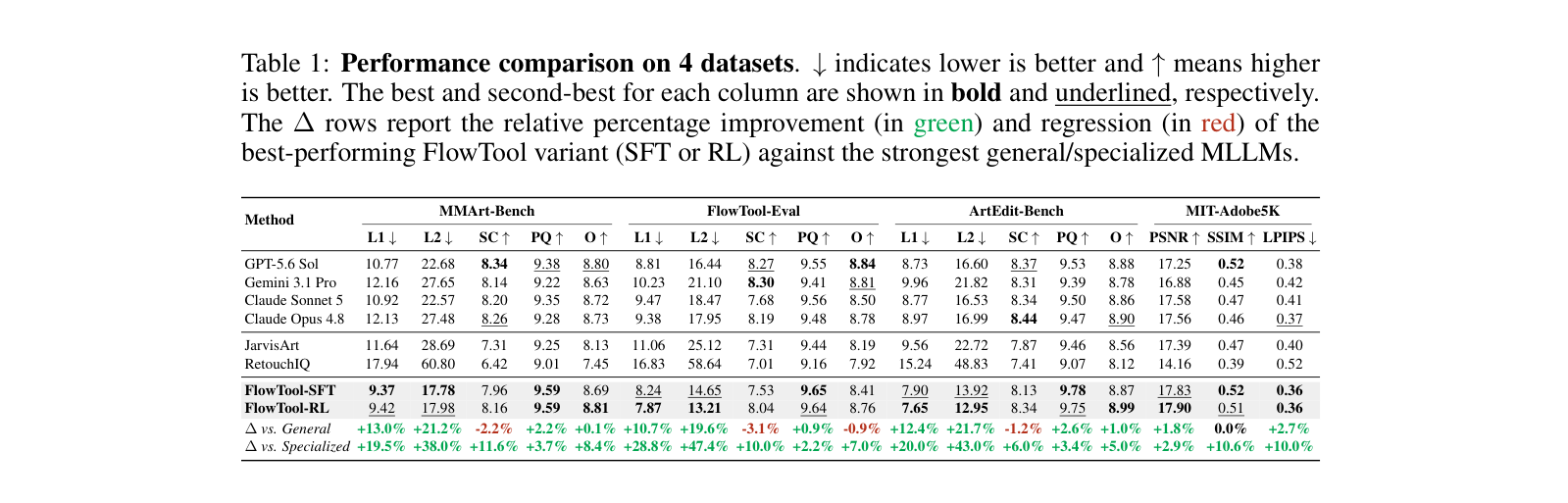
Table 1 — 4가지 주요 벤치마크에서 FlowTool과 다양한 MLLM baseline들의 정량적 성능을 비교한 핵심 결과 테이블.
4. Conclusion & Impact
FlowTool은 autoregressive reasoning을 direct structured tool-parameter generation으로 대체함으로써, tool-based image editing을 위한 새롭고 효율적인 접근 방식을 성공적으로 제시합니다. 이 연구는 IR 태스크의 continuous하고 precision-sensitive하며 multimodal한 본질에 더 적합한 conditional generative modeling 프레임워크가 MLLM 기반 autoregressive 방식보다 우수함을 입증합니다. FlowTool은 editing quality를 유지하면서도 inference latency를 50배 이상, memory를 2배 가까이 절감하여, interactive environments 및 resource-constrained devices에서 high-quality tool-based image editing을 실용화했습니다. 이는 tool-based image editing 분야에서 autoregressive reasoning 없이 structured continuous editing parameters를 직접적으로 생성하는 것이 매우 효과적인 대안임을 보여주는 중요한 시사점을 제공합니다.
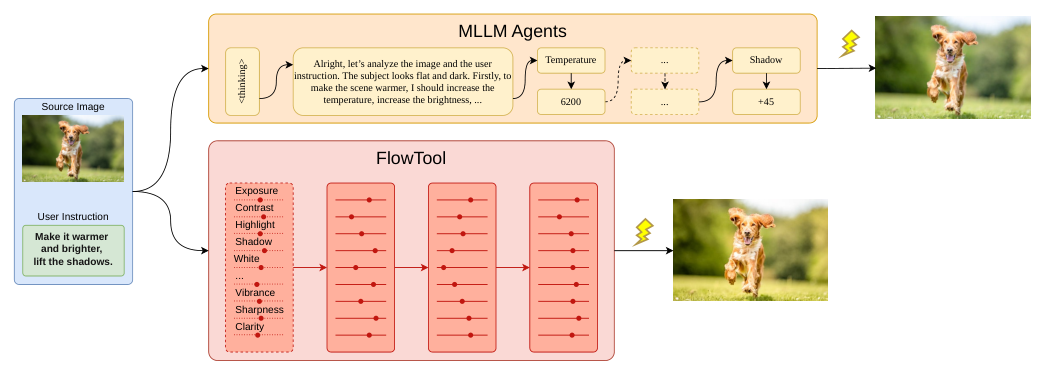
Figure 1 — 기존 MLLM 기반 방식과 제안된 FlowTool의 근본적인 차이를 개념적으로 보여주는 핵심 다이어그램.
⚠️ 알림: 이 리뷰는 AI로 작성되었습니다.
관련 포스트
- [논문리뷰] LLMs4All: A Review on Large Language Models for Research and Applications in Academic Disciplines
- [논문리뷰] YuE2: Unifying Symbolic and Audio Music Generation at Frontier Quality
- [논문리뷰] WorldPlay2: Extending Real-Time Interactive World Models in Control and Horizon
- [논문리뷰] WideSWE: Can Coding Agents Coordinate Changes Across Repositories?
- [논문리뷰] TraceDance: An Automated System for Building Agent Behavior Benchmarks from Real-World Agent Deployment Traces
Review 의 다른글
- 이전글 [논문리뷰] Fewer Tokens, More Self-Teaching: On-Policy Self-Distillation for Extreme Visual Token Reduction
- 현재글 : [논문리뷰] FlowTool: Controlling Tool Parameter in Image Retouching via Flow Matching
- 다음글 [논문리뷰] GeoVerse: World-Consistent Novel View Synthesis in Geometric Latent Space
댓글