[논문리뷰] MC-Sparse: Deconstructing and Closing the Dense-Sparse Attention Gap in Diffusion Transformers
링크: 논문 PDF로 바로 열기
I have browsed the paper. Now I will proceed with summarizing it according to the specified format and constraints. I need to identify the key terms, motivation, methodology, results, and conclusion, and then select up to 3 important figures with their URLs and Korean captions.
Authors: Jiarui Chen, Zeqiang Lai, Jiangshan Wang, Ziheng Ouyang, Ye Huang, Xiangyu Yue, Cewu Lu, Chunchao Guo
Keywords: Diffusion Transformers, Sparse Attention, Video Generation, 3D Asset Generation, Efficiency, Fidelity
1. Key Terms & Definitions (핵심 용어 및 정의)
본 논문은 Diffusion Transformers의 long-sequence generation tasks에서 발생하는 Attention Bottleneck 문제를 해결하기 위한 MC-Sparse 프레임워크를 제안한다.
- Sparse Attention: 전체 Query-Key 상호작용 중 일부만 계산하여 Attention 연산의 Latency를 줄이는 기법.
- Diffusion Transformers (DiTs): Transformer 아키텍처를 기반으로 하는 Diffusion 모델로, 고해상도 이미지, 비디오 및 3D Asset Generation에 사용되는 Backbone.
- Structural Binding Error: Block-sparse attention에서 KV 토큰들이 블록으로 묶여 불필요한 토큰까지 선택되거나, 같은 Query Group 내 Query들이 다른 Attention 패턴을 가짐에도 하나의 Selection을 공유하여 발생하는 품질 저하.
- Selection Error: Approximate scoring (예: mean pooling)으로 인해 Attention Scoring이 부정확하여 중요한 KV 토큰을 놓치는 오류.
- Discarded Tail Error: 선택되지 않은 토큰들도 작은 Attention Weight를 가지지만, 이들의 기여가 무시되어 Dense Attention과의 Output Gap이 발생하는 현상.
2. Motivation & Problem Statement (연구 배경 및 문제 정의)
Diffusion Transformers는 고해상도 비디오 및 3D Asset Generation에서 지배적인 Backbone으로 자리 잡았으나, 증가하는 Sequence Length로 인해 Attention 연산의 Quadratic Cost가 주요 Inference Bottleneck으로 작용한다. Sparse Attention은 이러한 문제를 해결하기 위한 자연스러운 접근 방식이지만, 높은 Sparsity Level에서는 Generation Quality와 Fidelity가 저하되는 문제가 발생하여 Dense Attention과의 성능 격차가 지속된다.
기존 Block-sparse attention (BSA) 방식은 Block Granularity로 Sparsity를 부여하며, GPU Tile Alignment에 효율적이다. 그러나 이는 근사적인 Scoring (예: Mean Pooling)과 Coarse Block Layout으로 인해 Structural Binding Error와 Selection Error를 유발한다. 또한, 생략된 토큰들이 여전히 Nonzero Attention Mass를 가지므로 Discarded Tail Error가 발생한다. 본 연구는 Oracle Comparison을 통해 이러한 세 가지 주요 오류를 정량적으로 분석하고 [Figure 2], 이들이 Dense Attention과의 Quality Gap에 미치는 영향을 규명하며, 이를 해결할 새로운 Sparse Attention Framework의 필요성을 제기한다.
3. Method & Key Results (제안 방법론 및 핵심 결과)
저자들은 기존 Sparse Attention의 품질 저하 원인인 Structural Binding Error, Selection Error, Discarded Tail Error를 완화하기 위해 Meta-Cached Sparse Attention (MC-Sparse)이라는 Training-Free Framework를 제안한다. MC-Sparse는 Token-level KV Selection, Tile-aligned Query Grouping, 그리고 Cross-step Reuse를 결합한다.
Structural Binding Error 완화를 위해 MC-Sparse는 Query Group별로 Block Boundaries를 넘어선 Individual KV Token을 선택하고, 유사한 Query들을 Equal-size Tile-aligned Group으로 묶는다. 이를 위해 Fast Principal Direction Divisive Partitioning (PDDP) 기법을 사용하여 그룹 내 유사성을 최대화하고 Tile Alignment를 유지한다. Selection Error 완화를 위해 MC-Sparse는 매 Step마다 Costly한 Exact Attention Score를 재계산하는 대신, Attention Pattern의 Temporal Stability를 활용하여 Anchor Step에서 계산된 Exact KV Selections를 Reuse Step에 걸쳐 재사용한다. Figure 4에서 볼 수 있듯이, 이전 Step의 Exact Selection 재사용이 매 Step Mean-pooled Selection을 재계산하는 것보다 높은 Fidelity를 보인다. Discarded Tail Error 완화를 위해 Dense-Sparse Output Residual의 Temporal Stability를 활용한다. Anchor Step에서 Dense Attention Output과 Sparse Attention Output의 Residual (𝐑τ=𝐎τfull−𝐎τsparse)을 계산하고, 이를 Subsequent Reuse Step에서 Additive Correction으로 사용하여 Discarded Contributions를 보상한다. Figure 5는 Dense-Sparse Residual이 Attention Output 자체보다 Step 간 변화가 적음을 보여준다.
실험 결과, MC-Sparse는 여러 Diffusion Transformer 모델에서 Dense Attention Output에 대한 더 높은 Fidelity와 더 큰 Denoising Speedup을 달성한다. Minimax-H3-Base 모델에서 15% Attention Density로 1.80× Denoising Speedup을 달성하며 27.30 dB의 PSNR을 기록하여 경쟁 Sparse 방법들보다 높은 Fidelity를 유지한다 [cite: 1, Table 1]. HY3D-Internal 모델에서는 동일 Density에서 2.32× Denoising Speedup를 달성하고, Chamfer Distance (CD)를 PISA의 0.976에서 0.177로 크게 감소시켜 가장 우수한 Geometric Fidelity를 보인다 [cite: 1, Table 2]. 또한, Ablation Study를 통해 Exact KV Selection, Token Granularity, Query Grouping, Residual Compensation 각 요소가 Cumulative하게 PSNR, SSIM, LPIPS 지표를 개선함을 입증했다 [Table 3].
4. Conclusion & Impact (결론 및 시사점)
본 논문은 Diffusion Transformers의 효율적인 Long-Sequence Generation을 위한 Training-Free Sparse Attention Framework인 MC-Sparse를 성공적으로 제안하였다. Oracle Comparison을 통해 Sparse Attention의 품질 저하가 Structural Binding Error, Selection Error, Discarded Tail Error라는 세 가지 핵심 원인에 기인함을 명확히 규명하였다. MC-Sparse는 Token-level KV Selection, Tile-aligned Query Grouping, Temporal Reuse of Exact Selections, 그리고 Dense-Sparse Residual Compensation을 결합하여 Approximation Quality와 Execution Efficiency 간의 효과적인 균형을 이룬다.
이 연구는 비디오 및 3D Asset Generation과 같은 Long-Sequence Task에서 Diffusion Transformers의 Inference Latency를 크게 줄이면서도 High-Fidelity Output을 유지할 수 있는 실용적인 해결책을 제시한다. 특히, 기존 Sparse Attention 방법론들이 높은 Sparsity에서 겪던 Quality Degradation 문제를 효과적으로 해소함으로써, Diffusion Model의 확장성과 실제 적용 가능성을 높이는 데 중요한 시사점을 제공한다. 이는 학계에서는 Sparse Attention 연구의 새로운 방향을 제시하고, 산업계에서는 고품질 콘텐츠 생성의 효율성을 극대화하는 데 기여할 것으로 기대된다.
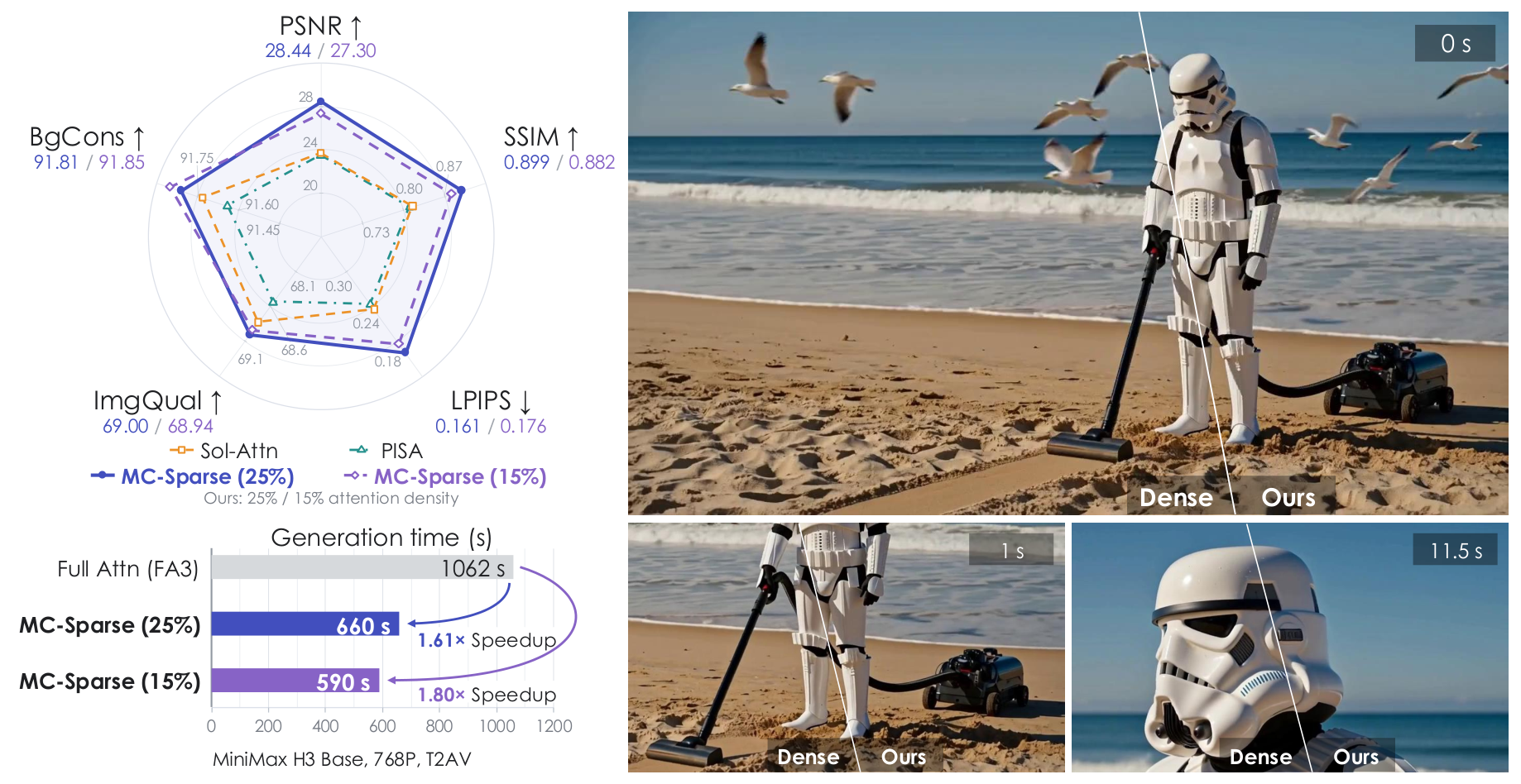
Figure 1 — MC-Sparse의 품질 및 효율성
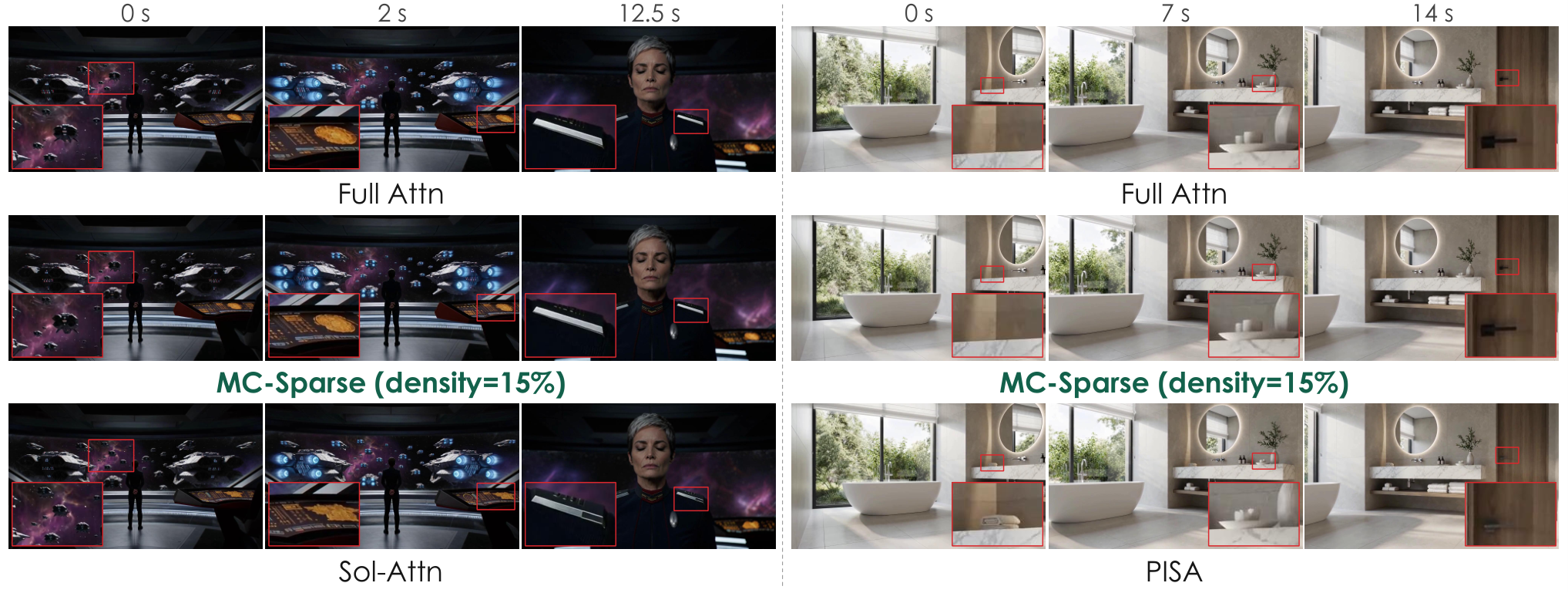
Figure 7 — 비디오 생성 정성적 비교
⚠️ 알림: 이 리뷰는 AI로 작성되었습니다.
관련 포스트
- [논문리뷰] LLMs4All: A Review on Large Language Models for Research and Applications in Academic Disciplines
- [논문리뷰] WorldCast: Exploring Intelligent Visual Generation in World State Prediction
- [논문리뷰] Waypoint-OPD: Transferring RL-Induced Policy Shifts via Gated On-Policy Distillation
- [논문리뷰] Virtual Head Attention
- [논문리뷰] VLA-Δ: Learning Physical State Transition for Vision-Language-Action Models
Review 의 다른글
- 이전글 [논문리뷰] Learn2Play Bench: How Well Do LLM Agents Learn from Experience in Unfamiliar Environments?
- 현재글 : [논문리뷰] MC-Sparse: Deconstructing and Closing the Dense-Sparse Attention Gap in Diffusion Transformers
- 다음글 [논문리뷰] Memento 3: Model-Based Recursive Self-Improvement through Reflective Rulebooks
댓글