[논문리뷰] Intern Lumina U2: A Multi-Codebook Diffusion Large Language Model for Omni-Visual Understanding and Image Generation
링크: 논문 PDF로 바로 열기
I have browsed the paper. Now I will proceed with extracting information and formatting the output.
Authors: Qian Yu, Zongyang Qiu, Juncheng Yan, Hongliang Li, Qi Qin, Keqi Wang, Siqi Luo, Junkui Ju, Yapeng Mi, Tiantian Lu, Tian Liu, Pengyu Xie, Chenhao Ji, Minghui Zhang, Yiang Zhao, Siyu Yan, Haiying Xu, Yanbo Wang, Jianghan Shen, Yuandong Pu, Jiayi Lei, Borui Zhang, Jinxin Shi, Bo Zhang, Yuhang Zang, Shenglong Ye, Lixin Gu, Hongjie Zhang, Linghan Liu, Xinyuan Chen, Yuewen Cao, Lihe Zhang, Xiaohong Liu, Junjun He, Qiangwei Liu, Qi Zhang, Yu Cheng, Tianfan Xue, Hui Xiong, Chang Xu, Yu Qiao, Yihao Liu, Bin Fu Since there are many authors, I will list the first two and then "et al.".
Keywords: I will look for terms frequently used in the abstract and introduction, focusing on academic terminology.
Potential keywords: Diffusion Language Model, Multi-Codebook, Omni-Visual Understanding, Image Generation, Image Editing, Discrete Representation, Masked Diffusion, Inference Acceleration. I will pick 5-8 of these.
Part 1: Summary
1. Key Terms & Definitions
- Diffusion Language Model (dLLM): Text와 visual token을 모두 discrete space에서 masked-prediction objective로 최적화하는 모델.
- Multi-Codebook Visual Tokens: 각 visual position을 K개의 상호보완적인 codebook에서 나온 code 그룹으로 표현하여, 단일 codebook 방식의 시각적 정보 표현 capacity 한계를 극복하는 방식.
- Omni-Visual Understanding: 이미지, 비디오, 3D 에셋 등 다양한 시각 modality에 대한 통합적인 이해를 의미하며, 단일 모델과 백본 내에서 처리된다.
- AToken: Intern Lumina U2에서 사용되는 frozen visual tokenizer로, SigLIP2 인코더를 기반으로 재구성과 이해(reconstruction and understanding)를 위해 공동 학습되어 semantic structure를 유지하면서 충실한 재구성을 지원한다.
- Plateau-Halton Sampling with V-verify (PHV): 이미지 생성 추론 시 효율성을 높이기 위한 안정성 인지 샘플링 전략으로, confidence plateau에서 토큰을 커밋하고 hidden-state drift 시 캐시를 새로고침하여 end-to-end 속도를 가속화한다.
2. Motivation & Problem Statement 본 논문은 통합 Multimodal model에서 이질적인 modality (text, image)를 효율적으로 단일 backbone 내에서 공유된 optimization space로 모델링하는 문제를 해결하고자 한다. 기존 통합 Multimodal model은 discrete, continuous, 또는 hybrid 패러다임을 사용하는데, discrete 단일 codebook 방식은 텍스트 모델링과 잘 맞지만 representational capacity가 제한적이다. 반면 continuous 및 hybrid 방식은 더 풍부한 시각적 표현을 유지하지만, 텍스트와 이미지를 이질적인 공간에서 다른 training objective로 모델링하여 modality 간 최적화 충돌을 야기할 수 있다. 이러한 한계는 고용량 시각적 표현을 텍스트 콘텐츠와 함께 단일 백본 내의 공유된 최적화 공간에서 효율적으로 모델링하는 방법에 대한 핵심 질문을 제기한다. 특히, 기존 discrete 통합 모델들은 각 시각적 위치의 정보가 단일 discrete code로 압축되어 시각적 재구성 충실도와 다양한 시각 task 커버리지 면에서 한계를 보인다.
3. Method & Key Results 저자들은 이러한 문제를 해결하기 위해 Intern Lumina U2를 제안하며, 이는 Multi-Codebook visual token을 완전한 discrete space에서 표현하는 최초의 Diffusion Language Model이다. 이 모델은 AToken을 visual tokenizer로, LLaDA2.0-mini를 backbone으로 사용하여 이미지, 비디오, 3D 에셋 입력을 통합된 4D code space로 인코딩한다. 각 시각적 위치는 K=8개의 complementary codebook으로부터 얻은 code 그룹으로 표현되며, 이는 representational capacity를 증가시키면서 discrete 텍스트 모델링과의 호환성을 유지한다. 입력에서는 code embedding이 각 위치에서 concatenate되며, 출력에서는 lightweight multi-codebook AR head가 각 위치 내의 code들을 순차적으로 예측하는 반면 diffusion backbone은 모든 위치를 병렬로 처리한다 [cite: 1, Figure 3].
주요 실험 결과로, Intern Lumina U2는 1.4B activated parameters에도 불구하고 10개의 image-understanding benchmark 중 6개에서 1위를 차지했으며 (MME-C에서 BAGEL과 공동 1위), LLaDA2.0-Uni 대비 8개 벤치마크에서 우수한 성능을 보였다 [cite: 1, Table 5]. 특히 CharXiv, HallusionBench, MathVision, DynaMath에서 가장 큰 차이로 앞섰다. Video-MME, MLVU, MVBench의 3가지 video benchmark 모두에서 최고의 점수를 기록했으며, 3D MM-Vet에서도 3D 전문 모델인 ShapeLLM 및 PointLLM을 능가하는 성능을 입증했다 [cite: 1, Table 6]. 이미지 생성 및 편집 측면에서는 DPG-Bench, UniGenBench, TIIF-Bench에서 최고의 점수를 달성하고 GenEval에서 최고 점수와 동률을 기록하며, FLUX.1 같은 생성 전용 모델을 능가하고 Qwen-Image에 근접한 성능을 보였다 [cite: 1, Table 7, Table 8, Table 9]. 또한, Plateau-Halton Sampling with V-verify (PHV) 추론 전략은 end-to-end image generation latency를 4.45배 가속화하면서도 생성 품질(GenEval)을 86.6에서 89.3으로 향상시켰다 [cite: 1, Table 4].
4. Conclusion & Impact 본 논문은 Multi-Codebook visual state를 완전한 discrete space에서 모델링하고 이미지, 비디오, 3D 에셋 전반에 걸친 omni-visual understanding을 확장한 최초의 통합 understanding-and-generation Diffusion Language Model인 Intern Lumina U2를 성공적으로 제시했다. Codebook-specific input embedding과 multi-codebook AR head의 설계가 next-code top-1 accuracy 및 generation quality 향상에 기여했음을 ablation study를 통해 확인했다. 이 연구는 fully discrete diffusion language modeling이 광범위한 시각 이해와 고품질 생성을 단일 프레임워크 내에서 통합할 수 있는 잠재력을 입증했다. 특히, Ascend NPU 플랫폼에서의 성공적인 full-stack 훈련 및 평가 시스템 구축은 cross-platform 호환성을 검증하고, 효율적인 추론 전략은 실제 적용 가능성을 높인다. 향후 연구에서는 비디오 및 3D 생성으로 확장을 계획하고 있다.
Part 2: Important Figure Information I need to find up to 3 important figures.
- Figure 3: Overall architecture. This is very important.
- Figure 4: Input interface comparison. This is a method detail, but quite important to the unique approach.
- Figure 5: Multi-codebook AR head. This is also a core method component.
Let's pick Figure 3 (architecture), Figure 4 (input interface), and Figure 5 (AR head). I'll verify the image URLs.
- Figure 1:
2610.20818v1/figures/teaser.png(Teaser, not chosen as it's less architectural) - Figure 2:
2610.20818v1/figures/effect_gallery.jpg(Effect gallery, not chosen as it's qualitative examples) - Figure 3:
2610.20818v1/main.png(Overall architecture - selected) - Figure 4:
2610.20818v1/input.png(Input interface - selected) - Figure 5:
2610.20818v1/ar_head.png(AR head - selected) - Figure 6:
2610.20818v1/fig6.png(Task-aware attention mask - important but 3 figures limit. Will prioritize architecture components) - Figure 7:
2610.20818v1/data_flow.png(Data construction pipeline - not as core as model architecture) - Figure 8:
2610.20818v1/fig6.png(Confidence calibration - same as Fig 6, and not architecture) - Figure 9:
2610.20818v1/fig7.png(Temporal stability of PHV - good for results, but sticking to core architecture) - Figure 10:
2610.20818v1/fig8.png(Input-interface ablation - results of method, Fig 4 shows the method) - Figure 11:
2610.20818v1/figures/accel_param_main_d18f05.png(Inference-sampling ablation - results of method) - Figure 12:
2610.20818v1/figures/under_gen.png(Qualitative examples) - Figure 13:
2610.20818v1/figures/edit.png(Qualitative examples)
Okay, the selected figures are 3, 4, and 5. I will create the full URLs and short Korean captions.
Figure 3: https://arxiv.org/html/2610.20818v1/main.png, "모델 전체 아키텍처"
Figure 4: https://arxiv.org/html/2610.20818v1/input.png, "Multi-codebook 입력 인터페이스"
Figure 5: https://arxiv.org/html/2610.20818v1/ar_head.png, "Multi-codebook AR 헤드"
저자: Qian Yu, Zongyang Qiu, et al.
1. Key Terms & Definitions (핵심 용어 및 정의)
- Diffusion Language Model (dLLM): 텍스트와 visual token을 모두 discrete space에서 masked-prediction objective로 최적화하여 multimodal 이해 및 생성을 수행하는 모델입니다.
- Multi-Codebook Visual Tokens: 각 visual position을 K개의 상호보완적인 codebook에서 나온 code 그룹으로 표현하여, 단일 codebook 방식의 시각적 정보 표현 capacity 한계를 극복하고 풍부한 시각적 detail을 보존하는 방법론입니다.
- Omni-Visual Understanding: 이미지, 비디오, 3D 에셋 등 다양한 시각 modality에 대한 통합적인 이해 능력을 의미하며, 단일 모델과 백본 내에서 처리되는 포괄적인 시각 인식 패러다임입니다.
- AToken: Intern Lumina U2에서 사용되는 frozen visual tokenizer로, SigLIP2 인코더를 기반으로 재구성과 이해(reconstruction and understanding)를 위해 공동 학습되어 semantic structure를 유지하면서 충실한 재구성을 지원합니다.
- Plateau-Halton Sampling with V-verify (PHV): 이미지 생성 추론 시 효율성을 높이기 위한 안정성 인지 샘플링 전략으로, confidence plateau에서 토큰을 커밋하고 hidden-state drift 시 캐시를 새로고침하여 end-to-end 속도를 가속화합니다.
2. Motivation & Problem Statement (연구 배경 및 문제 정의)
본 논문은 통합 Multimodal model에서 텍스트와 시각 정보를 효율적으로 단일 backbone 내의 공유된 optimization space로 모델링하는 문제를 해결하고자 한다. 기존 통합 Multimodal model은 discrete, continuous, 또는 hybrid 패러다임을 사용하지만, discrete 단일 codebook 방식은 텍스트 모델링과 잘 맞음에도 불구하고 representational capacity가 제한적이라는 한계가 있다. 반대로 continuous 및 hybrid 접근법은 더 풍부한 시각적 표현을 유지할 수 있지만, 텍스트와 이미지를 이질적인 공간에서 서로 다른 training objective로 모델링하여 modality 간 최적화 충돌을 야기할 수 있다. 이러한 기존 연구의 한계점은 고용량 시각적 표현을 텍스트 콘텐츠와 함께 단일 백본 내의 공유된 최적화 공간에서 효율적으로 모델링하는 방법에 대한 핵심 연구 질문을 제기한다. 특히, 이전 discrete 통합 모델들은 각 시각적 위치의 정보가 단일 discrete code로 압축되어 시각적 재구성 충실도와 다양한 시각 task 커버리지 면에서 부족함을 보였다.
3. Method & Key Results (제안 방법론 및 핵심 결과)
저자들은 이러한 문제를 해결하기 위해 Multi-Codebook visual state를 완전한 discrete space에서 모델링하는 최초의 Diffusion Language Model인 Intern Lumina U2를 제안한다. 이 모델은 AToken을 frozen visual tokenizer로, LLaDA2.0-mini를 backbone으로 활용하여 이미지, 비디오, 3D 에셋 입력을 통합된 4D code space로 인코딩한다. 각 시각적 위치는 K=8개의 complementary codebook에서 얻은 code 그룹으로 표현되어, representational capacity를 증가시키면서 discrete 텍스트 모델링과의 호환성을 유지한다. 입력 인터페이스에서는 각 codebook이 독립적인 embedding table을 가지며, 이 embedding들은 각 시각적 위치에서 concatenate된 후 단일 backbone token으로 projection된다 [cite: 1, Figure 4]. 출력 인터페이스에서는 lightweight multi-codebook AR head가 각 시각적 위치 내의 K개 code를 순차적으로 예측하고, diffusion backbone은 모든 spatial position을 병렬로 처리한다 [cite: 1, Figure 3, Figure 5].
주요 실험 결과로, Intern Lumina U2는 1.4B activated parameters에도 불구하고 10개의 image-understanding benchmark 중 6개에서 1위를 차지했으며 (MME-C에서 BAGEL과 공동 1위), 동일한 언어 backbone을 사용하는 LLaDA2.0-Uni 대비 8개 벤치마크에서 우수한 성능을 보였다 [cite: 1, Table 5]. 이는 multi-codebook visual token의 강화된 representational capacity와 일치하는 결과이다. 특히, CharXiv에서 85.9점, HallusionBench에서 64.6점, MathVision에서 36.5점, DynaMath에서 63.6점을 기록하며 가장 큰 우위를 점했다 [cite: 1, Table 5]. Video-MME, MLVU, MVBench의 3가지 video benchmark 모두에서 최고의 점수를 기록했으며, 3D MM-Vet에서도 3D 전문 모델인 ShapeLLM 및 PointLLM을 능가하는 성능을 입증했다 [cite: 1, Table 6]. 이미지 생성 및 편집 측면에서는 DPG-Bench, UniGenBench, TIIF-Bench에서 최고의 점수를 달성하고 GenEval에서 최고 점수와 동률을 기록하며, FLUX.1 같은 생성 전용 모델을 능가하고 Qwen-Image에 근접한 성능을 보였다 [cite: 1, Table 7, Table 8, Table 9]. 또한, Plateau-Halton Sampling with V-verify (PHV) 추론 전략은 end-to-end image generation latency를 4.45배 가속화하면서도 생성 품질(GenEval)을 86.6에서 89.3으로 향상시키는 효과를 보였다 [cite: 1, Table 4].
4. Conclusion & Impact (결론 및 시사점)
본 논문은 Multi-Codebook visual state를 완전한 discrete space에서 모델링하고 이미지, 비디오, 3D 에셋 전반에 걸친 omni-visual understanding을 확장한 최초의 통합 understanding-and-generation Diffusion Language Model인 Intern Lumina U2를 성공적으로 제시했다. Codebook-specific input embedding과 multi-codebook AR head의 설계가 next-code top-1 accuracy 및 generation quality 향상에 기여했음을 ablation study를 통해 확인했다. 이 연구는 fully discrete diffusion language modeling이 광범위한 시각 이해와 고품질 생성을 단일 프레임워크 내에서 통합할 수 있는 잠재력을 입증했다. 특히, 1,024대 Huawei Ascend 910B NPU 플랫폼에서의 성공적인 full-stack 훈련 및 평가 시스템 구축은 cross-platform 호환성을 검증하고, 4.45배 가속된 효율적인 추론 전략은 실제 적용 가능성을 크게 높인다. 향후 연구에서는 비디오 및 3D 생성으로의 확장, 더욱 긴밀하게 연동된 multimodal generation, 그리고 reinforcement learning을 활용한 post-training 탐색을 계획하고 있다.
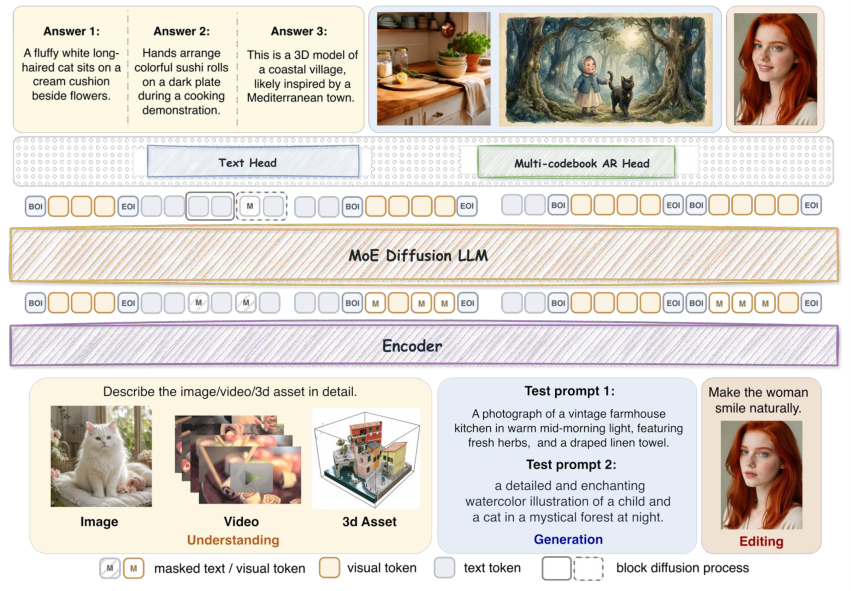
Figure 3 — 모델 전체 아키텍처
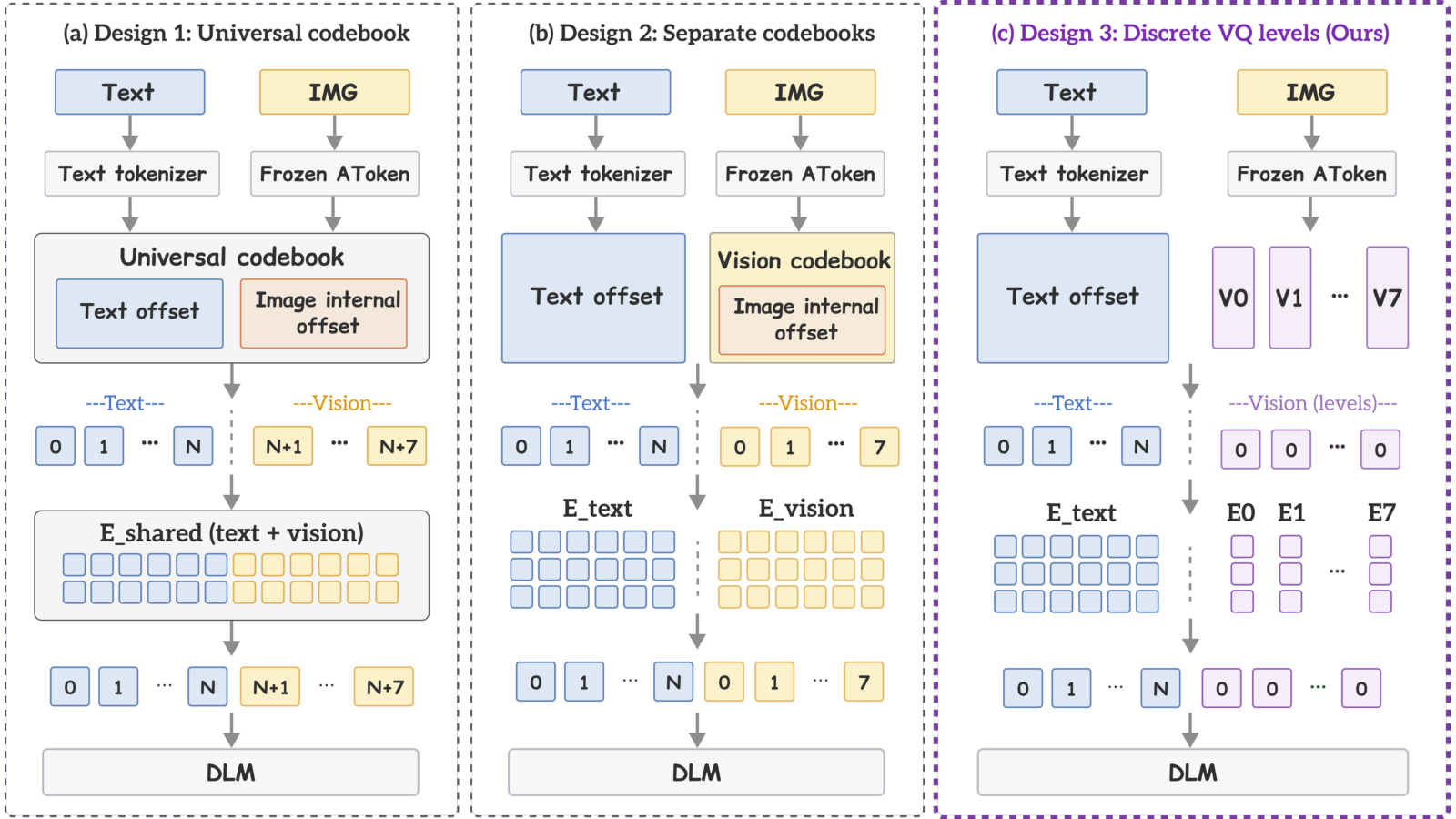
Figure 4 — Multi-codebook 입력 인터페이스
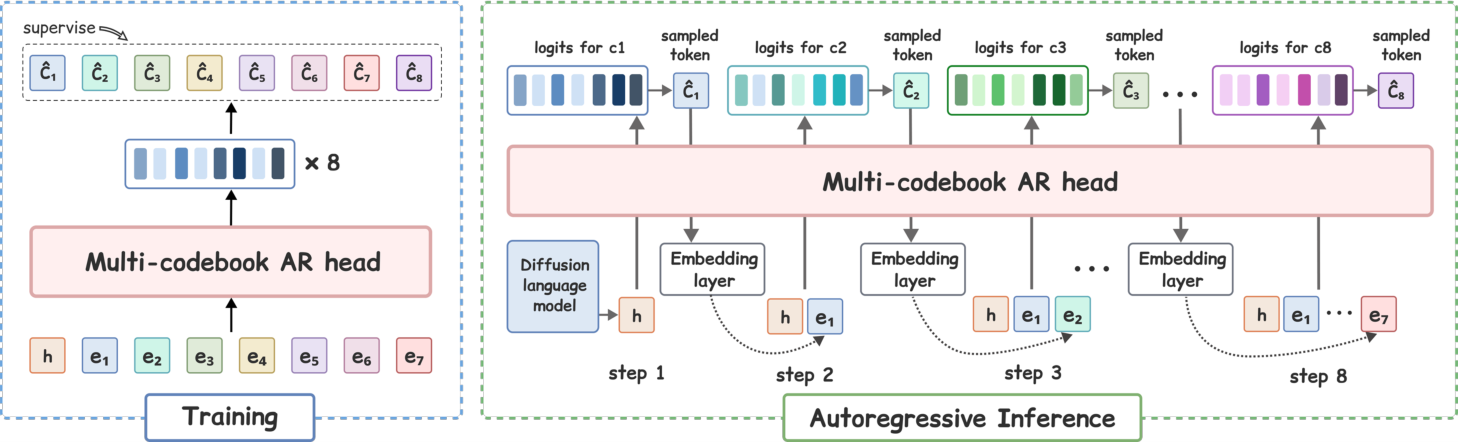
Figure 5 — Multi-codebook AR 헤드
⚠️ 알림: 이 리뷰는 AI로 작성되었습니다.
관련 포스트
- [논문리뷰] LLaDA-Image: Building Strong Image Generators with Fully Open Training Recipes
- [논문리뷰] UniSpace: Unified Visual Representation and Scalable Multimodal Modeling
- [논문리뷰] Mage-Flow: An Efficient Native-Resolution Foundation Model for Image Generation and Editing
- [논문리뷰] ImagenWorld: Stress-Testing Image Generation Models with Explainable Human Evaluation on Open-ended Real-World Tasks
- [논문리뷰] DreamLite: A Lightweight On-Device Unified Model for Image Generation and Editing
Review 의 다른글
- 이전글 [논문리뷰] Intern-Decision: Efficient Multimodal Decision Making with Autoregressive Masked Language Modeling
- 현재글 : [논문리뷰] Intern Lumina U2: A Multi-Codebook Diffusion Large Language Model for Omni-Visual Understanding and Image Generation
- 다음글 [논문리뷰] Learning Where to Split: Dynamic Band Splitting for Audio Source Separation
댓글