[논문리뷰] OpenMobile-2: Building Versatile Mobile Agents with Scalable Environments and App-Native Tools
링크: 논문 PDF로 바로 열기
저자: Chenyang Yan, Yingying Zhang, et al.
1. Key Terms & Definitions (핵심 용어 및 정의)
본 논문에서 다루는 핵심 용어 및 개념은 다음과 같습니다:
- OpenMobile-2: fully open training environments와 recipe를 갖춘 near-frontier mobile agent입니다. scalable environment, open training data, hybrid GUI 및 app-native tool use의 세 가지 주요 발전을 제시합니다.
- MobileGym++: 35개의 사실적이고 기능이 풍부한 상업용 스타일 앱과 cross-app workflows를 특징으로 하는 large-scale mobile environment입니다. reset 및 verification을 위한 complete controllability를 유지합니다.
- App-native tools: 앱이 GUI와 함께 선택된 기능을 노출하여 agent가 task 내에서 GUI actions와 tool calls를 interleave할 수 있도록 하는 실험적인 mobile-use setting입니다.
- MobileGym++ Bench: complex하고 long-horizon 상업용 mobile scenarios를 위한 benchmark suite입니다. GUI-only 및 hybrid GUI–tool evaluation을 동일한 task suite에서 지원합니다.
- OpenMobile-Data-v2: supervised fine-tuning을 위한 약 12K개의 mobile interaction trajectories와 mobile agents를 위한 2K개 이상의 executable tasks로 구성된 verifiable RL training data 컬렉션입니다.
2. Motivation & Problem Statement (연구 배경 및 문제 정의)
본 논문은 mobile agents의 성능 향상에 필수적인 large-scale interaction experience를 구축하는 데 있어 기존 연구의 한계점을 해결하고자 합니다. 기존 vision-language models 기반의 mobile agents는 smartphone interface를 이해하고 일상적인 task를 자동화하는 능력이 증가하고 있으나, 이러한 발전은 다양한 task, application, environment에서 수집된 trajectory 형태의 대규모 interaction 경험에 크게 의존합니다. 하지만 고품질의 interaction data는 대부분 proprietary로 남아 있어, open community는 제한된 training resources와 후발 주자인 open models 문제에 직면해 있습니다.
기존 open source 환경들은 주로 Android emulators 내의 소규모 open-source apps 및 system utilities에 의존합니다. 이러한 환경들은 사실적인 interaction을 제공하지만, third-party apps의 경우 신뢰할 수 있는 reset 기능이 부족하고, full Android stack을 대규모 rollout 및 reinforcement learning에 replication하는 데 비용이 많이 듭니다. 최근 simulated environments는 효율적인 reset 및 parallelization을 제공하지만, application 수가 적고 depth가 얕으며, 확장 가능한 recipe가 없습니다. 따라서 상업용 애플리케이션의 풍부한 workflow와 persistent user states를 대규모로 재현하고, GUI-only interaction의 비효율성을 보완할 수 있는 새로운 접근 방식이 필요합니다.
3. Method & Key Results (제안 방법론 및 핵심 결과)
본 연구는 versatile mobile agents를 구축하기 위해 Scalable Environments와 App-Native Tools를 갖춘 OpenMobile-2를 제안합니다. 저자들은 MobileGym (Wu et al., 2026a)의 simulation framework를 기반으로 **MobileGym++**를 구축하여, reset 및 programmatic verification의 이점을 유지하면서 상업용 애플리케이션의 domain coverage, 풍부함, 그리고 native cross-app interaction 지원을 대폭 확장했습니다. 특히, 35개의 새로운 high-fidelity 상업용 애플리케이션을 re-implement하여 총 110개 이상의 앱을 아우르는 diverse playground를 조성했습니다. 또한, OpenMobile-Data-v2를 통해 supervised fine-tuning을 위한 약 12K개의 mobile interaction trajectories와 reinforcement learning을 위한 2K개 이상의 executable tasks를 curated하여 공개했습니다.
또한, 본 논문은 GUI interaction과 app-native tool use를 결합한 hybrid mobile-use setting을 탐구합니다. MobileGym++에서 50개 이상의 앱에 걸쳐 300개 이상의 app-native tools를 노출시켜, agent가 task 내에서 GUI actions와 tool calls를 interleave할 수 있도록 훈련시킵니다. 이를 위해 상업용 mobile workflow 및 hybrid GUI–tool interaction을 위한 새로운 벤치마크인 MobileGym++ Bench를 도입했으며, 이는 215개의 long-horizon cross-app tasks를 포함합니다. 모든 task는 tools 유무와 관계없이 해결 가능하여, GUI-only agent와 hybrid agent를 동일한 task suite에서 비교할 수 있도록 합니다.
주요 실험 결과는 다음과 같습니다:
- OpenMobile-2는 기존 mobile agent 벤치마크에서 강력한 성능을 보여, AndroidWorld에서 79.9%, MobileWorld에서 50.4%의 성공률을 달성했습니다 [cite: 1, Figure 1].
- Real-device mobile use에 대한 transferability도 입증되어, SPA-Bench 성능을 31.9%에서 59.6%로 거의 두 배 향상시켰습니다.
- MobileGym++ Bench에서 hybrid SFT는 GUI-only SFT 대비 hybrid evaluation에서 두 모델 스케일 모두에서 성능 향상을 가져왔습니다 (예: 27B 모델 57.7%에서 65.6%로 증가) [cite: 1, Table 2]. 이는 app-native tools가 mobile agent interaction을 위한 유용한 complementary action channel임을 보여줍니다.
- Hybrid training은 학습된 tools를 넘어 일반화 가능한 tool-use behavior를 가능하게 합니다. training 중에 본 적 없는 tools를 사용하는 MobileWorld MCP 벤치마크에서 hybrid SFT는 GUI-only SFT보다 높은 성능을 달성했습니다 (예: 27B 모델 35.0%에서 45.0%로 증가) [cite: 1, Table 2].
- Fixed data budget 내에서 broader environment coverage는 unseen applications에 대한 transferability를 향상시켰습니다 (AndroidWorld에서 Pass@1이 60.7%에서 67.5%로 증가) [cite: 1, Figure 5]. 또한, hybrid training 이후 app-native tool use는 task success를 향상시키고 interaction efficiency를 개선하여, trajectories가 4.8단계 (9B 모델) 및 5.8단계 (27B 모델) 더 짧아졌습니다 [cite: 1, Figure 5].
4. Conclusion & Impact (결론 및 시사점)
본 논문은 diverse environments, open training data, 그리고 trained agent models를 포괄하는 mobile agents를 위한 개방형 training stack인 OpenMobile-2를 제시했습니다. **MobileGym++**와 새로 구성된 emulator apps는 reset 및 verification이 가능한 high-fidelity 상업용 스타일 앱을 포함하여 110개 이상의 애플리케이션을 아우르는 diverse playground를 구축했습니다. 또한, 거의 12K개의 demonstration trajectories와 2K개 이상의 executable RL tasks를 자동 reward와 함께 공개했습니다.
이 stack에서 훈련된 models는 기존 mobile agent benchmarks에서 강력한 성능을 입증했으며, real-device evaluation으로의 효과적인 transfer를 보여주었습니다. 연구는 app-native tools가 mobile agents를 위한 complementary action interface로서의 잠재력을 탐구했으며, tool access만으로는 제한적인 이득을 제공하지만 hybrid training과 결합될 때 그 이점이 크게 증폭된다는 것을 발견했습니다. OpenMobile-2는 environment, data, benchmarks, 그리고 trained models를 open-source로 공개하여 mobile agents 분야의 추가적인 open research를 지원하는 데 크게 기여할 것입니다.
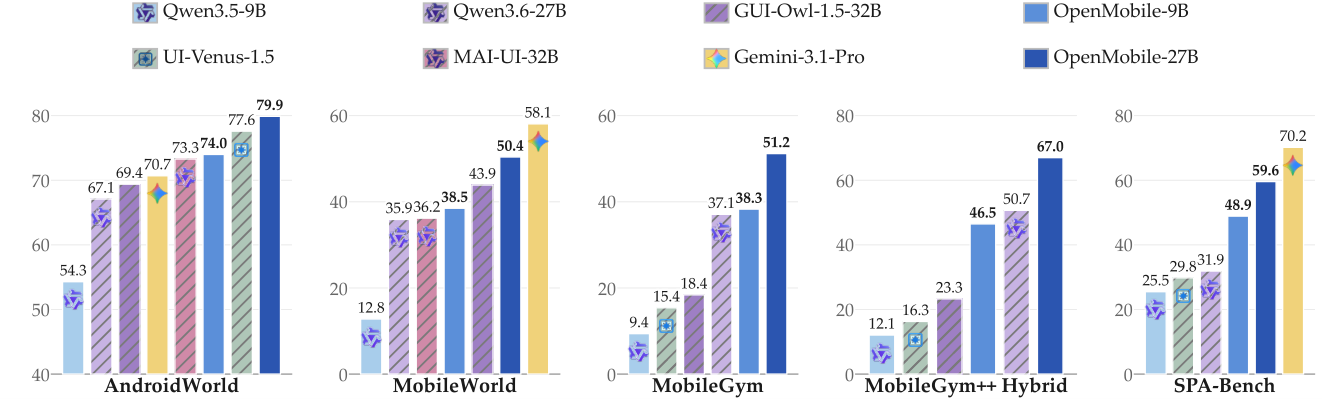
Figure 1 — 벤치마크 성능 비교
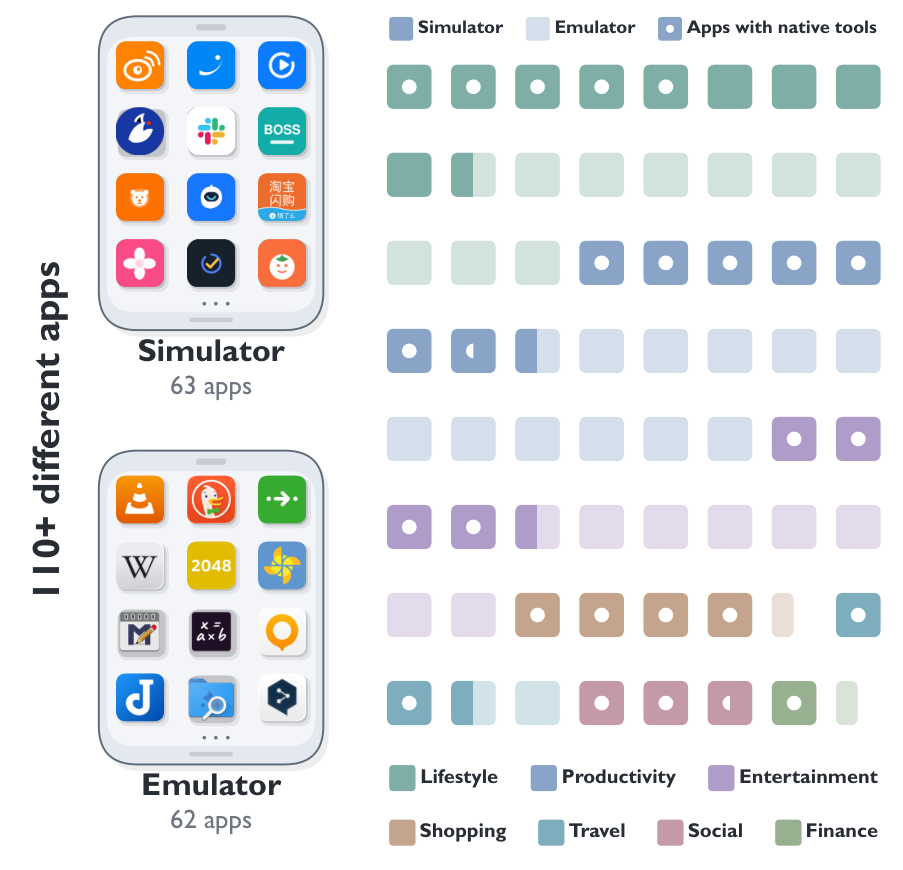
Figure 2 — 애플리케이션 커버리지
⚠️ 알림: 이 리뷰는 AI로 작성되었습니다.
관련 포스트
- [논문리뷰] CompoWorld: Compositional Environment Scaling for General Agents
- [논문리뷰] RoboAlign: Learning Test-Time Reasoning for Language-Action Alignment in Vision-Language-Action Models
- [논문리뷰] X-Coder: Advancing Competitive Programming with Fully Synthetic Tasks, Solutions, and Tests
- [논문리뷰] Monet: Reasoning in Latent Visual Space Beyond Images and Language
- [논문리뷰] Thinking-while-Generating: Interleaving Textual Reasoning throughout Visual Generation
Review 의 다른글
- 이전글 [논문리뷰] OmniXRef: A Unified Framework for Multimodal Multi-Reference Video Editing
- 현재글 : [논문리뷰] OpenMobile-2: Building Versatile Mobile Agents with Scalable Environments and App-Native Tools
- 다음글 [논문리뷰] PRISM: PRIvileged Sibling-guided Multi-Agent Topology Design
댓글