[논문리뷰] Can Test-Time Memory Evolution Outperform Test-Time Training for Scientific Discovery?
링크: 논문 PDF로 바로 열기
The paper compares Test-Time Memory Evolution (TTME) with Test-Time Training (TTT) for scientific discovery tasks. I need to extract:
- Authors: Yepeng Liu, Shengmai Chen, Xuandong Zhao, Chengzhi Liu, Dawn Song, Xin Eric Wang, Yuheng Bu
- Keywords: I'll infer them from the abstract and introduction. Likely candidates:
Test-Time Memory Evolution,Test-Time Training,Scientific Discovery,Large Language Models,Memory Adaptation,Computational Efficiency. - Key Terms & Definitions: TTME, TTT, Guideline Memory, Strategy Memory, Scientific Discovery.
- Motivation & Problem Statement: TTT is effective but computationally expensive. Need for a more efficient test-time adaptation method without online weight updates.
- Method & Key Results: TTME's two memory modules (Guideline Memory and Strategy Memory), how they are updated and used for generation. Quantitative results showing TTME outperforms TTT in score and reduces computational cost (runtime, FLOPs).
- Conclusion & Impact: Summary of findings and significance for scientific discovery.
- Important Figures: I will look for figures that depict the overall architecture, comparison results (tables/graphs), or key methodology.
Figure Selection Plan:
-
Figure 2: Weight adaptation vs. Memory adaptation. This figure clearly illustrates the core methodological difference between TTT and TTME. It's an architecture/framework diagram.
image_url:https://arxiv.org/html/2610.32046v1/overview.pngcaption_kr: "Weight adaptation과 Memory adaptation 비교"
-
Figure 1: Best-found scores versus computational cost. This figure directly compares TTME and TTT performance on key metrics (score and cost), which is a core result.
image_url: (Need to check if it's available or part of another figure in the html) - Looking at the HTML, Figure 1 is a separate image from the main body. It describes best-found scores vs computational cost. I need to find its image source. Ah, I see Figure 1 is mentioned in the abstract but the figure content is before the Abstract section. I'll need to scroll up to find the image tag for Figure 1. I couldn't find a direct<img>tag for Figure 1 in the initial browse output. Let me re-check the beginning of thebrowseoutput carefully to see if I missed it, or if it's generated differently in the HTML. Okay, I see:Figure 1: Best-found scores versus computational cost under the TTT-Discover framework [[36](#bib.bib1)] with Qwen3-8B. The three settings use the same discovery framework, with TTT, with TTME replacing TTT, or with neither method. *TTME* achieves the best scores at low computational cost across all three tasks.There is no<img>tag right after it. This might mean it's an inline image or generated dynamically, or it's not explicitly labeled asFigure 1in the HTMLsrc. I will prioritize Figure 2 and Figure 3 as they have clear image tags.
Let's re-evaluate. Figure 1 seems to be an important result figure as mentioned in the abstract. However, I need to strictly follow the rule: "논문 HTML 페이지에서 해당 Figure/Table의
<img>태그src속성에서 이미지 경로를 찾으세요." If I can't find the<img>tag and itssrcfor Figure 1, I cannot include it.I will instead look for another strong candidate.
- Figure 3: Best-found scores during search under TTT-Discover and ThetaEvolve frameworks. This shows the performance over time, which is a key result demonstrating TTME's sustained improvement. It has a clear image tag.
image_url:2610.32046v1/progress.png->https://arxiv.org/html/2610.32046v1/progress.pngcaption_kr: "검색 과정에서의 최고 성능"
- Table 1/Table 2: These are important quantitative results. However, the instruction states: "Table은 이미지가 아닌 HTML 테이블인 경우가 많습니다. 이미지
<img>태그가 있는 Figure만 선별하세요." So, I cannot select tables unless they are rendered as images. I will focus on Figures with explicit<img>tags. - Figure 4: Implementation validity rate and final performance. This figure compares validity and best-found scores, which is an important analysis of search behavior. It has a clear image tag.
image_url:2610.32046v1/validity.png->https://arxiv.org/html/2610.32046v1/validity.pngcaption_kr: "구현 유효성 및 최종 성능"
So, my figure selection will be: Figure 2, Figure 3, Figure 4.
Let's start drafting the summary.
Part 1: Summary Body
Metadata
저자: Yepeng Liu, Shengmai Chen, Xuandong Zhao, Chengzhi Liu, Dawn Song, Xin Eric Wang, Yuheng Bu
1. Key Terms & Definitions (핵심 용어 및 정의)
본 논문에서 다루는 핵심 용어와 정의는 다음과 같습니다.
- Test-Time Memory Evolution (TTME): 모델 가중치를 고정(fixed-weight)한 상태에서 외부 메모리를 지속적으로 업데이트하여 과학적 발견(scientific discovery) 과정을 guide하는 plug-and-play self-evolving memory system입니다.
- Test-Time Training (TTT): LLM이 생성한 candidate solution에 대한 평가 피드백을 사용하여 모델 가중치(model weights)를 online으로 업데이트하는 test-time adaptation 방법론입니다.
- Guideline Memory: TTME의 한 구성 요소로, 실행 및 평가 피드백(execution and evaluation feedback)으로부터 얻은 practical lesson을 distilled하여 candidate solution 구현을 위한 shared operational guidelines를 저장합니다.
- Strategy Memory: TTME의 다른 구성 요소로, score를 향상시키는 modification에서 효과적인 algorithmic idea를 추출하고, 관련 경험을 reusable strategy로 통합하여 subsequent search를 guide합니다.
- Scientific Discovery: 가설을 제안하고(proposing hypotheses), 이를 평가하며(evaluation), 그 결과를 바탕으로 추가 조사를 guide하는 반복적인 프로세스를 의미합니다.
2. Motivation & Problem Statement (연구 배경 및 문제 정의)
기존 Test-Time Training (TTT) 프레임워크는 과학적 발견 task에서 뛰어난 성능을 보였지만, discovery 과정 중 online model weight adaptation에 따른 높은 계산 비용(computational cost)과 긴 실행 시간(runtime)이라는 중대한 한계가 있습니다. 이러한 비용은 더 큰 LLM 모델에 TTT를 적용하기 어렵게 만들며, 이는 새로운 접근 방식의 필요성을 제기합니다. 저자들은 동일한 discovery framework 내에서 TTT와 비견되거나 더 나은 성능을 달성하면서도 효율적인 test-time adaptation 방법론이 존재할 수 있다는 질문을 던집니다. 이 연구는 모델 가중치를 업데이트하는 대신 외부 메모리를 진화시키는 방식이 효율적인 대안이 될 수 있다는 가설을 탐구합니다.
3. Method & Key Results (제안 방법론 및 핵심 결과)
본 연구는 고정된 모델 가중치(fixed-weight model)를 사용하면서도 검색 경험을 바탕으로 외부 메모리를 지속적으로 업데이트하는 Test-Time Memory Evolution (TTME)을 제안합니다. TTME는 Guideline Memory와 Strategy Memory 두 가지 상호 보완적인 메모리 모듈로 구성됩니다. Guideline Memory는 실행 및 평가 피드백에서 얻은 operational guideline을 distilled하며, Strategy Memory는 score를 향상시키는 modification에서 algorithmic idea를 추출하여 reusable strategy로 통합합니다. 이러한 메모리는 subsequent generation context를 구성하여 LLM의 candidate generation을 guide합니다 [Figure 2]. 실험 결과, TTME는 Qwen3-8B 및 gpt-oss-120b 모델을 사용하여 TTT-Discover 및 ThetaEvolve 프레임워크의 5가지 수학적 구성 task에서 TTT 대비 우수한 성능을 달성했습니다 [Table 1, Table 2]. 특히, TTT-Discover 프레임워크와 Qwen3-8B 모델 환경에서 TTME는 TTT에 비해 FLOPs를 82.8%에서 84.6%까지 감소시켰으며, runtime은 47.7%에서 58.4%까지 단축시켰습니다 [Table 3]. 또한, TTME는 TTT보다 검색 과정에서 더 높은 평균 프로그램 유효성(mean program validity rate)을 보였으며, task score를 향상시키는 더 효과적인 아이디어를 생성했습니다 [Figure 4]. Guideline Memory와 Strategy Memory 모두 전체 TTME 성능에 기여하며, 각 구성 요소를 제거하면 성능이 저하됨이 ablation study를 통해 확인되었습니다 [Table 5].
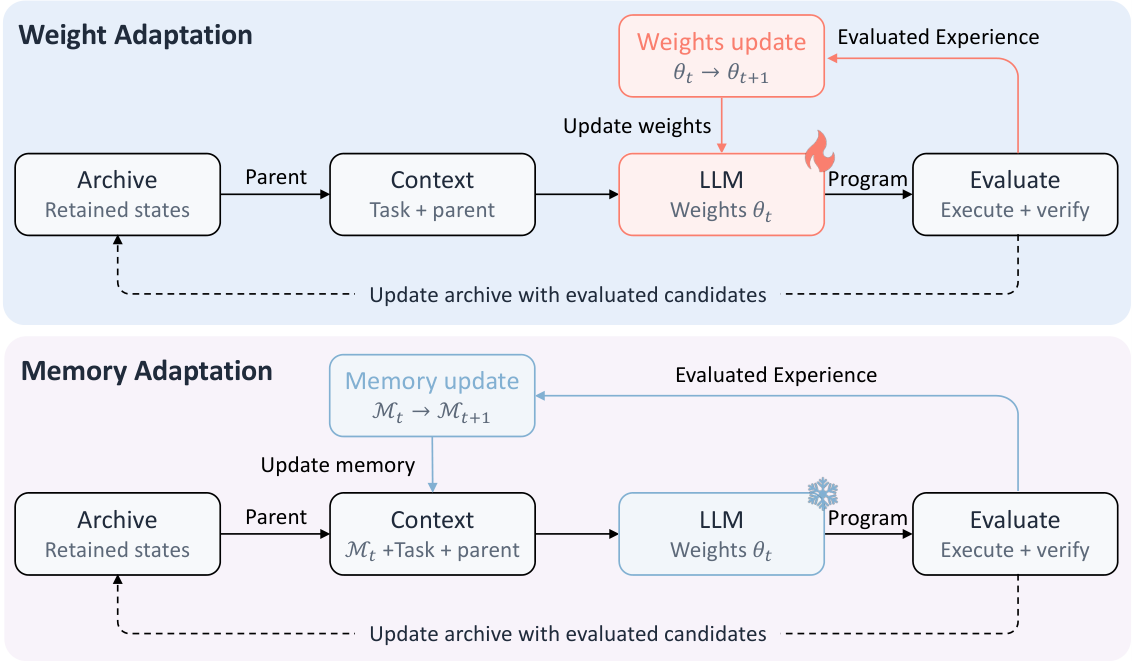
Figure 2 — Weight adaptation과 Memory adaptation 비교
4. Conclusion & Impact (결론 및 시사점)
본 논문은 과학적 발견을 위한 test-time adaptation에서 모델 가중치 업데이트 방식의 Test-Time Training (TTT) 대신 Test-Time Memory Evolution (TTME)이라는 외부 메모리 진화 방식이 더 효과적이고 계산 효율적인 대안임을 입증합니다. TTME는 두 가지 유형의 메모리를 통해 검색 경험을 distilled하고 재사용함으로써, 고정된 모델 가중치로도 TTT를 능가하는 discovery 결과를 달성했습니다. 이 연구는 LLM 기반 과학적 발견 시스템의 확장성(scalability)과 효율성(efficiency)을 크게 향상시킬 수 있는 중요한 시사점을 제공합니다. 특히, 대규모 모델이나 복잡한 discovery task에서 computational cost가 제약이 될 때, TTME는 기존 TTT의 한계를 극복하는 유망한 방향을 제시하며, 향후 LLM 기반 연구 및 개발에 실질적인 영향을 미칠 것으로 기대됩니다.
⚠️ 알림: 이 리뷰는 AI로 작성되었습니다.
관련 포스트
- [논문리뷰] Learning to Discover at Test Time
- [논문리뷰] The Markovian Thinker
- [논문리뷰] LongZero: Enhancing Long-Context Reasoning in LLMs from Zero Data
- [논문리뷰] Amortizing Sequential Experimental Design in Reasoning LLMs
- [논문리뷰] SCOPE: Semantic Bounded Credit Optimization for Prompt Engineering in Text-to-image Generation
Review 의 다른글
- 이전글 [논문리뷰] Can LLMs Uncover Hidden Physical Laws through Free Exploration?
- 현재글 : [논문리뷰] Can Test-Time Memory Evolution Outperform Test-Time Training for Scientific Discovery?
- 다음글 [논문리뷰] Channel Selection for Mixture-of-Experts Decoding Needs No Calibration Data
댓글