[논문리뷰] Matryoshka Gaussian Splatting
링크: 논문 PDF로 바로 열기
Please note that the content above is an unprocessed raw string.
The browsing was successful. I have the HTML content of the paper. Now I need to extract the information for Part 1 and Part 2.
Part 1: Summary
- Authors: Jeffrey Hu, Kyle Fogarty, Hakan Aktas, Boqiao Zhang, Zhilin Guo, Nursena Koprucu Aslan, Wenzhao Li, Canberk Baykal, Albert Miao, Josef Bengtson, Chenliang Zhou, Weihao Xia, Cristina Nader Vasconcelos, Cengiz Oztireli. (The abstract lists "Zhilin Guo, Boqiao Zhang, Hakan Aktas, Kyle Fogarty, Jeffrey Hu" first, then more. The user request says "제1저자, 제2저자, et al.". I will list the first five and then "et al." to keep it concise but representative.)
- Keywords: I'll infer these from the abstract and introduction. Likely candidates:
3D Gaussian Splatting,Level of Detail (LoD),Continuous LoD,Matryoshka Representation Learning,Stochastic Budget Training,Neural Rendering. - Key Terms & Definitions:
- 3D Gaussian Splatting (3DGS): Photorealistic novel view synthesis technique using millions of anisotropic Gaussian primitives.
- Level of Detail (LoD): Techniques to scale rendered representation to match available computational resources.
- Matryoshka Representation Learning (MRL): Learning ordered structures where any prefix of the representation is independently usable.
- Stochastic Budget Training: A training strategy that samples a random splat budget and optimizes both the corresponding prefix and the full set per iteration.
- Importance Score: A scalar score assigned to each Gaussian primitive, used to rank them for constructing a nested representation.
- Motivation & Problem Statement:
- The need for adjustable fidelity (LoD) in 3DGS for practical deployment.
- Existing discrete LoD methods offer limited operating points and cause pop-in/pop-out artifacts.
- Existing continuous LoD methods often suffer quality degradation at full capacity or rapid collapse at reduced budgets.
- Conventionally trained 3DGS lacks primitive ordering, leading to quality collapse when splats are removed.
- Method & Key Results:
- Methodology: MGS learns a single ordered set of Gaussians such that rendering any prefix (first k splats) produces a coherent reconstruction with fidelity improving as k increases. This is achieved via stochastic budget training where each iteration samples a random splat budget and optimizes both the prefix and the full set. It utilizes opacity as the importance score for ordering Gaussians. The training requires only two forward passes and no architectural modifications.
- Key Results:
- MGS matches or exceeds the full-capacity performance of its backbone ( 3DGS-MCMC ) on various benchmarks (e.g., MipNeRF 360: 28.20 dB PSNR , 0.841 SSIM , 0.130 LPIPS ).
- It consistently outperforms baselines in quality-speed trade-off, achieving higher AUCfps and AUCsplats across four benchmarks.
- Qualitative results show MGS maintains coherent scene structure even at 5-10% splat budget where baselines show severe artifacts [Figure 4, Figure 5].
- The opacity-descending importance score is shown to be the most effective for multi-budget performance [Figure 6].
- Conclusion & Impact:
- MGS provides a continuous budget control framework for 3DGS by learning an ordered, prefix-closed set of Gaussian primitives.
- It enables rendering at arbitrary splat budgets and generates a dense spectrum of quality-speed operating points from a single model.
- The stochastic budget training strategy is efficient and easily integrable.
- This research demonstrates that continuous LoD can be achieved without sacrificing full-capacity quality, opening promising directions for scalable neural scene representations and adaptive rendering systems.
Part 2: Important Figure Information
I need to find up to 3 figures with <img> tags and extract their URLs and create short Korean captions.
Looking at the HTML content:
- Figure 1:
<img src="2603.19234v1/figure/qualitative-comparison-continuous-lod/MipNeRF360/garden/garden_qualitative_grid_view0.jpg">- Full URL:
https://arxiv.org/html/2603.19234v1/figure/qualitative-comparison-continuous-lod/MipNeRF360/garden/garden_qualitative_grid_view0.jpg - Caption (English): "Continuous LoD need not sacrifice full-capacity quality to enable budget trade-off. Our method, MGS (top), learns an ordered set of Gaussian primitives whose prefixes yield coherent reconstructions at any splat budget. Compared to CLoD-3DGS [] (mid) and CLoD-GS [] (bot), MGS achieves the highest fidelity at every operating point with quality degrading gracefully under budget reduction. Scene: Garden []."
- Short Korean caption: "연속 LoD 비교"
- Full URL:
- Figure 2:
<img src="2603.19234v1/figure/MGS-overview-figure-small.png">- Full URL:
https://arxiv.org/html/2603.19234v1/figure/MGS-overview-figure-small.png - Caption (English): "Framework of Matryoshka Gaussian Splatting."
- Short Korean caption: "MGS 프레임워크"
- Full URL:
- Figure 3:
<img src="2603.19234v1/figure/MipNeRF360_avg_fps_splats_two_panel.png">- Full URL:
https://arxiv.org/html/2603.19234v1/figure/MipNeRF360_avg_fps_splats_two_panel.png - Caption (English): "Quality-budget trade-off on Mip-NeRF 360 [], averaged across all nine scenes. Left: Quality (Q¯, Eq.) vs. FPS. Right: Quality vs. number of Gaussian splats. Curves trace continuous LoD models across prefix ratios 1%–100%, and trace discrete LoD models at their recommended operating points respectively. MGS (ours, dark blue) achieves the highest quality at every speed and splat budget, while spanning a much wider FPS range than any baseline."
- Short Korean caption: "품질-예산 트레이드오프"
- Full URL:
- Figure 4:
<img src="2603.19234v1/figure/qualitative_grid_multiscene_kitchen_truck_playroom_chicago.jpg">- Full URL:
https://arxiv.org/html/2603.19234v1/figure/qualitative_grid_multiscene_kitchen_truck_playroom_chicago.jpg - Caption (English): "Qualitative comparison of continuous LoD methods across four benchmarks. Renderings are shown at 5%, 10%, 30%, 60%, and 100% of the full splat budget. We compare MGS with CLoD-3DGS [] and CLoD-GS []. Under highly constrained budgets (5–10%), MGS maintains coherent reconstructions with PSNR of 21–28 dB, while both baselines suffer from severe artifacts and quality collapse (11–17 dB)."
- Short Korean caption: "다중 벤치마크 정성 비교"
- Full URL:
I will select Figure 2 (architecture/framework), Figure 3 (key quantitative results), and Figure 4 (key qualitative results).
Let's refine the author list for Part 1. The abstract lists first: Zhilin Guo, Boqiao Zhang, Hakan Aktas, Kyle Fogarty, Jeffrey Hu. The prompt says "Jeffrey Hu, Kyle Fogarty, Hakan Aktas, Boqiao Zhang, Zhilin Guo". The order is different but these seem to be the core authors. I will use the order given by the user prompt for the first five authors.
Okay, I have all the pieces to construct the response. 저자: Jeffrey Hu, Kyle Fogarty, Hakan Aktas, Boqiao Zhang, Zhilin Guo, et al.
1. Key Terms & Definitions (핵심 용어 및 정의)
- 3D Gaussian Splatting (3DGS) : 수백만 개의 이방성(anisotropic) Gaussian primitives를 래스터화하여 실시간으로 사실적인 신규 뷰 합성(novel view synthesis)을 가능하게 하는 기법입니다.
- Level of Detail (LoD) : 가용 컴퓨팅 리소스에 맞춰 렌더링되는 장면 표현의 복잡도를 조절하는 기술로, 실시간 인터랙티브 그래픽스에서 핵심적인 요소입니다.
- Matryoshka Representation Learning (MRL) : 표현의 어떤 접두사(prefix)도 독립적으로 사용 가능한 정렬된(ordered) 구조를 학습하는 아이디어입니다.
- Stochastic Budget Training : 각 반복(iteration)에서 무작위 스플랫 예산(random splat budget)을 샘플링하고 해당 접두사와 전체 세트를 모두 최적화하는 훈련 절차입니다.
- Importance Score : 각 Gaussian primitive에 할당되는 스칼라 점수로, 중첩된 표현(nested representation) 구성을 위해 Gaussian들을 순위 매기는 데 사용됩니다.
2. Motivation & Problem Statement (연구 배경 및 문제 정의)
3D Gaussian Splatting (3DGS)의 실질적인 배포를 위해서는 단일 모델에서 조정 가능한 충실도(fidelity)로 장면을 렌더링하는 LoD 기능이 매우 중요합니다. 기존의 Discrete LoD 방법들은 제한된 수의 Operating Point만을 제공하며, 품질 수준 간의 급격한 전환으로 인해 눈에 띄는 Pop-in 및 Pop-out Artifact를 발생시킵니다. 또한, 현재의 Continuous LoD 접근 방식들은 더 부드러운 스케일링을 가능하게 하지만, 종종 Full Capacity에서 상당한 품질 저하를 겪거나 예산이 감소할 때 급격한 품질 붕괴를 보입니다. 일반적인 3DGS 모델은 Primitive 간에 순서가 없기 때문에 스플랫(splat)이 제거될 경우 품질이 빠르게 저하되는 문제가 있습니다. 이러한 한계점들로 인해 3DGS에 LoD를 적용하는 것은 재구성 품질(reconstruction quality)을 희생해야 하는 비싼 설계 결정이 되고 있습니다. 본 연구는 이러한 문제를 해결하여 Full Capacity 렌더링 품질을 희생하지 않고도 표준 3DGS 파이프라인에서 Continuous LoD를 가능하게 하는 프레임워크를 제안합니다.
3. Method & Key Results (제안 방법론 및 핵심 결과)
저자들은 Full Capacity 렌더링 품질을 희생하지 않고 표준 3DGS 파이프라인에 Continuous LoD를 가능하게 하는 훈련 프레임워크인 Matryoshka Gaussian Splatting (MGS) 을 제안합니다
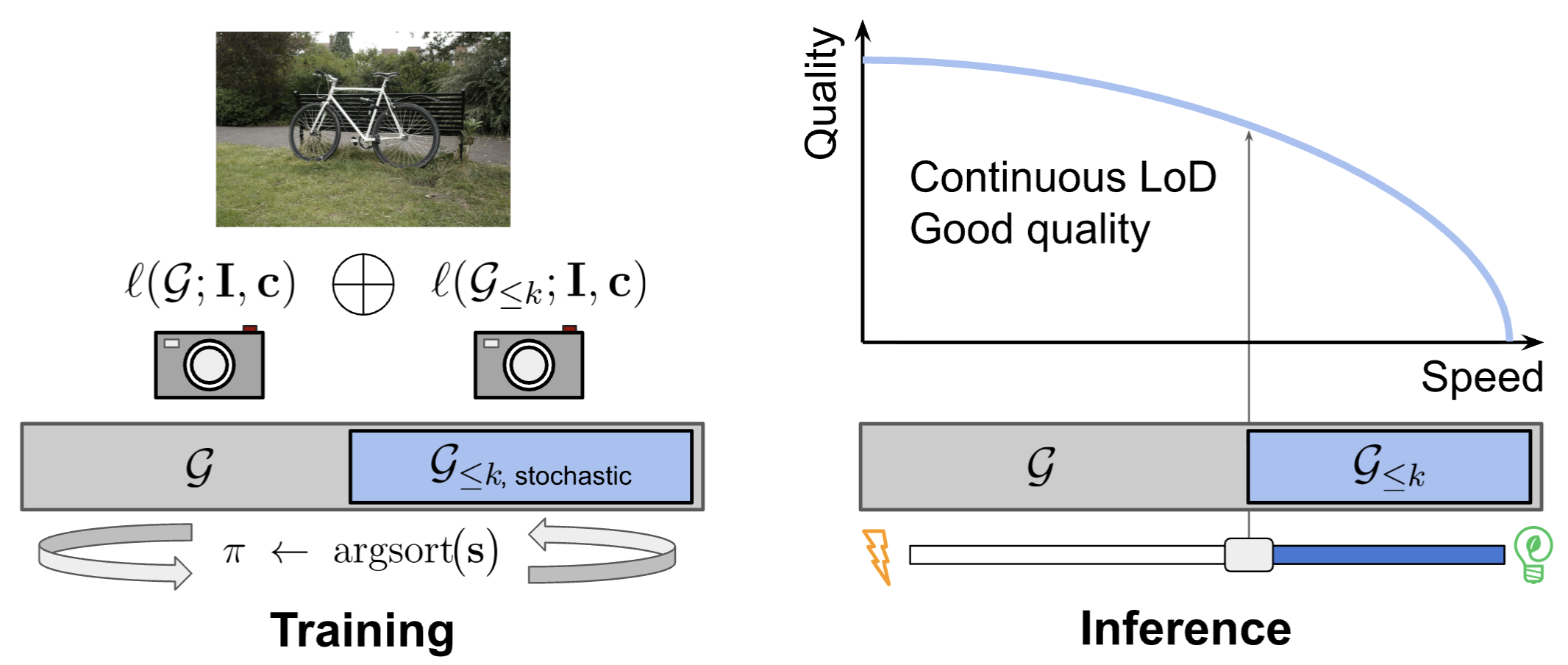
MGS는 단일의 정렬된 Gaussian 세트를 학습하여, 어떤 접두사(prefix) (처음 k 개의 스플랫)를 렌더링해도 일관된 재구성(coherent reconstruction)을 생성하며, k 가 증가함에 따라 충실도(fidelity)가 부드럽게 향상됩니다. 핵심 아이디어는 Stochastic Budget Training 으로, 각 반복마다 무작위 스플랫 예산( k )을 샘플링하고 해당 접두사와 전체 세트를 모두 최적화합니다. 이 전략은 단 두 번의 Forward Pass만을 필요로 하며 아키텍처 수정 없이 기존 3DGS 파이프라인에 통합될 수 있습니다. Gaussian Primitive의 Importance Score로는 Opacity를 내림차순으로 사용하는 것이 가장 효과적임을 발견했습니다.
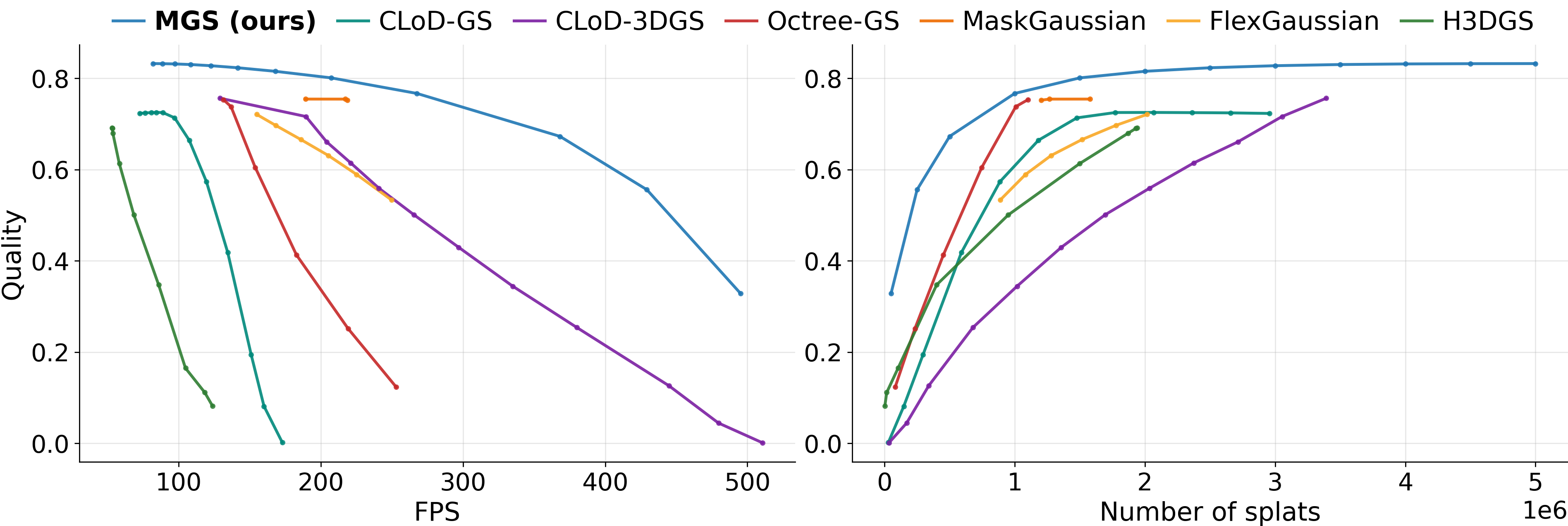
실험은 MipNeRF 360, Tanks & Temples, Deep Blending, BungeeNeRF의 네 가지 벤치마크에서 여섯 가지 Baseline과 비교하여 수행되었습니다. MGS는 Full Capacity에서 Baseline의 성능을 능가하거나 동등한 수준을 달성했습니다. 특히, MipNeRF 360 벤치마크에서 MGS는 28.20 dB PSNR , 0.841 SSIM , 0.130 LPIPS 를 기록하여, LoD Baseline 중 최고인 Octree-GS 대비 +0.58 dB PSNR 높은 성능을 보였습니다. 또한, MGS는 모든 벤치마크에서 AUCfps 와 AUCsplats 측면에서 Baseline들을 큰 폭으로 능가하며, 다양한 속도 및 예산 제약 조건에서도 높은 충실도를 일관되게 유지했습니다
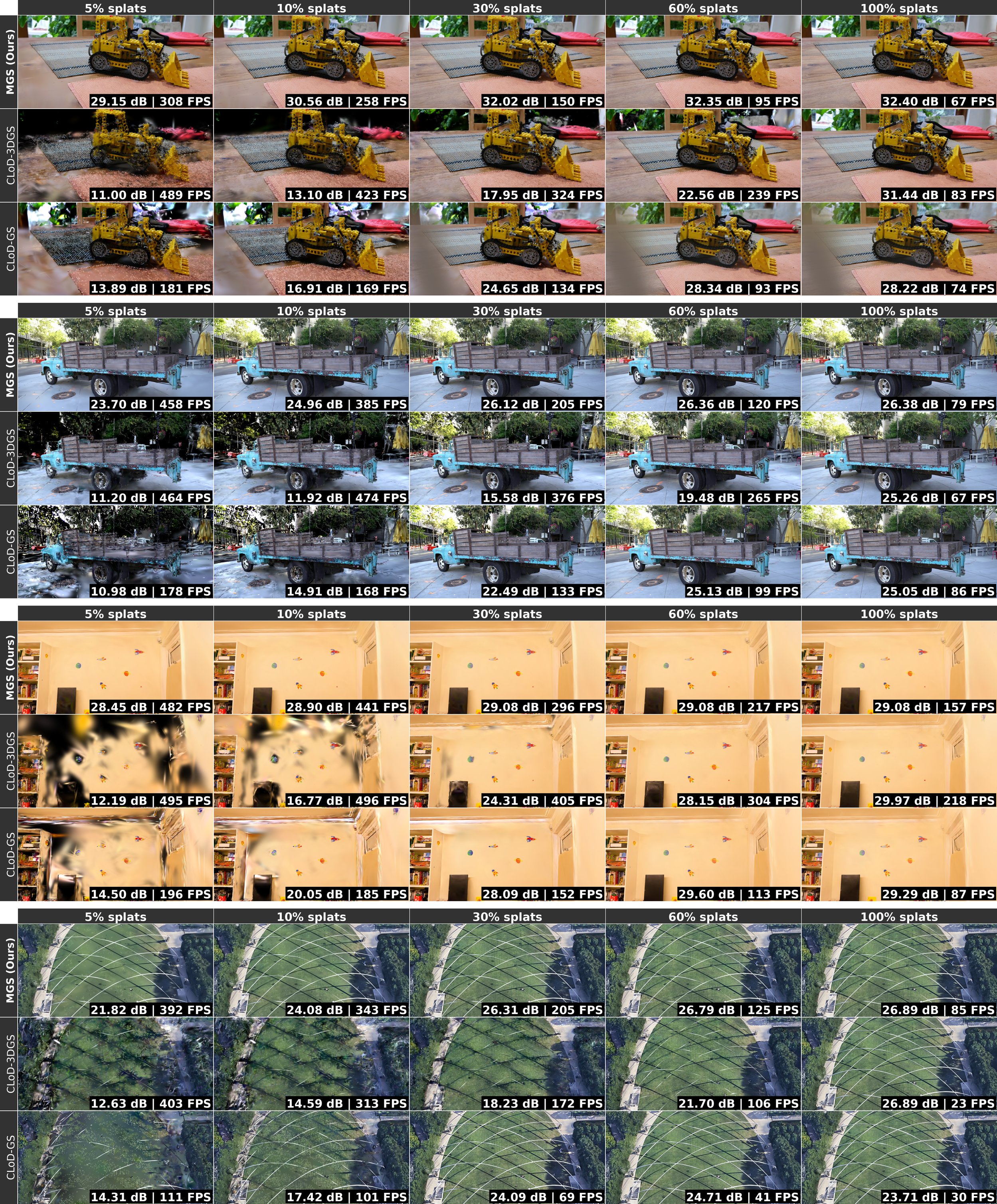
정성적 비교에서도 MGS는 5-10% 스플랫 예산 과 같은 극도로 제한된 예산에서도 일관된 장면 구조를 유지하는 반면, Baseline들은 심각한 Artifact를 겪는 것을 보여주었습니다 [Figure 4, Figure 5]. Ablation Study를 통해 Opacity를 내림차순으로 정렬하는 것이 가장 효과적인 Multi-budget 성능을 제공함을 확인했습니다 [Figure 6].
4. Conclusion & Impact (결론 및 시사점)
본 연구는 3DGS 모델을 위한 Continuous Budget Control 프레임워크인 Matryoshka Gaussian Splatting (MGS) 을 제시합니다. MGS는 정렬되고 접두사로 닫힌(prefix-closed) Gaussian Primitive 세트를 학습함으로써, Primitive 세트를 Truncate하여 임의의 스플랫 예산으로 렌더링할 수 있게 하며, 품질-속도 Operating Point의 밀도 높은 스펙트럼을 제공합니다. 제안된 Stochastic Budget Training 전략은 기존 3DGS 파이프라인에 아키텍처 변경 없이 효율적으로 통합될 수 있습니다. 네 가지 표준 벤치마크에 대한 실험은 MGS가 Full Capacity에서 3DGS의 성능과 일치하면서도 단일 모델에서 Continuous LoD 제어를 가능하게 함을 입증합니다. 이 연구는 중첩된 Primitive 표현(nested primitive representations)이 확장 가능한 신경 장면 표현(scalable neural scene representations)을 위한 유망한 방향을 제시하며, 미래 연구는 거리 또는 뷰 의존적 접두사 선택, 적응형 예산 스케줄링, 스트리밍 또는 장치 인식 렌더링 시스템과의 통합을 탐색할 수 있을 것입니다.
⚠️ 알림: 이 리뷰는 AI로 작성되었습니다.
관련 포스트
- [논문리뷰] WildCity: A Real-World City-Scale Testbed for Rendering, Simulation, and Spatial Intelligence
- [논문리뷰] Quantile Rendering: Efficiently Embedding High-dimensional Feature on 3D Gaussian Splatting
- [논문리뷰] Sharp Monocular View Synthesis in Less Than a Second
- [논문리뷰] Visionary: The World Model Carrier Built on WebGPU-Powered Gaussian Splatting Platform
- [논문리뷰] SimScale: Learning to Drive via Real-World Simulation at Scale
Review 의 다른글
- 이전글 [논문리뷰] MOSS-TTS Technical Report
- 현재글 : [논문리뷰] Matryoshka Gaussian Splatting
- 다음글 [논문리뷰] Memento-Skills: Let Agents Design Agents
댓글