[논문리뷰] D^2-Monitor: Dynamic Safety Monitoring for Diffusion LLMs via Hesitation-Aware Routing
링크: 논문 PDF로 바로 열기
The paper "D^2-Monitor: Dynamic Safety Monitoring for Diffusion LLMs via Hesitation-Aware Routing" proposes a bi-level safety monitoring system for Diffusion Large Language Models (D-LLMs).
Here's a breakdown of the information I need to extract and format:
Part 1: Summary
-
Metadata:
- Authors: Aoxi Liu, Yupeng Chen, James Oldfield, Guanzhe Hong, Junchi Yu, Baoyuan Wu, Philip Torr, Adel Bibi
- Keywords: Need to select 5-8 relevant keywords in English from the text. Potential keywords:
Diffusion LLMs,Safety Monitoring,Hesitation-Aware Routing,Probe-based Monitors,Multi-step Trajectory,Sample Difficulty,Efficiency-effectiveness Tradeoff,Adversarial Inputs.
-
1. Key Terms & Definitions:
- D-LLMs (Diffusion Large Language Models): Generative models that iteratively refine entire text sequences through a multi-step denoising process using bidirectional attention, as an alternative to autoregressive LLMs.
- Probe-based Monitors: Lightweight auxiliary modules that operate on internal model representations to detect harmful user inputs or problematic model behaviors, suitable for always-on, low-cost deployment.
- Hesitation Steps: Intermediate denoising steps in a D-LLM's trajectory whose hidden representations lie close to a safety probe's decision boundary, indicating uncertainty in safety decisions.
- Hesitation Severity (n_τ): The count of hesitation steps within a D-LLM's multi-step trajectory, serving as an effective proxy for sample difficulty for safety probes.
- D^2-Monitor: A dynamic bi-level safety monitor for D-LLMs that utilizes hesitation severity for test-time routing, employing a lightweight base probe for easy samples and a more complex advanced probe for samples with high hesitation.
-
2. Motivation & Problem Statement:
- The paper addresses the underexplored area of safety monitoring for D-LLMs, which is critical given their growing adoption and potential for malicious misuse.
- Unlike AR-LLMs, D-LLMs generate text through a multi-step denoising process, offering richer intermediate hidden representations that are largely overlooked by existing single-step monitoring approaches.
- Existing safety monitoring literature for LLMs primarily focuses on AR-LLMs, with techniques like LLM-as-monitors being computationally expensive and probe-based monitors often struggling with "harder" samples due to limited expressivity.
- The core problem is to develop an efficient and effective safety monitoring system for D-LLMs that can dynamically adapt to the difficulty of inputs without incurring prohibitive computational overhead.
-
3. Method & Key Results:
- D^2-Monitor proposes a bi-level safety monitoring framework for D-LLMs, consisting of a low-complexity base probe, a router, and a high-complexity advanced probe.
- The base probe, typically a linear probe, continuously monitors and estimates hesitation severity (n_τ) by identifying steps where hidden states are close to the decision boundary.
- When the hesitation severity exceeds a predefined threshold (λ), the router escalates the sample to the more expressive advanced probe (e.g., MLP or TimeAttn) for a second-stage classification, thereby dynamically allocating computational resources.
- This approach uses out-of-fold (OOF) scoring to collect unbiased hesitation trajectories from the training set, which are then used to exclusively train the advanced probe on these "harder" samples within their hesitation windows.
- Evaluations across 3 datasets (WildguardMix, ToxicChat, OpenAI-Moderation) and 4 D-LLMs (LLaDA-8B-Base, LLaDA-8B-Instruct, LLaDA-1.5-8B, LLaDA-2.0-mini-16B) show that D^2-Monitor consistently achieves state-of-the-art performance in terms of Accuracy and F1 score while maintaining a compact parameter footprint (≤ 0.85M parameters).
- Specifically, D^2-Monitor demonstrates the best efficiency-effectiveness tradeoff compared to 8 baselines, achieving up to 2.4x–6.6x speedup over full-trajectory methods like MLP (Mean) and 4x–5x faster than TimeAttn, with FLOPs reduced by 22x–150x compared to sequence-based baselines.
- The margin-based hesitation signal (n_τ) consistently outperforms probe-extrinsic signals like entropy and confidence in stratifying sample difficulty, and the routed subset is significantly enriched with adversarial inputs, confirming its effectiveness in identifying high-risk samples.
-
4. Conclusion & Impact:
- D^2-Monitor effectively addresses the challenge of dynamic safety monitoring for D-LLMs by leveraging intrinsic safety hesitation signals from multi-step denoising trajectories.
- The research establishes that the number of hesitation steps serves as a robust proxy for sample difficulty, enabling a resource-efficient, bi-level monitoring framework.
- This dynamic allocation of computational resources, guided by hesitation-aware routing, allows for high performance on critical safety tasks while keeping computational costs low, particularly valuable for resource-constrained deployment.
- The state-of-the-art performance in both intra-dataset detection and cross-dataset generalization, coupled with superior efficiency-effectiveness tradeoff, makes D^2-Monitor a promising direction for more reliable and practical D-LLM safety monitors.
Part 2: Important Figure Information
I need to identify up to 3 key figures and their URLs from the HTML.
-
Figure 1: Main problem, core methodology, and key result showing effectiveness-efficiency trade-off. This looks like a good candidate for overall architecture/results.
src="2605.25893v1/x1.png"->https://arxiv.org/html/2605.25893v1/x1.png- Caption: "제안 모델의 전체 아키텍처 및 핵심 결과"
-
Figure 2: F1 differences and F1 score as a function of hesitation steps. This illustrates the core concept of hesitation and its correlation with difficulty. It has multiple subfigures, but the overall figure captures a key finding.
src="2605.25893v1/x2.png"(for (a))src="2605.25893v1/x3.png"(for (b))src="2605.25893v1/x4.png"(for (c))src="2605.25893v1/x5.png"(for (d))- Figure 2 itself has the caption. It's best to pick the main image if possible or clarify. Looking at Figure 2, it seems to be one conceptual figure split into multiple image files (a, b, c, d). I will choose (c) as it directly shows F1 vs hesitation steps. And then include the general caption.
- Let's check the instruction again: "논문 HTML 페이지에서 해당 Figure/Table의
태그 src 속성에서 이미지 경로를 찾으세요." Figure 2 is a collection of figures (a)-(d). I should probably pick one representative image for Figure 2. Figure 2(c) "F1 - LP (MV)" seems good to illustrate hesitation severity.
- Caption for Figure 2: "F1 score as a function of the number of hesitation steps under different threshold values τ"
- So,
image_url:https://arxiv.org/html/2605.25893v1/x4.png,caption_kr: "Hesitation 단계 수에 따른 F1 점수"
-
Figure 5: Adversarial fraction vs. hesitation severity. This shows the relationship between hesitation and adversarial inputs.
src="2605.25893v1/x11.png"(for (a))- Caption: "Adversarial fraction vs. hesitation severity nτ"
- So,
image_url:https://arxiv.org/html/2605.25893v1/x11.png,caption_kr: "Hesitation severity에 따른 Adversarial 비율"
Let's refine the keywords and check for exact phrasing.
Keywords: Diffusion LLMs, Safety Monitoring, Hesitation-Aware Routing, Probe-based Monitors, Multi-step Trajectory, Sample Difficulty, Efficiency-effectiveness Tradeoff, Adversarial Inputs. (8 keywords, good range).
Citations: I need to ensure every sentence that refers to browsed content ends with ``.
Double check "Natural Korean Phrasing" and "Technical Terminology in English" constraints. The instructions say: "명사나 핵심 동사는 영어를 섞어 사용하는 전문적인 문체를 유지하세요." (Maintain a professional writing style by mixing English nouns and key verbs).
Let's start drafting the summary.
Metadata
저자: Aoxi Liu, Yupeng Chen, James Oldfield, Guanzhe Hong, Junchi Yu, Baoyuan Wu, Philip Torr, Adel Bibi
Part 1: 요약 본문
1. Key Terms & Definitions (핵심 용어 및 정의)
- D-LLMs (Diffusion Large Language Models): 텍스트 시퀀스를 다단계 denoising process를 통해 반복적으로 refine하는 generative model로, autoregressive LLM에 대한 대안으로 최근 부상하고 있습니다.
- Probe-based Monitors: LLM의 internal representation에 작동하는 lightweight auxiliary module로, 악성 사용자 입력이나 문제가 있는 모델 동작을 낮은 비용으로 지속적으로 탐지하는 데 적합합니다.
- Hesitation Steps: D-LLM의 denoising trajectory 내에서 safety probe의 decision boundary에 인접하게 위치하는 intermediate hidden state를 의미하며, 안전성 판단에서의 불확실성을 나타냅니다.
- Hesitation Severity (n_τ): D-LLM trajectory 내에서 hesitation steps의 수를 정량화한 metric으로, probe의 classification difficulty에 대한 효과적인 proxy로 활용됩니다.
- D^2-Monitor: D-LLM을 위한 dynamic bi-level safety monitor로, hesitation severity를 활용하여 inference-time routing을 수행하며, lightweight base probe와 high-complexity advanced probe를 계층적으로 운용합니다.
2. Motivation & Problem Statement (연구 배경 및 문제 정의)
본 논문은 D-LLM의 안전성 monitoring 연구가 미흡하며, D-LLM의 오용 가능성이 증대함에 따라 효과적인 방어 메커니즘이 필요하다고 주장합니다. 기존 autoregressive LLM(AR-LLM)과 달리, D-LLM은 multi-step denoising process를 통해 텍스트를 생성하며, 이 과정에서 안전성 관련 정보를 담고 있는 intermediate hidden representation이 노출됩니다. 하지만 기존의 AR-LLM 중심 안전성 모니터링 연구는 이러한 D-LLM의 고유한 특성을 충분히 활용하지 못하고 있습니다. 특히, LLM-as-monitors 방식은 높은 computational overhead를 발생시키고, probe-based monitors는 "harder" samples에 대한 제한적인 expressivity로 인해 오분류될 가능성이 있습니다. 따라서 저자들은 D-LLM의 multi-step trajectory에서 얻을 수 있는 신호를 활용하여, efficiency와 effectiveness 사이의 균형을 맞추는 동적인 안전성 모니터링 시스템의 필요성을 강조합니다.
3. Method & Key Results (제안 방법론 및 핵심 결과)
저자들은 D-LLM의 intrinsic safety hesitation을 활용하는 dynamic bi-level safety monitor인 D^2-Monitor를 제안합니다. D^2-Monitor는 low-complexity base probe, router, high-complexity advanced probe의 세 가지 주요 구성 요소를 포함합니다. 모든 입력 sample은 먼저 lightweight linear probe인 base probe에 의해 처리되며, 이 과정에서 safety prediction과 함께 hesitation severity (n_τ) score가 산출됩니다. 이 hesitation score가 사전에 정의된 threshold (λ)를 초과하면, router는 해당 sample을 computationally heavier한 advanced probe (예: MLP 또는 TimeAttn)로 routing하여 2단계 classification을 수행합니다 [Figure 1]. Advanced probe는 out-of-fold (OOF) scoring을 통해 training set에서 선별된 hesitation trajectories와, 특히 해당 sample의 hesitation window 내의 hidden states를 활용하여 훈련됩니다.
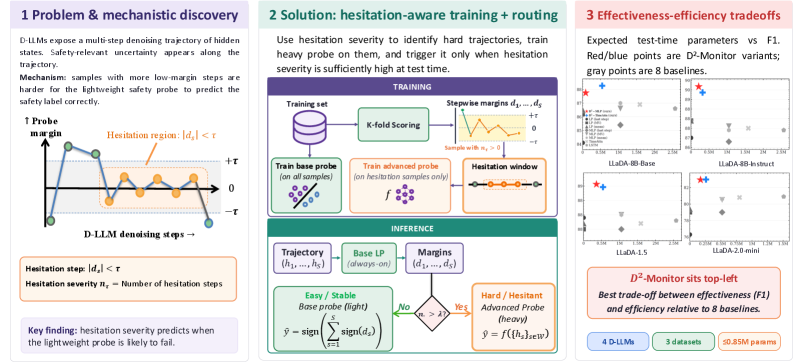
Figure 1 — 제안 모델의 전체 아키텍처 및 핵심 결과
실험 결과, D^2-Monitor는 WildguardMix, ToxicChat, OpenAI-Moderation 3가지 safety dataset과 LLaDA-8B-Base, LLaDA-8B-Instruct, LLaDA-1.5-8B, LLaDA-2.0-mini-16B 4가지 D-LLM에 걸쳐 state-of-the-art 성능을 달성했습니다. 특히, D^2-Monitor는 Accuraccy와 F1 score에서 모든 baseline 대비 우수했으며, 최소 0.85M 미만의 compact parameter footprint를 유지했습니다 [Table 1, Table 2]. D^2-Monitor는 efficiency-effectiveness tradeoff 측면에서 가장 우수한 결과를 보였는데 [Figure 1], full-trajectory baselines 대비 최대 2.4x–6.6x의 inference speedup을 달성하고, TimeAttn 대비 4x–5x 더 빠르며, FLOPs는 sequence-based baselines 대비 22x–150x 절감되었습니다. 또한, margin-based hesitation signal (n_τ)은 entropy 및 confidence와 같은 probe-extrinsic signal보다 sample difficulty를 더욱 효과적으로 계층화했으며 [Figure 2, Figure 6], routed된 subset은 adversarial inputs가 크게 enrichment된 것을 확인했습니다 [Figure 5].
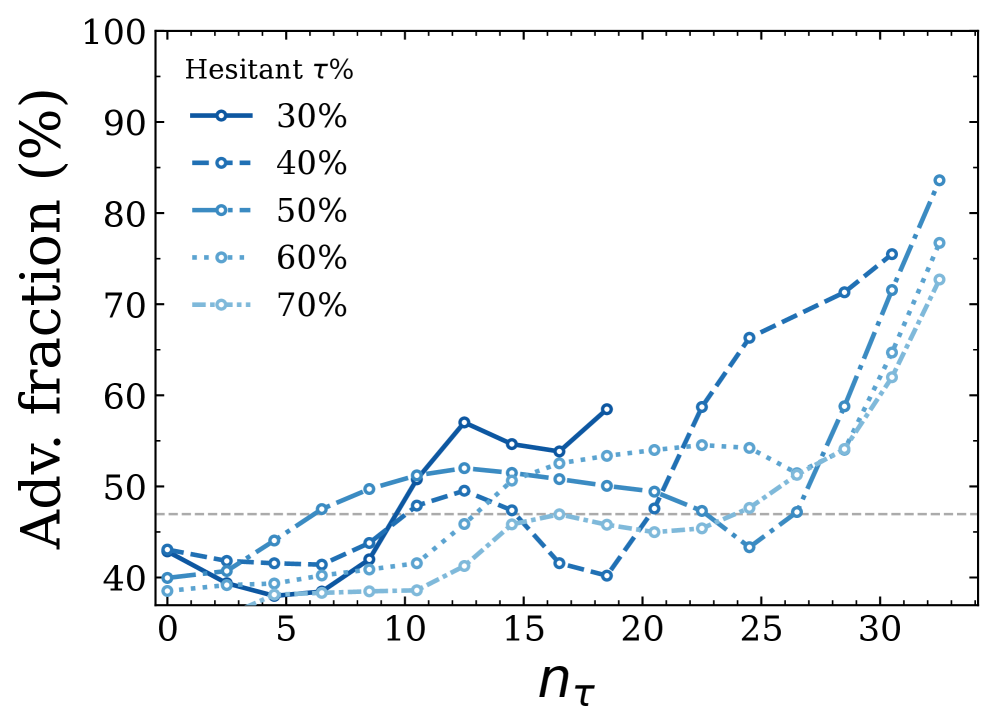
Figure 5 — Hesitation severity에 따른 Adversarial 비율
4. Conclusion & Impact (결론 및 시사점)
본 논문은 D-LLM의 multi-step denoising trajectory에서 발생하는 intrinsic safety hesitation 신호를 활용하여 dynamic safety monitoring의 새로운 접근 방식인 D^2-Monitor를 성공적으로 제안합니다. 이 연구는 hesitation steps의 수가 probe의 classification difficulty를 예측하는 효과적인 proxy임을 명확히 밝혔으며, 이를 바탕으로 자원 효율적인 bi-level monitoring framework를 구축했습니다. Hesitation-aware routing을 통한 computational resource의 동적 할당은 resource-constrained deployment 환경에서 높은 안전성 탐지 성능을 유지하면서도 비용을 절감할 수 있는 실용적인 솔루션을 제공합니다. 궁극적으로 D^2-Monitor의 state-of-the-art 성능과 우수한 efficiency-effectiveness tradeoff는 D-LLM을 위한 더욱 신뢰할 수 있고 효율적인 안전성 모니터 개발에 중요한 시사점을 제공하며, 학계와 산업계 모두에 긍정적인 영향을 미칠 것으로 기대됩니다.
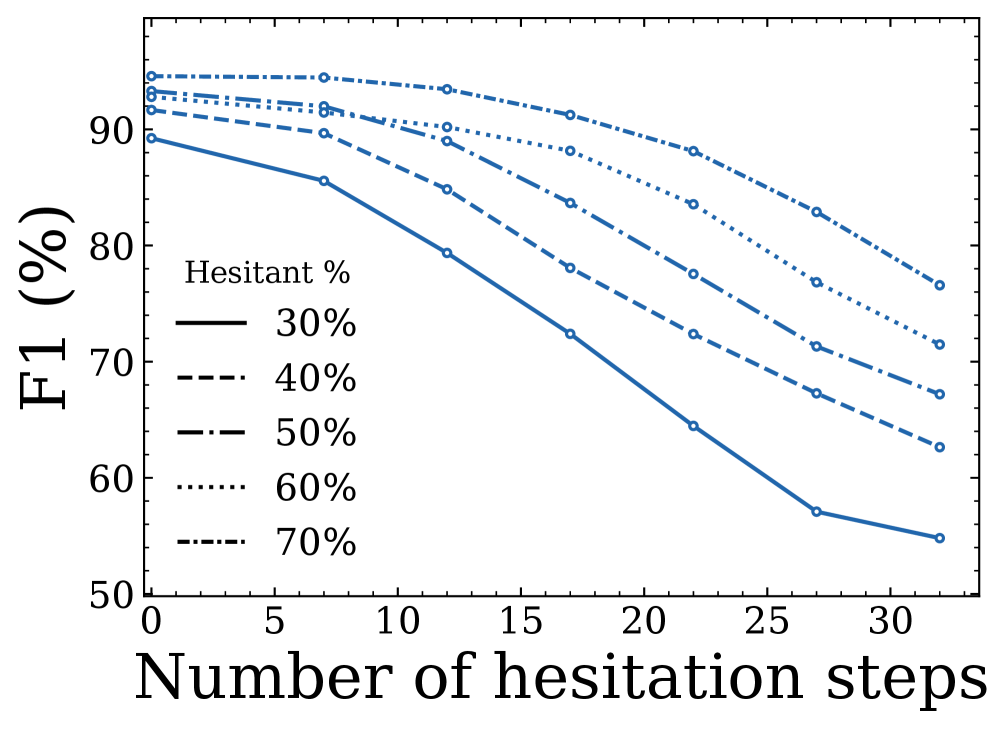
Figure 2 — Hesitation 단계 수에 따른 F1 점수
⚠️ 알림: 이 리뷰는 AI로 작성되었습니다.
관련 포스트
- [논문리뷰] Flash-dLLM: IO-Aware KV Caching and Parallel Decoding for Fast, Memory-Efficient Diffusion LLMs
- [논문리뷰] MOLE: Detecting Insider Threats in AI Agents
- [논문리뷰] S2D2: Fast Decoding for Diffusion LLMs via Training-Free Self-Speculation
- [논문리뷰] Skip to the Good Part: Representation Structure & Inference-Time Layer Skipping in Diffusion vs. Autoregressive LLMs
- [논문리뷰] Attention Is All You Need for KV Cache in Diffusion LLMs
Review 의 다른글
- 이전글 [논문리뷰] Your Embedding Model is SMARTer Than You Think
- 현재글 : [논문리뷰] D^2-Monitor: Dynamic Safety Monitoring for Diffusion LLMs via Hesitation-Aware Routing
- 다음글 [논문리뷰] EvalVerse: Pipeline-Aware and Expert-Calibrated Benchmarking for Professional Cinematic Video Generation
댓글