[논문리뷰] DreamX-Phi 1.0: Action-Conditioned Video World Model for Robotic Manipulation
링크: 논문 PDF로 바로 열기
Now I have the content of the paper. I will proceed with summarizing it according to the specified format and constraints.
Metadata Extraction:
- 저자: DreamX Team, Rui Chen, Xiangxiang Chu, Geng Li, Jifan Li, Qingfeng Shi, Datao Tang, Jing Tang, Jun Wang, Pengfei Zhang
Figure Selection: I'll look for architecture diagrams, key results, and methodology explanations.
- Figure 1: "Overview of DreamX-Phi 1.0, an action-conditioned video world model that predicts future observations from a single frame and prescribed bimanual actions." This looks like an overall architecture.
2608.13489v1/dreamx_phi_overview_crop.png - Figure 2: "Overview of the DreamX-Phi 1.0 framework. (1) Given an observed RGB frame, a language instruction, and an externally specified bimanual action trajectory, a Wan2.2-TI2V-5B video diffusion transformer predicts the future RGB video. Arm-grouped PRoPE and a robot-only optical-flow cue provide complementary geometric and image-plane action conditioning. (2) During training, SAM3-derived masks reweight the RGB objective, Depth Anything 3 (DA3) depth maps provide targets for the depth-latent objective, and a frozen V-JEPA teacher supplies object-relational supervision. (3) DMD with adversarial training distills the multi-step teacher into a few-step student." This is a detailed framework diagram, crucial for method explanation.
2608.13489v1/dreamx_phi_train.png - Figure 3: "Qualitative WorldArena 2.0 Track 1 rollouts from DreamX-Phi 1.0. Each row is a predicted episode, with frames sampled in temporal order from left to right. (a) Standard RoboTwin 2.0 scenes. (b) Domain-randomized scenes with varied backgrounds, textures, lighting, and distractor objects." This shows key qualitative results.
2608.13489v1/world_arena_clean_crop.pngand2608.13489v1/world_arena_random_crop.png. I should pick one to represent qualitative results, or acknowledge both if possible for a single figure. Figure 3 has two sub-figures, (a) and (b), but they are part of the same Figure 3. I'll use the main image URL for Figure 3. The HTML usesdreamx_phi_overview_crop.png,dreamx_phi_train.png,world_arena_clean_crop.png. For Figure 3, the image link is2608.13489v1/world_arena_clean_crop.pngand2608.13489v1/world_arena_random_crop.png. I'll use2608.13489v1/world_arena_clean_crop.pngas the primary image URL for Figure 3 and note that it shows qualitative results for clean scenes.
I will use Figure 1, Figure 2, and Figure 3.
Full URLs for Figures:
- Figure 1:
https://arxiv.org/html/2608.13489v1/dreamx_phi_overview_crop.png - Figure 2:
https://arxiv.org/html/2608.13489v1/dreamx_phi_train.png - Figure 3:
https://arxiv.org/html/2608.13489v1/world_arena_clean_crop.png
Now I will draft the summary following all the specified sections and constraints.
저자: DreamX Team, Rui Chen, Xiangxiang Chu, Geng Li, Jifan Li, Qingfeng Shi, Datao Tang, Jing Tang, Jun Wang, Pengfei Zhang, et al.
1. Key Terms & Definitions (핵심 용어 및 정의)
본 논문에서 다루는 핵심 기술 용어 및 개념은 다음과 같습니다:
- Action-Conditioned Video World Model: 주어진 초기 프레임, 언어 명령어, 그리고 End-Effector Pose 및 Gripper State를 포함하는 Action Sequence를 기반으로 미래의 관측(Future Observations)을 예측하는 모델입니다. 이는 로봇이 물리적 실행 전 가상의 환경에서 계획을 세울 수 있도록 돕습니다.
- SE(3) Transformation (Special Euclidean Group in 3D): 로봇의 End-Effector Motion을 3D 공간에서 수학적으로 표현하는 Rigid-Body Transformation 그룹입니다. 본 논문에서는 로봇 팔의 연속적인 3D 궤적을 보존하는 데 활용됩니다.
- PRoPE (Projective Relative Positional Encoding): Self-Attention 메커니즘에 알려진 Relative Transformation을 직접 삽입하여 Geometric Control을 가능하게 하는 방식입니다. DreamX-Phi에서는 End-Effector Motion의 SE(3) 구조를 Attention에 반영하는 데 사용됩니다.
- V-JEPA (Video Joint-Embedding Predictive Architecture): Self-Supervised Video Model로, 물체의 Temporal Consistency 및 Object-Relational Supervision을 제공하기 위해 사용되는 Teacher Model입니다. 예측된 영상 내에서 조작 대상(Manipulated Object)의 일관된 진화를 유도합니다.
- DMD (Distribution Matching Distillation): Multi-Step Generator의 반복적인 생성 프로세스를 Few-Step Student로 Distill하여 효율적인 Inference를 가능하게 하는 Post-Training 기법입니다.
2. Motivation & Problem Statement (연구 배경 및 문제 정의)
기존 World Model들은 로봇 조작(Robotic Manipulation)을 위한 미래 관측 예측(Future Observation Prediction)에서 Photorealistic한 결과를 제공하지만, Action Fidelity 측면에서 중요한 한계점을 가집니다. 즉, 생성된 영상이 시각적으로 설득력이 있더라도 명령된 동작과 다르게 팔을 움직이거나, 대상 물체를 놓치거나, Gripping과 Release를 혼동하는 등의 문제가 발생할 수 있습니다. 이는 기존 접근 방식들이 Action을 Compact Token이나 Feature-wise Modulation으로 인코딩하여 End-Effector Motion의 Rigid-Body Geometry나 이미지 내에서의 Spatial Structure를 명시적으로 보존하지 못하기 때문입니다.
또한, 정확한 로봇 동작만으로는 장면의 Geometry나 조작되는 작은 물체(Manipulated Objects)의 Evolution을 완전히 제약하기 어렵습니다. 물체가 상호작용 과정에서 시각적 정체성(Visual Identity)을 유지하고 일관되게 변화하는지 보장하는 것이 중요합니다. 따라서 Action Conditioning이 Scene Geometry와 Manipulated Object의 상태를 보존하도록 하는 Dense Supervision의 필요성이 제기됩니다. 본 연구는 이러한 Action Fidelity, Scene Geometry 보존, 그리고 Object-Centric Temporal Consistency의 문제를 해결하기 위해 새로운 접근 방식을 제안합니다.
3. Method & Key Results (제안 방법론 및 핵심 결과)
본 논문은 로봇 조작을 위한 Action-Conditioned Video World Model인 DreamX-Phi 1.0을 제안합니다. 이 모델은 Wan2.2-TI2V-5B Video Diffusion Transformer를 기반으로 하며, Geometry-Aware Action Conditioning과 Auxiliary Geometric 및 Object-Centric Supervision을 결합합니다. 제안 방법론의 핵심은 크게 세 가지 부분으로 구성됩니다: Action-Conditioned Video Prediction, Training Supervision, 그리고 Few-Step Post-Training [Figure 2, cite: 1].
첫째, Action Conditioning을 위해 기존의 Low-Dimensional Token 방식 대신 PRoPE-style Geometric Encoding을 통해 End-Effector Motion의 SE(3) Structure를 Attention 메커니즘에 직접 주입합니다. 이는 각 로봇 팔의 명령된 궤적에 대한 예측의 충실도(Faithfulness)를 보장하며, 로봇 팔의 Identity와 Rigid-Motion Structure를 보존합니다. 또한, Gripper State는 SE(3) Transformation과 별도로 Per-Arm Bias로 Attention Head에 주입되어 Residual Branch를 통해 Pretrained Generative Path를 강화합니다.
둘째, Scene Geometry와 Manipulated Object의 일관된 진화를 위해 Auxiliary Depth Supervision과 Object-Centric Physical Consistency를 도입합니다. Auxiliary Depth Branch는 RGB Transformer의 Tail에 연결되어 Depth Anything 3 (DA3) Depth Map을 Latent Space에서 직접 예측하여 3D Consistency를 강화합니다. Object-Centric Physical Consistency는 SAM3 Mask를 활용하여 RGB Loss Objective를 조작되는 물체에 집중시키고, Frozen V-JEPA Teacher를 통해 Object Feature 간의 Gram Matrix를 정렬함으로써 Spatiotemporal Evolution의 일관성을 유지하도록 규제합니다. 이는 물체 Identity, Shape, State가 상호작용 과정에서 변형되지 않도록 합니다.
셋째, 효율적인 배포를 위해 DMD (Distribution Matching Distillation)를 사용하여 Multi-Step Generator를 Few-Step Student로 Post-Training합니다. 이 과정은 KL Objective를 통해 분포 일치(Distribution Matching)를 최적화하고, Noised Non-Saturating GAN Objective로 보완됩니다.
평가 결과, DreamX-Phi 1.0은 WorldArena 2.0 Track 1에서 EWMScore-P 60.65를 기록하며 31개 참가 팀 중 1위를 차지했습니다 [Table 2, cite: 1]. 특히 Physics Adherence (57.36), 3D Accuracy (98.55), Controllability (60.65) 등의 Metrics에서 우수한 성능을 보였습니다 [Table 2, cite: 1]. WorldArena 2.0 Track 2에서는 제안된 World Model을 Rollout Environment로 사용하여 훈련된 Policy가 Adjust Bottle Task에서 67.19%의 성공률을 달성하며 공동 2위를 기록했습니다 [Table 3, cite: 1]. WorldArena 1.0 Track 1 오프라인 평가에서는 EWMScore-P 76.88로 기존 리더보드 1위 모델 대비 3.24점 높은 성능을 보였습니다 [Table 4, cite: 1]. 이러한 결과는 DreamX-Phi 1.0이 Action-Conditioned Video Prediction과 World-Model-based Policy Training 모두에서 강력한 System-Level Performance를 입증함을 보여줍니다 [Figure 3, cite: 1].
4. Conclusion & Impact (결론 및 시사점)
본 논문은 로봇 조작을 위한 Action-Conditioned Video World Model인 DreamX-Phi 1.0을 성공적으로 제안했습니다. 이 모델은 로봇 팔의 명령된 동작을 정확히 따르면서도 장면의 Geometry와 조작되는 물체의 상태를 일관되게 유지하는 문제를 해결합니다. PRoPE 기반의 SE(3) Action Conditioning, Auxiliary Depth Supervision, 그리고 V-JEPA를 활용한 Object-Centric Consistency를 통해 높은 예측 충실도(Prediction Fidelity)와 물리적 일관성(Physical Consistency)을 달성했습니다.
이 연구는 World Model 기반의 로봇 제어 및 계획(Planning) 분야에 상당한 영향을 미칠 것으로 예상됩니다. 특히, WorldArena 2.0 및 1.0 벤치마크에서의 뛰어난 성능은 DreamX-Phi가 복잡한 조작 작업을 위한 사실적인 시뮬레이션 환경을 제공할 수 있음을 입증합니다. 이는 로봇이 실제 환경에서 작업하기 전에 다양한 시나리오를 가상으로 탐색하고 학습할 수 있는 확장 가능한 방법을 제시하며, 향후 Closed-Loop Control 및 Joint World Action Model 개발의 기반을 마련할 것으로 기대됩니다.
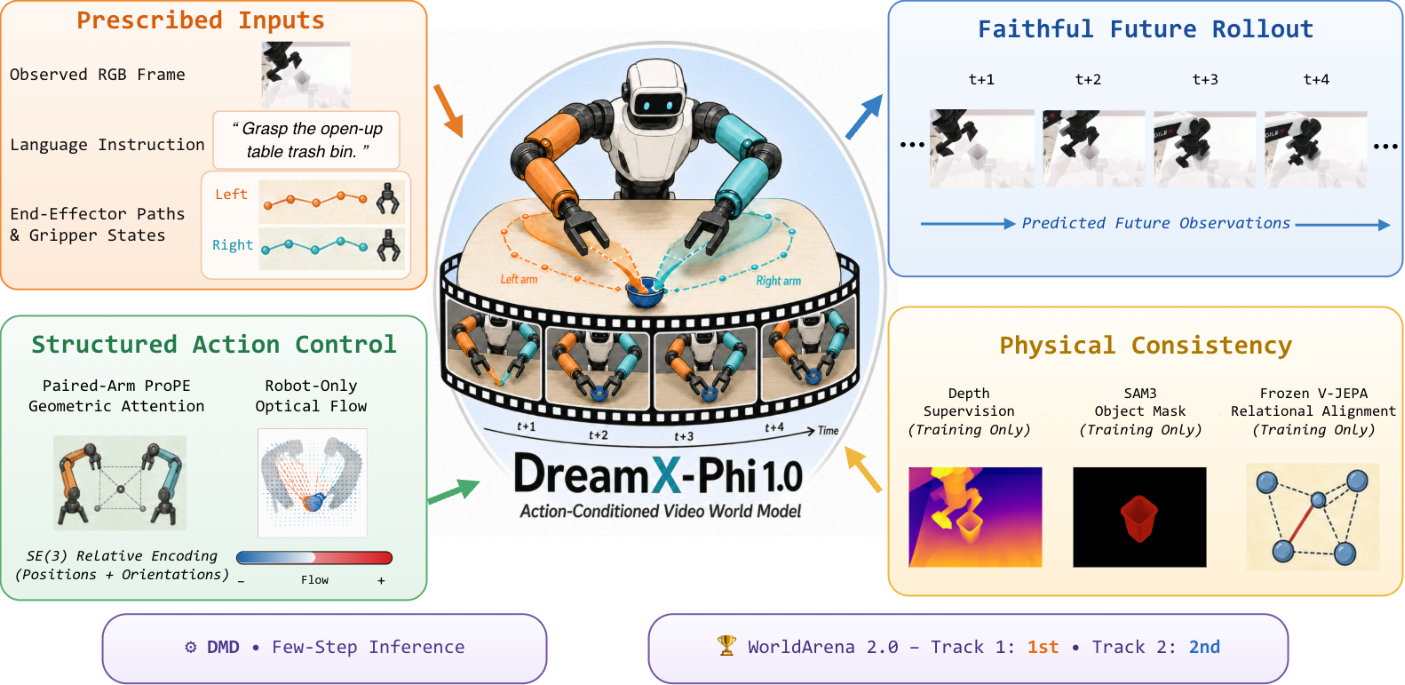
Figure 1 — DreamX-Phi 1.0 개요
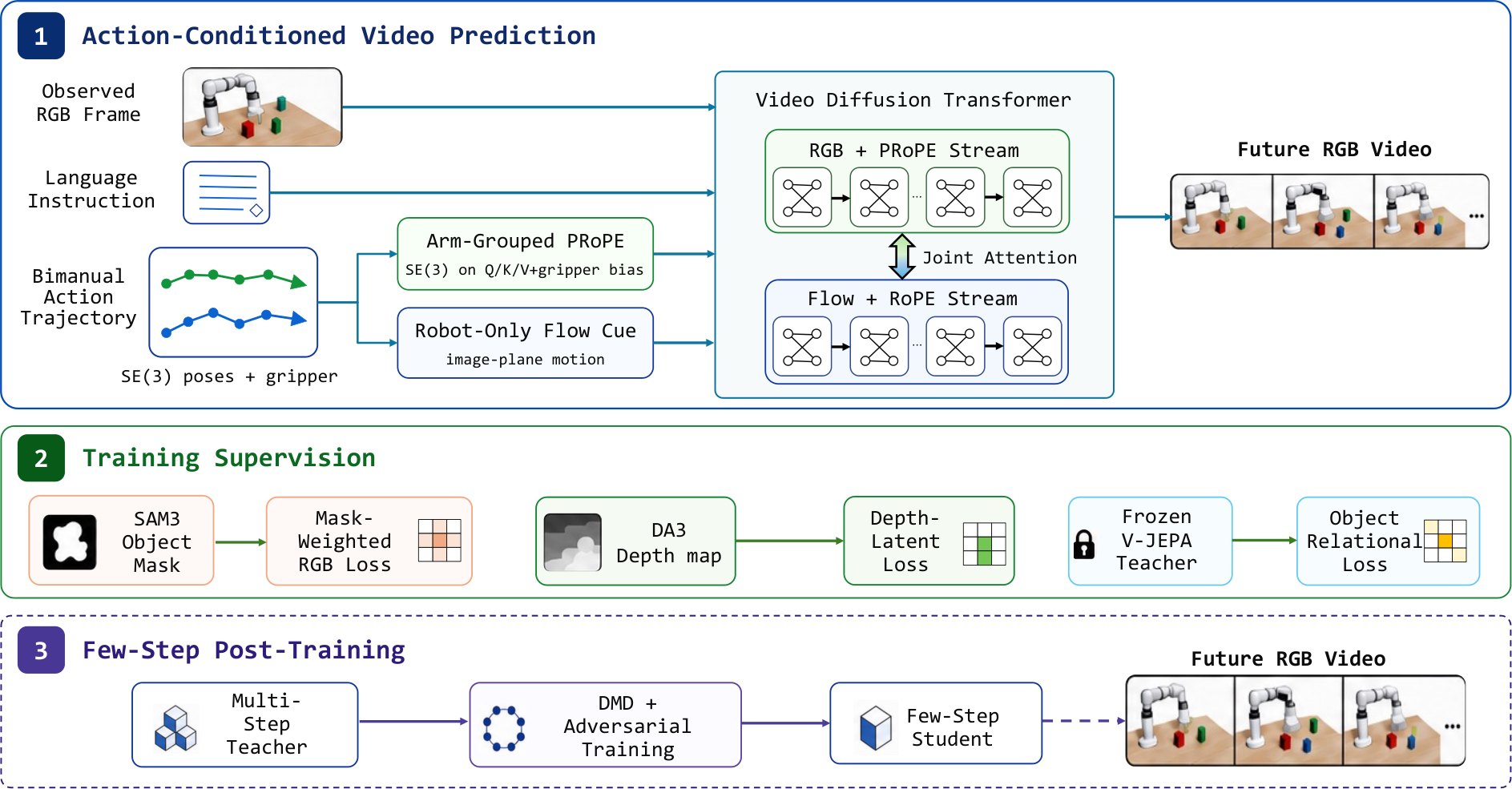
Figure 2 — DreamX-Phi 1.0 프레임워크
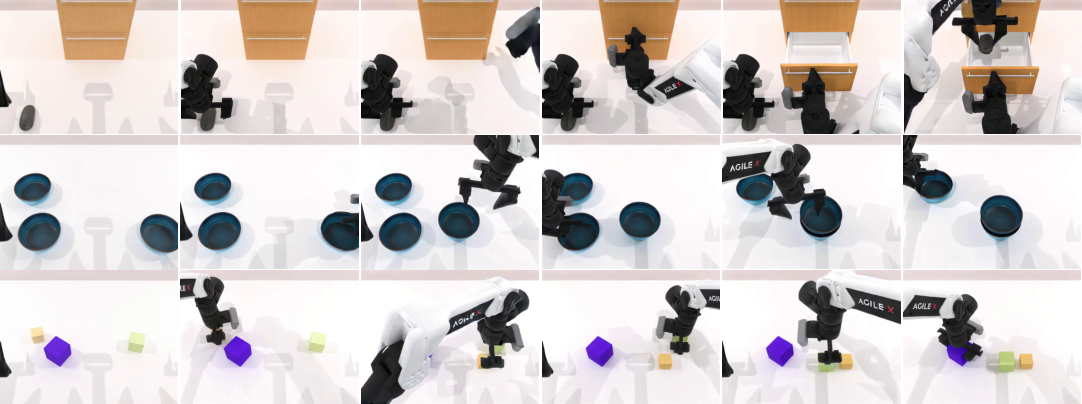
Figure 3 — WorldArena 2.0 Track 1 질적 결과
⚠️ 알림: 이 리뷰는 AI로 작성되었습니다.
관련 포스트
- [논문리뷰] ViRDM: Taming Representation Distribution Matching for Few-Step Causal Video Generation
- [논문리뷰] RoboFollow: Unveiling the Instruction Following Mirage in Embodied Agents
- [논문리뷰] CARE: Experience-Guided Atomic Corrective Execution for Vision-Language-Action Policies
- [논문리뷰] Zing-0.5: Toward Playable Worlds with Real-Time Joint Action and Text Control
- [논문리뷰] Attention-DP3: Spatially Object-aware 3D Diffusion Policy via Geometry-aligned Attentional Conditioning
Review 의 다른글
- 이전글 [논문리뷰] DarwinX: Evolving Agent Harnesses Through Natural Selection
- 현재글 : [논문리뷰] DreamX-Phi 1.0: Action-Conditioned Video World Model for Robotic Manipulation
- 다음글 [논문리뷰] Full-bandwidth transformer
댓글