[논문리뷰] Bilevel Coordinated Reflection: A Game-Theoretic Approach to Multi-Agent LLM Systems
링크: 논문 PDF로 바로 열기
The paper "Bilevel Coordinated Reflection: A Game-Theoretic Approach to Multi-Agent LLM Systems" by Yihang Chen et al. has been browsed. Now I need to extract the information as per the user's request.
Metadata Extraction:
- Authors: Yihang Chen, Yuxiang Chen, Yuxuan Huang, Meng Fang, Weilin Luo, Jun Wang
- Keywords: I'll read the abstract and introduction to pick 5-8 relevant academic keywords.
- Multi-Agent LLM Systems
- Bilevel Coordination Game
- Textual Reflection
- Game Theory
- Stochastic Approximation
- Environment Grounding
- Verifier-Gated Reflection
- SWE-bench
Figure Identification:
I need to find <img> tags. I see one directly below the abstract:
Figure 1: Bilevel coordinated reflection. The orchestrator (leader) selects a decomposition τ\tau and updates strategy memory mom_{o} on the slower timescale; workers (followers) update execution memory mem_{e} via ηc\eta_{c}-better responses on the faster timescale. Under bounded coupling, the followers’ subgame is an approximate potential game with slack ηc≤2dmaxκ\eta_{c}\leq 2d_{\max}\kappa, while verifier-gated SRMA separately governs which memory proposals are committed.- URL:
2609.02750v1/bilevel.png->https://arxiv.org/html/2609.02750v1/bilevel.png - Caption: "Bilevel coordinated reflection." (Korean: "이중 레벨 조정 반영")
- URL:
Looking for more figures, I see:
- Table 1: Overcooked score (HTML table, not image)
- Table 2: RC results (HTML table, not image)
- Table 3: Accepted proposals and final risk (HTML table, not image)
- Table 4: SWE-bench results (HTML table, not image)
It seems Figure 1 is the only image-based figure directly presented. The user specifically asked for <img> tags. If there are no other image figures, I will only include Figure 1.
Let's proceed with drafting the summary.
Part 1: Summary Body
1. Key Terms & Definitions
- Bilevel Coordination Game: Orchestrator(Leader)-Worker(Follower) 상호작용을 모델링하는 게임 이론적 프레임워크로, Leader는 task decomposition을 담당하고 Follower는 sub-solution을 생성하며, 이 과정에서 approximate potential game이 형성된다.
- Textual Reflection: LLM 시스템이 공유된 텍스트 메모리(critiques, hypotheses, lessons)를 업데이트하여 시스템 성능을 개선하는 메커니즘으로, 모델 weight가 고정된 상태에서 주요 적응 채널로 기능한다.
- Environment Grounding: 생성된 transcript에만 의존하지 않고, 실제 환경(예: test harness, simulator, API responses)으로부터 오는 신호를 활용하여 reflection의 진실성을 평가하는 과정이다.
- Stochastic Reflective Memory Ascent (SRMA): Grounded verifier의 평가 위험(risk)이 엄격하게 감소할 때만 candidate memory를 commit하는 gated reflection 메커니즘이다.
- Approximate Potential Game: 각 플레이어의 unilateral deviation에 따른 utility 변화가 전체 시스템의 potential 함수 변화와 일정 slack(ηc) 범위 내에서 일치하는 게임이다.
2. Motivation & Problem Statement
본 논문은 Multi-agent LLM 시스템에서 coordination, memory improvement, 그리고 external verification의 역할에 대한 통합적인 이론적 설명을 제공한다. 기존 Multi-agent LLM 시스템들은 orchestrator가 task를 worker들에게 분해하고 텍스트 reflection을 통해 개선하는 방식을 사용해왔지만, 이러한 시스템들은 조정, 메모리 개선, 외부 검증의 역할에 대한 통일된 이론적 기반이 부족했다. 특히, orchestrator의 decomposition quality가 worker coordination에 어떻게 영향을 미치는지, 무조건적인 reflection이 언제 수렴하지 않고 plateau에 도달하는지, 그리고 외부 verifier가 왜 text-only critic보다 더 성공할 수 있는지에 대한 세 가지 핵심 질문이 미해결 상태였다. 이러한 한계점들은 복잡한 작업에서 LLM의 context dilution 및 reasoning degradation 문제를 야기하며, 기존의 절차적 프레임워크만으로는 전략적 안정성이나 reflection이 개선하는 양적 지표를 설명할 수 없었다.
3. Method & Key Results
저자들은 Multi-agent LLM 시스템의 orchestrator–worker 상호작용을 bilevel coordination game으로 모델링하고, 텍스트 메모리 편집을 discrete semantic state space 상의 stochastic process로 분석하는 방법론을 제안한다. 이 프레임워크에서, worker들의 subgame은 ηc-approximate potential game이며, 그 equilibrium slack은 decomposition quality에 의해 제어된다.
Free-form reflection에 대한 분석 결과, one-sided drift condition 하에서는 유한 시간 upper bound가 존재하며, persistent harmful commitment 조건 하에서는 비제로 lower bound가 존재함을 증명했다. 이는 무조건적인 reflection이 hallucination floor에 도달할 수 있음을 의미한다.
가장 중요한 기여 중 하나는 Self-Gating Impossibility Theorem이다. 이 정리는 동일한 텍스트 생성 규칙을 가지지만 의미가 반대인 두 환경에서, transcript-only gate는 어떠한 경우에도 두 환경 모두에서 uniform하게 개선될 수 없음을 입증한다. 반면, environment-grounded gate는 이러한 환경을 구별하고 geometric convergence를 달성할 수 있음을 보여주었다.
이러한 결과에 기반하여, 저자들은 Stochastic Reflective Memory Ascent (SRMA)를 도입한다. SRMA는 grounded evaluation risk가 엄격하게 감소할 때만 candidate memory를 commit하는 방식으로 작동한다. Verifier Calibration 및 Non-Degenerate Corrective Mass 가정 하에서, SRMA는 exact convergence를 달성하며, 수렴 속도는 geometric 또는 polynomial (오차 eT∝T−1/βe_{T}\propto T^{-1/\beta})로 order-tight함이 증명되었다. 실험 결과는 이러한 이론적 예측을 강력하게 뒷받침한다. SWE-bench에서 완전한 Kimi 기반 시스템은 500개 인스턴스 중 72.2%를 해결하여, ungated free-form multi-agent reflection의 58.4% 및 기존 public mini-SWE-agent reference의 70.8%를 능가했다 [cite: 1, Table 4]. 또한, Resource Contest 실험에서 SRMA는 oracle reward의 98.5%–99.5%에 도달하며, 실행 메모리가 평균 2.6 reward points를 추가하고 mean regret을 60.8% 감소시켰다 [cite: 1, Table 2]. Overcooked 실험에서는 Grounded SRMA가 모든 레이아웃에서 가장 우수한 성능을 보였으며, text-only self-gate 대비 score를 14.3%에서 30.0%까지 향상시켰다 [cite: 1, Table 1]. Grounded SRMA는 harmful proposals의 acceptance rate를 6.2%로 대폭 줄이고 helpful proposals의 acceptance rate를 85.4%로 높여, 최종 risk를 self-gating 대비 절반으로 줄였다 [cite: 1, Table 3]. 이러한 결과들은 Figure 1에 제시된 bilevel coordinated reflection 프레임워크가 multi-agent LLM 시스템의 성능과 신뢰성을 향상시키는 데 필수적임을 시사한다 [cite: 1, Figure 1].
4. Conclusion & Impact
본 논문은 Multi-agent LLM 시스템의 reflection 메커니즘에 대한 조건부 및 정보 인식 이론을 제시했다. 핵심 결론은 bilevel coupling이 follower의 equilibrium slack을 제어하고, persistent harmful commitment가 free-form reflection에서 error floor를 발생시키며, reflection의 진실이 외부 상태에 의존할 경우 transcript-only gate는 uniform하게 성능을 개선할 수 없다는 것이다. 저자들이 제안하는 SRMA는 이러한 문제를 해결하기 위한 grounding을 제공하며, confidence-gating 및 re-anchoring 확장을 통해 order-tight geometric 또는 polynomial rates로 정확하게 수렴함을 이론적으로 입증하고 실험적으로 확인했다.
이 연구는 학계 및 산업계에 Multi-agent LLM 시스템 설계에 대한 깊은 이론적 통찰을 제공한다. 특히, external verification과 environment grounding의 중요성을 강조함으로써, 현재 LLM 시스템의 주요 문제점인 hallucination과 coordination failure를 극복할 수 있는 실질적인 가이드라인을 제시한다. SWE-bench와 같은 복잡한 실세계 소프트웨어 엔지니어링 작업에서의 성공적인 적용은, 제안된 접근 방식이 LLM 기반 agent의 신뢰성과 효율성을 크게 향상시킬 잠재력을 가지고 있음을 보여준다. 향후 연구는 memory quality와 budget-aware termination의 공동 최적화를 탐색할 수 있다.
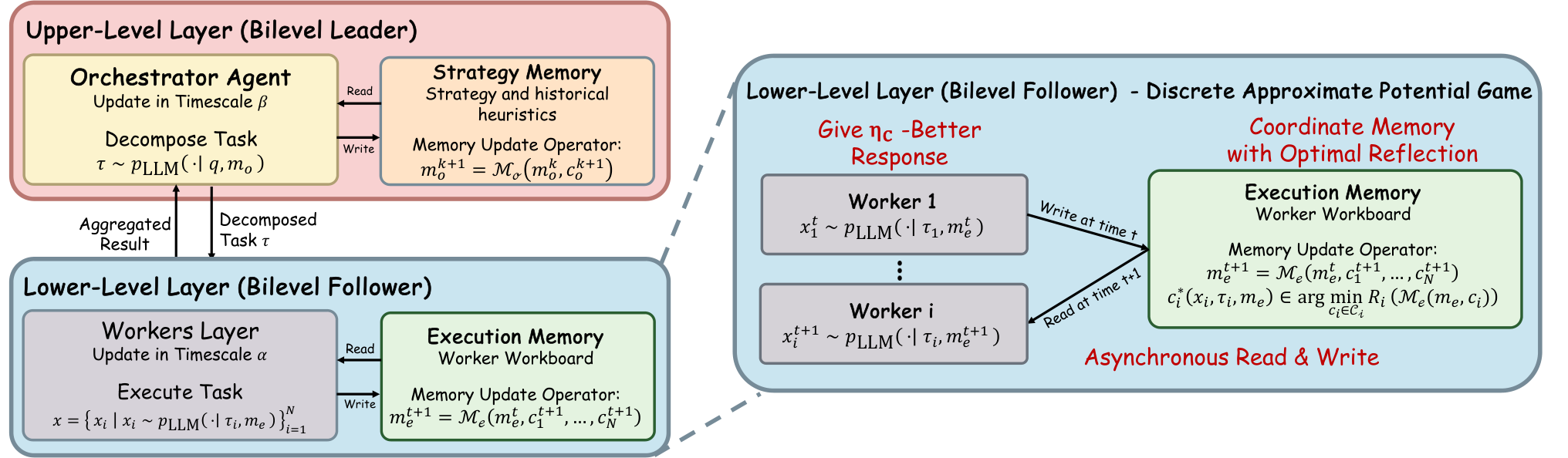
Figure 1 — 이중 레벨 조정 반영
⚠️ 알림: 이 리뷰는 AI로 작성되었습니다.
관련 포스트
- [논문리뷰] LLMs4All: A Review on Large Language Models for Research and Applications in Academic Disciplines
- [논문리뷰] X-AuT: Progressive Audio-Encoder Compression for Speech LLMs with Cross-Scale Distillation
- [논문리뷰] World in World: Explore the World with World Models
- [논문리뷰] UniH^3: Unifying Hierarchical Homogeneity and Heterogeneity for All-in-One Medical Image Restoration
- [논문리뷰] SpatialBlock: Enhancing Spatial Intelligence in LVLMs via Synthetic Block-Stacking Problem
Review 의 다른글
- 이전글 [논문리뷰] Beneath the Surface of Chains-of-Thought: A Mechanistic Interpretation of Reasoning Operations in LLMs
- 현재글 : [논문리뷰] Bilevel Coordinated Reflection: A Game-Theoretic Approach to Multi-Agent LLM Systems
- 다음글 [논문리뷰] Don't Drop Dropout: Optimizing Layer Sparsity for Efficient LLM Training and Inference
댓글