[논문리뷰] Agentic Visual Generation: From Generative Models to Agentic Control
링크: 논문 PDF로 바로 열기
The paper discusses "Agentic Visual Generation" and proposes a five-level hierarchy (L0 to L4) for classifying systems based on the "maximum temporal and causal reach of the decisions a controller can make" in the visual generation process.
Here's the information extraction plan:
Metadata:
- Authors: Yinming Huang, Shuyuan Tu, Xi Yan, Jiahao Zhan, Zihan Yang, Zhen Xing, Hui Zhang, Tiehua Zhang, Yu-Gang Jiang, Zuxuan Wu
- Keywords: From the abstract and Index Terms:
Agentic Visual Generation,Image Generation,Video Generation,Agentic Control,Reinforcement Learning,World Model,Multi-Agent Systems. I'll pick 5-8 from these.
Part 1: Markdown Summary
## 1. Key Terms & Definitions
- Agentic Visual Generation: Visual generation processes that involve a controller capable of planning, tool selection, output inspection, failure revision, and experience reuse, moving beyond single-invocation generative models.
- Controller Decision-Making Scope: 에이전틱 시스템의 컨트롤러가 시각적 생성 프로세스에서 내릴 수 있는 결정의 시간적 및 인과적 도달 범위. L0에서 L4까지의 계층을 정의하는 핵심 기준이다.
- L0 Fixed Support: 에이전틱 컨트롤러 없이 미리 결정된 추론 경로를 따르는 고정된 생성기, 편집기, 검색기, 평가기 등의 지원 구성 요소를 포함하는 단계.
- L1 Conditioning Control: 컨트롤러가 미리 결정된 실행기(executor)를 위해 입력 조건을 구성하지만, 어떤 시각적 operation이 실행될지는 제어하지 않는 단계.
- L2 Execution Control: 컨트롤러가 실제 생성, 편집, 렌더링 또는 기타 콘텐츠 수정 operation을 선택하고 호출할 수 있는 단계.
- L3 Outcome-Adaptive Control: 컨트롤러가 중간 결과물(outcome)을 관찰하고, 그 관찰을 사용하여 현재 task 내에서 후속 operation을 변경하는 단계.
- L4 Experience-Adaptive Control: 컨트롤러가 완료된 task의 경험을 유지하고, 그 경험을 사용하여 미래의 독립적인 task에 대한 결정을 변경하는 단계.
## 2. Motivation & Problem Statement
- Motivation: Visual generation은 단순한 generative models의 단일 호출(single invocation)을 넘어, 계획, 도구 선택, 중간 결과물 검사, 실패 수정, 이전 경험 재사용이 가능한 agentic control processes로 진화하고 있다.
- Problem: 기존 연구들은 시각적 생성 시스템이 언제 'agentic'이 되는지에 대한 일관된 기준이 부족하며, 계획 깊이, 도구 사용, 다중 역할 협업, Reinforcement Learning 등이 에이전시의 증거로 간주되지만, 컨트롤러가 어떤 생성 결정을 내릴 수 있는지를 명확히 정의하지 못한다. 이로 인해 파편화된 연구 분야와 에이전시 식별의 불일치 문제가 발생한다.
## 3. Method & Key Results
- Methodology: 본 논문은 컨트롤러의 decision-making scope를 기반으로 에이전틱 시각적 생성 시스템을 L0부터 L4까지의 계층적 분류(hierarchy)로 체계화한다. 이 분류는 컨트롤러가 생성 프로세스 내에서 미래의 어떤 결정까지 인과적으로 변경할 수 있는지를 기준으로 한다.
- L0 Fixed Support: 고정된 생성기, 편집기, 평가기 등 에이전틱 컨트롤러 없이 predetermined된 구성 요소.
- L1 Conditioning Control: 컨트롤러가 고정된 실행기를 위한 입력 조건(예: prompt, layout, reference)을 구성한다 [cite: 1, Figure 7].
- L2 Execution Control: 컨트롤러가 시각적 operation(예: tool/model, program, call order)을 선택하고 호출한다 [cite: 1, Figure 7].
- L3 Outcome-Adaptive Control: 컨트롤러가 중간 결과물(perceptual, structured, physical feedback)을 관찰하고, 이를 바탕으로 현재 task 내에서 후속 operation을 수정한다 [cite: 1, Figure 8].
- L4 Experience-Adaptive Control: 컨트롤러가 완료된 task의 경험(예: memory, skills, profiles, policy updates)을 저장하고, 이를 통해 미래의 독립적인 task에 대한 결정을 변경한다 [cite: 1, Figure 8].
- Key Results:
- 저자들은 이 프레임워크를 이미지, 비디오, 편집, 3D, 월드, 슬라이드, 사용자 인터페이스 생성 분야에 적용하여 컨트롤러의 역량(capability)이 어떻게 진화했으며, 메커니즘이 레벨별로 어떻게 분포하는지 분석했다.
- 특히, 2025년 이후의 급격한 성장(steep growth)은 L3 Outcome-Adaptive Control에 의해 주도되며, 생성된 결과물을 바탕으로 후속 결정을 내리는 within-trajectory feedback 방식이 가장 흔한 Agentic behavior임을 보여준다 [cite: 1, Figure 5].
- 반면, L4 Experience-Adaptive Control는 전체 연구의 작은 부분을 차지하며, cross-task persistence 재사용이 L3의 within-task correction보다 덜 성숙한(less mature) 연구 도전 과제임을 시사한다 [cite: 1, Figure 5].
- 제안하는 level-conditioned evaluation framework는 동일한 생성기, 도구, 예산, 평가기를 사용하여 각 레벨에서 컨트롤러의 decision-making scope 확장이 가지는 가치를 효과적으로 분리하여 평가할 수 있음을 제시한다 [cite: 1, Figure 9].
## 4. Conclusion & Impact
- 본 논문은 에이전틱 시각적 생성을 컨트롤러의 maximum causal reach를 기준으로 하는 5단계 계층(L0-L4)으로 정의함으로써, 기존의 파편화된 연구 분야를 통일된 관점으로 정리했다.
- 이 분류는 에이전시(agenticity)를 모델 크기, 시스템 복잡성, 출력 품질, 도구 수 또는 학습 방법과 독립적인 개념으로 명확히 구분한다.
- 특히, within-trajectory feedback에 중점을 둔 L3 컨트롤러의 성장은 실제 응용 분야에서 생성 결과의 수정 및 개선의 중요성을 강조한다 [cite: 1, Figure 5].
- 이 연구는 향후 연구 방향으로 executable action interfaces, reliable visual verification, causal credit assignment, selective long-term memory, 그리고 궁극적으로 generator-as-controller 패러다임으로의 전환을 제시하며, 시각적 생성 시스템의 지능적 자율성 및 적응성 향상에 중요한 이론적 및 실용적 기반을 제공한다.
Part 2: 중요 Figure 정보 I need to find up to 3 important figures. Looking at the HTML content, I see several figures:
2609.06758v1/firstpicture.png- Visual overview of controller decision-making scope. This is crucial as it visualizes the L0-L4 hierarchy. (Figure 1 in paper)2609.06758v1/popularpaper.png- Popular-paper roadmap across the L1–L4 controller levels. This shows the evolution. (Figure 2 in paper)2609.06758v1/compare_final.png- Illustrative comparisons across adjacent controller levels. Conceptual examples for each level. (Figure 3 in paper)2609.06758v1/fig4-part1.pngand2609.06758v1/fig4-part2.png- Four-tier taxonomy and roadmap of controller decision-making scope. (Figure 4 in paper) (These are combined from the text into one figure number, but are two separate images)2609.06758v1/fig5-temporal.png- Half-year capability evolution in the structured corpus. Quantitative data about adoption of levels. (Figure 5 in paper)2609.06758v1/fig6-cross-section.png- Corpus cross-sections (Modality x primary level and Controller organization x primary level). (Figure 6 in paper)2609.06758v1/fig7-l0-l2.png- From L0 Fixed Support to L2 Execution Control. Diagram showing the flow. (Figure 7 in paper)2609.06758v1/fig8-l3-l4.png- The distinction between L3 Outcome-Adaptive Control and L4 Experience-Adaptive Control. Diagram showing the flow. (Figure 8 in paper)2609.06758v1/evaluation-causal-framework.png- Causal evaluation of agentic visual generation. (Figure 9 in paper)
I'll choose:
- Figure 1 (
firstpicture.png): Overall hierarchy visualization (L0-L4). This is the core concept. - Figure 5 (
fig5-temporal.png): Quantitative landscape of capability evolution over time. This shows key results and trends. - Figure 9 (
evaluation-causal-framework.png): Causal evaluation framework. This is a key contribution for evaluation.
Let's find the exact figure_id in the paper for these images and ensure the URL is correct.
firstpicture.pngcorresponds to the first uncaptioned image after the abstract. The text refers to it as "Visual overview of controller decision-making scope." It is typically Figure 1. I'll use "Figure 1" for its ID.fig5-temporal.pngis explicitly captioned as "Figure 5: Half-year capability evolution in the structured corpus..."evaluation-causal-framework.pngis explicitly captioned as "Figure 9: Causal evaluation of agentic visual generation."
The URLs must be absolute: https://arxiv.org/html/2609.06758v1/x.png.
Final check on constraints:
- Technical Terminology in English: Yes, kept original terms.
- Natural Korean Phrasing: Yes, structured sentences in Korean.
- Mandatory Metadata: Yes, authors and keywords.
- Output format (Markdown + JSON): Yes.
- Sections: All 4 sections present.
- First sentence direct answer: Yes.
- Figure/Table references: Only selected ones, in
[Figure N]format, immediately after relevant text. - JSON format for figures: Yes,
figure_id,image_url,caption_kr. - Image URL rules: Absolute URL.
- Max 3 figures, no logos: Yes.
Confidence Score: 5/5 - I'm confident I can meet all requirements.저자: Yinming Huang, Shuyuan Tu, Xi Yan, et al.
1. Key Terms & Definitions
- Agentic Visual Generation: Generative models의 단일 호출(single invocation)을 넘어, 계획, 도구 선택, 중간 생성 결과물 검사, 실패 수정 및 이전 경험 재사용이 가능한 컨트롤러가 포함된 시각적 생성 프로세스를 의미한다.
- Controller Decision-Making Scope: Agentic 시스템의 컨트롤러가 시각적 생성 프로세스에서 내릴 수 있는 결정의 시간적 및 인과적 도달 범위를 지칭하며, 본 논문의 L0부터 L4까지의 계층을 정의하는 핵심 기준이다.
- L0 Fixed Support: 에이전틱 컨트롤러의 어떠한 결정 개입 없이 미리 결정된 추론 경로를 따르는 고정된 생성기, 편집기, 검색기, 평가기 등의 지원 구성 요소를 포함하는 단계이다.
- L1 Conditioning Control: 컨트롤러가 미리 결정된 실행기(executor)를 위한 입력 조건(예: textual prompt, spatial/geometric specification, retrieved evidence)을 구성하지만, 실제 어떤 시각적 operation이 실행될지는 제어하지 않는 단계이다 [cite: 1, Figure 1].
- L2 Execution Control: 컨트롤러가 실제 생성, 편집, 렌더링 또는 기타 콘텐츠 수정 operation을 동적으로 선택하고 호출할 수 있는 단계이며, 그 결과가 관찰되기 전에 operation을 결정한다 [cite: 1, Figure 1].
- L3 Outcome-Adaptive Control: 컨트롤러가 중간 결과물(perceptual, structured, execution, physical, human review feedback)을 관찰하고, 그 관찰을 사용하여 현재 task 내에서 후속 operation을 수정하는 단계이다 [cite: 1, Figure 1].
- L4 Experience-Adaptive Control: 컨트롤러가 완료된 task의 경험(예: capability/tool profiles, episodic/user memory, reusable procedures/skills, executable workflows/harnesses, policy/model updates)을 유지하고, 그 경험을 사용하여 미래의 독립적인 task에 대한 결정을 변경하는 단계이다 [cite: 1, Figure 1].
2. Motivation & Problem Statement
본 논문은 Visual Generation 분야가 단일 호출(single invocation) Generative Models에서 계획, 도구 선택, 중간 Synthesized Outputs 검사, 실패 수정 및 이전 경험 재사용이 가능한 Agentic Control Processes로 진화하고 있음을 강조한다. 기존 연구에서는 생성 시스템이 언제 Agentic으로 간주되어야 하는지에 대한 일관된 기준이 부족하며, Planning depth, Tool use, Multi-role collaboration, Reinforcement Learning 등이 Agenticity의 증거로 제시되었지만, 컨트롤러가 어떤 종류의 생성 결정을 내릴 수 있는지에 대한 명확한 정의는 제시되지 않았다. 이러한 불명확성으로 인해 연구 분야가 파편화되고 Agenticity 식별에 일관성이 결여되는 문제가 발생했다. 저자들은 이러한 한계를 극복하기 위해 컨트롤러의 Decision-Making Scope에 따라 분야를 체계적으로 조직하는 새로운 분류 체계를 제안한다.
3. Method & Key Results
저자들은 에이전틱 시각적 생성 시스템을 컨트롤러의 Decision-Making Scope를 기준으로 L0부터 L4까지의 계층적 분류(hierarchy)로 체계화하는 방법론을 제안한다. 이 계층은 컨트롤러가 생성 trajectory 내에서 미래의 어떤 생성 결정까지 인과적으로 변경할 수 있는지를 기준으로 시스템을 분류한다. L0 Fixed Support는 고정된 생성기, 편집기, 평가기 등 Agentic 컨트롤러 없이 미리 결정된 추론 경로를 따르는 구성 요소를 포함하며 프레임워크의 포함 경계(inclusion boundary)를 형성한다 [cite: 1, Figure 1]. L1 Conditioning Control은 컨트롤러가 고정된 실행기를 위한 입력 조건(예: prompt, layout, reference)을 구성하는 단계이고, L2 Execution Control은 컨트롤러가 실제 시각적 operation을 선택하고 호출하는 단계이다 [cite: 1, Figure 1]. 나아가 L3 Outcome-Adaptive Control은 중간 결과물(perceptual, structured, physical feedback 등)을 관찰하여 현재 task 내에서 후속 operation을 수정하며, L4 Experience-Adaptive Control은 완료된 task의 경험을 저장하고 이를 통해 미래의 독립적인 task에 대한 결정을 변경한다 [cite: 1, Figure 1].
주요 결과로, 이 프레임워크를 Image, Video, Editing, 3D, World, Slide, User-Interface Generation 분야에 적용한 결과, 컨트롤러 역량(capability)의 진화와 메커니즘의 레벨별 분포를 파악할 수 있었다. 특히, 2025년 이후의 급격한 시스템 증가는 L3 Outcome-Adaptive Control이 주도하는 것으로 나타났으며, 이는 생성된 결과물을 바탕으로 후속 결정을 내리는 within-trajectory feedback 방식이 현재 가장 흔한 Agentic behavior임을 시사한다 [cite: 1, Figure 5]. 반면, L4 Experience-Adaptive Control는 전체 연구의 작은 부분을 차지하며, Cross-task persistence 재사용이 within-task correction에 비해 덜 성숙한(less mature) 연구 도전 과제임을 보여준다 [cite: 1, Figure 5]. 또한, 저자들은 Level-conditioned Evaluation Framework를 개발하여, 동일한 생성기, 도구, 예산, 평가기를 사용하여 각 레벨에서 컨트롤러의 decision-making scope 확장이 가지는 한계 가치(marginal value)를 효과적으로 분리하여 평가할 수 있음을 제시한다 [cite: 1, Figure 9]. 이 평가 프로토콜은 L0 baseline 대비 L1에서 Specification Control, L2에서 Operation Selection, L3에서 Outcome-Dependent Repair, L4에서 Cross-Task Experience Reuse의 추가적인 가치를 정량적으로 측정하는 방법을 제공한다 [cite: 1, Figure 9].
4. Conclusion & Impact
본 논문은 Agentic Visual Generation을 컨트롤러의 Maximum Causal Reach를 기준으로 하는 L0부터 L4까지의 5단계 계층으로 정의함으로써, 기존의 파편화된 연구 분야를 통일된 관점으로 정리하는 데 기여했다. 이 분류는 Agenticity를 모델 크기, 시스템 복잡성, 출력 품질, 도구 수 또는 학습 방법과 독립적인 개념으로 명확히 구분한다. 특히, Within-trajectory feedback에 중점을 둔 L3 컨트롤러의 성장은 실제 응용 분야에서 생성 결과의 수정 및 개선이 중요함을 강조하며, 이는 Agentic Visual Generation 시스템의 지능적 자율성 및 적응성 향상에 중요한 시사점을 제공한다 [cite: 1, Figure 5]. 이 연구는 향후 연구 방향으로 Executable Action Interfaces, Reliable Visual Verification, Causal Credit Assignment, Selective Long-Term Memory와 같은 핵심 과제를 제시하며, 궁극적으로 Visual State와 Control State를 공유하여 보다 정교한 수정과 낮은 상호작용 비용을 가능하게 하는 Generator-as-Controller 패러다임으로의 전환을 제안한다. 이러한 제안은 시각적 생성 기술의 발전 방향을 제시하고, 학계 및 산업계에서 보다 지능적이고 자율적인 시각 콘텐츠 생성 시스템을 개발하는 데 중요한 이론적 및 실용적 기반을 제공할 것으로 기대된다.
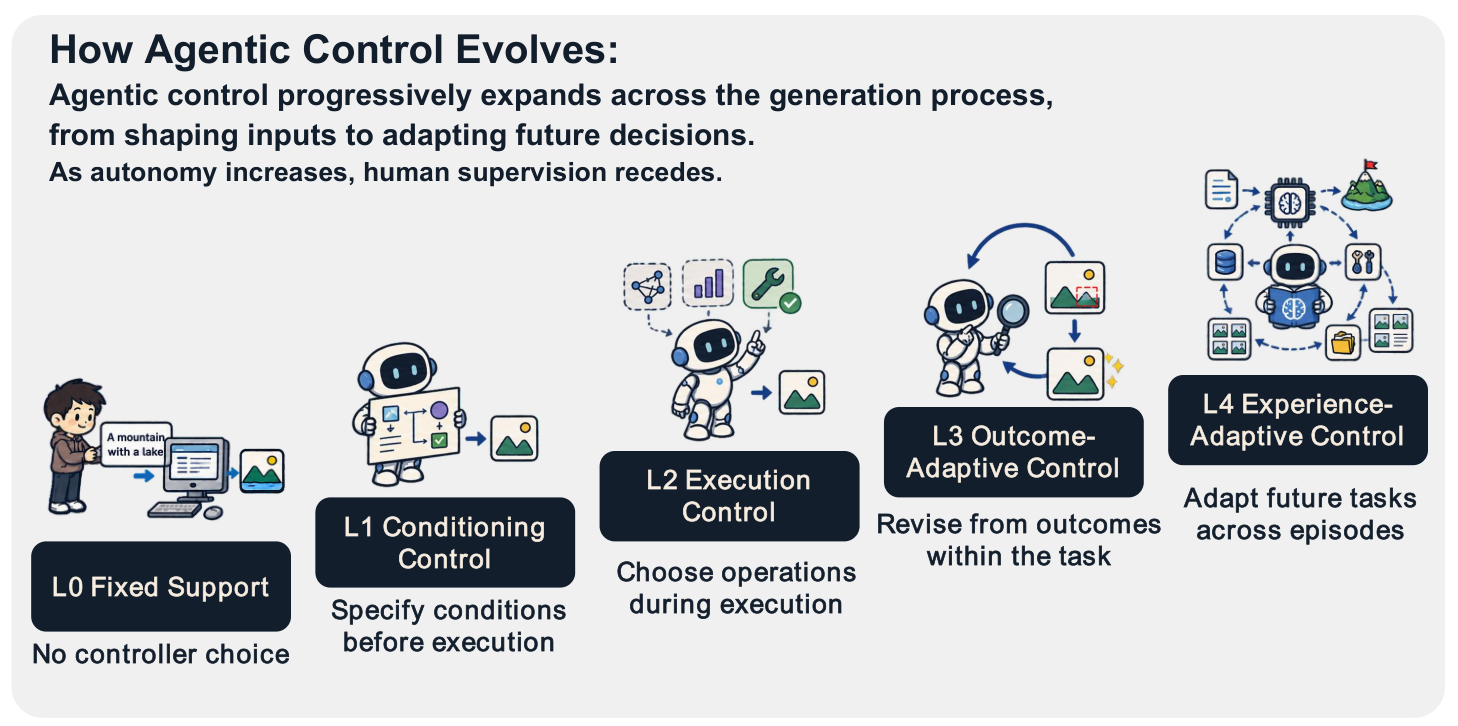
Figure 1 — 컨트롤러 의사결정 범위 개요
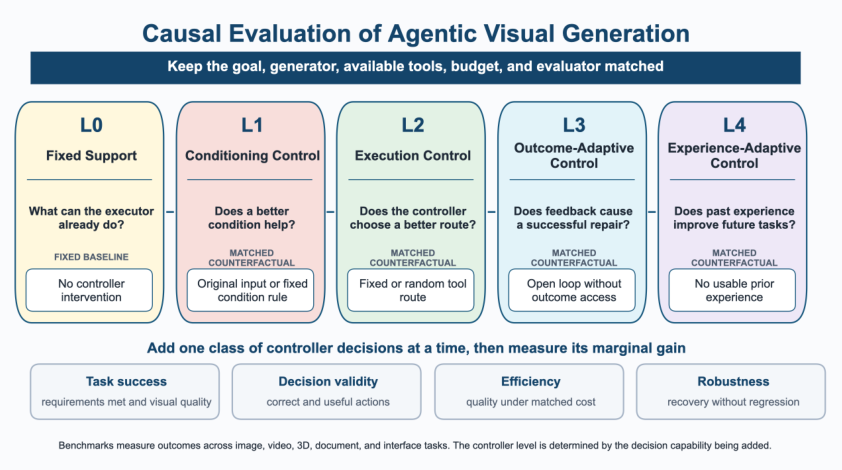
Figure 9 — 에이전틱 시각 생성 인과 평가
⚠️ 알림: 이 리뷰는 AI로 작성되었습니다.
관련 포스트
- [논문리뷰] The Hitchhiker's Guide to Agentic AI: From Foundations to Systems
- [논문리뷰] AgentFugue: Agent Scaling for Long-Horizon Tasks through Collective Reasoning
- [논문리뷰] Agent Bazaar: Enabling Economic Alignment in Multi-Agent Marketplaces
- [논문리뷰] Reinforcement Learning for LLM-based Multi-Agent Systems through Orchestration Traces
- [논문리뷰] RationalRewards: Reasoning Rewards Scale Visual Generation Both Training and Test Time
Review 의 다른글
- 이전글 [논문리뷰] A*-Thought-V2: Efficient Latent Reasoning via Geometric Dynamics of LLM
- 현재글 : [논문리뷰] Agentic Visual Generation: From Generative Models to Agentic Control
- 다음글 [논문리뷰] AuK Technical Report: An Open-Source Foundational Model for Speech Generation and Editing
댓글