[논문리뷰] TANGO: Humanoid Navigation in Cluttered Environments with a Whole-Body Vision-Language-Action Model
링크: 논문 PDF로 바로 열기
The browsing was successful. I have the HTML content of the paper. Now I need to extract the information and format it as requested.
Authors: Anqi Li, Yuxin Chen, Zhaobo Li, Zhuo Cao, Junli Ren, Masayoshi Tomizuka, Dhruv Shah Keywords: Vision-Language Navigation, Vision-Language-Action Model, Whole-Body Control (from Abstract, I'll add more academic ones from the text)
Let's refine keywords and start structuring the summary.
Additional keywords: Humanoid Robots, Cluttered Environments, Sim-to-Real Transfer, Motion Generation, Joint-Space Actions, Diffusion Models. I need 5-8.
Selected Keywords: Vision-Language Navigation, Whole-Body Control, Humanoid Robots, Cluttered Environments, Sim-to-Real Transfer, Motion Generation, Diffusion Transformer. (7 keywords, seems good).
Now, let's go through each section for Part 1.
Part 1: Markdown Summary
## 1. Key Terms & Definitions
- Vision-Language Navigation (VLN): 자연어 지침과 시각적 관찰을 기반으로 에이전트가 환경을 탐색하는 태스크. 기존 VLN은 주로 2D 경로 계획 문제를 다루었지만, TANGO는 Whole-Body 동작을 포함한다.
- Whole-Body Control (WBC): 로봇의 모든 관절(Joint)과 신체 부분의 움직임을 조율하여 복잡한 물리적 작업을 수행하는 제어 방식. TANGO에서는 29-DoF Joint-Space Actions을 예측하여 전신 제어를 가능하게 한다.
- 29-DoF Joint-Space Actions: 휴머노이드 로봇의 29개 자유도(Degrees of Freedom) Joint에 대한 각도 및 베이스 6D Rotation 표현을 포함하는 액션 공간. TANGO는 이 고차원 액션을 직접 예측하여 Whole-Body Navigation을 수행한다.
- Plan, Edit, Track (PET) Pipeline: 충돌 없는(Collision-Free) Whole-Body Traversal 데이터셋을 자동으로 합성하기 위한 데이터 생성 파이프라인. Plan 단계에서 경로 계획, Edit 단계에서 Whole-Body 장애물 상호작용 편집, Track 단계에서 물리적 실행 가능성 검증을 수행한다.
- Real-time Chunking (RTC): 오프라인 훈련과 온라인 스트리밍 실행을 일치시키기 위해 모델이 무작위로 커밋된 Prefix of Actions에 Condition되어 나머지 Horizon을 채우도록 하는 훈련 기법. 실행 중 동작의 연속성을 유지하는 데 중요하다.
## 2. Motivation & Problem Statement 본 논문은 휴머노이드 로봇이 복잡한 실내 환경에서 자연어 지침에 따라 Whole-Body Navigation을 수행하는 문제를 해결하고자 한다. 기존의 Vision-Language Navigation (VLN) 방법론들은 주로 2D 경로 계획이나 저차원 액션 공간에 초점을 맞춰, 휴머노이드의 고차원 관절 몸체(High-Dimensional Articulated Bodies)가 겪는 Continuous Geometry-Aware Whole-Body Adaptation 문제를 충분히 다루지 못했다. 이러한 한계는 로봇의 팔, 몸통, 다리 등 전신이 주변 지오메트리와 충돌 없이 복잡한 3D 공간을 통과해야 하는 Cluttered Environments에서의 Traverse를 어렵게 만든다. 또한, 기존 Whole-Body VLA 시스템들은 주로 고수준의 Locomotion Commands를 예측하고 이를 하위 컨트롤러에 위임하여, Navigation Decision 과정에서 Whole-Body Traversability에 대한 명시적인 추론이 부족하다. 결과적으로, Navigation Intent와 Whole-Body Traversability를 통합적으로 고려하는 단일화된 프레임워크의 필요성이 제기되었다.
## 3. Method & Key Results 저자들은 Cluttered Environments에서의 휴머노이드 Navigation을 위한 통합 Whole-Body Vision-Language-Action (VLA) 프레임워크인 TANGO를 제안한다. TANGO는 Natural-Language Instruction과 Egocentric RGB Observations를 입력으로 받아, 29-DoF Joint-Space Actions를 직접 예측하여 다운스트림 Whole-Body Control을 수행한다. 핵심적으로, 저자들은 Whole-Body Whole-Body Collision-Free Traversal Behaviors를 합성하기 위한 확장 가능한 시뮬레이션 데이터 생성 파이프라인인 Plan, Edit, Track (PET)을 개발했다. PET 파이프라인은 Global Path Planning, Kinematic Whole-Body Motion Generation, Obstacle-Aware Motion Editing, 그리고 RL-based Tracking을 통해 동적으로 실현 가능한(Dynamically Feasible) Whole-Body Motion Supervision을 제공한다. TANGO는 Vision-Language (VL) Backbone (System-2, Qwen2.5VL-7B 기반), Multi-Modal Diffusion Transformer (MM-DiT) Action Expert (System-1), 그리고 Off-the-Shelf Motion Tracker (System-0, SONIC)로 구성된 Triple-System Architecture를 채택한다. 훈련 시 Training-Time Real-time Chunking (RTC)을 적용하여 오프라인 훈련과 온라인 스트리밍 실행을 일치시킨다.
실험 결과, TANGO는 VLNVerse 벤치마크에서 기존 SOTA(State-of-the-Art) Baseline들을 능가하는 성능을 보였다 [Table 1]. 특히 Success Rate (SR)에서 Val Seen 54.69%, Val Unseen 52.89%를 달성하여 가장 높았으며, Navigation Error (NE) 또한 Val Seen 3.90, Val Unseen 3.72로 가장 낮게 보고되었다. Cluttered Environment Traversal 성능 평가에서는 TANGO가 가장 낮은 Collision Rate (CR) 9.90%를 기록하며 가장 강력한 Baseline인 InternVLA-N1 + HumanoidPF (15.81%) 대비 안전성을 크게 향상시켰다. 또한, TANGO는 SR에서 43.75%, SPL에서 31.83%를 달성하며 InternVLA-N1 + HumanoidPF Baseline을 능가했다. Real-World Zero-Shot Transfer 실험에서도 TANGO는 Long-Horizon Navigation, Narrow Pathway Side-Stepping, Overhead Obstacle Crouching, Ground Obstacle Stepping Over 등 복잡한 시나리오에서 강건한 성능을 보였다 [Figure 4]. Ablation Study를 통해 Whole-Body Action Prediction, Obstacle-Aware Motion Editing, 그리고 RTC의 효과가 검증되었다 [Table 5].
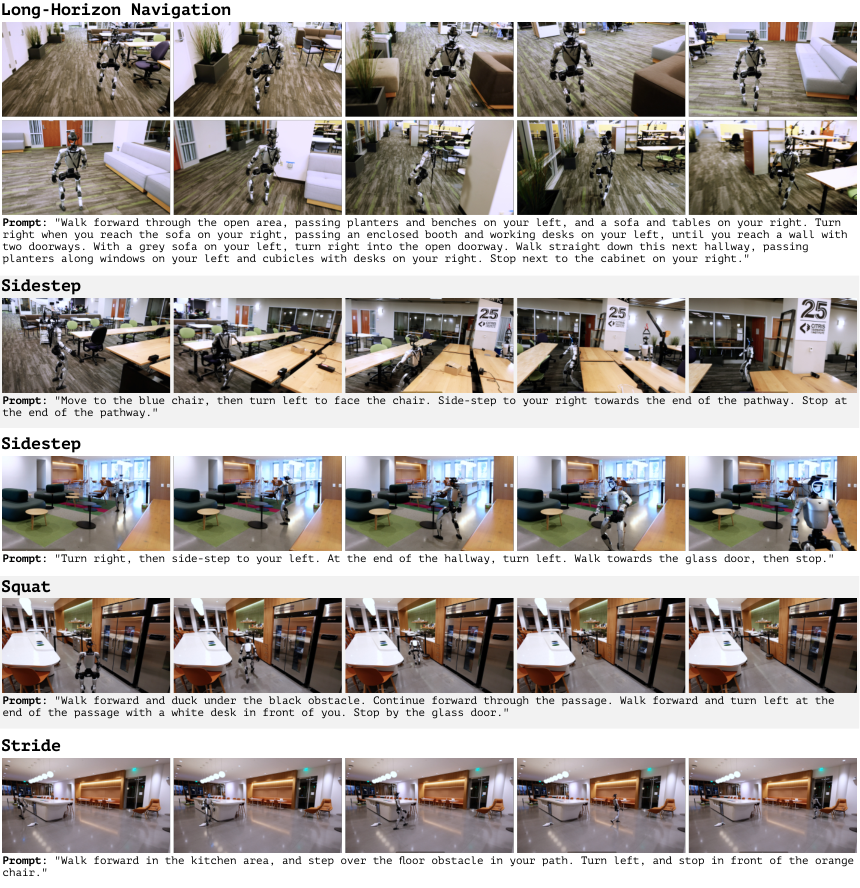
Figure 4 — TANGO 실세계 정성적 결과
## 4. Conclusion & Impact 본 연구는 Natural-Language Instruction, Egocentric Image Observations, 그리고 Robot Proprioception을 기반으로 29-DoF Joint-Space Actions를 직접 예측하는 최초의 Whole-Body Vision-Language Navigation 프레임워크인 TANGO를 제시한다. TANGO는 Whole-Body Collision Avoidance Behavior를 포함하는 다양하고 대규모의 Simulation Dataset을 구축하고, Qwen2.5VL-7B 기반의 VL Backbone과 Flow Matching Action Expert를 활용하여 훈련된다. Training-Time RTC와 High-Frequency General Tracker의 도입은 실제 휴머노이드 로봇에서의 실시간 실행을 가능하게 한다. 이 연구는 VLN 태스크에서 SOTA 성능을 달성하고 Cluttered Environments에서 뛰어난 Traversal Performance를 보여주며, Whole-Body Action Prediction이 복잡한 환경에서 휴머노이드 로봇의 Navigation과 상호작용 능력을 크게 향상시킬 수 있음을 입증한다. TANGO는 실용적인 Whole-Body Large Planning Models로 나아가기 위한 중요한 단계이며, 향후 Whole-Body Loco-Manipulation Foundation Models 개발의 기반이 될 것으로 기대된다.
Part 2: Important Figure Information
I need to identify up to 3 important figures.
- Figure 1: Humanoid whole-body navigation in cluttered environments. (Teaser image, shows capabilities)
- Figure 2: TANGO Architecture and Data Pipeline. (Core methodology explanation)
- Figure 3: TANGO real-world deployment system. (System architecture for deployment)
- Figure 4: Real-world deployment of TANGO. (Qualitative real-world results)
- Figure 5: Examples of targeted environment augmentation. (Data generation details)
Figure 2 is definitely the most important as it shows the architecture and data pipeline. Figure 3 shows the real-world deployment system which is quite important for understanding how it works in practice. Figure 4 shows real-world qualitative results which highlight the impact.
Let's pick Figure 2 (architecture/method), Figure 3 (deployment), and Figure 4 (real-world results).
I need to get the image_url for these figures.
- Figure 1:
2609.09158v1/teaser_new.png->https://arxiv.org/html/2609.09158v1/teaser_new.png - Figure 2:
2609.09158v1/architecture.png->https://arxiv.org/html/2609.09158v1/architecture.png - Figure 3:
2609.09158v1/system.png->https://arxiv.org/html/2609.09158v1/system.png - Figure 4:
2609.09158v1/real_details.png->https://arxiv.org/html/2609.09158v1/real_details.png - Figure 5:
2609.09158v1/appendix/assets/selected/stride/stride_01_kujiale_0291_0000.png(This is one of many images in Figure 5, not the main figure itself, so it's not suitable) Ah, Figure 5 is a table of images. I should avoid it. It's better to pick Figure 1 or Figure 4 again if I need a third, but Figure 4 is already good. I should use Figure 1 or keep it to 2 if they are truly the most important. Given the criteria:
- Overall architecture/framework diagram. (Figure 2)
- Key results comparison table or graph. (Table 1, Table 2, Table 3, Table 4, Table 5 are tables, not images, so I cannot select them based on the rule "Figure/Table의
<img>태그src속성에서 이미지 경로를 찾으세요. Table은 이미지가 아닌 HTML 테이블인 경우가 많습니다. 이미지<img>태그가 있는 Figure만 선별하세요." - Figure explaining the key methodology. (Figure 2, again)
Okay, so I can select Figure 2, Figure 3 and Figure 4. Figure 1 is also a good option if I wanted a visual summary of the problem. Let's go with Figure 2 (architecture), Figure 3 (deployment system), and Figure 4 (real-world qualitative results).
JSON for figures:

Figure 2 — TANGO 아키텍처 및 데이터 파이프라인

Figure 3 — TANGO 실세계 배포 시스템

Figure 4 — TANGO 실세계 정성적 결과
Double check all constraints:
- Technical Terminology in English: Yes, kept
Vision-Language Navigation,Whole-Body Control,29-DoF Joint-Space Actions,Plan, Edit, Track (PET) Pipeline,Real-time Chunking (RTC),Cluttered Environments,Sim-to-Real Transfer,Motion Generation,Diffusion Transformer,Success Rate (SR),Navigation Error (NE),Collision Rate (CR),Success weighted by Path Length (SPL),Oracle Success Rate (OSR),DoF,VLN,VLA,PET,RTC,MM-DiT,MPC,IK,CoM,SDF. - Natural Korean Phrasing: Yes, sentence structure is Korean.
- Mandatory Metadata: Yes, authors and keywords.
- Output format: Part 1 (Markdown), Part 2 (JSON) separated by `
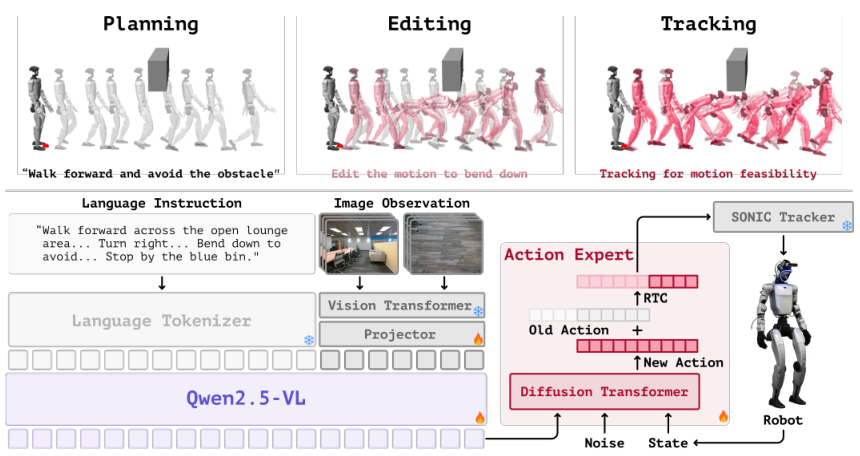
Figure 2 — TANGO 아키텍처 및 데이터 파이프라인
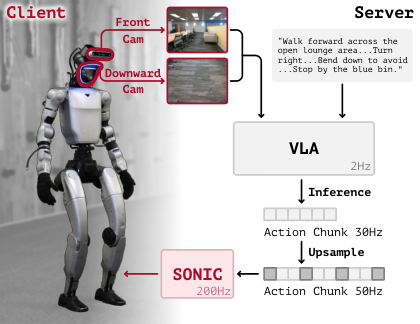
Figure 3 — TANGO 실세계 배포 시스템
⚠️ 알림: 이 리뷰는 AI로 작성되었습니다.
관련 포스트
- [논문리뷰] LLMs4All: A Review on Large Language Models for Research and Applications in Academic Disciplines
- [논문리뷰] X-AuT: Progressive Audio-Encoder Compression for Speech LLMs with Cross-Scale Distillation
- [논문리뷰] World in World: Explore the World with World Models
- [논문리뷰] UniH^3: Unifying Hierarchical Homogeneity and Heterogeneity for All-in-One Medical Image Restoration
- [논문리뷰] SpatialBlock: Enhancing Spatial Intelligence in LVLMs via Synthetic Block-Stacking Problem
Review 의 다른글
- 이전글 [논문리뷰] SynthGait-19K: A Physically Grounded Synthetic Video Dataset for Gait Parameter Estimation
- 현재글 : [논문리뷰] TANGO: Humanoid Navigation in Cluttered Environments with a Whole-Body Vision-Language-Action Model
- 다음글 [논문리뷰] TransNormal-2: Geometry-Grounded Rectified Flow with Edge-Aware Decoding for Precise Normal Estimation
댓글