[논문리뷰] TransNormal-2: Geometry-Grounded Rectified Flow with Edge-Aware Decoding for Precise Normal Estimation
링크: 논문 PDF로 바로 열기
저자: Mingwei Li, Yi Yang, Hehe Fan, et al.
1. Key Terms & Definitions (핵심 용어 및 정의)
- VAE Reconstruction Degradation: Diffusion-based geometry estimation 모델에서 VAE(Variational Autoencoder)의 8x8 spatial compression으로 인해 특히 객체 경계(object boundaries)에서 표면 normal의 세부 정보가 손상되는 현상.
- Rectified Flow: FLUX.2와 같은 Diffusion Transformer (DiT) 모델에서 단일 스텝(single-step)의 deterministic inference를 가능하게 하는 효율적인 훈련 패러다임.
- Geometric Refinement Module (GRM): 본 논문에서 제안하는 경량(lightweight)의 RGB-guided post-decoder module로, VAE 디코딩 후 잔존하는 경계-localization된 디코딩 에러(boundary-localized decoding errors)를 줄이는 역할을 수행한다.
- von Mises-Fisher (vMF) Angular Loss: 디코딩된 unit normal에 대해 적용되는 pixel-space directional loss로, unit vector의 방향적 데이터에 적합하며 latent space MSE가 포착하지 못하는 angular deviation을 penalize한다.
- Inverse Rendering Self-Consistency Loss: Lambertian reflectance 가정을 기반으로 예측된 normal과 관찰된 shading 간의 상관관계를 최대화하여 일반 장면(general-scene)의 geometry를 regularization하는 self-supervised loss.
2. Motivation & Problem Statement (연구 배경 및 문제 정의)
본 논문은 diffusion-based monocular geometry estimation에서 간과되었던 VAE reconstruction degradation이라는 근본적인 문제점을 제기한다. 최신 text-to-image diffusion model을 dense geometric prediction에 재활용하는 방식은 빠르게 발전했지만, 공통적으로 사용되는 VAE encoder-decoder의 8x8 spatial compression은 객체 경계(object boundaries)에서의 표면 normal 변화를 평균화하여 pixel-space precision을 저해한다. 저자들의 정량적 연구에 따르면, ground-truth normal을 VAE에 인코딩하고 디코딩하는 과정만으로도 **1.3°에서 8.5°**의 Mean Angular Error (MAE)가 발생하며, 특히 경계 영역(edge regions)에서의 MAE는 전체 평균 MAE의 최대 2.8배에 달한다. 이러한 degradation은 latent-space training objective만으로는 해결할 수 없으며, 기존 latent representation으로는 보유하지 못하는 full-resolution 정보를 통해 교정이 필요하다는 점이 본 연구의 주요 동기이다. [Figure 2]는 VAE 재구성 degradation의 정량적 규모와 에러가 기하학적 경계에 집중됨을 시각적으로 보여준다.
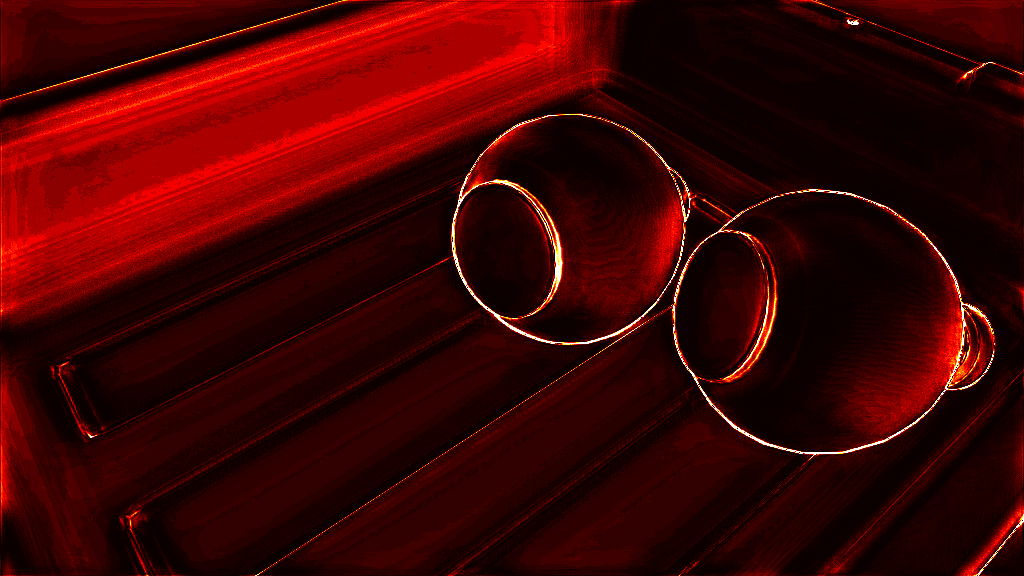
Figure 2 — VAE 재구성 에러 맵
3. Method & Key Results (제안 방법론 및 핵심 결과)
저자들은 VAE reconstruction bottleneck을 해결하기 위해 TransNormal-2를 제안하며, 이는 FLUX.2-based rectified-flow framework를 기반으로 단일 스텝(single-step)의 deterministic inference를 수행한다. 본 방법론은 VAE 디코더의 양측면에서 degradation을 제어하는 두 가지 상호 보완적인 전략을 사용한다:
- Geometry-aware pixel-space losses: 훈련 중 디코딩된 normal field를 감독하여, latent prediction이 VAE-latent MSE에 의해서만 판단되지 않도록 한다. 이는 von Mises-Fisher (vMF) angular loss(ℒvmf)를 통해 spherical normal geometry를, wavelet edge-aware regularization(ℒwavelet)을 통해 객체 경계에 고주파 감독을 집중하며, inverse rendering self-consistency loss(ℒrender)를 통해 diffuse image-formation cues로부터 추가적인 제약을 부과한다. [Figure 4]는 이러한 geometry-aware pixel-space losses의 개념을 시각적으로 설명한다.
- Geometric Refinement Module (GRM): 디코딩 후 경량(lightweight)의 RGB-guided residual correction을 적용하여 잔존하는 경계-localization된 디코딩 에러를 줄인다. GRM은 coarse prediction을 자유롭게 덮어쓰는 대신, 게이트(gated) 및 스케일링된 잔차(scaled residual)를 예측하여 residual error를 보정하도록 제한된다. [Figure 3]는 TransNormal-2 프레임워크의 전체적인 개요를 보여주며, 인코딩, 단일 스텝 직접 예측, 디코딩 및 GRM을 통한 refinement 과정을 포함한다.
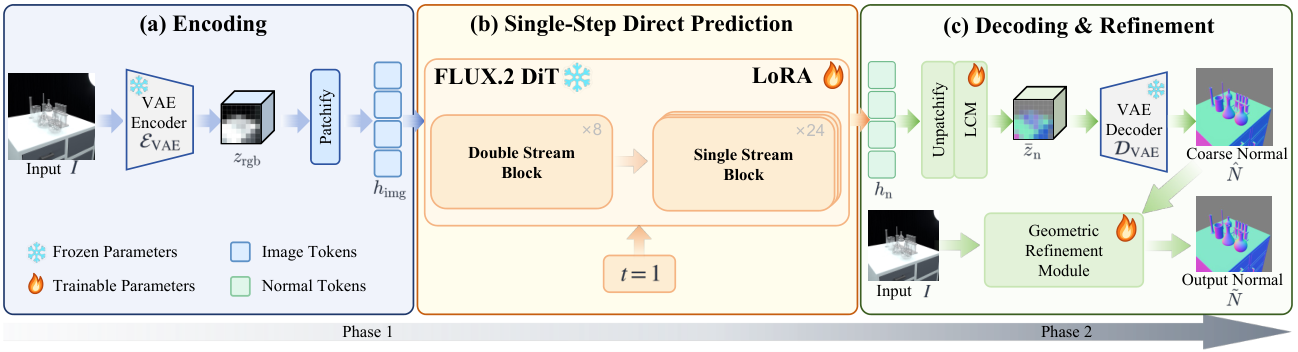
Figure 3 — TransNormal-2 프레임워크 개요
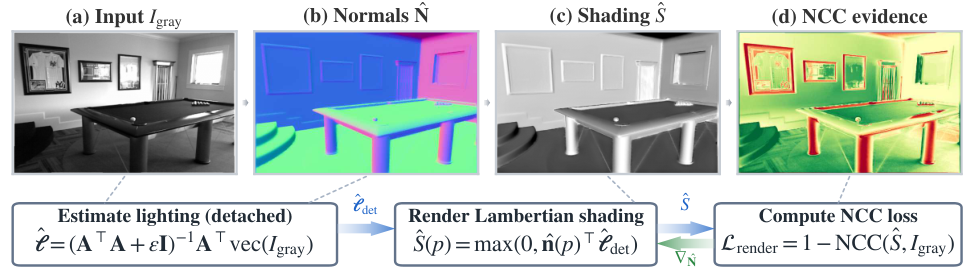
Figure 4 — 픽셀 공간 손실 설명
주요 실험 결과는 TransNormal-2의 우수성을 입증한다:
- General Scene Normal Estimation: TransNormal-2는 NYUv2, ScanNet, iBims, Sintel 등 8개 일반 장면 지표에서 MoGe-2와 동등하거나 능가하는 성능을 보였다. 특히, MoGe-2가 8.9M개의 task-specific normal annotation을 사용하는 반면, TransNormal-2는 1.4% 수준인 122K개의 training sample만으로 이러한 성능을 달성했다. 예를 들어, NYUv2에서 **14.7°**의 Mean Angular Error (MAE)와 62.5%의 11.25° 이내 정확도를 기록하여 MoGe-2와 동등하거나 더 나은 성능을 보여주며, 평균 랭크(Avg. Rank) 1.4로 MoGe-2(2.3)를 앞선다.
- Transparent Object Normal Estimation: 투명 객체에 대한 성능 향상이 특히 두드러진다. ClearGrasp에서 MAE를 4.2° 감소시켜 11.3° (Lotus-2의 15.5° 대비)를 달성했으며, zero-shot ClearPose에서는 MAE를 3.1° 감소시켜 19.1° (FE2E의 22.2° 대비)를 기록했다.
- Ablation Study: GRM은 edge MAE를 2.6° 감소시켜 비-edge MAE 개선(0.6°–0.8°) 대비 3.3–4.4배 더 큰 절대적 개선을 보여주며, VAE의 공간적 에러 프로필과 일치한다. 주파수 도메인 분석(Frequency-Domain Error Analysis)에 따르면, GRM refinement 후 고주파 대역의 에러 에너지(integrated error energy in the high-frequency band)가 NYUv2에서 53.2%, ScanNet에서 42.9% 감소했다.
4. Conclusion & Impact (결론 및 시사점)
본 논문은 diffusion-based geometry estimation에서 VAE reconstruction degradation이 야기하는 pixel-space precision 한계를 체계적으로 분석하고 정량화했다. 저자들은 이 문제를 해결하기 위해 geometry-aware pixel-space supervision (vMF, wavelet, inverse-rendering losses)과 Geometric Refinement Module (GRM)을 결합한 TransNormal-2 프레임워크를 제안한다. TransNormal-2는 일반 장면 normal estimation 벤치마크에서 기존 최고 성능 모델인 MoGe-2와 동등하거나 우수한 성능을 달성하며, 특히 투명 객체와 같이 경계 정밀도(boundary precision)가 중요한 시나리오에서 현저한 개선을 이루었다. 이 연구는 VAE 기반 latent-diffusion geometry pipeline의 고유한 한계를 극복하는 새로운 방향을 제시하며, 학계 및 로봇 공학(robotic manipulation)과 같은 산업 분야에서 보다 정확하고 신뢰할 수 있는 monocular geometry estimation을 가능하게 하는 중요한 시사점을 제공한다.
⚠️ 알림: 이 리뷰는 AI로 작성되었습니다.
관련 포스트
- [논문리뷰] V-RAE: Rethinking Video Latent Spaces for Generation
- [논문리뷰] PixSDS: Why Latent SDS Makes Noisy Pixels
- [논문리뷰] FedOT: Ownership Verification and Leakage Tracing via Watermarks for Federated LDMs
- [논문리뷰] JanusMesh: Fast and Zero-Shot 3D Visual Illusion Generation via Cross-Space Denoising
- [논문리뷰] Towards Consistent Video Geometry Estimation
Review 의 다른글
- 이전글 [논문리뷰] TANGO: Humanoid Navigation in Cluttered Environments with a Whole-Body Vision-Language-Action Model
- 현재글 : [논문리뷰] TransNormal-2: Geometry-Grounded Rectified Flow with Edge-Aware Decoding for Precise Normal Estimation
- 다음글 [논문리뷰] VidaForge: Open Research Infrastructure for Video Pretraining Data Recipes
댓글