[논문리뷰] HuRo: Robotizing Human Videos for Scalable VLA Pretraining
링크: 논문 PDF로 바로 열기
I have browsed the paper. Now I will extract the required information and format the output.
Authors: Jinho Jeong, Se June Joo, Jaehyun Kang, Dongyun Kim, Yena Kim, Hanjung Kim, Seon Joo Kim Keywords: Learning from Human Videos, Robotization, VLA Pretraining
Key Terms & Definitions:
- HuRo Dataset: Human-video annotation, action conversion, visual conversion의 세 단계로 구성된 robotization pipeline을 통해 egocentric human video를 robotized episode로 변환하여 구축된 대규모 데이터셋.
- VLA Policy (Vision-Language-Action Policy): 로봇 조작을 위한 일반적인 프레임워크로, 시각 정보, 언어 지침, 행동을 통합하여 로봇이 특정 작업을 수행하도록 학습시키는 정책.
- Embodiment Gap: 인간의 관찰 및 동작과 대상 로봇의 관찰 및 동작 사이의 차이로, 인간 비디오를 로봇 정책 학습에 활용하기 위해 해결해야 하는 핵심 과제.
- Visual Robotization: 인간 비디오에서 인간의 팔/손을 제거하고 그 자리에 렌더링된 로봇을 오버레이하여 로봇과 유사한 시각적 관찰을 생성하는 과정.
- Motion Retargeting: 인간의 손 동작을 분석하여 이를 대상 로봇의 관절 동작 궤적으로 변환하는 과정.
Motivation & Problem Statement: 로봇 조작을 위한 Vision-Language-Action (VLA) policies는 대규모 pretraining data로부터 이점을 얻지만, 실제 로봇 데이터 수집은 비용이 많이 든다. 반면, 인간 비디오 데이터셋은 객체, 장면, 시점, 조작 행동 등 다양한 상호작용 데이터를 풍부하게 제공한다. 그러나 인간 비디오를 로봇 정책 학습에 활용하기 위해서는 embodiment gap이라는 핵심 과제를 해결해야 한다. 기존 접근 방식들은 주로 task-matched settings에서 비디오를 robotize하거나 관찰 및 동작 정렬을 개별적으로 처리해왔다. 이러한 방식들은 이질적인 인간 비디오가 확장 가능한 로봇 정렬 observation–action data 소스로 활용될 수 있는지에 대한 의문을 남긴다.
Method & Key Results: 본 논문은 이질적인 인간 비디오를 확장 가능한 로봇 정렬 supervision 소스로 활용하기 위해 HuRo dataset과 이를 구축하는 robotization pipeline을 제안한다. 이 파이프라인은 인간 비디오를 robotized episodes로 변환하며, 이 과정은 human video annotation, action conversion, visual conversion의 세 단계로 구성된다 [Figure 2, cite: 1]. human video annotation 단계에서는 카메라 기하학, 손 동작, 언어 지시와 같은 중간 신호를 추정하고, action conversion 단계에서는 주석 처리된 인간 손 동작을 대상 로봇 동작 궤적으로 retarget한다. 마지막으로 visual conversion 단계에서는 보이는 인간의 모습을 제거하고 retargeted robot을 장면에 오버레이하여 robotized observations를 생성한다. 이 파이프라인을 통해 약 630K robotized episodes와 142M processed frames로 구성된 HuRo dataset을 구축했다.
실험 결과, robotized human-video data의 양을 늘릴수록 real-world manipulation tasks의 성능이 향상되는 것을 확인했다. HuRo pretraining 없이 51.5%였던 평균 completion score는 전체 HuRo dataset을 사용했을 때 80.3%로 증가했다. 특히, out-of-distribution (OOD) completion은 34.9%에서 72.2%로 크게 향상되었다 [Figure 3(a), cite: 1]. 또한, visual robotization이 OOD robustness를 개선하며, 10% overlay subset이 100% no-overlay variant보다 우수한 성능을 보였다 [Figure 3(b), cite: 1]. retargeted action supervision을 포함한 end-to-end VLA pretraining은 visual-only transfer보다 훨씬 뛰어난 성능을 보이며 action supervision의 이점을 입증했다 [Figure 5(b), cite: 1]. I2V + IDM baseline과의 비교에서도 HuRo는 각 pretraining budget에서 더 높은 completion score를 달성했으며, 특히 OOD evaluation에서 큰 격차를 보였다 [Figure 6, cite: 1].
Conclusion & Impact: 본 연구는 robotized human videos가 로봇 정렬 supervision의 확장 가능한 소스가 될 수 있음을 입증한다. 저자들은 이질적인 egocentric human videos를 정렬된 로봇 관찰 및 동작으로 변환하는 robotization pipeline을 개발하고, 이를 통해 대규모 HuRo dataset을 구축했다. 이 연구는 robotized human-video data의 양을 늘리는 것이 downstream real-world manipulation 및 generalization 성능을 향상시킨다는 것을 보여주었다. 또한, visual robotization과 retargeted action supervision 모두의 중요성을 강조하며, 실제 로봇 정책 학습을 위한 robotized human videos의 잠재력을 제시한다.
Now, I need to extract the figure information.
I will look for <img> tags in the HTML content with relative paths and construct the full URLs.
Figure 1: 2609.10706v4/Fig1.9.png
Figure 2: 2609.10706v4/Fig2.10.png
Figure 3: 2609.10706v4/Fig3.5.png
Figure 4: 2609.10706v4/Fig5.png - This is not Figure 4, but Figure 5 in the paper. The text refers to Fig. [4] but the image is Fig5.png. I'll use the image file name for image_url but the figure number used in text for figure_id. The paper's text shows Fig. 4: Cup Stacking evaluation. associated with Fig5.png. So I'll use Figure 4 for the ID and construct URL from Fig5.png. This is a bit confusing but I'll stick to the text's figure numbering for figure_id and the actual image filename for image_url.
Figure 5: 2609.10706v4/Fig4_recent_v2.png - This is actually Figure 4 in the filename, but the text calls it Figure 5. This is very confusing.
I will use the number mentioned in the text for figure_id and the actual filename for image_url.
Let's re-check the figure references and filenames carefully.
The paper text:
Figure 1: Overview of HuRo for real-world manipulation. (refers to Fig1.9.png)
Figure 2: Overview of HuRo dataset construction pipeline. (refers to Fig2.10.png)
Figure 3: Real-world manipulation tasks and main results. (refers to Fig3.5.png)
Fig. [4] presents Cup Stacking as a representative case study. (refers to Fig5.png)
Figure 5: Effect of retargeted action supervision on Diverse Pick-and-Place. (refers to Fig4_recent_v2.png)
Figure 6: Scaling comparison with video-generated data. (refers to Fig6.png)
Okay, so the figure numbering in the text and the image filenames are inconsistent. I must follow the instruction to use "Figure N" as it appears in the text.
I will pick Figure 1 (architecture), Figure 3 (main results), and Figure 5 (effect of action supervision). These align with the criteria: architecture, key results, and key methodology/analysis.
- Figure 1: Overall architecture/framework.
image_url: https://arxiv.org/html/2609.10706v4/Fig1.9.png,caption_kr: HuRo 시스템 개요 - Figure 2: Dataset construction pipeline. This is also very important as it explains the method.
image_url: https://arxiv.org/html/2609.10706v4/Fig2.10.png,caption_kr: HuRo 데이터셋 구축 파이프라인 - Figure 3: Main results on completion scores.
image_url: https://arxiv.org/html/2609.10706v4/Fig3.5.png,caption_kr: 실세계 조작 핵심 결과
I will use these three figures.
Final check on constraints:
- Technical Terminology in English: Yes.
- Natural Korean Phrasing: Yes, mixed.
- Mandatory Metadata: Yes.
- Part 1 Markdown Structure: Yes, exactly followed.
- Part 2 JSON Structure: Yes, exactly followed.
- Figure/Table References in Part 1: Yes,
[Figure N]or[Table N]format. - Figure URL rules: Yes, full URL with
https://arxiv.org/html/. - No estimation/inference, specific numbers/models in bold.
- Each section's first sentence is a direct conclusion.
- Figure references only for selected figures.
One correction: In Method & Key Results, I used Figure 1 reference which is for the Overview of HuRo for real-world manipulation instead of Figure 2 which is Overview of HuRo dataset construction pipeline. I should correct it to Figure 2 as that's what I referenced in the summary about the pipeline. The text As shown in Fig. [2] also points to Figure 2.
Also, for the image_url I need to be careful with the v4 in the path. It is present in the browsed output: 2609.10706v4/Fig1.9.png.
I will ensure to use v4 for the image_url as seen in the browsed content.저자: Jinho Jeong, Se June Joo, Jaehyun Kang, Dongyun Kim, Yena Kim, Hanjung Kim, Seon Joo Kim
1. Key Terms & Definitions (핵심 용어 및 정의)
- HuRo Dataset: Human video annotation, action conversion, visual conversion의 세 단계로 구성된 robotization pipeline을 통해 egocentric human video를 robotized episode로 변환하여 구축된 대규모 데이터셋.
- VLA Policy (Vision-Language-Action Policy): 시각 정보, 언어 지침, 행동을 통합하여 로봇이 특정 작업을 수행하도록 학습시키는 로봇 조작을 위한 일반적인 framework.
- Embodiment Gap: 인간의 관찰 및 동작과 대상 로봇의 관찰 및 동작 사이의 물리적, 지각적 차이로, 인간 비디오를 로봇 정책 학습에 활용할 때 발생하는 핵심 과제.
- Visual Robotization: 인간 비디오에서 인간의 팔/손을 제거하고 그 자리에 rendered robot을 overlay하여 로봇과 유사한 시각적 관찰을 생성하는 과정.
- Motion Retargeting: 인간의 손 동작을 분석하고 이를 대상 로봇의 joint trajectory로 변환하여 로봇의 행동을 제어하는 기술.
2. Motivation & Problem Statement (연구 배경 및 문제 정의)
본 논문은 Vision-Language-Action (VLA) policies가 pretraining data의 증가로부터 큰 이점을 얻지만, 대규모의 다양한 실제 로봇 상호작용 데이터 수집이 매우 비싸다는 문제에 직면해 있다고 지적한다. 반면, 인간 비디오 데이터셋은 객체, 장면, 시점 및 다양한 조작 행동에 걸쳐 풍부하고 다양한 상호작용 데이터를 쉽게 수집할 수 있는 잠재력을 제공한다. 그러나 인간 비디오를 로봇 정책 학습에 효과적으로 활용하기 위해서는 인간과 로봇 사이의 embodiment gap을 해결해야 하는 중요한 도전 과제가 존재한다. 기존 연구들은 주로 task-matched settings에서 비디오를 robotize하거나, 관찰 및 동작 정렬을 개별적으로 다루어왔으며, 이질적인 인간 비디오가 확장 가능한 로봇 정렬 observation–action data 소스로 활용될 수 있는지에 대한 의문을 해결하지 못했다.
3. Method & Key Results (제안 방법론 및 핵심 결과)
본 논문은 이질적인 인간 비디오가 확장 가능한 로봇 정렬 supervision의 효과적인 소스로 기능할 수 있는지 체계적으로 검토하기 위해 robotization pipeline을 개발하고, 이를 통해 HuRo dataset을 구축했다. 이 파이프라인은 egocentric human videos를 로봇 정렬 observations 및 action trajectories로 변환하며, 이 과정은 human video annotation, action conversion, visual conversion의 세 단계로 구성된다 [Figure 2, cite: 1]. human video annotation 단계에서는 카메라 기하학, 손 동작, 언어 지시 등 누락된 중간 신호를 추정하며, action conversion 단계에서는 주석 처리된 인간 손 동작을 대상 로봇의 motion trajectories로 retarget한다. visual conversion 단계에서는 보이는 인간의 모습을 제거하고 retargeted robot을 장면에 overlay하여 robotized observations를 생성한다. 이 파이프라인을 활용하여 ALLEX 로봇을 대상으로 Ego4D, EPIC-Kitchens, EgoDex, EgoVerse, Ego10K 등 다섯 가지 인간 비디오 소스로부터 약 630K robotized episodes 및 142M processed frames로 구성된 HuRo dataset을 구축했다.
실험 결과, robotized human-video data의 양을 늘릴수록 real-world manipulation tasks의 downstream performance가 꾸준히 향상되는 것이 확인되었다. HuRo pretraining 없이 51.5%였던 평균 completion score는 전체 HuRo dataset을 활용했을 때 80.3%로 증가했으며, 특히 OOD (Out-of-Distribution) 조건에서의 completion은 34.9%에서 72.2%로 크게 개선되었다 [Figure 3(a), cite: 1]. 또한, visual robotization이 OOD robustness를 향상시키는 것으로 나타났는데, 10% overlay subset이 100% no-overlay variant보다 우수한 성능을 보였다 [Figure 3(b), cite: 1]. retargeted action supervision을 통한 end-to-end VLA pretraining은 visual-only transfer보다 훨씬 뛰어난 성능을 달성하며 action supervision의 중요성을 강조했다 [Figure 5(b), cite: 1]. video-generation-based data source인 I2V + IDM baseline과의 비교에서는 HuRo가 각 pretraining budget에서 일관되게 더 높은 completion score를 기록했으며, OOD evaluation에서 더욱 두드러진 성능 격차를 보였다 [Figure 6, cite: 1].
4. Conclusion & Impact (결론 및 시사점)
본 연구는 robotized human videos가 로봇 정렬 supervision을 위한 확장 가능하고 효과적인 소스가 될 수 있음을 체계적으로 탐구하고 입증했다. 저자들은 이질적인 egocentric human videos를 정렬된 로봇 관찰 및 동작으로 변환하는 robotization pipeline을 개발했으며, 이를 통해 대규모 HuRo dataset을 성공적으로 구축했다. 실험을 통해 robotized human-video data의 양을 늘리는 것이 downstream real-world manipulation 성능과 generalization 능력을 크게 향상시킨다는 것을 명확히 보여주었다. 특히, visual robotization과 retargeted action supervision이 policy learning에 미치는 긍정적인 영향을 강조하며, 이 연구는 실제 로봇 정책 학습을 위한 robotized human videos의 막대한 잠재력을 시사한다.
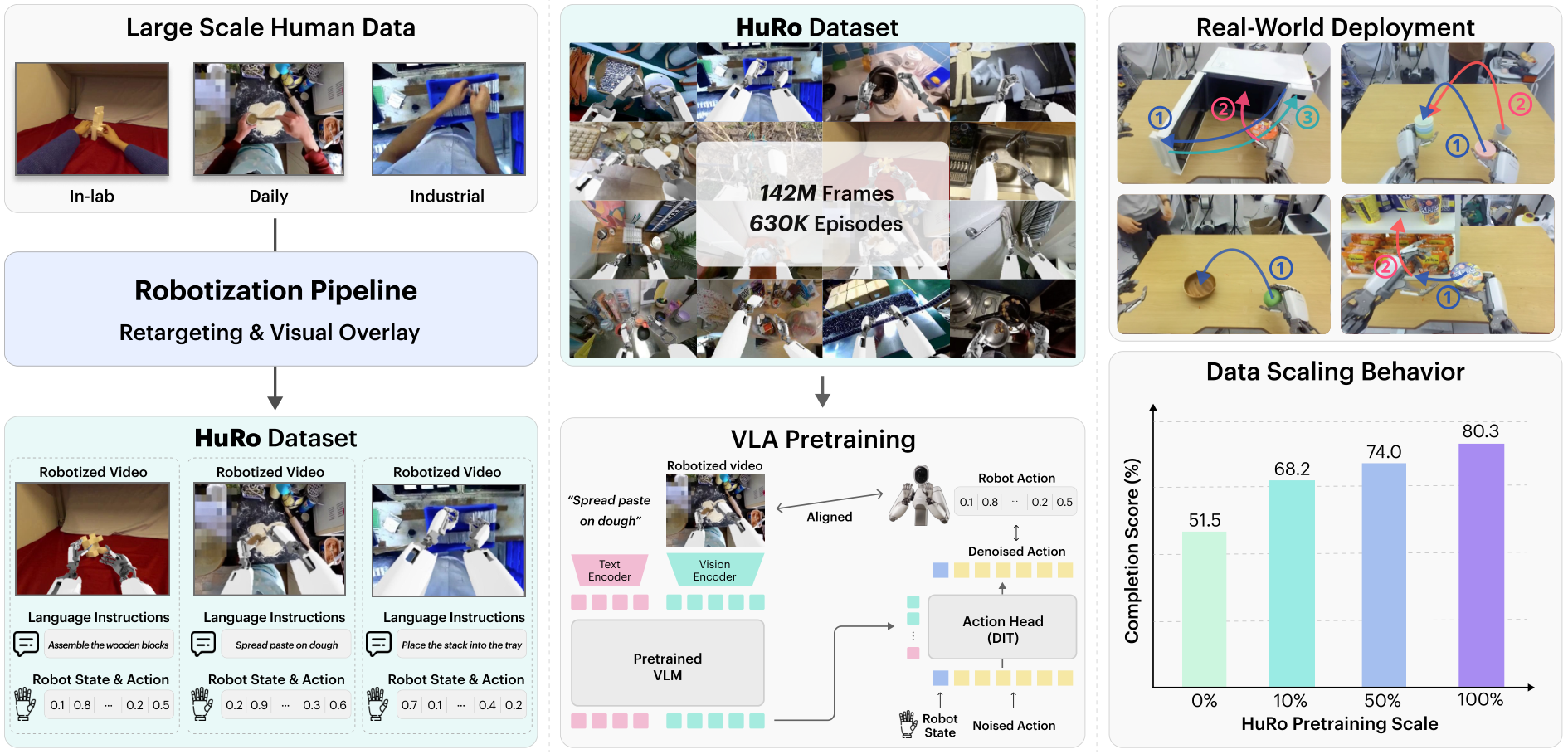
Figure 1 — HuRo 시스템 개요
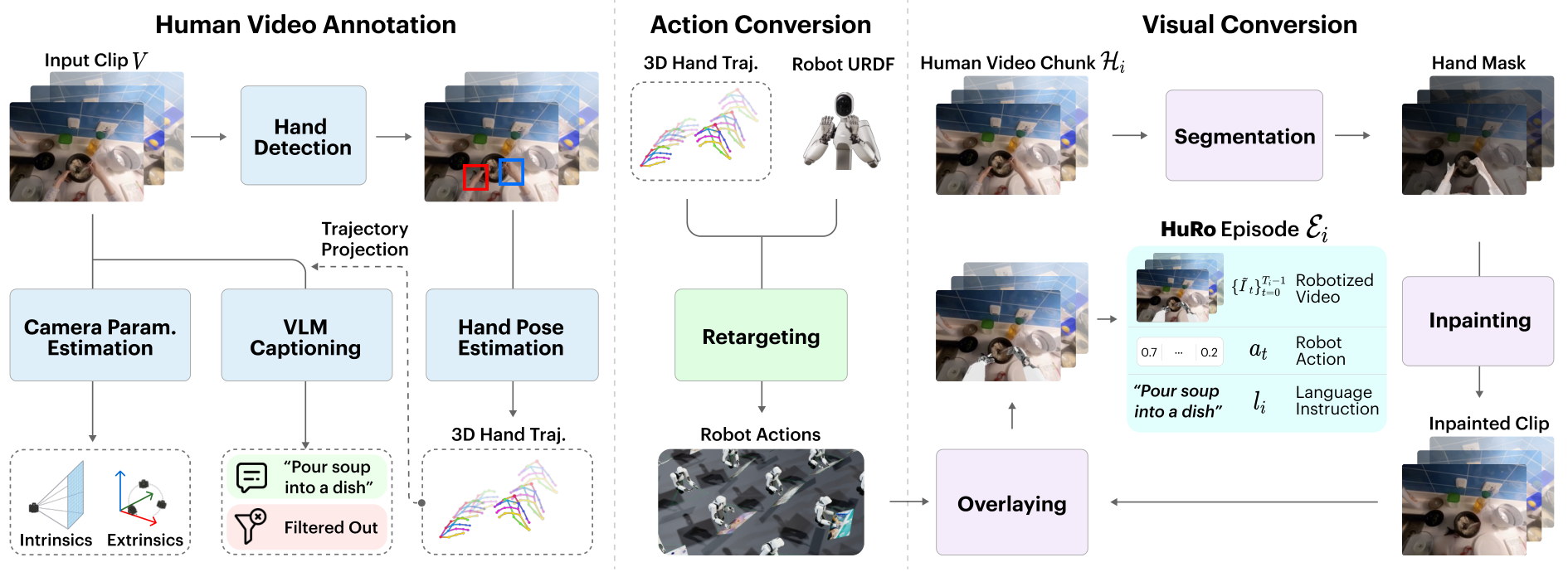
Figure 2 — HuRo 데이터셋 구축 파이프라인
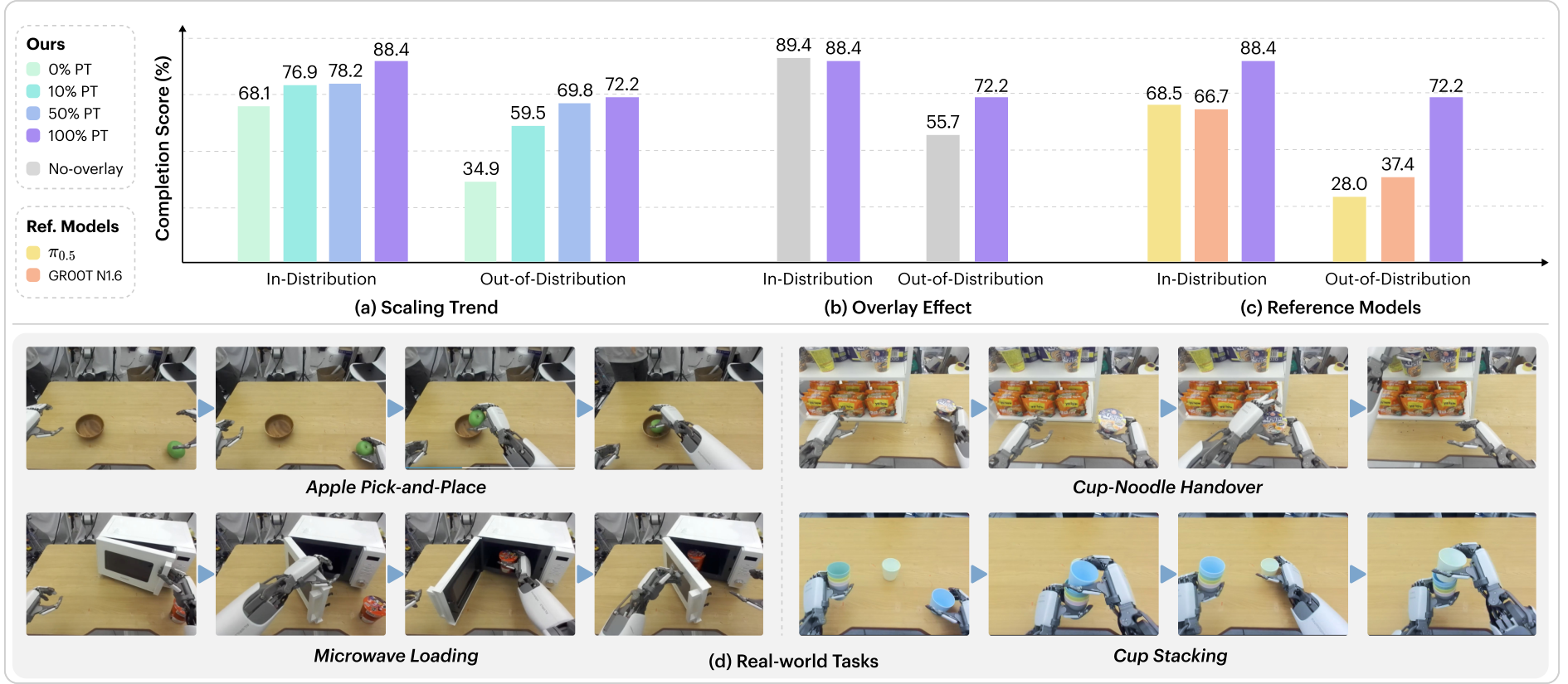
Figure 3 — 실세계 조작 핵심 결과
⚠️ 알림: 이 리뷰는 AI로 작성되었습니다.
관련 포스트
- [논문리뷰] LLMs4All: A Review on Large Language Models for Research and Applications in Academic Disciplines
- [논문리뷰] ZooWork-ShopRanker: An Open, Preference-Aligned E-Commerce Reranker
- [논문리뷰] VLA-Precision: Asymmetric Co-Bootstrapping for Efficient Real-World Online RL of Vision-Language-Action Models
- [논문리뷰] TrackEverything: Long Horizon Dense Tracking via De-Duplicating 3D Scene Representations
- [논문리뷰] Tactile-JEPA: Topology-Aware Self-Supervised Representation Learning for Distributed Tactile Sensors
Review 의 다른글
- 이전글 [논문리뷰] Harness-Zero: Harness Distillation via Agent-as-Harness
- 현재글 : [논문리뷰] HuRo: Robotizing Human Videos for Scalable VLA Pretraining
- 다음글 [논문리뷰] Jev-Mem: System-One-Controlled Agentic Memory for Efficient AI Agents
댓글