[논문리뷰] AgentWorld: Benchmarking Long-Horizon Collaboration of Multi-agent LLMs
링크: 논문 PDF로 바로 열기
The browsing result provides the full content of the arXiv paper, including abstract, introduction, related work, benchmark details, experimental setup, results, conclusion, and appendices. I can now proceed to summarize it according to the specified format and constraints.
Plan:
- Extract Metadata: Authors and keywords from the abstract/introduction.
- Part 1: Markdown Summary:
- Key Terms & Definitions: Identify 3-5 core technical terms and define them concisely based on the paper.
- Motivation & Problem Statement: Explain why this research is needed, existing limitations, and the problem AgentWorld addresses.
- Method & Key Results: Describe AgentWorld's methodology (MMORPG sandbox, API tools, turn-based, blackbox, CCE metric) and present the main experimental findings with quantitative results (SR, CCE for best model, communication analysis).
- Conclusion & Impact: Summarize the main conclusions and implications for the field.
- Ensure all constraints (English terminology, Korean phrasing, direct answers, bolding, figure references) are met.
- Part 2: Important Figure Information:
- Identify up to 3 crucial Figures. Likely candidates are the overview (Figure 2), a task example (Figure 3), and CCE illustration (Figure 5).
- Extract
figure_id,image_url(ensure full URL), andcaption_kr.
Let's start with Metadata extraction.
Authors: Raphael Shu, Yusen Zhang, Young Min Cho, Jin Mo Yang, Yuan Yuan, Wenliang Zheng, Sharath Chandra Guntuku, Lyle Ungar, Zhou Yu, Rui Zhang. I will list first two and then "et al."
Keywords: I will select 5-8 relevant keywords from the abstract and introduction, focusing on academic terms. Good candidates: Multi-agent LLMs, Benchmarking, Long-Horizon Collaboration, MMORPG, Causal Collaboration Effectiveness (CCE), Blackbox Environment, Asymmetric Roles.
Now, I will go through each section of Part 1.
Part 1: 요약 본문
메타데이터
저자: Raphael Shu, Yusen Zhang, et al.
## 1. Key Terms & Definitions (핵심 용어 및 정의)
- Long-Horizon Collaboration: 다수의 LLM 기반 Agent들이 복잡한 환경에서 수십 라운드 이상에 걸쳐 지속적으로 상호작용하며 공통의 목표를 달성하는 능력을 의미한다.
- Blackbox Environment: Agent들이 서로의 내부 상태(internal states), 관찰(observations), 행동 이력(action histories)에 직접 접근할 수 없으며, 오직 명시적인 채팅 메시지(explicit chat messages)를 통해서만 정보를 공유하고 조율해야 하는 환경 설정을 지칭한다.
- Asymmetric Roles: 각 Agent가 고유한 기술(skills), 장비(equipment), 인벤토리(inventory), 시작 위치(spawn locations)를 가지며, 이로 인해 특정 작업에 특화되어 상호 의존적인 협업이 필수적인 역할을 말한다.
- High-Level API Tools: MMORPG 환경에서 low-level game mechanics (예: 정밀 3D 내비게이션, 블록 배치)를 추상화하여, Agent들이 '무엇을 할지(what to do)'와 '누구와 협력할지(who to coordinate with)'에 집중할 수 있도록 캡슐화된 기능들을 의미한다.
- Causal Collaboration Effectiveness (CCE): Agent들의 모든 행동 궤적(task trajectories)에서 Causal Action Graph를 구성하여, 팀의 전체 행동 중 실제로 태스크 성공에 인과적으로 기여한 행동의 비율을 정량화하는 그래프 기반 Metric이다.
## 2. Motivation & Problem Statement (연구 배경 및 문제 정의)
본 논문은 LLM 기반 Agent의 Long-Horizon Collaboration 능력 평가에 있어 기존 벤치마크의 한계점을 해결하고자 한다. 기존의 Multi-Agent LLM 벤치마크들은 주로 단기적인 상호작용(short task horizons), 경쟁적인 설정(competitive settings), 또는 개별 Agent의 성능 집계에 초점을 맞춰 진정한 협업 능력을 고립시켜 평가하는 데 실패했다. 구체적으로, 대부분의 벤치마크는 10단계 미만의 짧은 태스크를 다루며 [cite: 1, Table 1], low-level action control에 대한 노력이 협업 능력 평가를 왜곡하는 경향이 있었다. 또한, Project Sid와 같은 대규모 시뮬레이션은 emergent social behavior에 중점을 두어, 명확하게 측정 가능한 결과(measurable outcomes)를 가진 구체적인 태스크가 부족했다. 이러한 문제점들은 LLM 기반 Agent가 소프트웨어 개발, 과학 연구, 복잡한 운영과 같은 현실 세계의 복잡한 협업 태스크를 수행하는 데 필요한 역량을 체계적으로 평가하고 이해하는 데 방해가 된다.
## 3. Method & Key Results (제안 방법론 및 핵심 결과)
본 연구는 Long-Horizon Multi-agent Collaboration을 벤치마킹하기 위해 AgentWorld라는 새로운 벤치마크를 제안한다. AgentWorld는 Kaetram이라는 오픈소스 MMORPG 엔진을 기반으로 구축된 rich MMORPG sandbox 환경을 제공한다. 이 환경은 380개 이상의 아이템, 144종의 몹, 70개 이상의 NPC, 1,531개의 채집 가능한 자원 노드 등을 포함하는 복잡한 세계를 가지며, Agent들은 13개의 High-Level API Tools (예: move, attack_entity, harvest_resource, craft, transfer, chat)를 통해 low-level control 없이 상호작용한다 [cite: 1, Figure 2]. 태스크는 2555라운드에 걸쳐 320개의 Asymmetric Roles를 가진 Agent들의 참여를 요구하며, Blackbox setting 하에서 오직 채팅을 통한 명시적 커뮤니케이션으로만 조율해야 한다. 100개의 Human-Annotated Task와 100개의 LLM-Augmented Variant가 제공되며, 전투, 제작, 채집, 거래, 탐험, 생존, 건설, 조정 등 8가지 카테고리로 구성된다 [cite: 1, Figure 4a].
평가 Metric으로는 기존의 Task Success Rate (SR) 및 Partial Success Rate (PSR) 외에, 협업의 질을 정량화하기 위한 Causal Collaboration Effectiveness (CCE)를 제안한다. CCE는 태스크 궤적(task trajectories)에서 Causal Action Graph를 구성하여, LLM Judge가 객관적인 이진 인과 판단(objective binary causal judgments)을 통해 태스크 성공에 인과적으로 기여한 행동의 비율을 측정한다 [cite: 1, Figure 5]. 실험은 Gemini 3 Flash, Claude Haiku 4.5, GPT-5 Mini, DeepSeek R1-70B의 4가지 최신 LLM을 대상으로 진행되었다. 결과에 따르면, Gemini 3 Flash가 Main Set에서 가장 높은 52.0%의 SR을 달성했으며, CCE는 0.320을 기록했다 [cite: 1, Table 2]. 이는 최고의 모델조차 전체 Agent 행동의 3분의 1 미만만이 태스크 성공에 기여했음을 의미하며, DeepSeek R1-70B의 CCE는 0.125로, 거의 88%의 행동이 비효율적임을 보여준다. Augmented Set에서는 모든 모델의 SR이 크게 하락하여 태스크 난이도 증가를 확인했다 (예: Gemini 3 Flash의 SR이 52%에서 24%로 하락) [cite: 1, Table 2]. 또한, GPT-5 Mini는 가장 많은 메시지를 보냈음에도 SR은 세 번째를 기록했고, DeepSeek R1-70B는 가장 적은 메시지로 최하위를 기록하여, 단순히 많은 커뮤니케이션이 더 나은 협업을 의미하지 않음을 시사한다. 통신 실패 유형 분석에서는 stale and redundant 메시지가 37.7%로 가장 큰 비중을 차지했다 [cite: 1, Table 5].
## 4. Conclusion & Impact (결론 및 시사점)
본 연구는 AgentWorld 벤치마크와 Causal Collaboration Effectiveness (CCE) Metric을 통해 Long-Horizon Multi-agent Collaboration의 평가 프레임워크를 제공한다. 실험 결과, 최신 LLM조차 협업 태스크에서 낮은 성공률(최고 SR 52.0%)을 보였으며, CCE 분석은 Agent 행동의 상당 부분이 비효율적(최고 CCE 0.320)임을 명확히 드러냈다. 이러한 결과는 LLM이 부분적인 목표 달성(PSR)은 가능하더라도 late-stage coordination에서 실패하는 경향이 있음을 보여주며, 커뮤니케이션 양이 반드시 성공적인 협업으로 이어지지 않는다는 중요한 통찰을 제공한다. 이 연구는 현재 foundational models에서 협업 능력이 single-agent reasoning과는 다른, 여전히 큰 gap임을 시사한다. AgentWorld는 LLM 기반 Agent 팀의 협업 능력을 체계적으로 평가하고, 향후 모델 개선을 위한 명확한 방향을 제시함으로써 해당 분야의 연구 발전에 크게 기여할 것으로 기대된다.
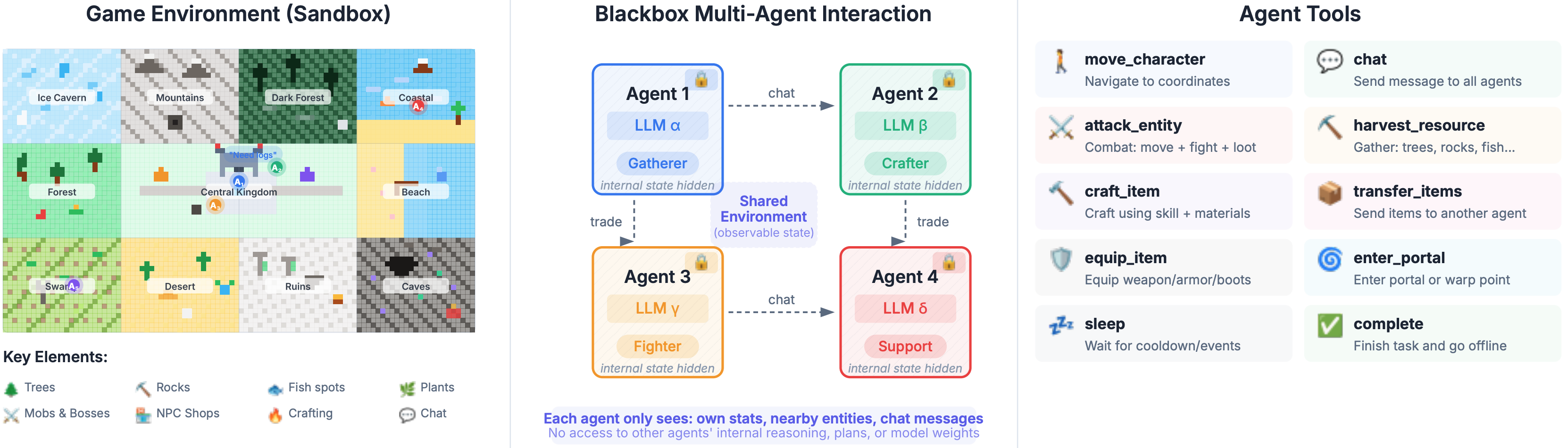
Figure 2 — AgentWorld 개요
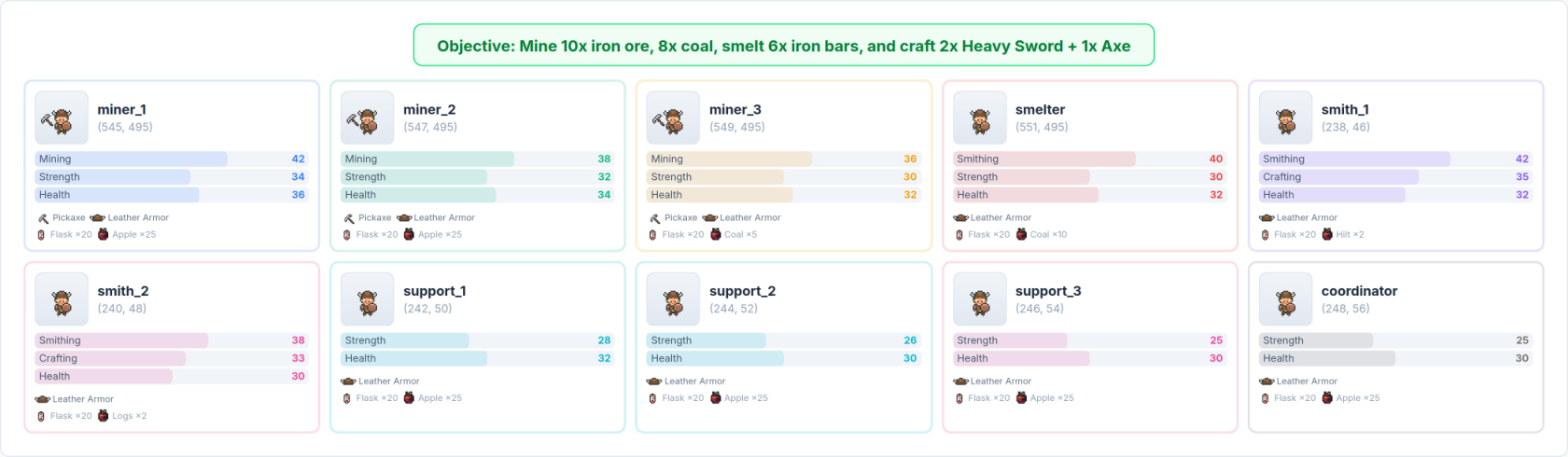
Figure 3 — 태스크 정의 예시
⚠️ 알림: 이 리뷰는 AI로 작성되었습니다.
관련 포스트
- [논문리뷰] IndicBankBench: Evaluating Safety and Reliability of Language Model Assistants in Indian Retail Banking
- [논문리뷰] Game Arena: Strategic LLM Evaluation in Competitive Environments
- [논문리뷰] Training Object Permanence in World Models
- [논문리뷰] Just Ask Jev: Reinforcement Learning for Calibrated Decisions as a Zero-Shot Detector of AI Alignment Failures
- [논문리뷰] GameHorizon Suite: Multi-Horizon Data and Evaluation in Gameplay
Review 의 다른글
- 이전글 [논문리뷰] Your Transformer Can Hold Two Thoughts at Once: Evidence of Linear Superposition in LLMs
- 현재글 : [논문리뷰] AgentWorld: Benchmarking Long-Horizon Collaboration of Multi-agent LLMs
- 다음글 [논문리뷰] Block Sparse Attention with Log-Linear Complexity
댓글