[논문리뷰] TestPrism: Rethinking Test Evaluation Beyond a Single Reference
링크: 논문 PDF로 바로 열기
저자: Han Li, Lingxiang Hu, Jiacheng Huang, Ziqian Jiang, Jingkai Luo, Wei Gao, Yunfan Tan, Zun Wang, Jiaheng Liu
1. Key Terms & Definitions (핵심 용어 및 정의)
- TestPrism:
TestPrism은 기존Single Reference Evaluation의 한계를 극복하기 위해 제안된 새로운test generation평가 벤치마크입니다. 이 벤치마크는 다양한valid및invalid implementations에 대한 테스트의generalization능력을 측정합니다. - Single Reference Evaluation:
LLM coding agents의test generation능력 평가에 일반적으로 사용되는 방식으로, 생성된 테스트가 초기 프로그램에서 실패하고 하나의gold solution에서 통과하는지 여부만을 확인합니다. 본 논문에서는 이 방식이 테스트의 실제 품질을overstate할 수 있다고 지적합니다. - Joint Success Function:
TestPrism의 주요metric으로, 생성된 테스트가 초기 프로그램 상태에서는fail하고, 모든valid candidate에 대해서는accept하며, 모든invalid candidate에 대해서는reject해야 하는 엄격한 기준을 요구합니다. - TestHelix:
Single Reference Evaluation의weaknesses를 해결하고test generation의reliability를 향상시키기 위해 제안된methodology입니다.Heterogeneous Synthesis,Peer Cross Validation,Recursive Self Improvement (RSI)의 세 가지 핵심components로 구성됩니다. - Recursive Self Improvement (RSI):
TestHelix의 외부loopcomponent로,training tasks에서execution feedback을 통해test generation strategy를refine하여reliability를 향상시킵니다.
2. Motivation & Problem Statement (연구 배경 및 문제 정의)
본 연구는 Large Language Model (LLM) coding agents의 test generation 능력 평가에 있어 single reference evaluation의 근본적인 limitations를 해결하고자 합니다. 기존 benchmarks는 테스트를 단일 gold solution에 대해서만 평가하는 경향이 있으며, 이는 alternative valid implementations의 존재를 간과하고 test quality를 과대평가할 수 있습니다. 이러한 방식으로는 생성된 테스트가 required behavior를 놓치거나 불필요한 implementation constraints를 부과할 수 있으며, 이는 specification violations에 대한 sensitivity를 유지하면서 valid implementations 전반에 걸쳐 generalize하는 reliable tests를 생성하는 데 방해가 됩니다. 따라서 저자들은 implementations의 variation에 대한 generated tests의 평가 robustness에 의문을 제기하며, 이를 개선할 새로운 evaluation methodology의 필요성을 강조합니다.
3. Method & Key Results (제안 방법론 및 핵심 결과)
저자들은 test generation의 reliability를 높이기 위해 TestPrism 벤치마크와 TestHelix 방법론을 제안합니다. TestPrism은 task screening and adaptation, task selection, patch generation and validation, diversity filtering and task conversion의 네 단계를 거쳐 구축됩니다 [Figure 1]. 이 벤치마크는 17개 소스에서 수집된 300개의 test tasks와 각각에 대해 reference 포함 총 10개 (4개의 valid alternatives 및 5개의 invalid implementations)의 labeled implementations를 포함하여, single reference evaluation을 넘어선 평가를 가능하게 합니다. 핵심 metric인 Joint Success Function은 테스트가 초기 프로그램에서 fail하고, 모든 valid candidate를 accept하며, 모든 invalid candidate를 reject하도록 요구합니다.
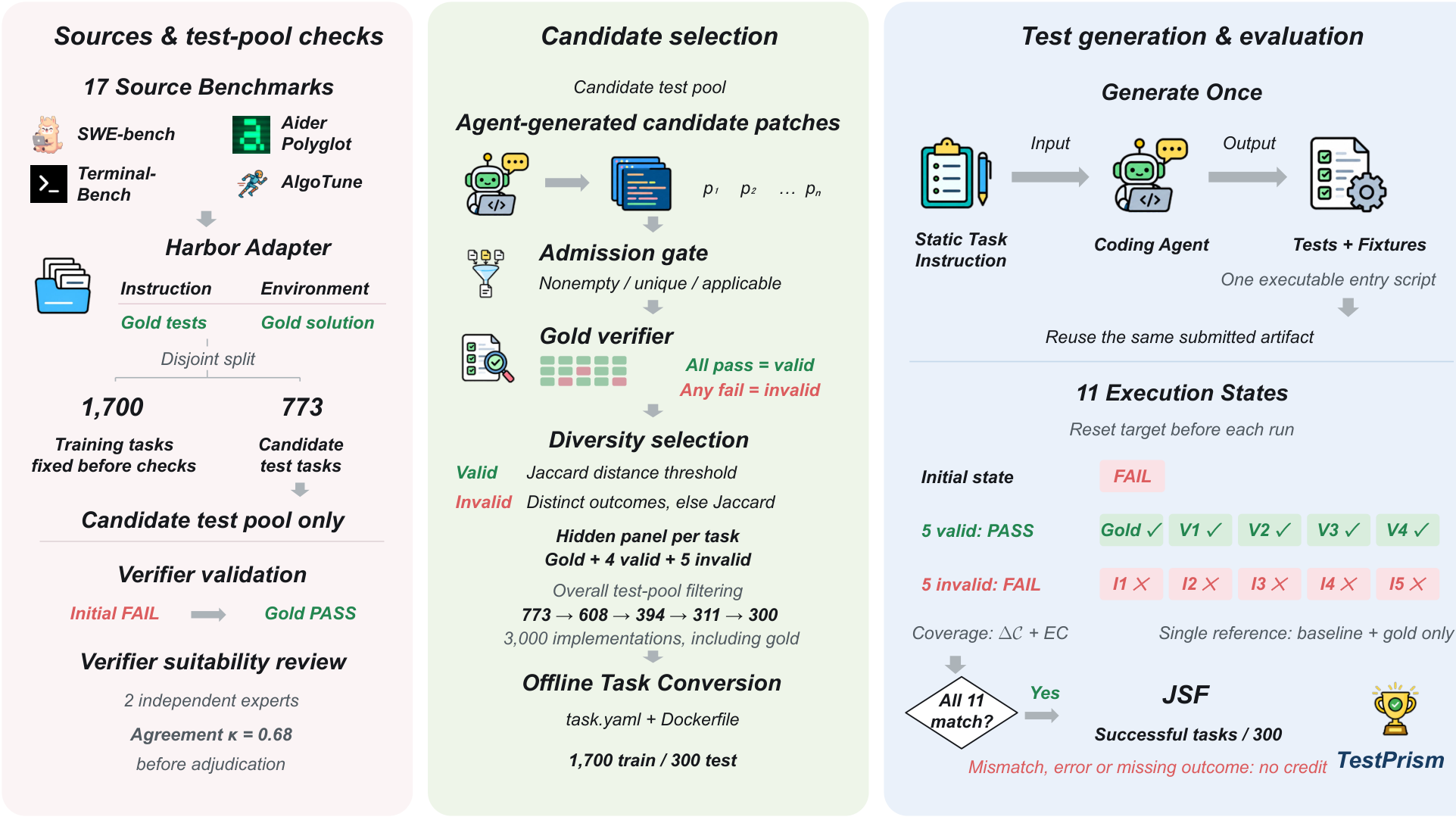
Figure 1 — TestPrism 구축 및 평가 개요
TestHelix는 test reliability를 개선하기 위한 heterogeneous synthesis (test 및 repair pair 생성), peer cross validation (cross execution, semantic review, corrective feedback), 그리고 Recursive Self Improvement (RSI) loop로 구성됩니다 [Figure 2].
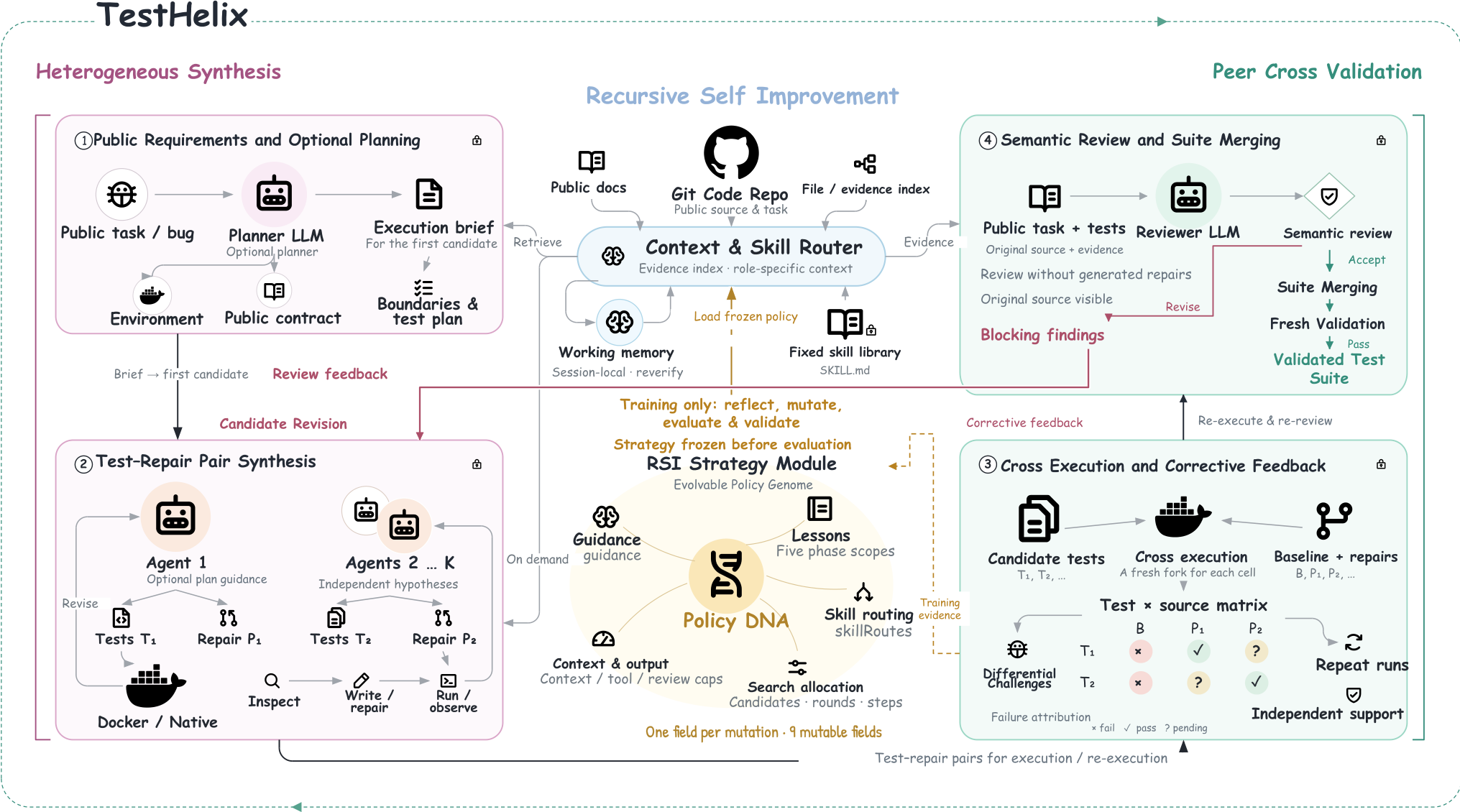
Figure 2 — TestHelix 아키텍처
주요 실험 결과에 따르면, 최강의 baseline coding agent도 TestPrism의 Joint Success Function에서 28.00%의 낮은 성능을 보인 반면, single reference success는 59.67%에 달했습니다. 이는 single reference evaluation이 테스트 품질을 과대평가할 수 있음을 명확히 보여줍니다. Change Coverage (r=0.91)와 Entry Coverage (r=0.96)는 Joint Success Function과 높은 correlation을 보였습니다. Joint Success Function은 implementations 전반에 걸친 reliability의 dynamic measure로서, candidate patch set을 확장할수록 success rate가 감소하여 diverse patch additions가 test errors를 드러냄을 확인했습니다. (예: valid alternatives를 reject하거나 invalid candidates를 accept하는 경우). test generation failures에 대한 analysis 결과, coverage gaps (34.6%), faulty checks (50.0%), execution logic errors (15.4%)가 주요 원인으로 나타났습니다 [Figure 4b]. 특히 missing inputs 및 weak assertions와 같은 faulty checks와 coverage gaps는 single reference evaluation에서는 통과하지만 추가 invalid patches에 의해 드러나는 blind spot을 형성했습니다. TestHelix는 peer cross validation과 RSI를 통해 Joint Success Function을 native agent comparators 대비 8.67% ~ 9.00%p 향상시켰으며, ablations 결과 각 component가 reliability 향상에 기여함을 입증했습니다. 특히 RSI를 적용한 peer cross validation은 Single 대비 Joint Success Function을 11.67% ~ 12.00%p 증가시켰습니다.
4. Conclusion & Impact (결론 및 시사점)
본 논문은 single reference evaluation의 한계를 넘어선 test generation 평가를 위해 TestPrism 벤치마크와 Joint Success Function metric을 도입했습니다. frontier coding agents의 reliable test generation에 여전히 상당한 limitations가 존재함을 밝혀냈으며, coverage gaps, faulty checks, execution logic errors와 같은 구체적인 failure mechanisms를 식별했습니다. 특히 single reference evaluation으로는 발견하기 어려운 test errors가 TestPrism의 diverse candidate sets를 통해 드러날 수 있음을 보여주었습니다. 제안된 TestHelix methodology는 heterogeneous synthesis, peer cross validation, recursive self improvement를 통해 test reliability를 효과적으로 향상시킬 수 있음을 입증했습니다. 이 연구는 LLM coding agents의 test generation 능력에 대한 보다 rigorous하고 comprehensive한 평가 기준을 제시함으로써, 향후 test generation strategies 및 coding agent 개발에 중요한 시사점을 제공하고 software engineering 분야의 발전에 기여할 것으로 기대됩니다.
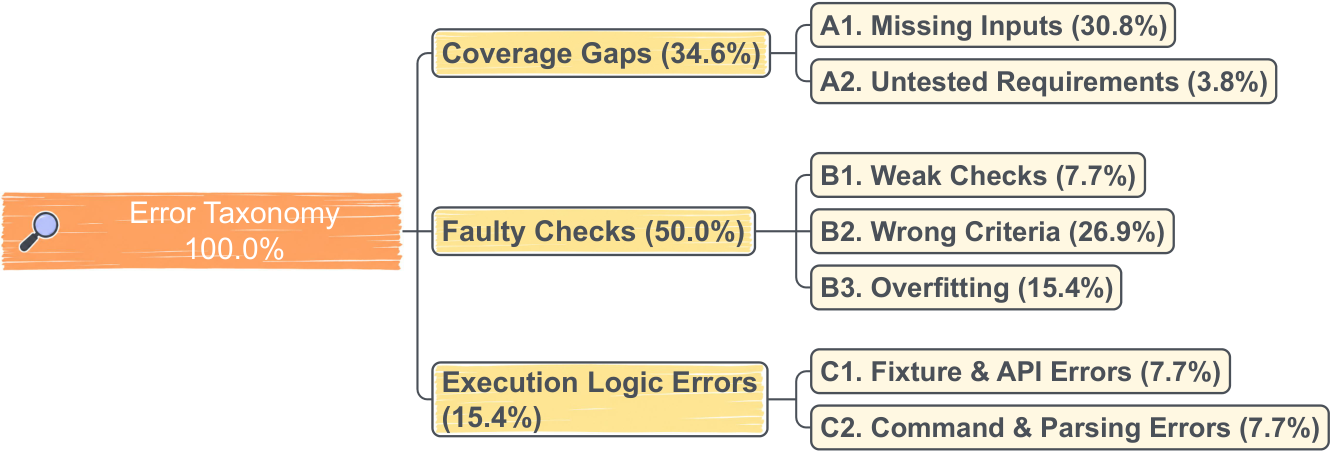
Figure 4 — 테스트 실패 메커니즘
⚠️ 알림: 이 리뷰는 AI로 작성되었습니다.
관련 포스트
- [논문리뷰] Foundations of Proactive Agents: Principles, Technical Layers, and Proactivity-Gym
- [논문리뷰] OmniVChat: Synthesizing, Benchmarking, and Training for Native Audio-Visual Dialogue
- [논문리뷰] QVal: Cheaply Evaluating Dense Supervision Signals for Long-Horizon LLM Agents
- [논문리뷰] CODA-BENCH: Can Code Agents Handle Data-Intensive Tasks?
- [논문리뷰] Comprehensive Benchmarking of Long-Form Speech Generation in Diverse Scenarios
Review 의 다른글
- 이전글 [논문리뷰] Synthesis Through Simulation: Generating Coherent Enterprise Data via Scalable Agent-System Interaction
- 현재글 : [논문리뷰] TestPrism: Rethinking Test Evaluation Beyond a Single Reference
- 다음글 [논문리뷰] TokenRouter: Efficient Serving System for Token-Level LLM Routing
댓글