[논문리뷰] Rethinking Projector Training in Multimodal LLMs
링크: 논문 PDF로 바로 열기
저자: Fabian Gröger, Naël Ouerghemi, Shuo Wen, et al.
Part 1: 요약 본문
1. Key Terms & Definitions
- Multimodal LLMs (MLLMs): 비전 인코더와 언어 모델을 통합하여 이미지와 텍스트를 동시에 이해하고 생성할 수 있는 대규모 언어 모델을 지칭합니다.
- Projector Training (Stage-I): MLLMs 훈련의 초기 단계로, frozen된 비전 인코더의 출력 feature들을 frozen된 LLM의 input space와 정렬시키기 위해 projector 네트워크를 대규모 image-caption paired data로 훈련하는 과정을 의미합니다.
- PORTAL (Projector via Optimal-transpoRT ALignment): 본 논문에서 제안하는 training-free projector initialization 방법론으로, image-caption paired data나 gradient-based optimization 없이 각 modality의 marginal statistics로부터 optimal transport를 통해 projector를 구성합니다.
- Optimal Transport: 두 확률 분포 간의 최적의 매핑을 찾는 수학적 프레임워크입니다. PORTAL에서는 Gaussian approximation을 기반으로 한 Bures-Wasserstein optimal transport를 사용하여 비전 및 언어 feature 분포를 정렬합니다.
- Coarse Alignment: Projector training이 fine-grained semantic correspondence를 학습하기보다는, 주로 비전 feature를 LLM input space의 광범위하게 호환 가능한 영역으로 매핑하는 "대략적인 정렬" 역할을 수행한다는 본 논문의 핵심 가설입니다.
2. Motivation & Problem Statement
본 논문은 Multimodal LLMs에서 널리 사용되는 Projector Training (Stage-I) 단계의 역할이 poorly understood 되어 있다는 핵심 문제를 제기합니다. 기존 연구들은 Stage-I의 중요성에 대해 conflicting evidence를 제시해왔습니다. 예를 들어, Prismatic 연구는 projector alignment를 건너뛰어도 성능이 향상될 수 있다고 보고한 반면, Cambrian-1은 Stage-I 훈련 데이터를 2.5M image-caption pairs로 확장하는 것이 도움이 된다고 주장했습니다. MM1 연구는 projector design 자체보다 resolution 및 data mixing 같은 요인이 더 중요하다고 제안하기도 했습니다. 이러한 상충하는 결과들은 projector alignment가 실제로 무엇을 하는지에 대한 deeper understanding의 부족을 드러냅니다. 현재의 projector training은 대규모 image-caption paired data와 상당한 gradient-based optimization 비용을 요구하여 Multimodal LLMs 개발의 주요 병목 중 하나로 작용하며, 이는 새로운 접근 방식의 필요성을 강력히 시사합니다.
3. Method & Key Results
저자들은 projector alignment가 주로 coarse alignment를 수행한다는 두 가지 주요 관찰에 기반하여 PORTAL (Projector via Optimal-transpoRT ALignment) 방법론을 제안합니다. 첫째, Stage-I 훈련에 전체 데이터셋의 10~20%만 사용해도 대부분의 downstream 성능 향상을 달성하며 성능이 saturate 되는 경향을 보였습니다. [Figure 2] 둘째, 서로 다른 데이터셋으로 훈련된 projector들을 linear interpolation해도 성능이 크게 유지되는데, 이는 projector weight 공간에 broad solution space가 존재함을 시사합니다. [Figure 3] 이러한 관찰을 바탕으로, PORTAL은 training-free projector initialization을 구현합니다.
PORTAL은 vision encoder feature distribution과 LLM input distribution의 Gaussian approximation 간의 Bures-Wasserstein optimal transport map을 계산하여 projector를 구성합니다. 이 과정은 paired image-caption data나 gradient-based optimization 없이, 오직 각 modality의 marginal statistics (means, principal directions, spread)만을 사용하여 closed-form solution으로 수행됩니다. 구체적으로, projector의 첫 번째 linear layer인 W1과 bias b1은 source 및 target feature의 top-k PCA subspace에서 통계적 속성을 일치시키도록 정의되며, 두 번째 layer W2와 bias b2는 각각 identity matrix와 zero vector로 고정됩니다. 저자들은 LLM이 attention 계산 전에 각 token을 normalize하기 때문에, attention이 token의 direction에 주로 의존하며, PORTAL의 covariance matching이 이러한 방향의 spread를 효과적으로 제어함을 이론적으로 설명합니다.
실험 결과, PORTAL은 558k image-caption pairs로 훈련된 표준 파이프라인과 대등한 downstream 성능을 달성했으며, 심지어 six LLM backbones, two vision encoders, 16 benchmarks에 걸쳐 3개 설정에서 baseline을 outperform하여 최고 106%의 성능을 기록했습니다. 나머지 4개 설정에서는 평균 98%의 성능을 달성했습니다. 특히, PORTAL을 projector alignment의 초기화 도구로 사용할 경우, 기존 baseline과 유사한 성능을 135x 더 적은 alignment FLOPs (약 4k의 image-caption pairs)로 달성할 수 있었습니다. [Figure 4] 이는 PORTAL이 substantial cost reduction을 가능하게 함을 의미합니다. 또한 PORTAL은 projector architecture (linear vs. MLP), image pool size, PCA rank (k=512) 선택에 대해 robust한 성능을 보였습니다. Object hallucination 벤치마크인 POPE에서도 PORTAL은 baseline보다 같거나 우수한 F1 scores를 기록했습니다.
4. Conclusion & Impact
본 논문은 Multimodal LLMs의 projector alignment 단계가 주로 coarse alignment를 수행하며, visual features를 LLM이 호환 가능한 input space로 매핑하는 역할을 한다는 결론을 제시합니다. 이러한 발견은 PORTAL이라는 training-free projector initialization 방법론을 개발하는 동기가 되었고, PORTAL은 paired image-caption data나 gradient-based optimization 없이도 기존의 훈련된 baseline과 비견할 만한 성능을 보여주었습니다. 나아가, PORTAL을 초기화에 활용할 경우, 기존 대비 약 135배 낮은 alignment compute budget으로도 유사한 성능에 도달할 수 있음을 입증했습니다. 이 연구는 Multimodal LLMs 개발에서 projector alignment 단계가 훨씬 lightweight한 feature-distribution matching step으로 대체되거나 축소될 수 있음을 시사하며, 이는 대규모 paired data 및 computation cost에 대한 의존도를 크게 낮출 수 있는 중요한 impact를 가집니다. 이는 Multimodal LLMs의 개발을 더욱 accessible하고 efficient하게 만들 잠재력을 가집니다.
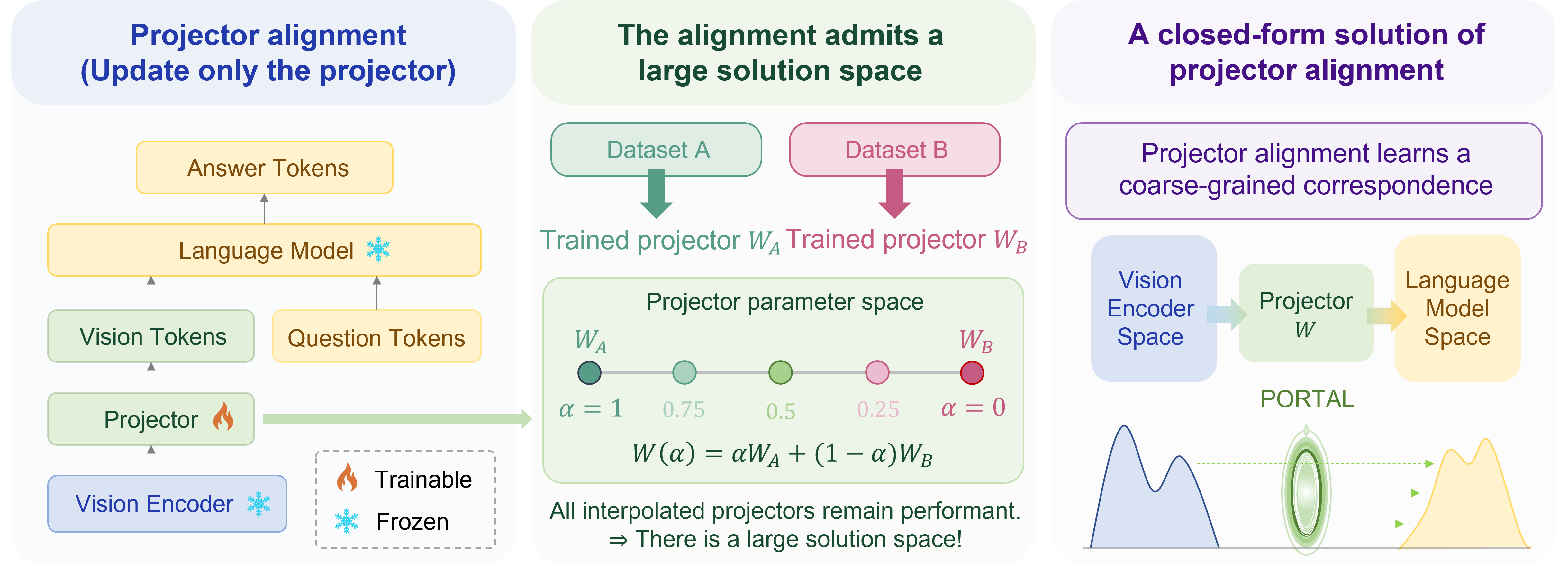
Figure 1 — 제안하는 PORTAL 방법론의 개념
⚠️ 알림: 이 리뷰는 AI로 작성되었습니다.
관련 포스트
- [논문리뷰] When Do Biological Reasoning Models Use Their Biological Inputs?
- [논문리뷰] Learning Discriminative Geometry for Drifting Models
- [논문리뷰] Reasoning with Image Generation
- [논문리뷰] Hard Vision, Easy Vision: What GPT-6 Astra Reveals Across Computer Vision
- [논문리뷰] Reason Through the Latent! Making Latent Visual Reasoning Necessary
Review 의 다른글
- 이전글 [논문리뷰] Recovering Reliable Supervision via Critique-Guided On-Policy Distillation
- 현재글 : [논문리뷰] Rethinking Projector Training in Multimodal LLMs
- 다음글 [논문리뷰] RuleTrek: Benchmarking Agentic Rule Reasoning in Complex Scenarios
댓글