[논문리뷰] BizBench: Unveiling Hidden Challenges in Deploying Long-Horizon Agents for Real-World Business
링크: 논문 PDF로 바로 열기
The browsing was successful. I have the content of the paper. Now I will proceed with generating the summary according to the specified format and constraints.
Part 1: Summary Body
- Metadata: Authors, Keywords.
- Sections: Key Terms, Motivation, Method, Conclusion.
- I need to extract 3-5 key terms and define them.
- For Motivation, I need to identify the core problem and limitations of existing work.
- For Method, I'll explain BizBench's methodology, environment, and evaluation, including quantitative results.
- For Conclusion, I'll summarize the findings and their impact.
- Crucially: Each section's first sentence must be a direct conclusion. Technical terms in English, natural Korean phrasing, bolding for specifics, and citations
[cite:INDEX]for browsed content.
Part 2: Important Figure Information (JSON)
- I need to find up to 3 important figures (architecture, key results, methodology).
- For each, I'll extract
figure_id,image_url(full URL), andcaption_kr. - Figure
<img>tags must be present. - I will examine the HTML content for
<img>tags.
Let's start by extracting the authors and keywords from the abstract. Authors: Enhan Zhao, Yongqi Tong, Xuejun Yu, Hang Wang, Pan Wang, Yichao Wang, Di He, Jianshe Li, Wei Wu Keywords: long-horizon agents, business workflows, payment systems, benchmark evaluation
Next, identify key terms and their definitions from the paper.
- Long-Horizon Agents: Agents capable of complex, multi-step planning and execution over extended periods, often involving interaction with external tools and dynamic environments.
- Execution Validity: 단순히 최종 결과 달성 여부를 넘어, 작업 수행 과정에서 발생하는 중간 단계의 제약 조건 및 비즈니스 규칙 준수 여부. (e.g., unauthorized payment is a violation even if funds are returned).
- BizBench: 실세계 결제 회사(payments company)의 비즈니스 워크플로우를 기반으로 하는 multi-turn 벤치마크로, long-horizon agent의 intermediate execution validity를 평가하는 데 중점을 둠.
- Strict Success: 목표 달성(Goal Attainment), 프로세스 요구사항(Process Requirements), 보호 요구사항(Protection Requirements) 세 가지 기준을 모두 충족하는 경우를 의미하는 평가 Metric.
Now, let's look for figures and their URLs.
Figure 1: Overview of BizBench construction.
src="2610.20424v1/benchmark_overview.png" -> https://arxiv.org/html/2610.20424v1/benchmark_overview.png
Figure 2: Reliability and resource use for models with three runs per task. Left: pass^k averages, over all kk-run subsets, the fraction of tasks that succeed in every selected run. Right: mean assistant turns, distinct documents read, and assistant tool calls per run.
src="2610.20424v1/reliability_resources.png" -> https://arxiv.org/html/2610.20424v1/reliability_resources.png
Figure 3: User-simulator model comparison using Qwen3.8-27B as the agent. Bars show the mean strict success rate over three runs; DeepSeek-V4.1-Flash is the default simulator.
src="2610.20424v1/simulator_comparison.png" -> https://arxiv.org/html/2610.20424v1/simulator_comparison.png
These three figures are good candidates for the JSON part. I will choose Figure 1 (architecture overview), Figure 2 (key results), and Figure 3 (simulator comparison).
Now I'll draft the summary body, ensuring all constraints are met.
Part 1: 요약 본문
저자: Enhan Zhao, Yongqi Tong, Xuejun Yu, Hang Wang, Pan Wang, Yichao Wang, Di He, Jianshe Li, Wei Wu et al.
1. Key Terms & Definitions (핵심 용어 및 정의)
본 섹션에서는 논문에서 다루는 주요 개념들을 정의한다.
- Long-Horizon Agents: 복잡한 비즈니스 워크플로우 내에서 다단계 계획 및 실행을 수행하며, 외부 도구와 상호작용하고 동적인 환경을 탐색하는 자율 에이전트를 의미한다.
- Execution Validity: 최종 목표 달성 여부와 무관하게, 작업 실행 과정의 각 중간 단계에서 비즈니스 정책, 규제 제약, 또는 기타 필수 요구사항을 일관되게 준수하는 것을 지칭한다.
- BizBench: 실세계 결제 회사의 복잡한 비즈니스 절차를 기반으로 구축된 multi-turn 벤치마크로, Long-Horizon Agents의 Goal Attainment뿐만 아니라 Execution Validity를 포괄적으로 평가하도록 설계되었다.
- Strict Success: 특정 태스크가 요청된 Goal을 달성하고, 모든 Process Requirements를 준수하며, Protected Objects에 대한 위반이나 Prohibited Side Effects가 없는 경우에만 주어지는 종합적인 성공 Metric이다.
2. Motivation & Problem Statement (연구 배경 및 문제 정의)
기존 long-horizon agent 벤치마크들은 주로 최종 태스크 성공(final task success)에 초점을 맞추어 intermediate execution validity에 대한 평가가 제한적이다. 그러나 결제(payments)와 같은 실제 비즈니스 환경에서는 에이전트가 광범위하고 잠재적으로 상충되거나 오래된 정책을 탐색하며, 실행 전반에 걸쳐 Critical Constraints를 충족해야 한다. 이러한 중간 단계에서의 위반(intermediate violations)은 최종 결과와 상관없이 재정적 손실이나 규제상의 문제를 초래할 수 있다. 기존 벤치마크들은 주로 기술적 진보와 소프트웨어 무결성을 강조하며, 비즈니스 환경의 복잡한 규칙, 산재된 도구 문서, 노이즈가 많거나 오래된 정보, 그리고 변화하는 조건을 제대로 반영하지 못한다. 이 연구는 이러한 평가 격차를 해소하고, 에이전트가 Consequential Actions을 수행하기 전에 적용 가능한 규칙을 식별하며, 실행 과정 내내 유효한 Execution을 유지하면서 비즈니스 요청을 완료할 수 있는지 평가하기 위해 BizBench를 도입한다.
3. Method & Key Results (제안 방법론 및 핵심 결과)
저자들은 실제 글로벌 결제 회사(leading global payments company)의 비즈니스 워크플로우를 기반으로 50개의 long-horizon 태스크를 포함하는 BizBench 벤치마크를 제안한다. 이 벤치마크는 789개의 Knowledge Documents와 601개의 Discoverable Business Tools을 통합한 실행 가능한 환경을 제공하며, Consistency가 보장된 정책, 상태, 도구 동작을 특징으로 한다. 태스크는 자원 제약(resource constraints), 시간 의존성(temporal dependencies), 사전 약속(prior commitments), 그리고 상충되거나 오래된 지침(conflicting or outdated guidance)을 포함한다. BizBench는 고객 고유의 정보를 제공하고 승인 요청에 응답하는 User Simulator와 상호작용하며 multi-turn dialogue를 포함한다. 평가 방법론은 deterministic evaluator를 통해 목표 달성(Goal Attainment)과 실행 유효성(Execution Validity)을 동시에 평가하며, 단일 솔루션 경로를 강요하지 않고 다양한 유효한 전략을 허용한다.
실험 결과, 최신 모델들도 BizBench에서 상당한 한계를 보였다. Claude Opus 5와 GPT-6 Sol은 Strict Success Rates가 각각 64.0%와 61.3%에 그쳤다 [cite: 1, Figure 2]. 특히 Qwen3.8-27B의 경우, Goal Attainment이 42.0%에 도달했음에도 불구하고 Strict Success는 32.7%로 떨어져, Outcome-based Evaluation이 Invalid Execution을 가릴 수 있음을 명확히 보여준다 [cite: 1, Table 1]. 또한, DeepSeek-V4.1-Flash는 Golden Traces 대비 약 70% 더 많은 평균 191.3회의 Tool Calls를 기록하여 상당한 Execution Overhead를 드러냈다 [cite: 1, Figure 2]. 정보 획득(Information Acquisition)에 대한 분석에서는 Gold-doc 제공 시 Strict Success가 43.3%에서 50.0%로, Full Customer Disclosure 시 70.0%로 증가하여, Customer-specific Constraints를 파악하고 유지하는 것이 특히 어려움을 시사한다 [cite: 1, Table 2].
4. Conclusion & Impact (결론 및 시사점)
본 논문은 Long-Horizon Agents의 신뢰성 있는 배포를 위해 태스크 결과뿐만 아니라 실행 과정의 유효성까지 평가하는 BizBench를 제안한다. 실험을 통해 현재 에이전트들이 태스크 완료, 프로세스 준수(Process Compliance), 그리고 반복 실행 간의 일관성(Consistency across runs) 측면에서 다양한 약점을 가지고 있음이 밝혀졌다 [cite: 1, Figure 2]. 특히, 정보 획득 능력, 즉 올바른 고객 정보를 얻는 것이 성능을 크게 향상시킬 수 있지만, 과도한 Tool Use가 반드시 의미 있는 진전을 나타내지는 않음을 보여주었다 [cite: 1, Table 2, Figure 2]. 이 연구는 에이전트가 충분한 근거를 가지고 다음 단계로 진행할 시점을 파악하고, 실행 과정에서 항상 충족되어야 하는 의무 사항들을 관리하는 등, 정보 수집과 행동 선택 간의 긴밀한 조정(closer coordination)이 필요함을 강조한다. BizBench는 복잡한 비즈니스 환경에서 Long-Horizon Agents가 Execution Validity를 유지하며 태스크를 수행하는 능력을 평가하고 발전시키기 위한 엄격한 테스트베드를 제공한다.
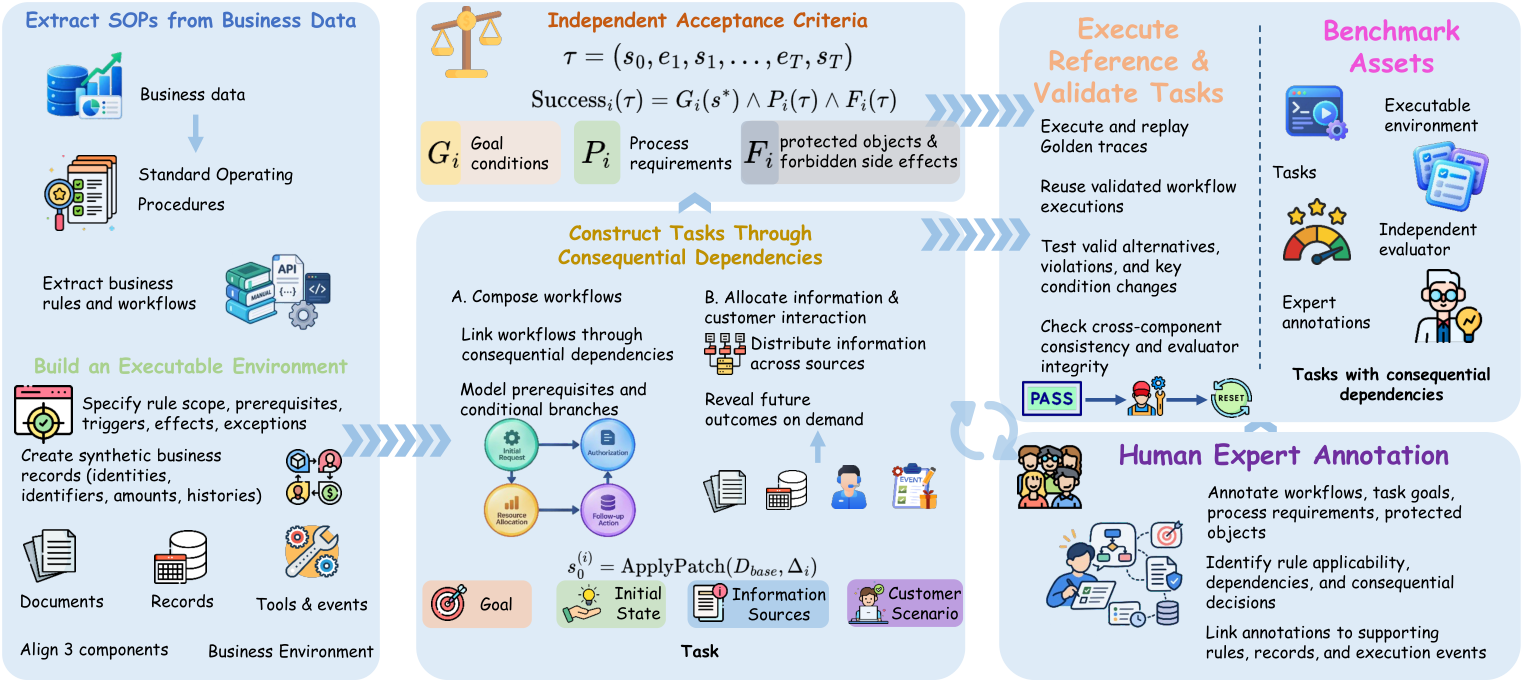
Figure 1 — BizBench 구성 개요
⚠️ 알림: 이 리뷰는 AI로 작성되었습니다.
관련 포스트
- [논문리뷰] LLMs4All: A Review on Large Language Models for Research and Applications in Academic Disciplines
- [논문리뷰] Xiaomi-Lens-0 Technical Report
- [논문리뷰] Tree-Aware Posterior Distillation for Long-Horizon Agentic Reinforcement Learning
- [논문리뷰] Towards Looped Models Done Right, Part I: Topology, Input Injection, Recurrent-State Design
- [논문리뷰] Stuck on Shuffle: On Attribute-Object Binding in Vision-Language Models
Review 의 다른글
- 이전글 [논문리뷰] Belief-Trajectory Energy: Measuring the Path to a Prediction
- 현재글 : [논문리뷰] BizBench: Unveiling Hidden Challenges in Deploying Long-Horizon Agents for Real-World Business
- 다음글 [논문리뷰] BridgeWAM: Bridging Video and Action Experts via Latent Bridge Queries
댓글