[논문리뷰] BridgeWAM: Bridging Video and Action Experts via Latent Bridge Queries
링크: 논문 PDF로 바로 열기
I have browsed the paper. Now I will extract the information and format it as requested.
Authors: Jiaxin Fang, Ruitong Liu, Zeyu Lai, Xingyu Wang, Mingyuan Jia, Pingyue Sheng, Weikang Wan, Mengdi Xu, Yuxiang Gao Formatted as: 저자: Jiaxin Fang, Ruitong Liu, et al.
Keywords: Need to identify from the abstract and introduction.
"World Action Models (WAMs)", "video and action experts", "Latent Bridge Queries (LBQs)", "Bridge-of-Experts (BoE)", "decoupled expert depths", "inference efficiency", "generalization", "robot manipulation". I'll pick 5-8.
World Action Models, Latent Bridge Queries, Bridge-of-Experts, Robotics, Vision-Language-Action Policies, Inference Efficiency, Generalization
Figures for Part 2:
- Figure 1: Overview of BridgeWAM. (Looks like an architecture overview and key results summary) ->
2610.14746v1/section/photo/bridgewam-teaser-926.png - Figure 2: Comparison of the BoE and MoT architectures. (Explains the core architectural difference) ->
2610.14746v1/section/photo/MoT_and_BoE.png - Figure 3: Overview of the BridgeWAM architecture. (More detailed architecture diagram) ->
2610.14746v1/section/photo/BridgeWAM-Figure.png - Figure 4: Real-world manipulation tasks and results. (Key real-world results) ->
2610.14746v1/section/photo/real-robot-photo.png - Figure 5: Action-conditioned visual routing maps. (Qualitative analysis) ->
2610.14746v1/section/photo/BridgeWAM_attention_maps_clean.png
I will choose Figure 1 (overall overview), Figure 2 (architectural comparison), and Figure 3 (detailed architecture). Figure 4 and 5 are also good but 1, 2, 3 provide better core method explanations.
Let's refine the keywords: World Action Models, Latent Bridge Queries, Bridge-of-Experts, Robot Control, Vision-Language-Action, Inference Efficiency, Generalization, Decoupled Experts.
Now, I'll write the summary following all the specified constraints.
Part 1: 요약 본문
저자: Jiaxin Fang, Ruitong Liu, et al.
1. Key Terms & Definitions (핵심 용어 및 정의)
- World Action Models (WAMs): 로봇의 Vision-Language-Action (VLA) 정책을 학습하여 시각적 관찰, 언어 지침 및 고유수용성 상태로부터 로봇의 Action을 예측하는 모델로, 시각적 Scene의 시간적 진화를 명시적으로 모델링한다.
- Mixture-of-Transformers (MoT) attention: 기존 WAM에서 Video Expert와 Action Expert 간에 정보를 결합하는 일반적인 방식으로, Dense하고 Layer-wise한 Attention을 통해 Video Feature를 Action Prediction에 노출시킨다.
- Bridge-of-Experts (BoE): 본 논문에서 제안하는 새로운 아키텍처로, Video Expert와 Action Expert를 Latent Bridge Queries (LBQs)라는 Compact한 Latent Space를 통해 연결하여 정보 전송의 효율성과 Action Expert의 선택성을 향상시킨다. [Figure 2]
- Latent Bridge Queries (LBQs): BoE의 핵심 구성 요소로, 32개의 Learnable Query로 구성된 Limited Latent Space이다. Video Expert 내부에서 시각, 언어 및 고유수용성 Prior를 통합하여 Action Expert가 Task-relevant 정보를 선택적으로 검색할 수 있도록 최적화된 Latent Feature를 제공한다.
- Decoupled Expert Depths: BoE 아키텍처의 특징으로, Video Expert와 Action Expert의 Layer 깊이를 독립적으로 설정할 수 있도록 하여, 기존 MoT 방식의 전문가 Depth 일치 강제로 인한 중복 Parameter 및 Inference Overhead 문제를 해결한다. [Figure 2]
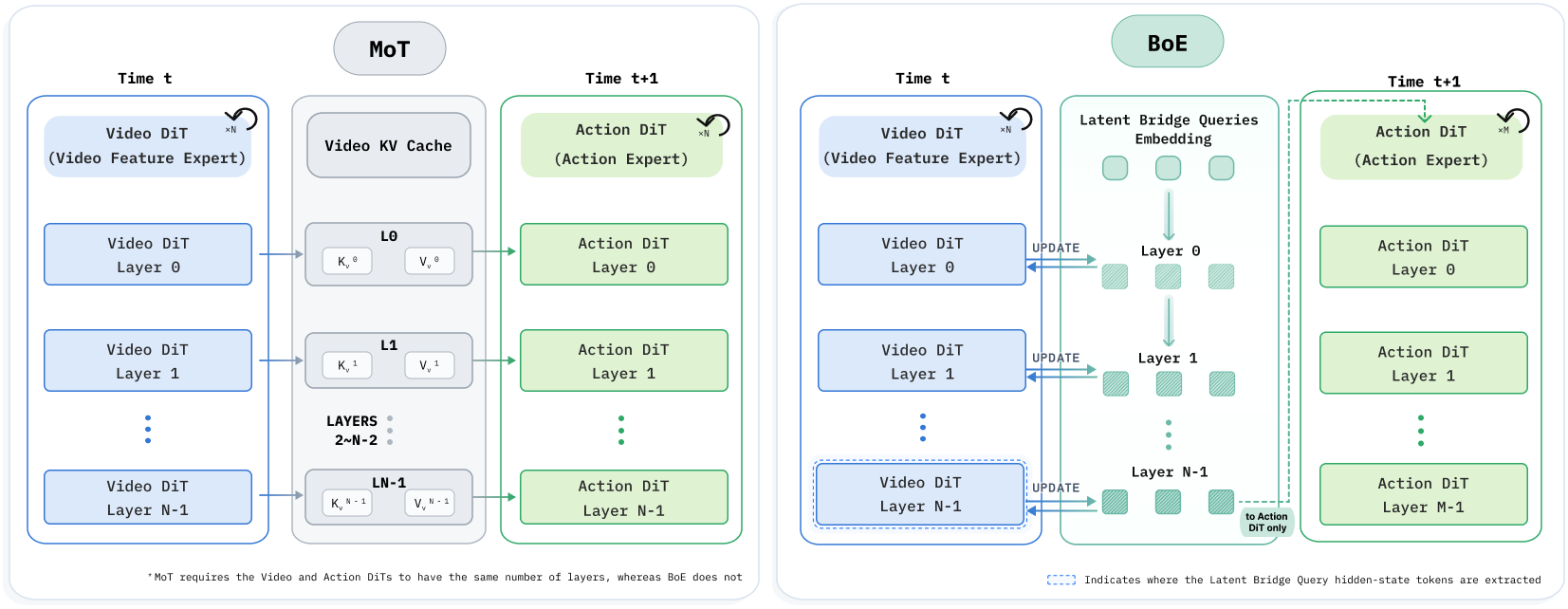
Figure 2 — BoE와 MoT 아키텍처 비교
2. Motivation & Problem Statement (연구 배경 및 문제 정의)
기존 World Action Models (WAMs)은 Video Expert와 Action Expert를 Mixture-of-Transformers (MoT) Attention을 통해 결합하여 로봇의 Action을 예측하지만, 이러한 방식은 몇 가지 본질적인 한계를 가진다. 첫째, Layer-wise MoT 디자인은 Video Expert의 Dense한 Visual Feature를 Action Layer에 직접적으로 노출시켜, Task-relevant 정보와 중복된 Detail이 Attention을 놓고 경쟁하게 만든다. 이는 Action Generation이 Task-irrelevant 시각 영역에 과도한 Attention을 할당하여 Task Execution을 방해하고 Visual Distribution Shift 상황에서의 Policy Generalization을 약화시킬 수 있다. 둘째, MoT의 One-to-one Layer Coupling은 두 Expert의 Depth를 동일하게 강제하여 중복 Parameter와 Inference Overhead를 야기한다. Action-side Capacity의 과도한 증가는 일반화 가능한 환경 Regularity 학습보다는 특정 Scene 패턴을 Memorize하는 경향을 부추겨 Generalization을 약화시킬 수 있다. 따라서 WAM은 Compact한 Latent Space에서 작동하며 Action Expert가 Task-relevant Visual Feature에 더 많은 Attention을 할당할 수 있도록 하는 Learnable Interface가 필요하며, 동시에 Action Supervision이 Visual Representation을 형성하도록 허용해야 한다. 또한, Expert Depth를 Decouple하여 중복 Parameter를 줄이고 Inference Efficiency를 개선해야 한다.
3. Method & Key Results (제안 방법론 및 핵심 결과)
본 논문은 기존 WAM의 한계를 극복하기 위해 Video Expert와 Action Expert를 Compact한 Latent Bridge Queries (LBQs)를 통해 연결하는 새로운 아키텍처인 Bridge-of-Experts (BoE)를 제안하며, 이를 BridgeWAM으로 구현한다 [Figure 1, Figure 3]. BoE는 32개의 LBQ를 사용하여 시각, 언어, 고유수용성 Prior를 통합하여 Action Generation에 최적화된 공유 Latent Space를 구축한다. End-to-End Optimization 과정에서 Action Loss Gradient는 LBQ를 통해 Video Expert로 흘러 들어가, Action Prediction에 더 적합한 Representation을 생성하도록 Video Expert를 유도한다. BridgeWAM은 Expert Depth를 Decouple하여 30-layer Video Expert와 경량의 Two-layer Alternating Cross–Self-Attention Action Expert를 결합한다 [Figure 2]. Action Expert는 Cross-Attention을 통해 LBQ로부터 정보를 검색하고, Self-Attention을 통해 Action Chunk를 Co-ordinate한다.
실험 결과, BridgeWAM은 다양한 벤치마크에서 뛰어난 성능과 효율성을 입증했다. LIBERO 벤치마크에서 98.25%의 성공률을 달성하여 Fast-WAM 대비 1.45%p 높은 성능을 보였으며, LIBERO-Object에서는 100% 성공률을 기록했다. 특히, LIBERO-Plus Zero-shot 평가에서는 Fast-WAM의 평균 49.5%를 72.2%로 크게 향상시켰다. 효율성 측면에서, BridgeWAM은 Fast-WAM 대비 Single-sample Inference FLOPs를 28.72% 감소시켰고, Real-robot Latency를 77.1ms (2.47배 Speedup)로 단축했다. Ablation Study 결과, Video Representation이 Action Learning과 함께 Joint하게 Adapt되어야 하며, LBQ 전용 Cross-attention이 MoT-style Readout보다 효과적임이 확인되었다. 또한, 24~36개의 LBQ라는 Limited Latent Space가 Action Prediction에 충분한 Conditioning을 제공하며, Action Expert Depth 증가는 Generalization 개선에 유의미한 영향을 미 미치지 않음이 밝혀졌다.
4. Conclusion & Impact (결론 및 시사점)
본 연구는 Layer-wise MoT Coupling의 Dense Visual Feature 노출 및 Expert Depth 일치 강제라는 두 가지 한계를 해결하기 위해 Bridge-of-Experts (BoE) 아키텍처를 제안하고 BridgeWAM으로 구현했다. BridgeWAM은 Compact하고 Learnable한 Latent Bridge Queries (LBQs)를 통해 Multimodal 정보를 효율적으로 통합하고 Action Expert의 선택적인 정보 검색을 가능하게 하며, Expert Depth를 Decouple하여 경량 Action Decoding을 지원한다. 이러한 디자인은 Task-relevant 정보와 중복 Visual Detail 간의 경쟁을 완화하고 Action-side Computation을 줄여, Task Performance, Generalization, Inference Efficiency 간의 균형을 효과적으로 달성했다. 이 연구는 로봇 제어 분야에서 효율적이고 Robust한 World Action Model 개발을 위한 새로운 방향을 제시하며, 특히 Resource-constrained 환경에서의 실용적인 로봇 시스템 구현에 중요한 시사점을 제공한다. 향후 연구는 Long-horizon Manipulation 학습 개선 및 더욱 안정적이고 Capacity-limited한 Latent Space 구축에 초점을 맞출 예정이다.
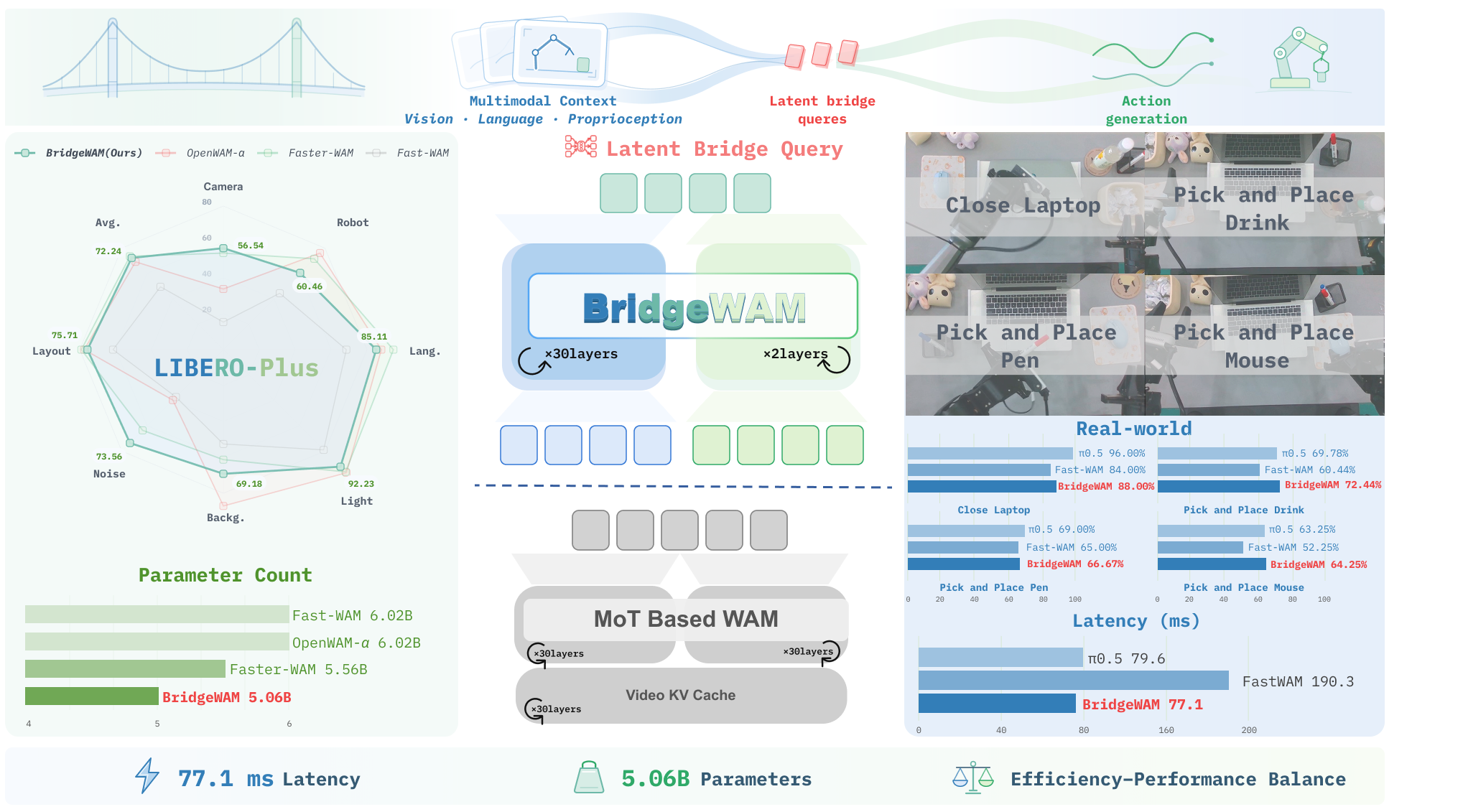
Figure 1 — BridgeWAM 개요
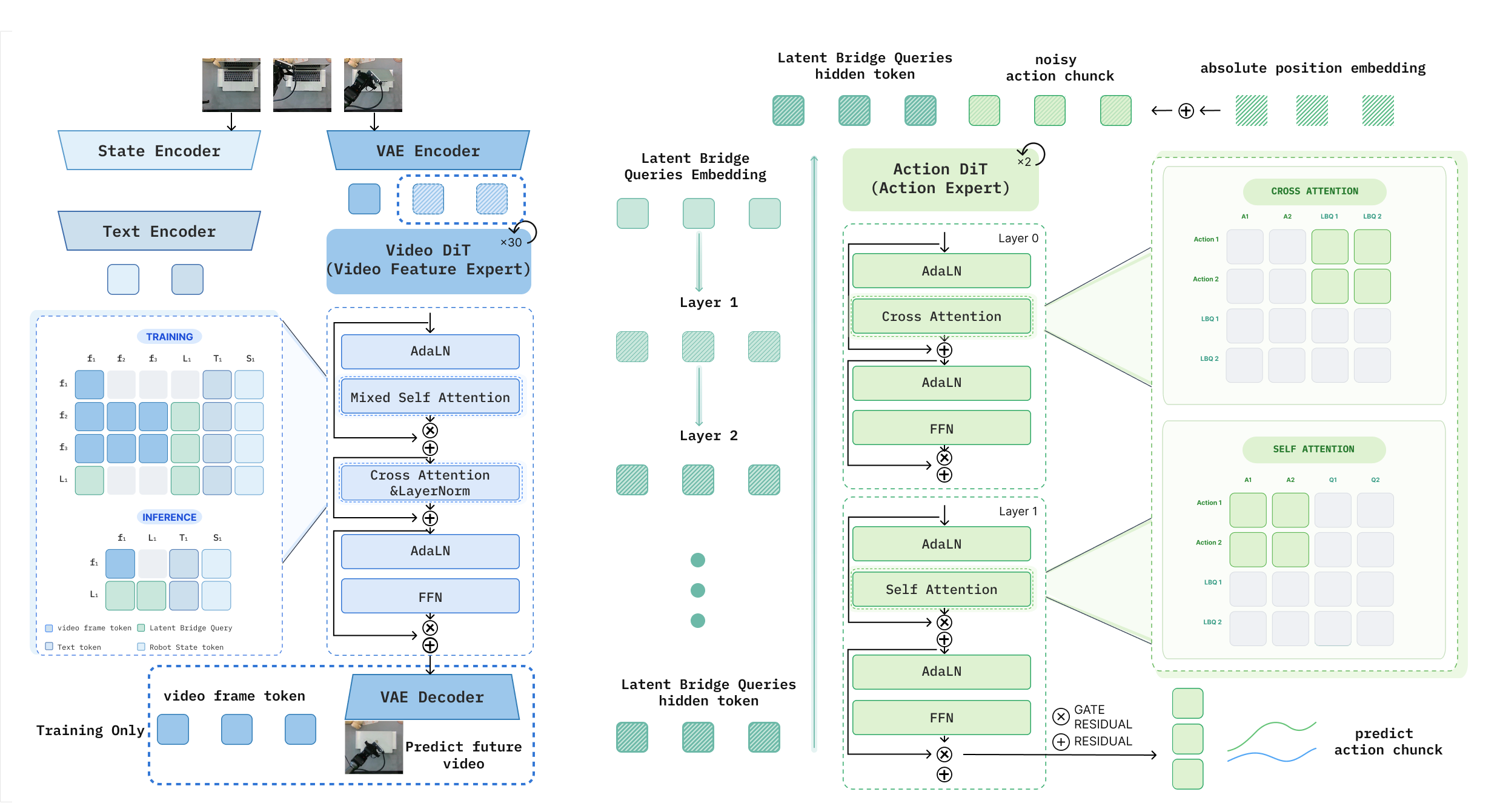
Figure 3 — BridgeWAM 아키텍처
⚠️ 알림: 이 리뷰는 AI로 작성되었습니다.
관련 포스트
- [논문리뷰] What Makes World Action Models Generalize? An Empirical Study of Test-Time Future Modeling
- [논문리뷰] RoboFollow: Unveiling the Instruction Following Mirage in Embodied Agents
- [논문리뷰] Latent Action as Intention Enables Efficient Future Imagination for World Action Models
- [논문리뷰] RISE: Adaptive Imagination for World Action Models
- [논문리뷰] GigaWorld-Policy-0.5: A Faster and Stronger WAM Empowered by AutoResearch
Review 의 다른글
- 이전글 [논문리뷰] BizBench: Unveiling Hidden Challenges in Deploying Long-Horizon Agents for Real-World Business
- 현재글 : [논문리뷰] BridgeWAM: Bridging Video and Action Experts via Latent Bridge Queries
- 다음글 [논문리뷰] Can Visual Generation Expand What Unified Multimodal Models Know?
댓글