[논문리뷰] Spatial Audio Generation and Editing with Executable Plans and Self-Distilling Transfusion
링크: 논문 PDF로 바로 열기
저자: Kam Man Wu, Yu Zhang, Pengjun Fang, Mingfei Chen, Weijia Chen, Zeyue Tian, Qifeng Chen
1. Key Terms & Definitions (핵심 용어 및 정의)
본 논문에서 다루는 핵심 기술 용어 및 개념은 다음과 같습니다:
- First-Order Ambisonics (FOA): 3D Soundfield를 포괄적으로 인코딩하는 spatial audio format입니다. 이 format은 immersive media 및 virtual acoustics와 같은 applications에서 사용됩니다.
- Executable ScenePlan: Source content, activity, 및 3D trajectories를 포함하는 structured plan으로, autoregressive planning과 rectified-flow rendering 간의 interface 역할을 합니다.
- Transfusion Backbone: Autoregressive planning과 rectified-flow rendering을 executable ScenePlans를 통해 연결하는 shared Transformer architecture입니다.
- Ambit CLAP: Spatial audio editing task에서 semantic 및 spatial grounding을 위해 사용되는 Contrastive Language-Audio Pretraining model입니다. 이는 source understanding을 돕습니다.
- On-Policy Self-Distillation (OPSD): Student-generated contexts에서 planning과 rendering을 jointly refinement하는 기법으로, student의 의사결정이 DiT의 조건과 샘플링 상태를 모두 변화시키는 문제에 대응합니다.
2. Motivation & Problem Statement (연구 배경 및 문제 정의)
본 논문은 text-driven generation과 instruction-guided editing을 포함하는 spatial audio authoring에서 coherence 있는 soundfield synthesis와 source decisions coordination이 필요한 핵심 문제를 해결하고자 합니다. 특히, editing task에서는 선택된 attributes를 변경하면서 surrounding sources의 acoustic details를 유지하는 것이 추가적인 요구사항입니다.
기존 연구(Baseline)의 한계점은 다음과 같습니다: 첫째, FOA authoring을 위한 language를 3D source controls에 grounding하는 것이 복잡하며, source-bound content, timing, 3D motion control 및 edit targets 식별이 요구됩니다. 둘째, continuous FOA autoencoders는 content generation을 지원하지만, inter-channel energy, coherence, 및 phase에 대한 explicit supervision이 부족하여 acoustic reconstruction과 spatial structure 보존에 한계가 있습니다. 셋째, discrete planning과 continuous rendering의 refinement 과정에서 inference 시 student predictions이 renderer에 주어지는 conditions와 sampling states를 모두 변경하므로, 이 두 모드를 jointly refinement하는 것이 어렵습니다. 이러한 한계점들로 인해 새로운 통합 framework가 필요합니다.
3. Method & Key Results (제안 방법론 및 핵심 결과)
본 연구는 Ambit이라는 통합 FOA authoring framework를 제안하며, 이는 세 가지 주요 기여를 통해 기존 문제들을 해결합니다 [Figure 2].
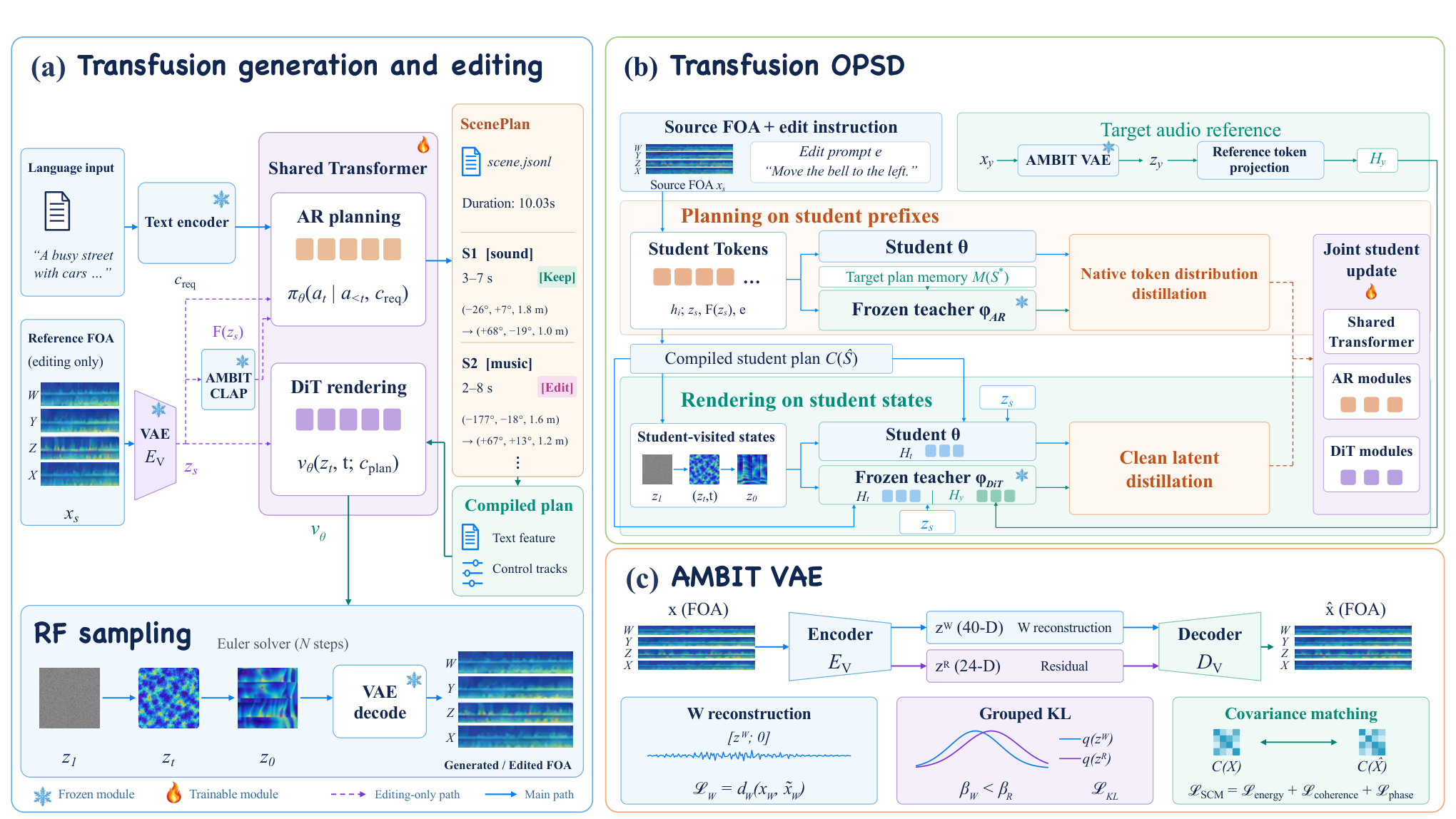
Figure 2 — Ambit 프레임워크 개요
첫째, Unified Transfusion Planning and Rendering입니다. Ambit은 Transfusion backbone을 공유하여 autoregressive planning과 rectified-flow rendering을 연결합니다. Executable ScenePlans는 source content, timing, 3D motion을 지정하며, editing 시에는 semantic 및 spatial contrastive features와 full reference latents를 사용하여 요청된 변경 사항을 grounding하고 acoustic detail을 보존합니다. 둘째, FOA-aware continuous Variational Autoencoder (VAE)는 acoustic content와 inter-channel structure를 보존하도록 설계되었습니다. 이는 shared-decoder omnidirectional recovery, asymmetric grouped KL, 및 spatial covariance matching (SCM)을 결합하여 inter-channel energy, coherence, 및 phase를 명시적으로 supervise합니다. Ambit VAE는 WW SI-SDR 6.39 dB, Direction error 4.96°, Intensity coherence error 0.04, 및 WW paired CLAP 0.90을 달성하여 DAC, EnCodec, WavTokenizer 등 기존 codec들보다 뛰어난 성능을 보였습니다 [Table 1]. 셋째, Joint Transfusion On-Policy Self-Distillation (OPSD)은 student-generated prefixes에 대한 planning과 student plans에 따라 도달한 sampling states에서의 rendering을 동시에 refinement합니다. 이 방법론은 frozen teachers를 사용하여 student의 두 모드를 supervise하며, shared parameters를 통해 planning과 rendering을 jointly update합니다 [Figure 2].
실험 결과, Ambit은 content generation에서 AudioX-Turbo 대비 music 및 sound domain에서 더 높은 paired CLAP과 더 낮은 FAD를 달성했으며, speech domain에서는 가장 낮은 WER 및 CER을 기록했습니다 [Table 2]. Spatial audio generation에서는 TangoFlux 대비 directional 및 binaural errors를 감소시켰으며, editing에서는 SwanWeave 대비 acoustic fidelity와 spatial accuracy가 향상되었습니다 [Table 3, Table 5]. 특히, Joint OPSD는 post-training 이후 SFT, ReFL, GRPO 등 모든 비교 baseline 대비 paired CLAP, FAD, LSD, GCC, CRW, FSAD를 포함한 아홉 가지 모든 metric에서 가장 우수한 editing quality를 보여주었습니다 [Table 6].
4. Conclusion & Impact (결론 및 시사점)
본 논문은 Executable ScenePlans, FOA-aware VAE, 및 joint Transfusion OPSD를 활용하여 native FOA generation 및 editing을 위한 통합 Transfusion framework인 Ambit을 성공적으로 제시했습니다.
이 연구는 spatial audio authoring 분야에서 content fidelity, spatial accuracy, 및 unedited-source preservation을 크게 향상시켰습니다. 특히, planning과 rendering을 student-generated contexts에서 jointly refinement하는 joint OPSD 접근 방식은 학계 및 산업계에서 보다 정확하고 현실적인 spatial audio content를 생성하고 편집하는 데 중요한 시사점을 제공합니다. 향후 Ambit을 더 긴 soundscapes로 확장하고 연속적인 editings 간의 acoustic consistency를 평가하는 것이 중요한 연구 방향이 될 것입니다.
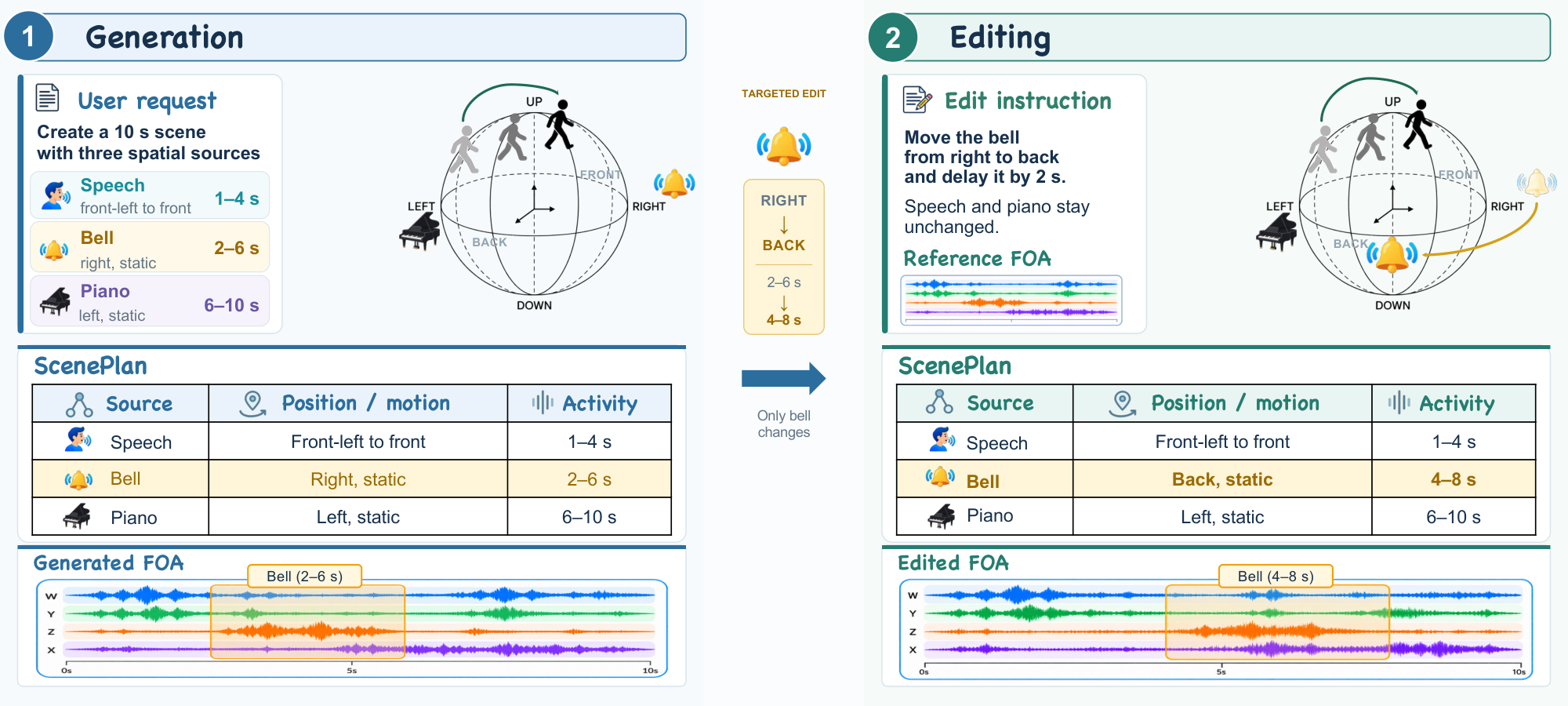
Figure 1 — Ambit 기능 개요
⚠️ 알림: 이 리뷰는 AI로 작성되었습니다.
관련 포스트
- [논문리뷰] On-Policy Self-Training: Data-Free Self-Improvement in Large Language Models
- [논문리뷰] Self-Distilling Future Video Representations for World Action Models
- [논문리뷰] VisionWeave: Weaving Elastic Visual Representations as a Native Capability of MLLMs
- [논문리뷰] The Missing Primitive: Diagnosing and Repairing Mathematical Reasoning in Large Language Models
- [논문리뷰] ASCENT: Online Test-Time Training of Long-Horizon Agents via Self-Distillation of Verified Experience
Review 의 다른글
- 이전글 [논문리뷰] Skill^{infty}: Recursive Self-Improvement for Agent Skill Optimization
- 현재글 : [논문리뷰] Spatial Audio Generation and Editing with Executable Plans and Self-Distilling Transfusion
- 다음글 [논문리뷰] Steering Black-Box Large Language Model Agents with Pitfall Anticipation World Model
댓글