[논문리뷰] Topology-Preserving Neural Operator Learning via Hodge Decomposition
링크: 논문 PDF로 바로 열기
저자: Dongzhe Zheng, Tao Zhong, Christine Allen-Blanchette
1. Key Terms & Definitions (핵심 용어 및 정의)
- HSD (Hodge Spectral Duality): 신경 연산자 학습을 위한 Hybrid Eulerian-Lagrangian 아키텍처로, discrete differential forms와 orthogonal auxiliary ambient space를 사용하여 topology-dominated components와 복잡한 local dynamics를 포착한다.
- Hodge Decomposition: Riemannian manifold의 k-form을 gradient-type, curl-type, harmonic components로 고유하게 분리하여 local differential structure를 global conservation으로부터 직교적으로 분리하는 이론이다.
- Discrete Exterior Calculus (DEC): simplicial complexes에서 algebraic 및 cohomological structure를 정확하게 보존하는 rigorous framework이다.
- Differential Forms: 온도와 같은 scalar fields(0-forms), 질량 흐름율과 같은 flux-type covector fields(1-forms), 와도(vorticity)와 같은 fluxes through surface elements(2-forms)와 같이 물리적 필드를 나타내는 수학적 개념이다.
- Neural Operator: 연속적인 함수 공간 매핑을 학습하여 PDE의 해를 찾는 모델로, 메시와 geometry 전반에 걸쳐 재사용 가능한 솔루션을 목표로 한다.
2. Motivation & Problem Statement (연구 배경 및 문제 정의)
본 연구는 Riemannian manifolds에서 physical field equations의 solution operators를 resolution-independent하고 structure-preserving 방식으로 학습하는 핵심 문제를 다룬다. 기존 Neural Operator 방법론들은 주로 Euclidean domains에서 성공을 거두었으나, 복잡한 Riemannian manifolds (boundary, curvature, non-trivial topology 포함)에 적용될 때 근본적인 한계에 직면한다. Graph Neural Operators (GNOs)와 같은 local aggregation 방식은 over-smoothing 문제와 장거리 의존성 모델링의 한계로 global topological structure를 포착하는 데 어려움을 겪으며, higher-order differential complexes에 대한 명시적인 인코딩이 부족하다. Fourier Neural Operators (FNOs)와 같은 extrinsic spectral methods는 Euclidean grids에서의 효율성을 활용하지만, cohomological 및 boundary topology에 무관하며 harmonic components와 topological invariants를 암묵적으로 얽히게 한다. 이러한 한계점들로 인해 operator learning이 varying geometries 전반에서 higher-order differential form structure를 효율적으로 포착하면서도 resolution-independent 및 structure-preserving 속성을 유지하는 것이 어렵다.
3. Method & Key Results (제안 방법론 및 핵심 결과)
저자들은 Hodge Decomposition과 operator splitting에 기반한 Hodge Spectral Duality (HSD) 프레임워크를 제안한다 [Figure 1]. 이 방법론은 discrete differential forms를 사용하여 topology-dominated components를 캡처하고, orthogonal auxiliary ambient space를 통해 복잡한 local dynamics를 표현한다. HSD는 dual-branch architecture로 구성된다. Base Space Branch는 truncated Hodge spectral domain에서 topology-dominated low-frequency response를 학습하며, harmonic projection을 통해 cohomological information과 global conserved quantities를 hard constraint로 보존한다. Ambient Fiber Space Branch는 auxiliary Euclidean grid에서 FFT 기반 convolution을 통해 metric-dominated high-frequency corrections를 처리하며, orthogonal projection을 통해 base space complement로 출력을 제한함으로써 global conservation을 유지한다. topological 및 geometric operator 간의 non-commutativity에서 발생하는 systematic splitting residuals를 처리하기 위해 C(l) correction operator를 도입하며, 이는 geometric lift와 spectral derivatives로부터 유도된 interaction features z(l)를 사용하여 commutator-dominated coupling을 점진적으로 학습한다.
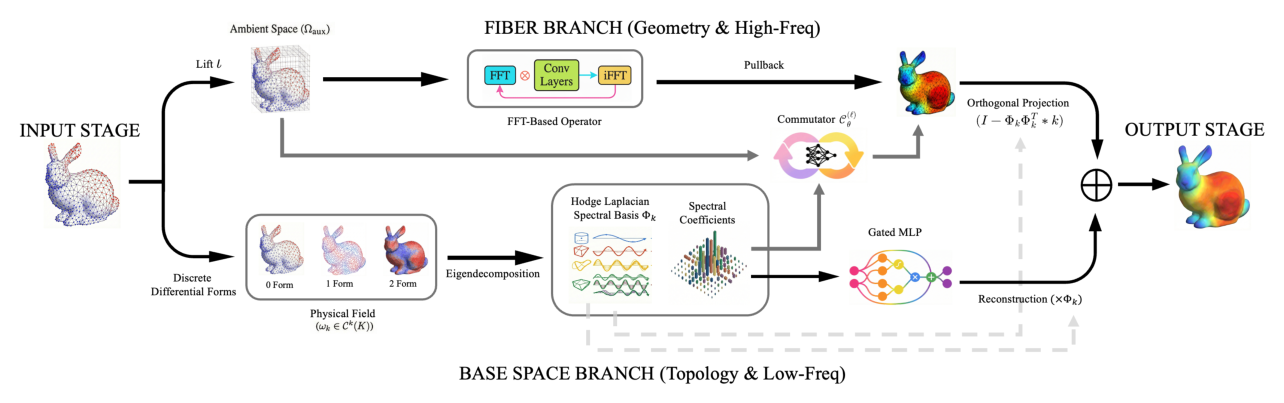
Figure 1 — 전체 HSD 모델의 아키텍처를 보여주는 핵심 다이어그램
실험 결과는 HSD가 기존 Neural Operator 방법론 대비 우수한 정확도와 효율성을 달성함을 보여준다 [Table 1]. External Aerodynamics 태스크에서 HSD는 MSE 1.08 x 10^-2를 기록하여 FNO-3D 대비 40%의 감소를 보였으며, Enstrophy Fidelity 0.7658과 Spectral Fidelity 0.8423로 높은 high-frequency vortex feature 포착 능력을 입증했다. Magnetostatics 태스크에서는 DeepONet 대비 36% 감소한 MSE 1.84 x 10^-4와 Enstrophy Fidelity 0.9444를 달성하여 global topological obstacle에 의해 지배되는 영역에서 local flux concentration structure를 정확하게 식별했다. Toroidal Transport 태스크에서는 FNO-3D 대비 36% 감소한 MSE 3.56 x 10^-4와 Energy Fidelity 0.6968, Bo Score 0.7829를 기록하여 long-time integration 시 에너지 소산 및 topological structure의 안정적인 보존 능력을 입증했다. 또한, HSD는 spectral energy decay 분석에서 high-frequency regions에서 ground truth와 가장 유사한 spectrum을 보여, spectral bias를 효과적으로 극복했음을 입증했다 [Figure 7]. 학습 효율성 측면에서도 HSD는 대부분의 태스크에서 DeepONet보다 느리지만, MGN이나 GNO보다는 훨씬 빠르며, offline precomputation과 online inference의 분리로 resolution-independent한 효율성을 달성한다.
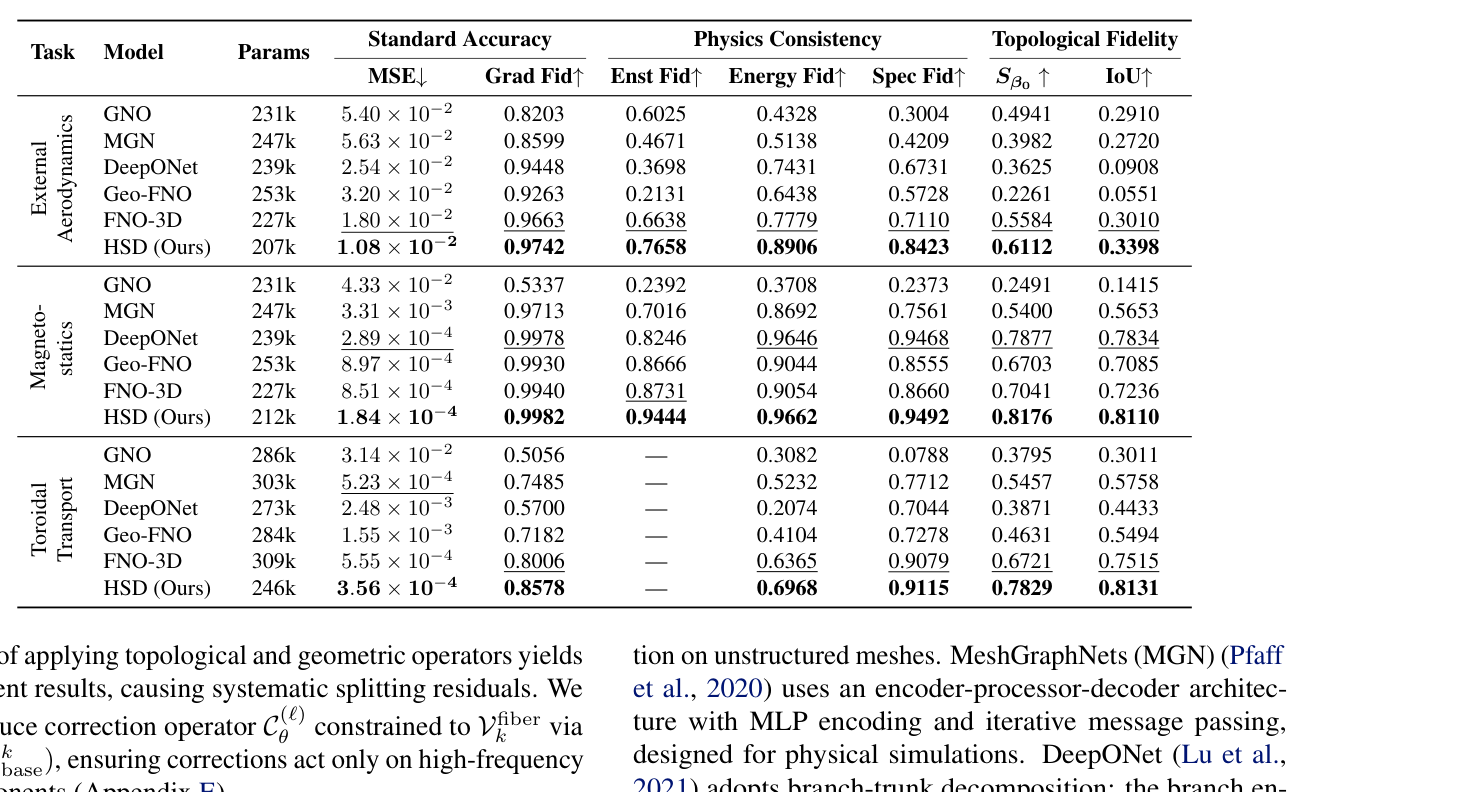
Table 1 — 주요 실험 태스크에 대한 HSD와 baseline 모델들의 정량적 성능 지표를 비교하는 핵심 테이블
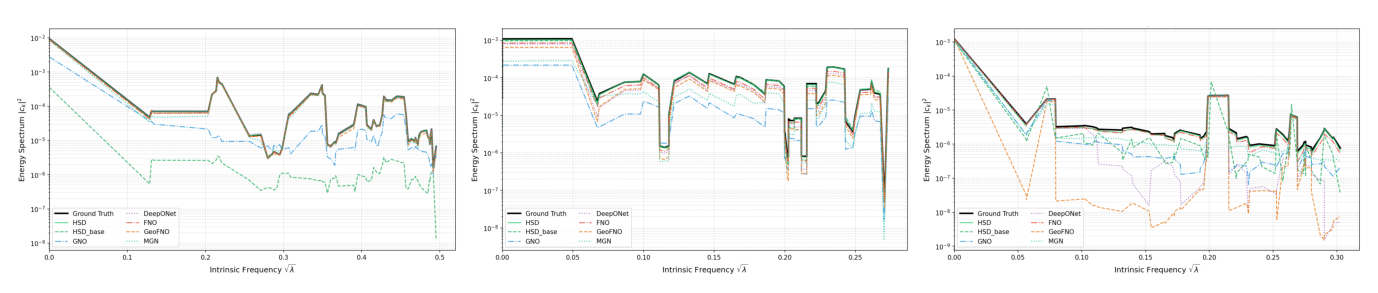
Figure 7 — HSD 모델이 high-frequency 영역에서 spectral bias를 효과적으로 극복함을 보여주는 spectral energy decay 분석 그래프
4. Conclusion & Impact (결론 및 시사점)
본 논문은 Hodge Spectral Duality (HSD) 프레임워크를 통해 복잡한 Riemannian manifolds에서 물리적 필드 방정식을 위한 topology-preserving neural operator learning을 성공적으로 제시한다. HSD는 topological constraints와 geometric dynamics를 동시에 처리하여, 물리적 일관성과 resolution-independent한 operator approximation을 가능하게 한다. 이 연구는 operator learning on manifolds에 내재된 intrinsic Hodge-orthogonal additive structure에 대한 경험적 증거를 제공한다. 이는 일반 Riemannian manifolds에서 물리적 시뮬레이션 및 PDE solving 분야에서 신경 연산자의 적용 가능성을 크게 확장하며, high-frequency geometric details와 global conservation laws를 동시에 포착하는 데 있어 전통적인 신경 연산자들의 어려움을 해결하는 데 중요한 시사점을 던진다.
⚠️ 알림: 이 리뷰는 AI로 작성되었습니다.
관련 포스트
- [논문리뷰] HodgeCover: Higher-Order Topological Coverage Drives Compression of Sparse Mixture-of-Experts
- [논문리뷰] Frequency Bias and OOD Generalization in Neural Operators under a Variable-Coefficient Wave Equation
- [논문리뷰] LLMs4All: A Review on Large Language Models for Research and Applications in Academic Disciplines
- [논문리뷰] World Model Interpretability: From Decoding Representations to Understanding Latent Worlds
- [논문리뷰] Where is Physical RSI capability from? An Observational Scaling Law of LLM-as-policy
Review 의 다른글
- 이전글 [논문리뷰] Self-Distilled Agentic Reinforcement Learning
- 현재글 : [논문리뷰] Topology-Preserving Neural Operator Learning via Hodge Decomposition
- 다음글 [논문리뷰] Unlocking Complex Visual Generation via Closed-Loop Verified Reasoning
댓글