[논문리뷰] Hierarchical Advantage Weighting for Online RL Fine-Tuning of VLAs from Sparse Episode Outcomes
링크: 논문 PDF로 바로 열기
저자: Tongyan Fang, Siyuan Huang, Naiyu Fang, Ganlong Zhao, Zhongjin Luo, Jianbo Liu, Xiaogang Wang, Ying Dong, Hongsheng Li
1. Key Terms & Definitions (핵심 용어 및 정의)
- VLA (Vision-Language-Action) Models: 시각, 언어, 동작 이해를 결합하여 다양한 manipulation task에 일반화할 수 있는 사전 학습된 정책(policy)을 의미합니다.
- Sparse Episode Outcomes: Online RL fine-tuning은 종종 에피소드당 단일 binary(성공/실패) 신호만을 제공하여, transition 단위의 세밀한 피드백이 결여되는 상황을 가리킵니다.
- Viability: 주어진 상태(state)에서 여전히 task를 성공적으로 완수할 수 있는지를 나타내는 신호입니다.
- Efficiency: 성공이 가능하다는 전제하에, 현재 transition이 완수를 향해 진전하고 있는지 아니면 시간을 낭비하고 있는지를 나타내는 신호입니다.
- Intervention-Aware Credit Assignment: 에피소드 outcome label을 policy execution 구간으로 제한하여, human intervention 경계를 넘어 outcome이 잘못 귀속되는 것을 방지하는 메커니즘입니다.
2. Motivation & Problem Statement (연구 배경 및 문제 정의)
본 논문은 사전 학습된 VLA policy가 강건한 실제 환경 배포를 위해 여전히 online RL fine-tuning을 필요로 하지만, 이 과정이 transition 단위 지도(supervision)를 확보하기 어렵다는 근본적인 문제를 지적합니다. 핵심 문제는 VLA의 online RL fine-tuning이 일반적으로 에피소드당 단일하고 sparse한 binary outcome(성공 또는 실패)만을 산출하는 반면, actor 업데이트는 transition 단위의 supervision을 필요로 한다는 점입니다. 기존 방법들은 이 sparse outcome을 단일 scalar reward나 advantage 신호로 환원하는데, 이는 viability와 efficiency라는 서로 다른 형태의 transition 단위 피드백을 뒤섞어 버리고, 기본적인 task 성공이 달성된 이후에는 제한적인 가이드만을 제공합니다. 또한 실제 rollout은 autonomous policy execution과 human intervention 구간이 섞여 있는 경우가 많으며, 에피소드 outcome을 이 구간들에 단순하게 할당하면 잘못된 credit assignment가 발생하여 policy의 실수를 강화하거나 human의 교정을 오히려 페널티로 처리할 수 있습니다. 이러한 한계는 online interaction으로부터 강건한 로봇 manipulation 기술을 효과적이고 효율적으로 학습하는 것을 저해합니다.
3. Method & Key Results (제안 방법론 및 핵심 결과)
본 논문은 이러한 문제를 해결하기 위해 Hierarchical Advantage-Weighted Behavior Cloning (HABC)을 제안한다 [Figure 1]. HABC는 sparse episode outcomes에서 두 가지 separable한 신호인 viability와 efficiency를 추출하기 위해 dual-head critic을 학습한다. Viability head $V_v$는 현재 상태에서 task success 가능성을 예측하며, 모든 outcome-labeled policy execution windows에서 binary cross-entropy loss로 학습된다. Efficiency head $V_e$는 성공적인 trajectory에서만 steps-to-success를 예측하며, Huber loss로 학습되어 fast progress와 slow progress를 구분한다. 두 critic head의 one-step advantages, $A_v$와 $A_e$,는 state-adaptive gate $g_t$를 통해 결합되어 actor loss의 per-transition weights로 사용된다. 이 gate는 $p_v(s_t)$가 낮을 때는 $A_v$를, 높을 때는 $A_e$를 강조하여 viability가 불확실할 때 생존 가능성을, viability가 높을 때 효율성을 우선시한다. 또한, intervention-aware credit assignment를 통해 outcome labels을 policy execution segments로 제한하여, human intervention과 policy execution 간의 credit leakage를 방지하고 cleaner supervision을 제공한다.
실제 로봇 실험에서, HABC는 세 가지 contact-rich bimanual tasks인 Pencil Pouch, Paper Bag, Snack Bag에서 SFT (Supervised Fine-Tuning) baseline 대비 상당한 성능 향상을 보였다 [Figure 3]. HABC는 Pencil Pouch에서 36%에서 92%, Paper Bag에서 44%에서 88%, Snack Bag에서 12%에서 **38%**로 success rate를 향상시켰다. Efficiency head의 기여를 보여주는 HABC-V (viability head만 사용)에서 HABC로 전환했을 때, mean trajectory length가 Pencil Pouch에서 55프레임, Paper Bag에서 162프레임, Snack Bag에서 32프레임 감소하여 효율성 향상을 입증했다. 이러한 결과는 HABC가 sparse episode outcomes에서 효과적인 transition-level supervision을 추출하여 task success rate와 trajectory efficiency를 모두 개선함을 시사한다.
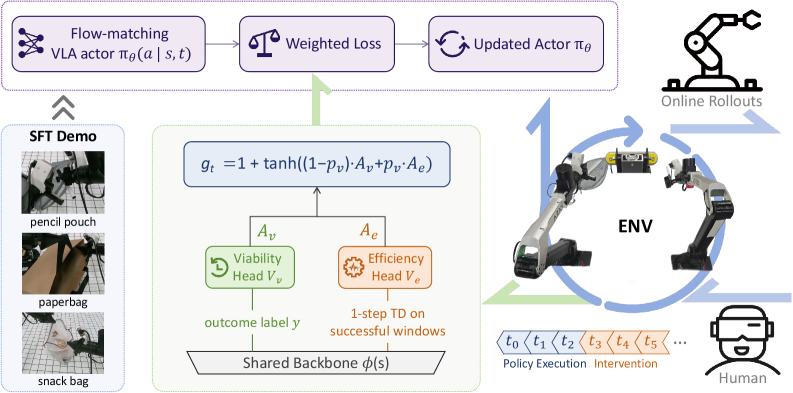
Figure 1 — HABC 방법론 개요
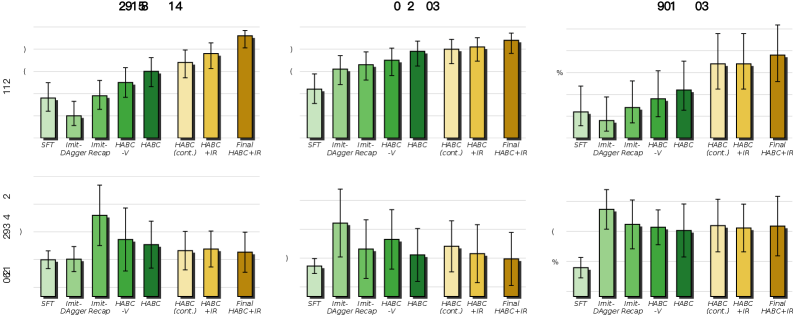
Figure 3 — 세 가지 작업의 주요 결과
4. Conclusion & Impact (결론 및 시사점)
본 연구는 sparse episode outcomes에서 per-transition behavior-cloning weights를 생성하는 VLA의 online RL fine-tuning 방법론인 HABC를 제안한다. HABC는 dual-head critic과 intervention-aware credit assignment를 활용하여 viability와 efficiency라는 두 가지 핵심 신호를 분리하고, 이를 바탕으로 효과적인 학습을 가능하게 한다. 이 연구는 VLA fine-tuning 시 직면하는 sparse reward와 mixed-control rollouts 문제에 대한 실질적인 해결책을 제시하며, 특히 contact-rich bimanual tasks와 같이 복잡한 로봇 조작 환경에서 로봇 정책의 robustness와 performance를 크게 향상시킬 수 있음을 입증했다. HABC는 로봇 학습 분야에서 온라인 상호작용을 통해 generalist robot policies를 실제 환경에 배포하고 지속적으로 개선하는 데 중요한 발판을 마련할 것으로 기대된다.
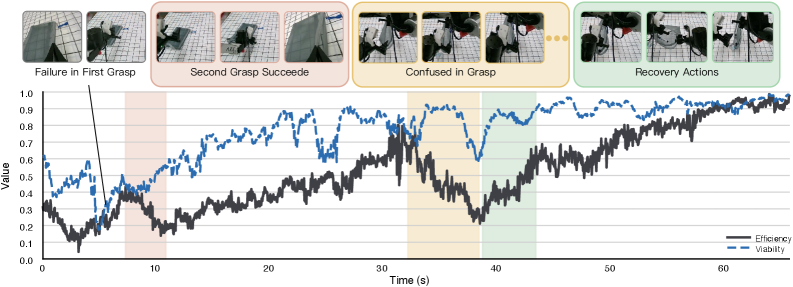
Figure 5 — Viability 및 효율성 신호 분석
⚠️ 알림: 이 리뷰는 AI로 작성되었습니다.
관련 포스트
- [논문리뷰] VLA-Precision: Asymmetric Co-Bootstrapping for Efficient Real-World Online RL of Vision-Language-Action Models
- [논문리뷰] Act with Intent: Distilling Behavior Intent for Vision-Language-Action Models
- [논문리뷰] TacForcing: Streaming Action Generation with Execution-Time Tactile Feedback
- [논문리뷰] Generalizable VLA Finetuning via Representation Anchoring and Language-Action Alignment
- [논문리뷰] InternVLA-A1.5: Unifying Understanding, Latent Foresight, and Action for Compositional Generalization
Review 의 다른글
- 이전글 [논문리뷰] Geometric Action Model for Robot Policy Learning
- 현재글 : [논문리뷰] Hierarchical Advantage Weighting for Online RL Fine-Tuning of VLAs from Sparse Episode Outcomes
- 다음글 [논문리뷰] Implicit Reasoning for Large Language Model-based Generative Recommendation
댓글