[논문리뷰] BVB: Benchmarking Agentic Video Understanding via Programmatic Reconstruction in Blender
링크: 논문 PDF로 바로 열기
I have browsed the paper. Now I will extract the information required for the summary.
Authors: Yolo Y. Tang, Daiki Shimada, Jiayue Meng, Jing Bi, Pinxin Liu, Yicheng Wang, Yunzhong Xiao, Zhangyun Tan, Zeliang Zhang, Chao Huang, Susan Liang, Qianxiang Shen, Luchuan Song, Ali Vosoughi, Mingqian Feng, Melika Filvantorkaman, Chenliang Xu
Keywords: From the abstract and introduction, the key themes are: Agentic Video Understanding, Programmatic Reconstruction, Blender, Benchmarking, Multimodal Agents, Spatiotemporal Understanding, Dual VQA, Latent Similarity. I'll pick 5-8 from these.
Key Figures:
- Figure 1: BVB overview and Overall cost frontier. This is a good overview.
2609.15478v1/teaser_frontier_combined.png - Figure 2: Controlled reconstruction and evaluation pipeline. This explains the methodology well.
2609.15478v1/pipeline.png - Figure 3: Semantic retention profiles (task difficulty). This shows key results and analysis.
2609.15478v1/semantic_retention_profiles.png - Table 1/Table 3: Main results / Full leaderboard. This provides quantitative results. I can't use an HTML table directly as a Figure for the JSON part, as the instruction specifically says "Image URL Rules" and "Table is not image". I will prioritize architectural diagrams and result graphs. So I will go with Figures 1, 2, and 3.
Let's start drafting the summary.
Part 1: 요약 본문
메타데이터
저자: Yolo Y. Tang, Daiki Shimada, Jiayue Meng, Jing Bi, Pinxin Liu, et al.
## 1. Key Terms & Definitions (핵심 용어 및 정의)
- BVB (Blender-VideoBench): 멀티모달 에이전트가 실제 비디오를 애니메이션화된 Blender 씬으로 재구성하는 능력을 테스트하는 벤치마크. 에이전트의 Video Understanding을 프로그램 재구성을 통해 평가한다.
- Programmatic Reconstruction: 비디오의 객체 배치, 카메라 궤적, 이벤트 순서 등을 Python 코드(Blender Python)를 통해 3D 씬으로 재구성하는 과정. 이는 에이전트가 비디오를 Spatiotemporal하게 이해했음을 증명하는 방법론이다.
- Dual VQA (DV): 재구성된 비디오가 원본 비디오의 Spatiotemporal한 사실(facts)을 얼마나 잘 보존하는지를 측정하는 지표. VLM judge가 원본 및 재구성 비디오에 대해 질문에 답변하고, judge가 원본에 대해 올바르게 답변한 질문 중 재구성에서도 올바르게 답변한 비율로 Retention Rate를 산출한다.
- Latent Similarity (LS): 재구성된 비디오가 원본 비디오와 시각적으로 얼마나 유사한지를 측정하는 지표. Frozen V-JEPA 2.1 representation을 사용하여 두 비디오의 Perceptual Similarity를 비교하며, Layout과 Motion 두 가지 측면을 평가한다.
- Overall Score: DV와 LS의 균형 잡힌 성능을 선호하기 위해 Square-Root Mean 방식을 사용하여 계산되는 종합 점수이다.
## 2. Motivation & Problem Statement (연구 배경 및 문제 정의)
기존 Video Understanding 벤치마크는 주로 Question Answering (QA) 방식으로 모델을 평가하지만, 이러한 방식은 모델이 Answer Prior나 단일 프레임(Single Frame) 정보에 의존하여 정답을 맞출 수 있어 비디오의 Spatiotemporal한 이해를 온전히 입증하지 못한다. 저자들은 에이전트가 비디오를 진정으로 이해한다면, 객체 배치(Object Placement), 카메라 궤적(Camera Trajectory), 이벤트 순서(Event Ordering)를 포함하여 비디오를 Programmatically Reconstruction할 수 있어야 한다고 주장한다. 이는 단일 프레임이나 Answer Prior로는 불가능한 복합적인 이해를 요구한다. 최근 Multimodal Agent는 Diffusion Model에 의존하지 않고 코드 작성을 통해 애니메이션화된 Blender 씬을 구축할 수 있게 되었지만, 기존 시스템들은 선별된 씬(Selected Scenes), 반복적인 Human Guidance, 외부 Asset Library 사용에 의존하여 신뢰성 있는 성능 평가가 어려웠다. 이러한 한계점을 해결하고 에이전트의 종합적인 Video Understanding 능력을 체계적으로 평가하기 위해, 본 연구는 Blender를 활용한 Programmatic Reconstruction 벤치마크인 BVB를 제안한다 [Figure 1, 2].
## 3. Method & Key Results (제안 방법론 및 핵심 결과)
저자들은 Multimodal Agent가 실제 비디오를 애니메이션화된 Blender 씬으로 재구성하도록 요구하는 BVB (Blender-VideoBench) 벤치마크를 제안한다. 에이전트는 Mini-BVB라는 경량 Harness를 통해 Docker Sandbox 환경에서 비디오 프레임을 검사하고 Blender Python 코드를 실행하며, 외부 Asset Library 없이 Primitives만으로 씬을 구성해야 한다 [Figure 2]. 평가는 재구성된 씬을 렌더링한 후 두 가지 축으로 이루어진다: 첫째, Dual VQA (DV)는 VLM Judge가 원본과 재구성 비디오에 대해 질문에 답변하여 Spatiotemporal Facts Retention Rate를 측정한다. 둘째, Latent Similarity (LS)는 Frozen V-JEPA 2.1 Representation을 사용하여 재구성 비디오의 Perceptual Similarity를 측정한다. 최종적으로 Overall Score는 DV와 LS의 Square-Root Mean으로 계산되어 균형 잡힌 성능을 평가한다.
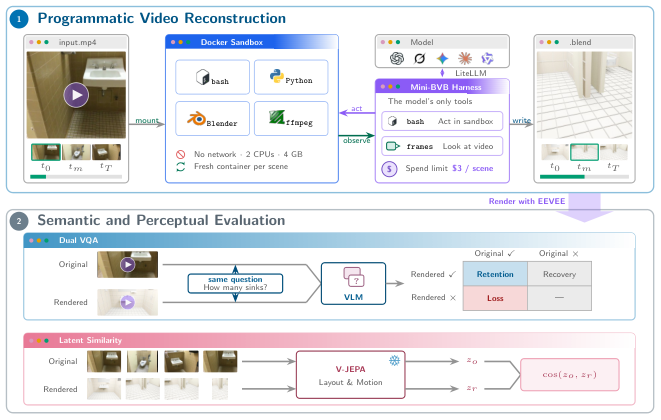
Figure 2 — 제안 방법론 및 평가 파이프라인
51개 Configurations (10개 모델 Family)에 대한 실험 결과, 최고 성능 모델인 GPT-6-Astra-high는 Overall 70.07을 달성했다. 그러나 이 모델의 DV는 53.7%에 그쳤으며, LS는 88.6%로 훨씬 높았다. 이는 현재 에이전트가 시각적으로 그럴듯한(Visually Plausible) 재구성을 생성하지만, 원본 비디오의 Spatiotemporal Facts 중 절반 가까이를 놓친다는 것을 시사한다. 추가 Reasoning Effort는 Visual Similarity (LS)를 향상시키지만, Factual Accuracy (DV)의 격차를 좁히지는 못했다 [Figure 5]. Task별 Retention을 분석한 결과, Object Size와 Route Planning 같은 단일 객체 속성 및 간단한 경로 추론은 비교적 높은 Retention (각각 63.0%, 58.5%)을 보인 반면, Object Count와 Appearance Order와 같이 전체 씬(Whole Scene)에 대한 추론이 필요한 Task는 낮은 Retention (각각 29.3%, 16.1%)을 나타냈다 [Figure 3]. 블라인드 Human Ranking Study에서는 Human Preference가 LS와 강하게 상관관계(Spearman ρ=0.83)를 보였으나, DV와의 상관관계는 낮았다 (ρ=0.11).
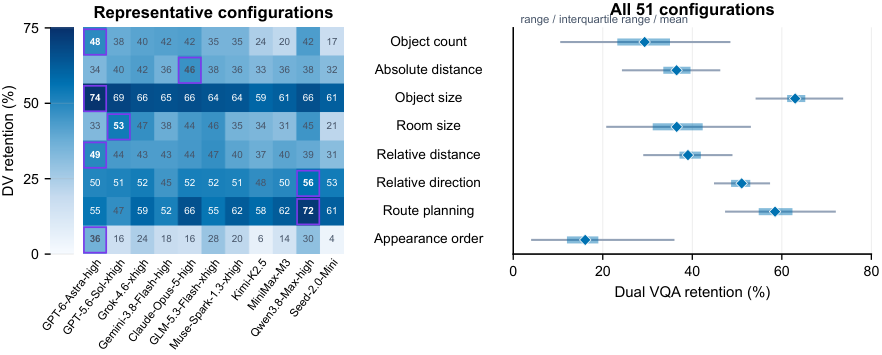
Figure 3 — Semantic Retention Task별 분포
## 4. Conclusion & Impact (결론 및 시사점)
BVB 벤치마크는 에이전트의 Spatiotemporal Video Understanding 능력을 Programmatic Reconstruction을 통해 평가하는 새로운 방법론을 제시한다. 이 연구는 Multimodal Agent가 이미 인지 가능한 수준의 비디오 재구성을 수행할 수 있음을 보여주며, 이는 Programmatic Reconstruction이 Video Understanding을 평가하는 유효한 테스트 방식임을 입증한다. 그러나 최고 성능 모델조차도 원본 비디오에서 검증 가능한 Spatiotemporal Facts의 약 절반가량을 놓치고 있어, Semantic Retention이 여전히 주요한 과제로 남아있음을 명확히 한다. 추가적인 Reasoning Effort가 Perceptual Similarity를 개선하더라도 Factual Accuracy와의 격차를 줄이지 못한다는 발견은, 향후 연구가 시각적 충실도와 더불어 Semantic Content의 정확한 이해 및 보존에 중점을 두어야 함을 시사한다. 이 벤치마크는 재현 가능한 평가 환경과 비용 통제된 설정을 제공하며, 학계 및 산업계에서 Agentic Video Understanding 모델 개발 방향을 제시하고 미해결 과제를 식별하는 데 중요한 역할을 할 것이다.
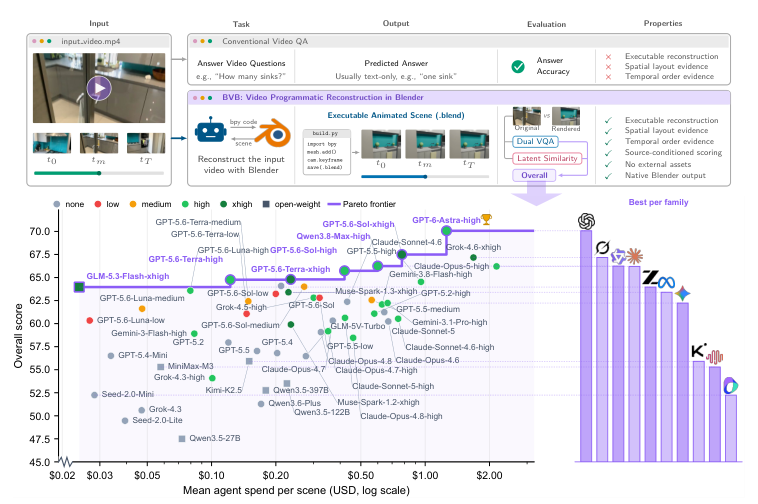
Figure 1 — BVB 개요 및 비용 효율성
⚠️ 알림: 이 리뷰는 AI로 작성되었습니다.
관련 포스트
- [논문리뷰] OSWorld2.0: Benchmarking Computer Use Agents on Long-Horizon Real-World Tasks
- [논문리뷰] 3DCodeBench: Benchmarking Agentic Procedural 3D Modeling Via Code
- [논문리뷰] Strategic Navigation or Stochastic Search? How Agents and Humans Reason Over Document Collections
- [논문리뷰] AgentVista: Evaluating Multimodal Agents in Ultra-Challenging Realistic Visual Scenarios
- [논문리뷰] VisGym: Diverse, Customizable, Scalable Environments for Multimodal Agents
Review 의 다른글
- 이전글 [논문리뷰] Attention-DP3: Spatially Object-aware 3D Diffusion Policy via Geometry-aligned Attentional Conditioning
- 현재글 : [논문리뷰] BVB: Benchmarking Agentic Video Understanding via Programmatic Reconstruction in Blender
- 다음글 [논문리뷰] Discovery Foundation Models: Toward Open-Ended Discovery Intelligence
댓글