[논문리뷰] OmniEcho: Spatial Audio Understanding for Embodied Agents
링크: 논문 PDF로 바로 열기
저자: Ruixun Liu, Yuxuan Wang, Jiacheng Xie, Yuhuan You, Donghua Cai, Junming Lin, Xiong-Hui Chen, Zhifang Guo, Yunfei Chu, Qize Yang, Xize Cheng, Jin Xu, Yiwu Zhong
1. Key Terms & Definitions (핵심 용어 및 정의)
본 논문은 embodied agents의 spatial audio understanding 능력을 향상시키기 위한 핵심 기술 용어들을 다룬다.
- Embodied Agents: 물리적 또는 시뮬레이션 환경에서 다중 모달 센서를 통해 환경을 인지하고 상호작용하는 인공지능 에이전트를 지칭한다.
- First-Order Ambisonics (FOA): 단일 지점에서 3D 사운드 필드를 표현하는 4채널 공간 오디오 포맷으로, 소스 방향과 같은 공간 정보를 포착한다.
- OmniEchoBench: 본 연구에서 제안하는 통합 벤치마크로, spatial audio-visual perception 및 audio-vision-language navigation 태스크를 평가하기 위해 고안되었다.
- OmniEcho: Qwen3-Omni를 기반으로 개발된 spatially aware omni-modal 모델로, FOA spatial encoder를 통합하여 청각적 Semantic 정보와 공간 정보를 동시에 이해한다.
- Spatial Audio Understanding: Embodied agent가 소리로부터 소스 방향, 3D 위치, 움직임 등 환경 내의 공간적 특성을 인식하고 추론하는 능력이다.
2. Motivation & Problem Statement (연구 배경 및 문제 정의)
Embodied agents에게 spatial audio understanding 능력은 인간의 인지 방식과 유사하게 중요한 정보원임에도 불구하고, 기존 연구에서는 충분히 탐구되지 않았다. 인간은 occluded된 소스나 시야 밖에 있는 소스도 쉽게 찾아내고 추적할 수 있지만, embodied agents에게 이러한 능력은 여전히 상당한 도전 과제로 남아 있다. 기존 omni-modal understanding 및 vision-language navigation (VLN) 분야의 발전에도 불구하고, 대부분의 모델들은 시각, 언어, 일반 오디오 신호 처리에 집중하며 spatial acoustic cues (예: sound-source direction, distance, spatial layout)를 네이티브 증거로 다루지 않았다.
이러한 연구 공백을 해결하기 위한 세 가지 주요 문제가 존재한다: 첫째, real-world spatial-audio data를 수집하는 것이 매우 비용이 많이 들고, 소스 및 리스너 포즈, 장면 지오메트리, 반사, 잔향 등이 정확하게 캡처되고 주석되어야 한다. 둘째, 대규모 훈련 데이터 합성을 위한 시뮬레이션 환경은 렌더링된 오디오뿐만 아니라 시각적 관찰 및 움직이는 agent와의 물리적 일관성을 유지해야 한다는 과제가 있다. 셋째, 기존의 pre-trained omni-modal models에 spatial audio를 효과적으로 통합하는 방법론이 명확하지 않았다.
3. Method & Key Results (제안 방법론 및 핵심 결과)
저자들은 embodied agents의 spatial audio understanding 문제를 해결하기 위해 OmniEchoBench 벤치마크와 OmniEcho라는 spatially aware omni-modal model을 제안한다 [cite: 1, Figure 1]. OmniEchoBench는 real-world spatial audio-visual perception 및 audio-vision-language navigation을 위한 통합 벤치마크로, 197개의 real-world spatial audio-visual scenes, 2,972개의 QA pairs, 그리고 900개의 navigation samples로 구성된다 [cite: 1, Figure 2, Figure 3]. 벤치마크 데이터 구축을 위해 sound sources, visual observations, agent trajectories 간의 geometric consistency를 보존하는 controllable rendering pipeline for spatial audio를 개발하여 대규모 훈련 데이터를 합성한다 [cite: 1, Figure 4].
OmniEcho 모델은 Qwen3-Omni-30B-A3B를 기반으로 하며, FOA spatial encoder를 통합하고 3단계 훈련 절차를 통해 auditory semantics 및 spatial information을 정렬한다 [cite: 1, Figure 5]. 첫 번째 단계에서는 경량 FOA encoder를 SigLIP objective와 frozen CLIP text encoder를 사용하여 open-vocabulary sound-semantic space로 semantic alignment를 수행한다. 두 번째 단계에서는 query-conditioned cross-attention localization head를 통해 sound-source localization을 fine-tune하며, azimuth, elevation, distance 예측을 최적화한다. 마지막 세 번째 단계에서는 frozen FOA encoder를 Qwen3-Omni backbone에 통합하고, FOA spatial tokens는 trainable projector를 통해 language embedding space로 매핑되어 기존의 frozen semantic audio pathway와 함께 작동한다 [cite: 1, Figure 5].
실험 결과, OmniEcho는 spatial audio-visual perception 및 sound-guided navigation 태스크에서 state-of-the-art 성능을 달성했다. OmniEchoBench-QA의 spatial audio-visual question answering에서, OmniEcho는 audio-only 및 audio-visual setting 모두에서 기존 baseline 모델들을 뛰어넘어 overall accuracy 28.5% (audio & vision)를 기록했다 [cite: 1, Table 1]. 특히, 3D Localization (14.2%) 및 Cognitive Map (47.5%) 태스크에서 다른 모델 대비 높은 정확도를 보여, real-world 환경에서 FOA encoder의 효과적인 공간 추론 능력을 입증했다 [cite: 1, Table 1]. OmniEchoBench-Nav의 sound-guided navigation 태스크에서는 Success Rate (SR) 16.2%와 Success weighted by Path Length (SPL) 11.5%를 달성하여, 기존 text-guided VLN baseline인 Seq2Seq (SR 11.3%, SPL 9.4%) 및 CMA (SR 9.8%, SPL 8.5%)를 크게 능가했다 [cite: 1, Table 2]. 이는 sound-guided navigation이 전통적인 text-guided VLN만큼 challenging함에도 불구하고, spatial audio guidance가 효과적인 보조 신호임을 시사한다. 또한, Sim2Real transfer analysis를 통해 real-world 데이터를 통한 fine-tuning이 overall performance를 28.5%에서 34.9%로 향상시켰으며, 특히 Direction (+8.4%), 3D Localization (+7.5%), Motion (+10.9%)과 같은 공간 추론 태스크에서 큰 개선을 보였다 [cite: 1, Table 15].
4. Conclusion & Impact (결론 및 시사점)
본 연구는 embodied agents를 위한 spatial audio understanding 분야의 중요한 진전을 이루며, OmniEchoBench라는 real-world unified benchmark와 이를 효과적으로 처리하는 omni-modal model인 OmniEcho를 성공적으로 제안하였다. OmniEcho는 FOA encoder와 pre-trained semantic audio pathway를 통합하여 auditory semantics 및 spatial information을 joint하게 이해함으로써, spatial audio perception 및 sound-guided navigation 태스크에서 state-of-the-art 성능을 달성했다. 이러한 결과는 spatial audio가 embodied agents의 scene reasoning 및 navigation에서 매우 가치 있는 신호로 기능할 수 있음을 입증한다.
이 연구는 기존 omni-modal models의 spatial audio reasoning 한계를 명확히 드러내며, 동시에 fine-grained spatial localization 및 distance estimation이 여전히 해결해야 할 중요한 과제임을 강조한다. OmniEchoBench는 학계 및 산업계 연구자들이 real-world spatial audio 이해를 위한 모델 개발 및 평가에 활용할 수 있는 견고한 기반을 제공한다. 궁극적으로 이 연구는 미래의 embodied agents가 환경에서 '무엇'을 인지하고 '어디서' 그것이 발생하는지에 대해 통합적으로 추론할 수 있도록 하는 연구 방향에 중요한 시사점을 제시한다.
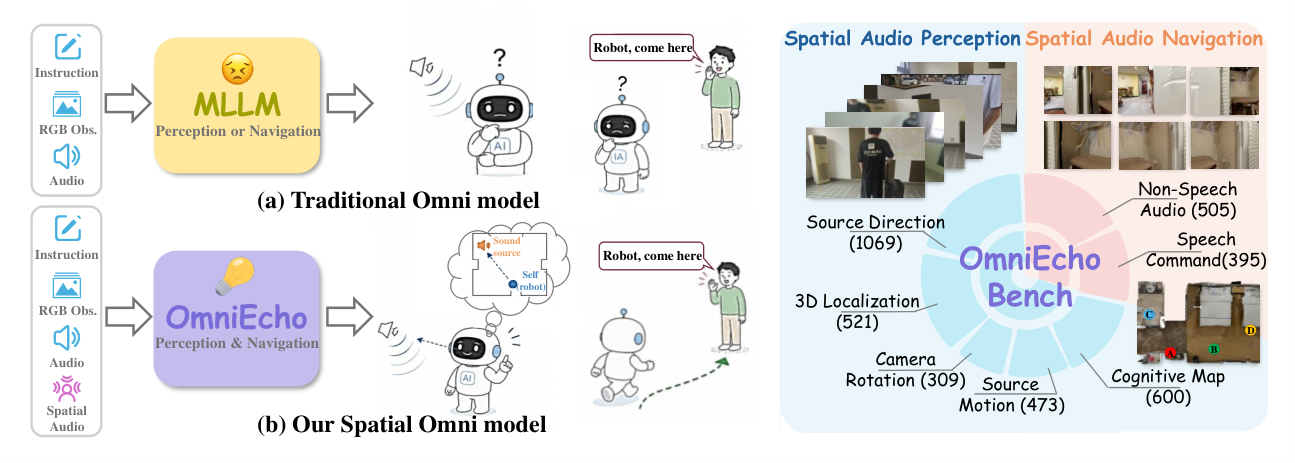
Figure 1 — 모델 및 벤치마크 개요
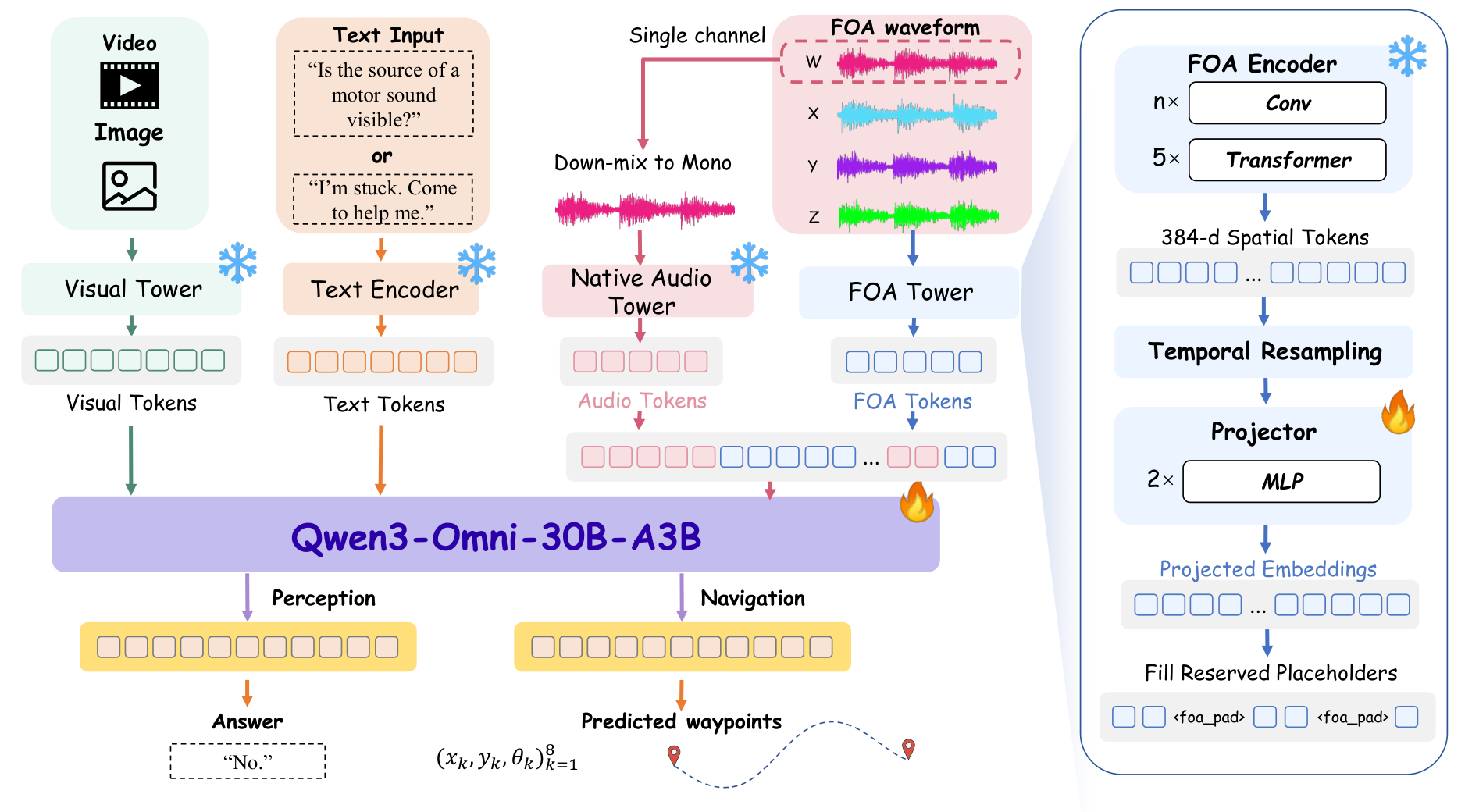
Figure 5 — 제안 모델 아키텍처
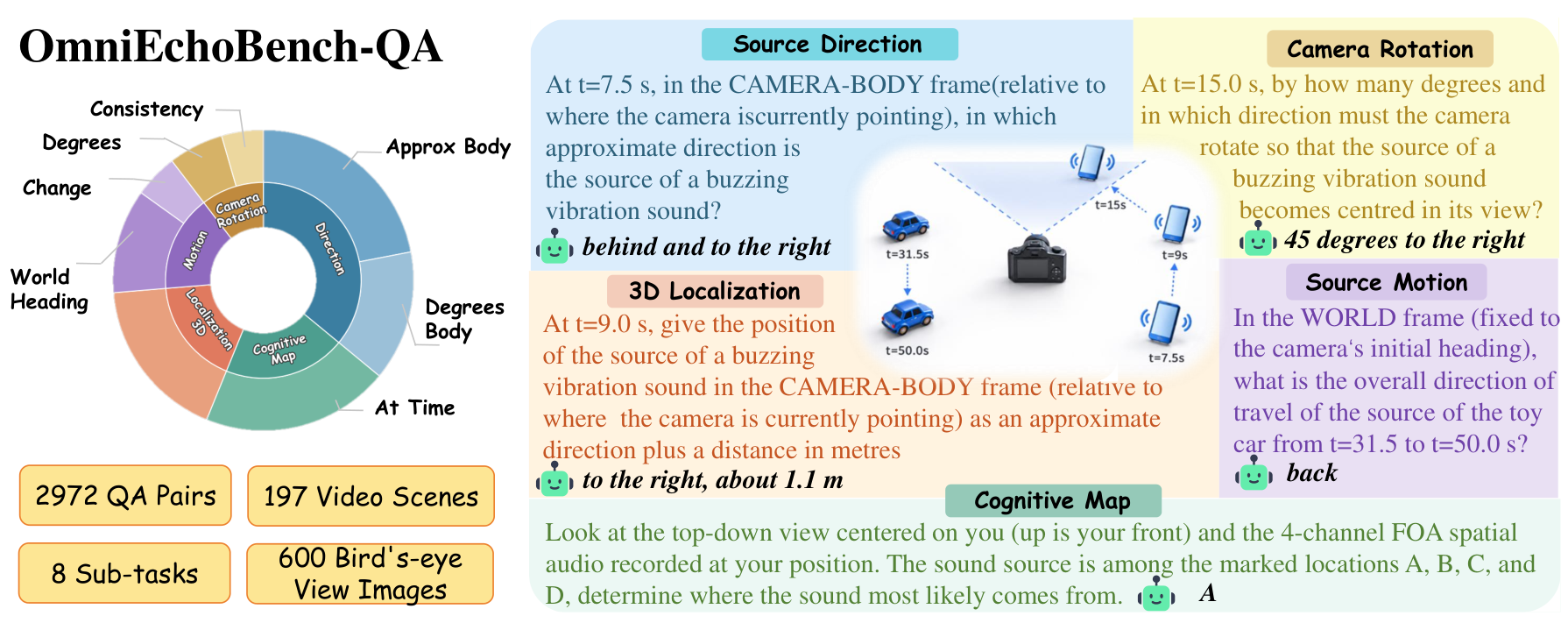
Figure 2 — QA 벤치마크 개요
⚠️ 알림: 이 리뷰는 AI로 작성되었습니다.
관련 포스트
- [논문리뷰] IndicParam: Benchmark to evaluate LLMs on low-resource Indic Languages
- [논문리뷰] BhashaBench V1: A Comprehensive Benchmark for the Quadrant of Indic Domains
- [논문리뷰] UNIDOC-BENCH: A Unified Benchmark for Document-Centric Multimodal RAG
- [논문리뷰] SimpleQA Verified: A Reliable Factuality Benchmark to Measure Parametric Knowledge
- [논문리뷰] OmniVBench: A Benchmark and Large-Scale Dataset for Omni Reference-to-Video Generation
Review 의 다른글
- 이전글 [논문리뷰] Neural Spectral Capacity: Measuring and Designing Architectures from Network Specification Alone
- 현재글 : [논문리뷰] OmniEcho: Spatial Audio Understanding for Embodied Agents
- 다음글 [논문리뷰] PUBG Ally: A Conversational Embodied Agent as an AI Teammate
댓글