[논문리뷰] Same Output, Different Gold: Measuring How Reference Choice Moves a Multilingual Benchmark Score
링크: 논문 PDF로 바로 열기
The paper "Same Output, Different Gold: Measuring How Reference Choice Moves a Multilingual Benchmark Score" by Parth Kulshreshtha, Shivali Dalmia, and Abhishek Mukherji investigates the impact of reference choice on multilingual benchmark scores for PII extraction. The authors highlight that while system output receives extensive methodological attention, the "reference" (gold standard) is often treated as a fixed property, despite being a product of an annotation pipeline with inherent disagreements and resolution rules. They show that different equally defensible references from the same annotation process can significantly alter benchmark scores and even change the ranking of system outputs. The core issue lies in an undocumented aggregation default within the pipeline, which inadvertently biases the "delivered gold" towards one annotator's output. The paper proposes measuring a "reference-sensitivity band" to quantify this uncertainty and recommends retaining and releasing annotation records, documenting aggregation rules, and reporting per-language annotator agreement to enhance benchmark robustness.
I have extracted the necessary information. Now I will structure the output according to the user's request.
Part 1: Summary
- Authors: Parth Kulshreshtha, Shivali Dalmia, Abhishek Mukherji
- Keywords:
Reference Choice,Benchmark Evaluation,Annotation Disagreement,PII Extraction,Multilingual Benchmarking,Evaluation Uncertainty,Aggregation Rule,Reference-Sensitivity Band
1. Key Terms & Definitions (핵심 용어 및 정의)
- Reference Choice: 벤치마크 평가에서 시스템 출력을 비교하는 데 사용되는 "Gold Standard" 또는 Ground Truth를 선택하는 과정 및 그 영향.
- Delivered Gold: 어노테이션 파이프라인을 통해 최종적으로 제공된 Ground Truth 라벨셋으로, 벤치마크 점수 산출에 사용되는 공식 레퍼런스이다.
- Reviewer Gold: 원본 데이터셋의 샘플에 대해 독립적인 전문가가 다시 어노테이션한 라벨셋으로, Delivered Gold와 함께 레퍼런스 선택의 영향을 측정하는 데 사용된다.
- Reference-Sensitivity Band: 레퍼런스 선택만으로 인해 벤치마크 점수가 얼마나 변동할 수 있는지를 나타내는 범위로, 평가 프로토콜의 Robustness를 측정한다.
- Aggregation Default: 어노테이터 간의 불일치가 발생했을 때, 명시적인 중재(Adjudication) 없이 특정 어노테이터의 라벨링을 기본값으로 채택하는 규칙.
2. Motivation & Problem Statement (연구 배경 및 문제 정의)
본 논문은 벤치마크 스코어가 시스템 성능뿐만 아니라 레퍼런스의 선택에도 크게 의존한다는 점을 직접적으로 다룬다. 기존 연구들은 시스템 출력에 대부분의 관심을 기울이고 레퍼런스를 데이터셋의 고정된 속성으로 간주했지만, 레퍼런스는 어노테이션 과정의 결과물이며 다양한 해결 규칙에 따라 달라질 수 있다. 이러한 레퍼런스 선택이 스코어에 실질적인 영향을 미친다면, 벤치마크 리더보드가 보고하는 결과는 시스템 자체의 속성이라기보다 어노테이션 파이프라인의 속성을 반영하게 된다. 특히, 다국어 Span Extraction 벤치마크에서, 동일한 생산 파이프라인에서 나온 동등하게 방어 가능한(equally defensible) 다른 레퍼런스로 교체했을 때 스코어가 얼마나 변하고 랭킹이 유지되는지에 대한 선행 연구는 부족하다. 저자들은 이러한 평가 불확실성(Evaluation Uncertainty)을 해결하고, 어노테이션 파이프라인의 숨겨진 메커니즘이 벤치마크 스코어에 미치는 영향을 정량화할 필요성을 제기한다.
3. Method & Key Results (제안 방법론 및 핵심 결과)
저자들은 기존 방식과 달리 시스템 출력(Annotator A 및 B의 라벨링)을 고정한 채 레퍼런스(Delivered Gold 및 Reviewer Gold)만 변경하여 스코어의 변동을 측정하는 방법론을 제안한다 [Figure 1, cite: 1]. 분석 단위는 prompt이며, PII Span Extraction을 위한 6개 언어(Hindi, Portuguese, Polish, Swedish, Chinese, Arabic)의 24,939개 prompt 데이터셋의 어노테이션 기록을 활용한다. 스코어링에는 Strict 및 Relaxed 두 가지 matching rules를 사용하며, micro-averaged F1을 지표로 삼는다. 모든 불확실성은 paired prompt-level bootstrap을 통해 계산된다.
핵심 결과는 다음과 같다.
첫째, Delivered Gold는 어노테이터 간에 중립적이지 않다. Delivered Gold는 모든 언어에서 Annotator A의 span set을 Annotator B보다 더 자주 재현하는 skew를 보였다 (평균 +7.3 points, A: 83.4%, B: 76.1%). 반면, Reviewer Gold는 이러한 일관된 편향을 보이지 않았다 (평균 +0.04 points). 이는 Delivered Gold가 어노테이션 파이프라인의 aggregation rule에 의해 체계적인 선호를 가지고 있음을 나타낸다.
둘째, 레퍼런스 교환은 스코어를 유의미하게 변화시킨다. Annotator A의 출력 스코어는 Delivered Gold 대비 Reviewer Gold로 변경했을 때 평균 4.95 F1 points (95% CI [3.23, 6.27]) 하락했으며, Annotator B의 출력 스코어는 2.00 F1 points (CI [0.26, 3.37]) 하락했다 [Table 2, cite: 1]. 가장 큰 변화는 Hindi 언어에서 7.55 points (CI [4.90, 10.91])로 나타났다. 이는 시스템 출력을 고정해도 레퍼런스 선택만으로 스코어가 크게 변동할 수 있음을 입증한다.
셋째, 레퍼런스 교환은 두 출력 간의 비교(랭킹)를 변화시킨다. 두 어노테이터 출력 간의 paired interaction은 풀링(pooled) 결과에서 +2.95 points (95% CI [+1.97, +3.87])로 나타났으며, 이는 Holm correction 후에도 유의미했다. 특히 Hindi 언어에서는 Delivered Gold에서 A가 B보다 3.97 points 앞섰으나, Reviewer Gold에서는 A가 B보다 1.30 points 뒤처지는 sign reversal이 발생했다. 이는 레퍼런스 선택이 시스템 간의 상대적 성능 평가를 직접적으로 변경할 수 있음을 시사한다.
연구의 주요 원인은 문서화되지 않은 aggregation default로, 어노테이터 간 불일치 발생 시 중재(adjudication)가 없으면 파이프라인이 Annotator A의 라벨링을 98.7%의 경우에 유지했기 때문이다. 이로 인해 Delivered Gold는 스코어링 대상인 출력 중 하나(Annotator A)의 부분적 복사본이 되었고, 이는 reference-sensitivity band로 측정될 수 있는 평가 편향을 초래했다.
4. Conclusion & Impact (결론 및 시사점)
본 연구는 시스템 출력을 고정한 채 레퍼런스만 변경했을 때, 벤치마크 스코어가 풀링(pooled) 기준으로 2.00 F1 points에서 4.95 F1 points까지, 개별 언어에서는 최대 7.55 F1 points까지 변동함을 명확히 보여준다. 또한, 두 출력 간의 비교(랭킹) 역시 유의미하게 변화하며, 특히 Hindi 언어에서는 그 우열이 뒤바뀌는 sign reversal까지 관찰되었다. 이러한 변화의 주된 원인은 어노테이션 파이프라인 내의 aggregation default로, 이는 문서화되지 않은 채 벤치마크의 모든 스코어에 영향을 미쳤다.
이 연구는 벤치마크 스코어를 시스템의 단독 속성이 아닌, system과 reference라는 두 가지 요소의 결합된 측정값으로 인식해야 한다는 중요한 시사점을 제공한다. 학계 및 산업계에 미치는 영향은 다음과 같다: 벤치마크 평가의 Robustness와 신뢰성 확보를 위해, 어노테이션 기록을 보존하고 공개하며, reference-sensitivity band를 스코어와 함께 보고할 것을 권고한다. 또한, aggregation rule을 명확히 문서화하고 중립성을 테스트하며, 언어별 annotator agreement를 보고함으로써 평가 프로토콜 자체를 측정 대상으로 삼아야 한다고 강조한다. 이는 특정 벤치마크의 결과가 방어 가능한 레퍼런스 선택에 얼마나 민감한지 이해하는 데 필수적이다.
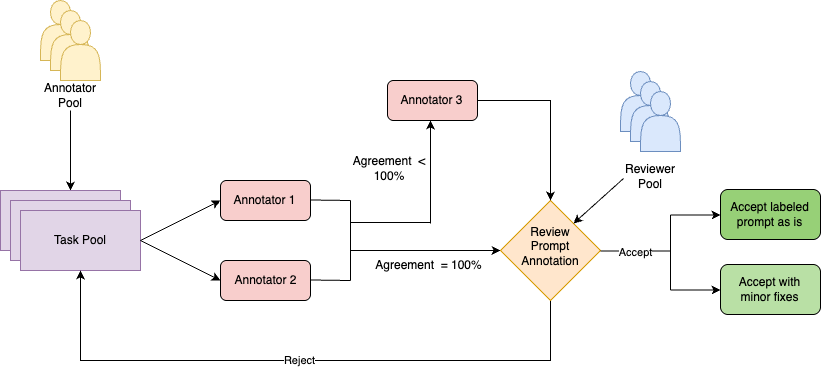
Figure 1 — 어노테이션 파이프라인 다이어그램
⚠️ 알림: 이 리뷰는 AI로 작성되었습니다.
관련 포스트
- [논문리뷰] LLMs4All: A Review on Large Language Models for Research and Applications in Academic Disciplines
- [논문리뷰] WorldCast: Exploring Intelligent Visual Generation in World State Prediction
- [논문리뷰] Waypoint-OPD: Transferring RL-Induced Policy Shifts via Gated On-Policy Distillation
- [논문리뷰] Virtual Head Attention
- [논문리뷰] VLA-Δ: Learning Physical State Transition for Vision-Language-Action Models
Review 의 다른글
- 이전글 [논문리뷰] SPLATIFY: Reproduce, Discover, Innovate! From Papers and Ideas to Trainable 3DGS Code
- 현재글 : [논문리뷰] Same Output, Different Gold: Measuring How Reference Choice Moves a Multilingual Benchmark Score
- 다음글 [논문리뷰] Scaling Agentic Data for Long-Horizon Terminal Intelligence
댓글