[논문리뷰] ExeWorldBench: Benchmarking Code-Based Executable 3D World Modeling
링크: 논문 PDF로 바로 열기
저자: Xinge Peng, Zhen Fang, Ruibing Wang, Yongxuan Lv, Haodong Li, Guohui Zhang, Xiaoxiao Ma, Yiting Lu, Lin Chen, Zehui Chen, Feng Zhao
1. Key Terms & Definitions (핵심 용어 및 정의)
- Executable World Modeling: 시각적 관찰을 넘어 세상이 어떻게 작동하는지 물리적 메커니즘과 인과적 상호작용을 포착하는 실행 가능한 3D 세상을 구축하는 통합적 능력.
- World Understanding: 세상의 기저에 있는 구조적, 기계적, 인과적 원리에 대해 추론하는 능력.
- Executable Realization: World Understanding을 물리적 상호작용을 통해 행동이 발현되는 코드 기반 시스템으로 변환하는 능력.
- Mechanism Executability (T1): 시각적 관찰로부터 개별 기계적 메커니즘을 추론하고 재현하는 능력.
- Compositional Executability (T2): 공간적, 기계적, 인과적 종속성을 포함하는 다단계 시스템으로 Mechanism Executability를 확장하는 능력.
- Intent-Driven Executable World Synthesis (T3): 고수준 텍스트 사양으로부터 실행 가능한 세상을 구축하는 능력으로,
Component-Constrained Synthesis (T3-1)와Goal-Constrained Synthesis (T3-2)로 나뉜다.
2. Motivation & Problem Statement (연구 배경 및 문제 정의)
본 논문은 coding agents가 3D 세상을 단순히 시각적으로 재현하는 것을 넘어, 세상이 '어떻게 작동하는지'를 포착하는 executable worlds를 구축하는 방향으로 발전함에 따라 발생하는 executable world modeling의 종합적인 평가 부재 문제를 해결한다. 기존 벤치마크들은 physical reasoning, visual fidelity 또는 behavioral correctness에 초점을 맞춘 파편적인 평가만을 제공하며, world understanding과 executable realization이라는 두 가지 핵심 능력의 통합 평가가 미흡했다. 특히, 기존 reasoning-centric benchmarks는 모델이 물리적 속성을 추론하는지 평가하지만, 이를 executable world로 실현하는 능력은 검증하지 못했다. 또한, construction-centric benchmarks는 시각적 또는 기하학적 구조 재현에 중점을 두어 물리적 작동 방식에 대한 이해를 평가하는 데 한계가 있으며, behavior-centric benchmarks는 단순하거나 고립된 행동에 치우쳐 복잡한 causal dependencies를 포괄적으로 다루지 못했다. 이러한 기존 벤치마크의 한계는 3D 환경에서의 spatial arrangement, collision geometry, mechanical assembly, joint alignment 등 복잡한 물리적 상호작용을 통합적으로 평가할 수 있는 벤치마크의 필요성을 강조한다.
3. Method & Key Results (제안 방법론 및 핵심 결과)
저자들은 ExeWorldBench를 제안하며, 이는 world understanding과 executable realization을 포괄적으로 평가하기 위한 코드 기반 3D 세계 구축 벤치마크이다. 이 벤치마크는 세계 복잡도와 모델 자율성을 점진적으로 증가시키는 세 가지 도전적인 태스크로 구성된다. Mechanism Executability (T1)는 시각적 관찰로부터 개별 mechanical mechanisms를 재구성하는 것을 평가하며, Compositional Executability (T2)는 다단계 mechanical systems로 확장하여 조정된 spatial, mechanical, causal interactions를 요구한다. 마지막으로, Intent-Driven Executable World Synthesis (T3)는 시각적 참조 없이 고수준 텍스트 사양으로부터 executable worlds를 구축하는 능력을 평가한다. ExeWorldBench의 데이터 구축 파이프라인은 [Figure 1]에 상세히 설명되어 있으며, 각 태스크에 맞춰 고유하게 설계되었다.
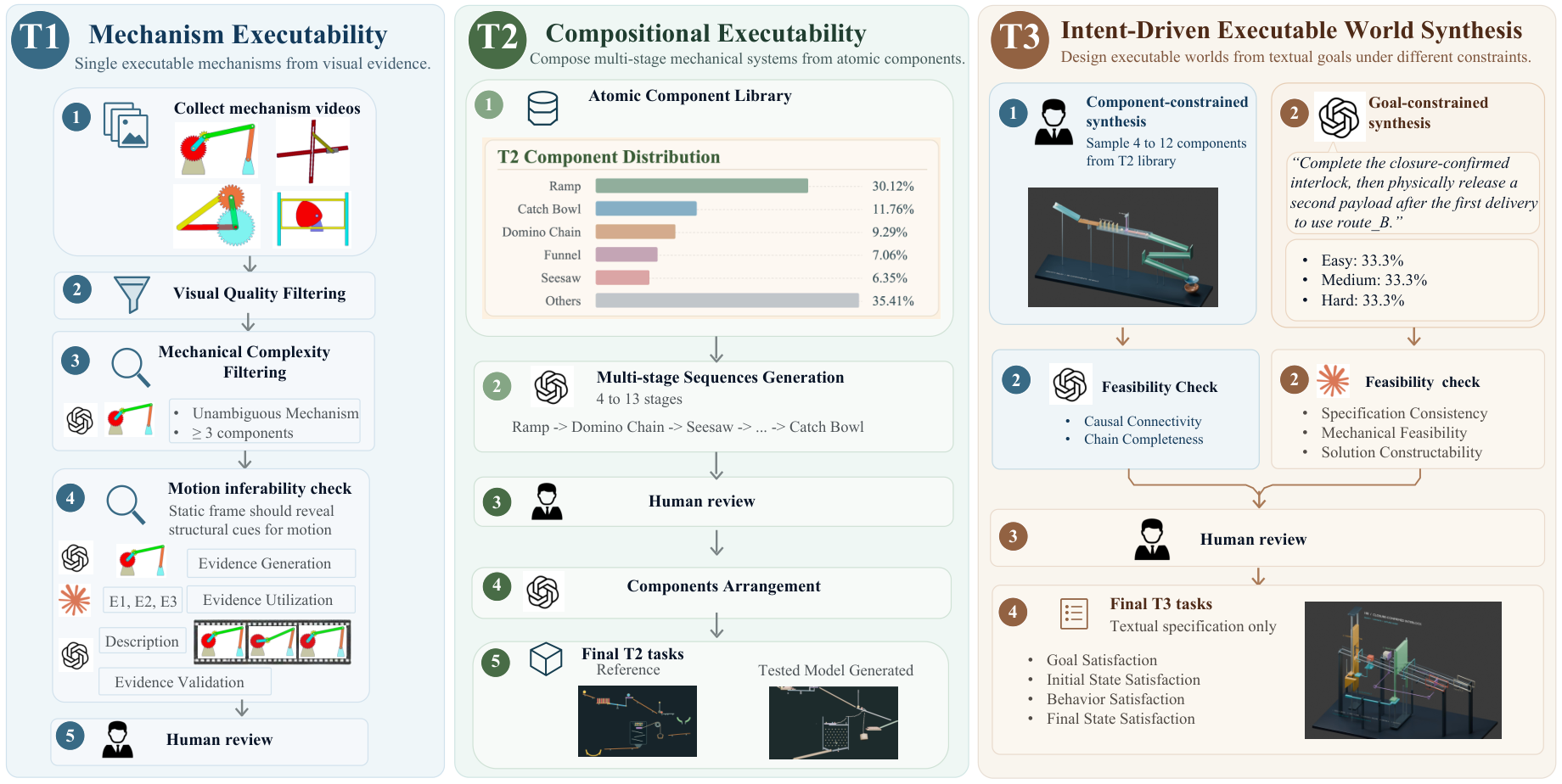
Figure 1 — ExeWorldBench 데이터 구축 파이프라인
실험 결과, code executability가 높다고 해서 physically coherent world construction 능력이 반드시 강한 것은 아님이 밝혀졌다. 예를 들어, T1: Mechanism Executability에서 GPT-6 Astra (Codex CLI)와 Claude Fable 5.1 (Claude Code)는 Executability 100%를 달성했으나, Visual Structure (V2) 점수는 각각 7.16 및 6.44였고, Mechanical Motion (M2) 점수는 6.32 및 5.68로 나타났다 [cite: 1, Table 1]. 특히 Fable 5.1의 경우, 높은 Visual Structure 점수(4.04)에도 불구하고 Mechanical Motion 점수(3.24)는 상대적으로 낮아 [cite: 1, Table 1] 구조적 정확성이 항상 정확한 기계적 dynamics를 보장하지 않음을 시사한다. T2: Compositional Executability에서는 multi-stage causal execution의 복잡성으로 인해 T1의 강력한 motion performance가 ECM으로 반드시 이어지지 않았다 [cite: 1, Table 2]. long-horizon execution 분석 결과, execution horizon이 증가함에 따라 성능이 감소하는 경향을 보였으며, T2에서는 execution stages 수가 증가할수록 모델들의 평균 ECM이 꾸준히 감소했다 [cite: 1, Figure 2]. 이러한 결과는 현재 모델들이 mechanically valid causal propagation을 유지하는 데 어려움을 겪고 있음을 보여준다. 또한, T3-2: Goal-Constrained Synthesis에서 Goal Satisfaction (G2) 점수가 GPT-6 Astra (Codex CLI)의 90.14%에 비해 다른 API-based models는 41.07% (GPT-6 Astra)에서 5.29% (GLM-5.3-Flash) 범위로 크게 낮았다 [cite: 1, Table 4, Figure 5]. 이는 고수준 의도(intent)로부터 적절한 메커니즘을 추론하고 이를 성공적으로 실행하는 데 상당한 어려움이 있음을 나타낸다.
4. Conclusion & Impact (결론 및 시사점)
ExeWorldBench는 mechanism execution, multi-stage causal composition, intent-driven synthesis를 아우르는 코드 기반 executable 3D world modeling을 평가하는 벤치마크를 제시한다. 본 연구의 핵심 결론은 높은 code executability가 반드시 강력한 structural, mechanical, 또는 causal correctness로 이어지지 않으며, causal complexity와 execution horizon이 증가할수록 성능이 저하된다는 점이다 [cite: 1, Figure 2]. 이 연구는 world understanding과 executable realization 사이의 상당한 격차를 드러내며, 물리적으로 일관된 executable worlds를 구축할 수 있는 모델 개발을 위한 중요한 통찰을 제공한다. ExeWorldBench는 향후 연구에서 physically grounded하고 causally coherent world construction systems의 발전을 촉진하는 데 기여할 것으로 기대된다.
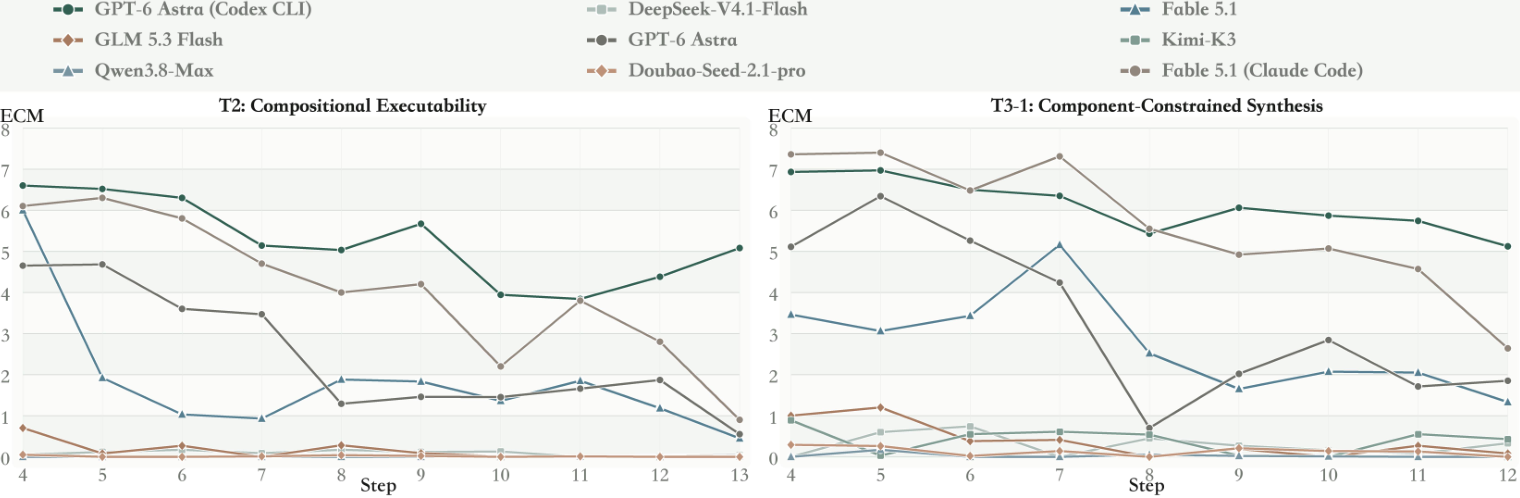
Figure 2 — Long-horizon 실행 성능
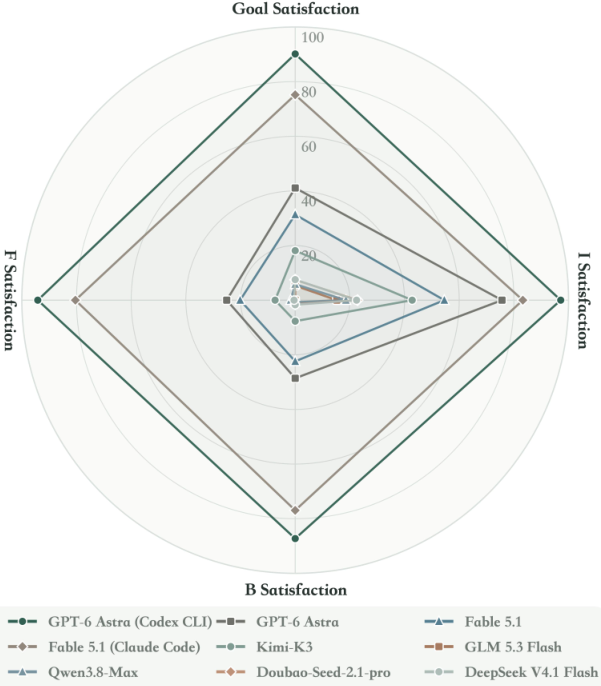
Figure 5 — T3-2 목표 만족도
⚠️ 알림: 이 리뷰는 AI로 작성되었습니다.
관련 포스트
- [논문리뷰] Training Object Permanence in World Models
- [논문리뷰] Principia: Relational Physics Tests for Video Models
- [논문리뷰] τ-Emotion-Bench: Exposing the Interaction Fragility of LLM Agents through Real-World User Emotions
- [논문리뷰] SWEeper-Bench: Can Agents Discover Bugs in Interactive Software?
- [논문리뷰] HumanoidToolBench: Benchmarking Humanoid Tool Use from Selection to Mobile Execution
Review 의 다른글
- 이전글 [논문리뷰] EviScene: Beyond 'Is It AI?' for Agentic Image Factuality Assessment
- 현재글 : [논문리뷰] ExeWorldBench: Benchmarking Code-Based Executable 3D World Modeling
- 다음글 [논문리뷰] FlashVSR+: Efficient Video Super-Resolution via Hybrid Attention and Reward-Yield Distribution Matching
댓글