[논문리뷰] MJev-Spatial: System One Spatial Intelligence via Native Attention Matching
링크: 논문 PDF로 바로 열기
저자: Luozheng Qin, Yuhan Zhu, Changhai Zhou, et al.
1. Key Terms & Definitions (핵심 용어 및 정의)
- System 1 Multimodal Decision Model: 기존 Large Language Models (LLMs)의 autoregressive text generation 방식과 달리, spatial understanding task를 위해 빠르고 직접적인(direct) spatial judgment를 수행하는 multimodal 모델이다. 이는 출력을 compact하고 finite한 candidate set으로 간주하여 classification framework를 통해 처리한다.
- Native Attention Matching: MJev-Spatial이 candidate를 scoring하는 핵심 방법론으로, backbone의 pretrained query 및 key projections를 재사용하여 별도의 trainable parameters나 prediction heads 없이 class scores를 계산한다.
- Coarse-to-fine Classification: Numerical prediction 및 point prediction task에서 높은 precision을 달성하기 위한 계층적(hierarchical) 예측 전략이다. 초기 coarse한 선택 후, 후속 classification stage를 통해 점차적으로 세부(fine-grained) 영역을 refine한다.
- Joint Stage Supervision: Multi-stage question (예: numerical 또는 point prediction)의 모든 stage를 단일 forward pass에서 teacher forcing을 사용하여 동시에 supervise하는 training recipe이다.
- Length-aware Global Batching: Heterogeneous spatial data의 효율적인 training을 위해 sequence 길이에 따라 microbatch를 정렬하고 GPU 간 workload를 balancing하여 padding 및 synchronization 지연을 줄이는 batching strategy이다.
2. Motivation & Problem Statement (연구 배경 및 문제 정의)
본 논문은 기존 Vision-Language Models (VLMs)이 spatial understanding task를 수행하는 방식의 비효율성을 핵심 문제로 지적한다. 현재 대부분의 VLM들은 spatial relation, numerical estimation, object placement와 같은 spatial judgments를 free-form text generation을 통해 제공한다. 이러한 autoregressive한 접근 방식은 여러 한계점을 가진다. 첫째, sequential decoding 과정에서 필연적으로 발생하는 latency 문제가 존재하며, 생성된 텍스트를 spatial prediction으로 변환하기 위한 parsing overhead가 추가된다. 둘째, spatial answer를 학습하는 과정이 텍스트 형식 및 formatting 학습과 불필요하게 결합되어, task-relevant prediction 자체를 넘어서는 supervision을 유발한다. 마지막으로, spatial output의 본질이 몇 가지 옵션, scalar 값, 또는 2D point와 같이 compact함에도 불구하고, 광범위한 text generation 메커니즘을 사용하는 것은 output space 비효율성을 초래한다. 이러한 문제점들은 물리 세계에서의 agent interaction rate에 맞는 빠른 spatial judgments를 어렵게 하며, System 1에 기반한 직접적인(direct) spatial understanding 접근 방식의 필요성을 강조한다.
3. Method & Key Results (제안 방법론 및 핵심 결과)
저자들은 기존 VLM의 한계를 극복하기 위해 MJev-Spatial이라는 System 1 multimodal decision model을 제안한다. MJev-Spatial은 옵션 선택(option selection), numerical estimation, image pointing의 세 가지 spatial task type을 unified classification framework 내에서 해결한다 [cite: 1, Figure 2]. 이 모델은 각 candidate를 하나의 class로 간주하고, backbone의 pretrained Query 및 Key projections를 재사용하여 class score를 계산한다 [cite: 1, Figure 3]. 이 과정에서 추가적인 trainable parameter나 prediction head를 도입하지 않아 효율성을 높였다.
Numerical prediction의 경우, MJev-Spatial은 최대 두 단계의 coarse-to-fine classification을 사용하여 넓은 범위의 값을 정밀하게 예측한다. Point prediction은 세 단계의 3x3 region selection과 함께 crop re-encoding을 통해 지역적 visual detail을 복구한다 [cite: 1, Figure 2]. Multiple points prediction을 위해, 동일하게 학습된 point predictor를 확장하는 conditional probability trees를 사용하여 추가 training 없이 여러 위치를 복구한다. Training 과정에서는 12.3M개의 question-answer 쌍으로 구성된 heterogeneous spatial data를 효율적으로 처리하기 위해, 모든 coarse-to-fine stage를 joint stage supervision으로 단일 forward pass 내에서 supervise한다. 또한, length-aware global batching 및 cross-GPU load balancing을 통해 training throughput을 최적화한다.
주요 실험 결과에 따르면, MJev-Spatial은 12개 spatial understanding benchmark에서 8개 모델 중 가장 높은 65.64%의 overall score를 달성했다. 특히, 12개 benchmark 중 7개에서 1위를 차지했으며, unmodified autoregressive base model인 Qwen3.5-4B 대비 모든 benchmark에서 우수한 성능을 보였다. Inference latency 측면에서도 MJev-Spatial은 가장 빠른 autoregressive baseline 대비 2.5배, base model 대비 5.6배 빠른 속도를 기록하며 평균 query latency 160.6ms를 달성했다. Training efficiency 측면에서는 length grouping과 cross-GPU load balancing을 통해 기존 batching strategy 대비 30.8%의 training throughput 향상을 입증했다.
4. Conclusion & Impact (결론 및 시사점)
MJev-Spatial은 pretrained multimodal knowledge를 활용하여 answer text generation 없이 직접적인(direct) spatial decision을 내리는 System 1 접근 방식을 성공적으로 탐구한다. 본 연구는 옵션, numerical value, image location을 포함한 다양한 spatial task를 단일 candidate classification mechanism으로 통합했으며, 계층적 refinement와 tree expansion을 통해 높은 precision과 multi-point prediction 능력을 제공한다. 이는 기존 autoregressive VLM의 고질적인 문제인 inference latency를 획기적으로 줄이면서도 뛰어난 prediction quality를 달성하여 spatial intelligence 분야에 새로운 패러다임을 제시한다.
이 연구의 영향력은 학계와 산업계 양쪽에 걸쳐 크다. 학계에서는 System 1 모델 설계 원칙과 pretrained attention projections 재사용이라는 혁신적인 방법론이 향후 효율적인 multimodal decision model 연구의 기반이 될 수 있다. 산업계에서는 MJev-Spatial이 달성한 2.5배에서 5.6배에 이르는 latency 감소와 높은 정확도는 autonomous agent, robotics, real-time interactive AI 시스템과 같이 즉각적인 spatial judgment가 필수적인 분야에 직접적으로 기여할 수 있다. 이는 AI 시스템이 물리 세계와 더욱 효율적이고 신뢰성 높게 상호작용할 수 있도록 하는 중요한 진전이다.
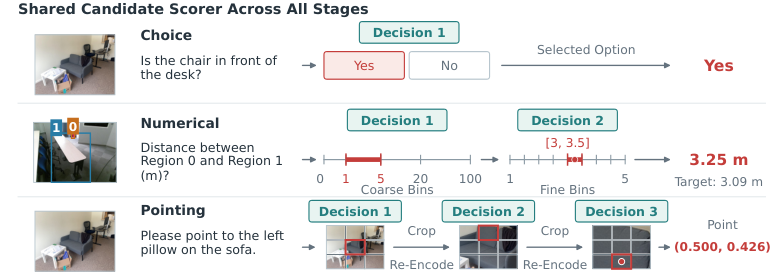
Figure 2 — 작업 정식화 및 Coarse-to-fine 추론
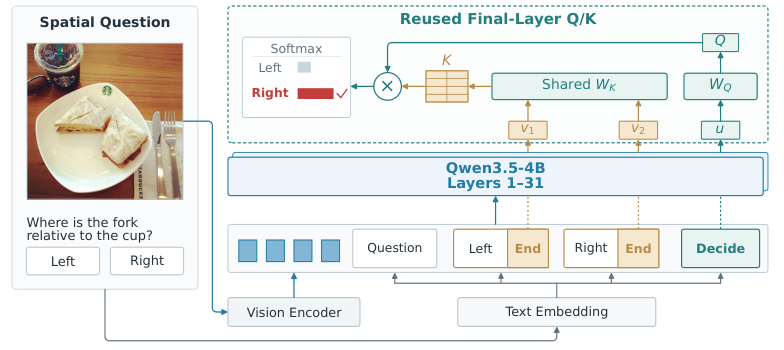
Figure 3 — MJev-Spatial 아키텍처
⚠️ 알림: 이 리뷰는 AI로 작성되었습니다.
관련 포스트
- [논문리뷰] SWE-Game: Can Coding Agents Build the Games We Want?
- [논문리뷰] Selection-Based Structured Reasoning: Toward Efficient Multimodal Search Agents
- [논문리뷰] Fewer Tokens, Better Action: GPT-6 Astra Robot Agents with 14% Higher Success Rate but 65% Fewer Tokens
- [논문리뷰] Systematically Exploring the Capabilities of GPT-6 Astra as Embodied Policies
- [논문리뷰] CoWindow Attention: Full Causal Coverage Is a Collective Property
Review 의 다른글
- 이전글 [논문리뷰] MAI-Gym: An Open All-in-One Platform for GUI Agent Evaluation and RL Training across Mobile and Computer Environments
- 현재글 : [논문리뷰] MJev-Spatial: System One Spatial Intelligence via Native Attention Matching
- 다음글 [논문리뷰] MLExpert: Towards a Generalist Agentic Model for Autonomous Machine Learning Engineering
댓글