[논문리뷰] Ego Guidance: Enhancing Robot Policy Learning with Action-Free Human Egocentric Videos
링크: 논문 PDF로 바로 열기
저자: Lin Long, Tianren Ma, Zhong Chu, et al.
1. Key Terms & Definitions (핵심 용어 및 정의)
- SPAR (Shared Prediction on Action and Representation): 이 논문이 제안한 MoT 기반 아키텍처입니다. 사전학습된 VLM backbone 위에 action expert와 generation expert를 두고, action prediction과 future visual state prediction을 함께 학습합니다. 두 expert는 서로 attend하지 않으므로 서로 독립적인 두 가지 proxy task가 됩니다.
- Action-Free Video: 정밀한 action annotation 없이 영상 형태로만 존재하는 데이터입니다. 논문에서는 Ego4D와 Open-AoE 같은 human egocentric video를 가리킵니다.
- Generation Expert: VLM의 layer별 hidden state에 cross-attention을 걸어 미래 시점 primary camera observation의 visual representation(예: SigLIP2 feature)을 예측하는 transformer stack입니다. Flow matching 또는 regression으로 supervision을 받으며, inference 때는 제거됩니다.
- Mixture-of-Transformers (MoT): 공유 backbone 위에 독립적으로 parameterize된 transformer stack(expert) 여러 개를 확장한 구조입니다.
- LIBERO-Plus: LIBERO에 7가지 distribution shift(sensor noise, object layout, lighting, background texture 등)를 적용한 OOD 평가 benchmark입니다.
2. Motivation & Problem Statement (연구 배경 및 문제 정의)
이 논문은 action label이 없는 human egocentric video를 action restoration 없이 robot policy learning에 직접 활용할 수 있는지를 다룹니다. Egocentric video는 대규모로 얻기 쉽고 open-world 환경과 가깝지만, 정밀한 action annotation은 비용이 커서 대부분 action-free 형태로만 존재합니다. 기존의 World Action Model (WAM) 계열은 generative latent space에서 diffusion을 수행하는 무거운 구조를 씁니다. 저자들은 이보다 단순하고 이미 잘 최적화된 VLM backbone에서 출발하는 방식을 택했습니다. 또한 action label은 저차원이고 embodiment-specific한 학습 신호여서, 공유 VLM에 일반화 가능한 high-capacity supervision을 주기 어렵습니다. 그래서 저자들은 visual state prediction을 보조 학습 신호로 추가하고, 어떤 target representation과 data curation이 효과적인지 체계적으로 분석했습니다.
3. Method & Key Results (제안 방법론 및 핵심 결과)
SPAR는 Qwen3.5-2B VLM을 MoT로 확장한 구조입니다. Action expert는 flow matching으로 action chunk를 예측하고, generation expert는 미래 visual feature를 예측합니다 [Figure 1].
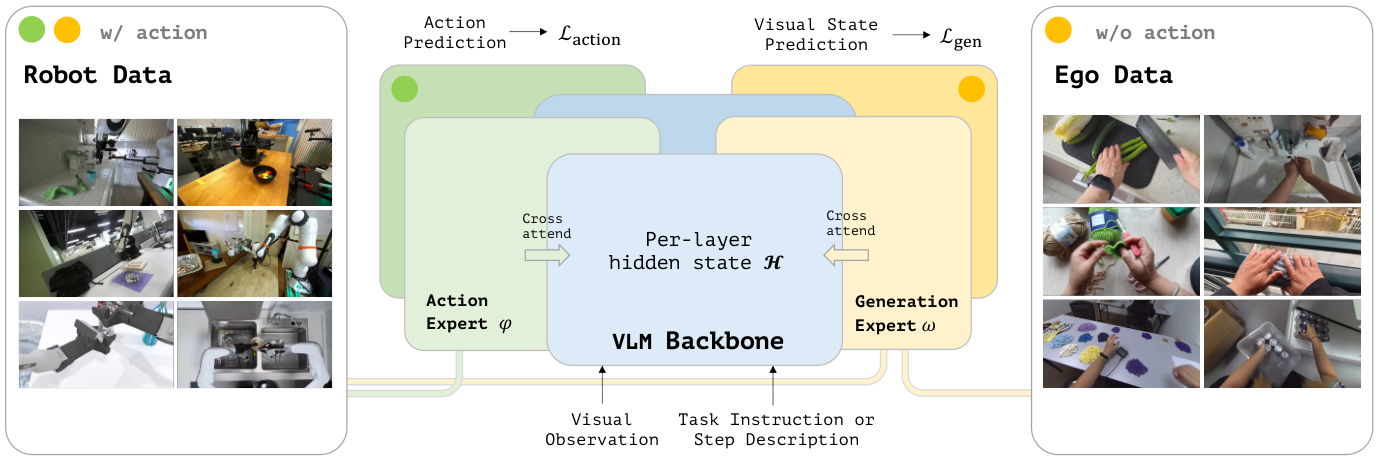
Figure 1 — SPAR 전체 아키텍처
방법론
- Loss 구성: Robot data는 $\mathcal{L}{action} + \lambda\mathcal{L}{gen}$, egocentric video는 $\lambda\mathcal{L}_{gen}$만 supervise합니다(λ=1). 따라서 egocentric video가 policy에 주는 효과는 오직 shared backbone representation을 거쳐서만 전달됩니다.
- 미래 frame 정렬: 예측 대상인 미래 frame $o_{t+\Delta}$는 action chunk의 마지막 시점 $a_{t+H}$와 timestep이 맞도록 정렬됩니다.
- Training 전략: Single-stage training은 overfitting 때문에 일반화 성능이 낮았습니다. 그래서 two-stage(robot+ego co-training 후 downstream fine-tuning)를 기본으로 채택했습니다. Fine-tuning 시 action expert를 재초기화하면 소폭 향상이 있었습니다.
- Inference: Generation expert를 제거하므로, 배포되는 policy의 비용은 standard VLA와 같습니다.
주요 결과 (LIBERO-Plus 기준)
- Target representation: SigLIP2가 평균 success rate 76.2%로 가장 높았고, Qwen-ViT 75.6%, DINOv2 74.9%가 뒤를 이었습니다. 반면 reconstruction 지향의 Wan-VAE latent는 60.0%에 그쳤습니다.
- Regression supervision: Regression으로 학습해도 diffusion과 대체로 비슷한 성능을 보였습니다.
- 예측 frame 수: 1-frame 예측(74.32%)과 4-frame 예측(74.62%)의 차이는 0.30%p에 불과했습니다. 이에 따라 기본 설정은 single frame + SigLIP2입니다.
Data curation 결과
- Gate 구성: Ego4D(3,976시간)에 두 가지 gate를 적용했습니다. 카메라 motion과 optical flow를 검사하는 Gate 1 이후 1,893시간(48%), hand visibility를 검사하는 Gate 2까지 적용하면 975시간(약 25%)이 남습니다.
- Gate별 효과: Raw Ego4D로 학습하면 robot-only baseline보다 오히려 성능이 낮았습니다. 두 gate를 모두 통과한 clip은 16k/20k fine-tuning step에서 baseline을 넘어섰습니다 [Figure 3].
- Scaling: Open-AoE 영상을 0→1,500시간으로 늘리자 in-domain LIBERO 성능은 거의 변하지 않았지만, OOD인 LIBERO-Plus 성능은 꾸준히 올랐습니다.
- Diversity: 고정 budget(200K clip-description pair) 안에서 scene·object·interaction diversity를 높이는 것은 일관된 이득을 주지 못했습니다.
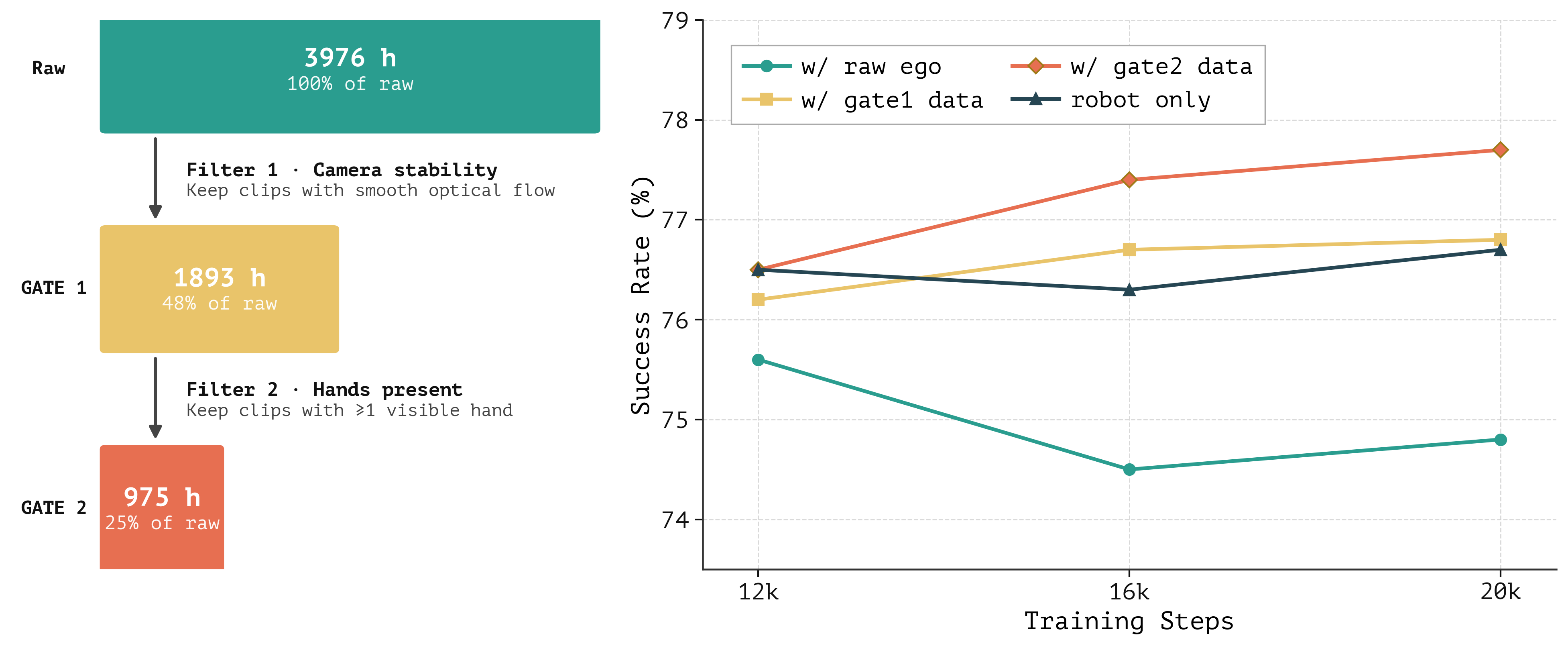
Figure 3 — Ego4D 큐레이션 효과
Real-world 평가
- 설정: AgileX Cobot Magic V2.0 bimanual platform에서 5개 task를 평가했습니다 [Figure 5].
- 전체 성능: Average success rate는 40%(20/50)로, π0.5의 44%(22/50)와 비슷했습니다. 이 결과는 더 작은 robot pretraining corpus를 쓰고 action expert를 scratch부터 학습한 조건에서 나왔습니다.
- Cucumber Transfer 시각 교란: 조명 변화(9/10 vs 7/10), 배경 변화(8/10 vs 7/10), distractor(5/10 vs 4/10) 모두에서 π0.5보다 우세했습니다.
- Flower Handover 시각 교란: 조명 변화(2/10 vs 5/10)와 distractor(0/10 vs 3/10)에서는 열세였고, 배경 변화에서는 2/10으로 동률이었습니다.
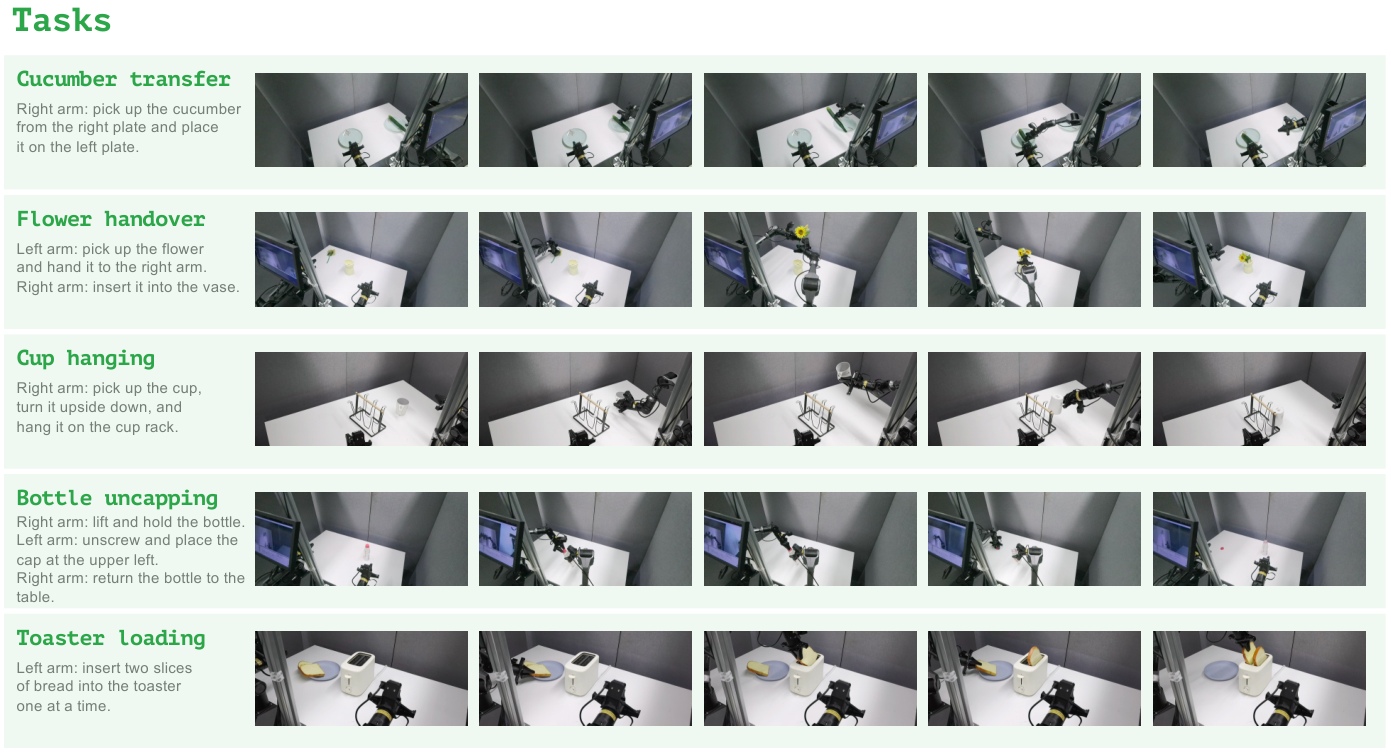
Figure 5 — 실제 로봇 평가 task
4. Conclusion & Impact (결론 및 시사점)
이 논문은 action-free egocentric video가 future visual-state prediction을 통해 transferable한 visual supervision 역할을 할 수 있음을 보여줍니다.
- 설계 측면: Distribution shift 상황에서 learned visual representation(SigLIP2 등)이 reconstruction latent보다 더 효과적인 prediction target입니다. Regression도 flow matching의 대안으로 쓸 수 있습니다.
- 데이터 측면: Stable motion과 visible hand 기준의 filtering이 중요합니다. 또한 영상 양을 늘릴수록 OOD 성능이 계속 오르는 scaling 경향이 관찰됐습니다.
- 산업적 시사점: Inference 비용을 늘리지 않고도 값싼 대규모 human video로 VLA의 robustness를 높일 수 있는 실용적인 경로를 제시합니다.
- 한계: Real-world 결과는 task에 따라 엇갈립니다. Precision grasping, bimanual rotational manipulation, long-horizon task는 두 방법 모두 여전히 어려운 과제로 남아 있습니다.
⚠️ 알림: 이 리뷰는 AI로 작성되었습니다.
관련 포스트
- [논문리뷰] SALA: Semantically Aligned Latent Actions Enable Dual-Axis Scaling of Embodied Foundation Models
- [논문리뷰] InternVLA-A1.5: Unifying Understanding, Latent Foresight, and Action for Compositional Generalization
- [논문리뷰] Open-HumanScale: An Open Recipe for Scaling Human and Robot Experience for Embodied Foundation Models
- [논문리뷰] HumanScale: Egocentric Human Video Can Outperform Real-Robot Data for Embodied Pretraining
- [논문리뷰] ST-WAM: Semantic-Temporal World Action Model for Robust Manipulation under Visual Distribution Shifts
Review 의 다른글
- 이전글 [논문리뷰] DominoBench: Evaluating Multi-Step Physical Reasoning from Still Images
- 현재글 : [논문리뷰] Ego Guidance: Enhancing Robot Policy Learning with Action-Free Human Egocentric Videos
- 다음글 [논문리뷰] Flexible Multi-Stack Super-Resolution of Clinical Brain MRI Using Hetero-Orientation Variational Encoding: Expert Reader Evaluation in a Nigerian Cohort
댓글