[논문리뷰] Native Action-Prior Learning from Videos for World Action Models
링크: 논문 PDF로 바로 열기
The content has been successfully retrieved. Now I will proceed with summarizing the paper according to the specified format and constraints.
Keywords identification: From the abstract and introduction, keywords that stand out are:
- World Action Models (WAMs)
- Native Action-Prior Learning
- Observation-Only Videos
- Action Policy
- Robot Control
- Flow Matching
- Mixture-of-Transformers (MoT)
- Action-Label Efficiency
I will select 5-8 of these.
Figure Selection: I need to identify up to 3 important figures.
- Figure 1: "Paradigms of leveraging observation-only videos for robot policy learning." This is a good overview figure.
- Figure 2: "Overview of NAVA-WAM." This shows the main architecture and training stages, which is crucial.
- Figure 3: "Real-robot evaluation on a Franka FR3." Shows real-world results, very important.
- Figure 4: "Attention of learned action representations." Shows qualitative insights into the learned representations.
- Figure 5: "Qualitative visualization of motion transfer across domains." Shows qualitative motion transfer.
- Figure 6: "Scaling observation-only pre-training data." Quantitative ablation.
I will choose Figure 1 (paradigms), Figure 2 (NAVA-WAM overview), and Figure 3 (real-robot evaluation) as they represent the problem context, the proposed method, and the key real-world results. Figure 4 and 5 are also good but 1, 2, 3 provide a more holistic understanding.
Now, I will construct the summary.
Part 1: Summary Body
- Metadata: Authors are clearly listed. I will extract and format them. Keywords will be chosen from the list above.
- Key Terms & Definitions: I will define WAMs, Native Action-Prior Learning, MoT, Flow Matching.
- Motivation & Problem Statement: Focus on the challenge of scaling WAMs due to action-annotated data scarcity and the limitations of existing observation-only learning paradigms (representation learning, latent-action learning). I will reference Figure 1 here.
- Method & Key Results: Describe NAVA-WAM's two-stage training (pre-training with future-video flow-matching and transition-structured attention, post-training with video-action flow matching and asymmetric attention for efficient inference). Highlight quantitative performance gains (LIBERO/LIBERO-Plus, RoboTwin 2.0, Franka FR3 success rates) and action-label efficiency. I will reference Figure 2 and Figure 3.
- Conclusion & Impact: Summarize the direct pre-training approach's benefits and its implications for scaling WAMs beyond expensive action-labeled data.
Part 2: Important Figure Information (JSON)
I will collect the image URLs and short Korean captions for Figure 1, 2, and 3.
- Figure 1:
2610.03391v1/fig1.png - Figure 2:
2610.03391v1/main.png - Figure 3:
2610.03391v1/real_robot.png
All relative URLs will be converted to full arXiv URLs.저자: Zhaochong An, Fei Zhang, Menglin Jia, Duncan Frost, Zijian Zhou, Yikai Wang, Xudong Wang, Aditya Patel, Belinda Zeng, Tao Xiang, Serge Belongie, Amir Bar, Sen He
1. Key Terms & Definitions (핵심 용어 및 정의)
- World Action Models (WAMs): 미래 시각 다이내믹스 예측과 로봇 액션 예측을 통합하여 정책 일반화(policy generalization)를 향상시키는 모델을 지칭합니다.
- Native Action-Prior Learning: 중간 인터페이스(intermediate interface) 없이 오직 비디오 관찰(observation-only videos)로부터 액션 정책(action policy)을 직접 사전 학습(pre-train)하는 접근 방식입니다.
- Mixture-of-Transformers (MoT): Video-DiT와 Action-DiT로 구성된 통합 아키텍처로, 각 전문가가 모달리티별 파라미터를 유지하면서 joint attention을 통해 정보를 교환합니다.
- Flow Matching: 미래 비디오 예측(future-video prediction) 및 액션 예측(action prediction)을 위한 표준적인 생성 모델링 기법으로, Continuous Normalizing Flows와 유사하게 타겟 데이터 분포로의 ODE 경로를 학습합니다.
- Action-DiT: NAVA-WAM 아키텍처 내에서 연속적인 로봇 액션(continuous robot actions)을 생성하는 역할을 담당하는 Transformer 기반의 모델입니다.
2. Motivation & Problem Statement (연구 배경 및 문제 정의)
본 논문은 World Action Models (WAMs)의 확장성(scalability)이 액션 주석이 달린(action-annotated) 로봇 궤적(robot trajectories) 데이터에 대한 의존성으로 인해 제한되는 문제를 해결하고자 합니다. 기존 접근 방식들은 대규모의 오직 비디오 관찰(observation-only videos)을 활용함에도 불구하고, 두 가지 주요 한계점을 가집니다. 첫째, Vision representation learning 패러다임은 비디오에서 시각적 표현(visual representations)을 학습한 후 이를 제어(control)에 적응시키는데, 이는 간접적인 representation-to-control transfer를 야기합니다. 둘째, Latent-action learning 패러다임은 시각적 transition으로부터 액션과 유사한 변수들을 추론하지만, 추가적인 latent-action modeling 단계와 shortcut solution을 방지하기 위한 복잡한 아키텍처적 제약(architectural constraints)을 필요로 합니다. 이러한 한계점들은 학습 복잡성을 증가시키고 latent-action space의 표현력(expressiveness)을 제한하여 정책 학습(policy learning)의 효과를 저해합니다. 따라서 저자들은 중간 인터페이스 없이 오직 비디오 관찰(observation-only videos)이 액션 정책(action policy)을 직접 최적화할 수 있는지에 대한 질문을 제기하며, 이를 위해 Native Action-Prior Learning을 제안합니다 [Figure 1].
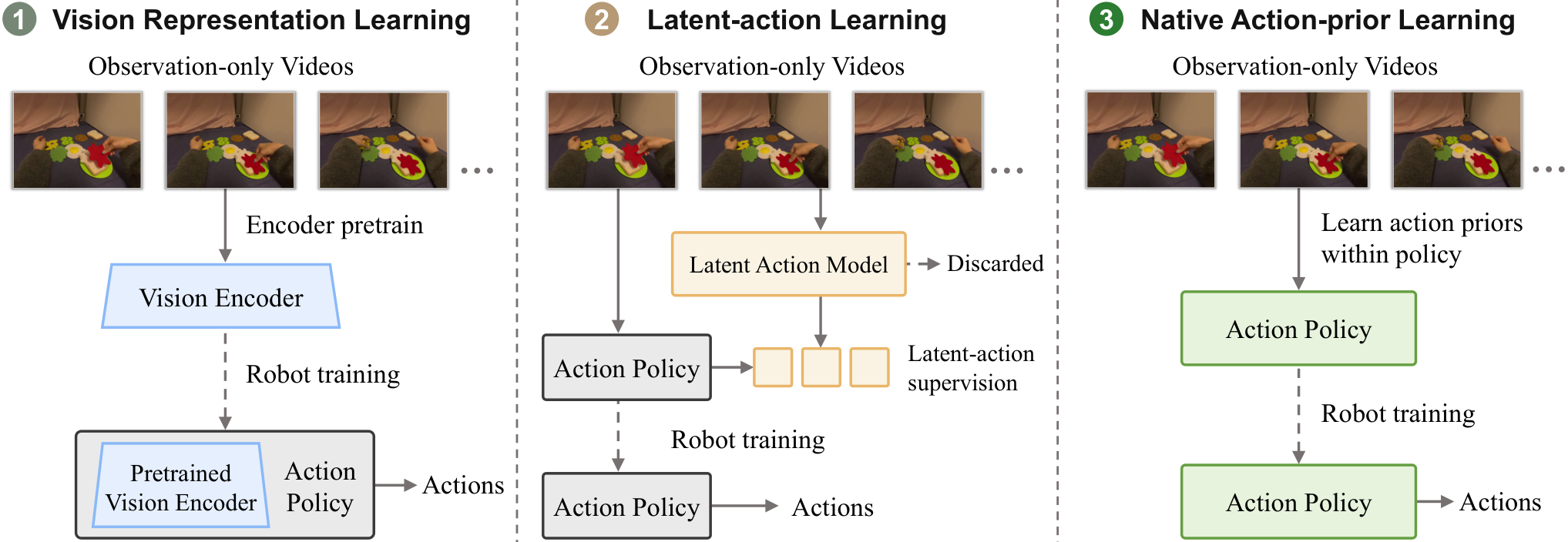
Figure 1 — 로봇 정책 학습을 위한 비디오 활용 패러다임
3. Method & Key Results (제안 방법론 및 핵심 결과)
저자들은 중간 인터페이스 없이 로봇 정책 내에서 직접 액션 관련 prior를 학습하는 NAVA-WAM을 제안합니다. NAVA-WAM은 Mixture-of-Transformers (MoT) 아키텍처를 기반으로 하며, Video-DiT와 Action-DiT로 구성됩니다. 제안하는 학습 과정은 두 단계로 이루어집니다 [Figure 2]. 첫 번째 단계인 Native Action-Prior Pre-training에서는 액션이 없는 오직 비디오 관찰(observation-only videos)을 사용하여 Action-DiT를 최적화합니다. 이 과정에서 Video-DiT는 고정되며, transition-structured joint attention을 통해 미래 비디오 flow-matching supervision이 Action-DiT로 전파되어 액션 관련 prior를 학습합니다. Action-DiT는 노이즈가 추가된 미래 상태(noised future state)에만 접근하여 직접적인 타겟 복사(target-copying shortcut)를 방지하며, implicit inverse-forward interaction을 통해 시각적 transition을 모델링합니다. 두 번째 단계인 Post-training and Inference에서는 액션 레이블이 있는 로봇 시연 데이터(action-labeled robot demonstrations)를 사용하여 Video-DiT와 Action-DiT를 함께 최적화합니다. 이 단계에서는 asymmetric attention을 적용하여 Video-DiT가 액션 스트림(action stream)과 독립적으로 동작하게 하며, 이를 통해 시각적 표현을 캐싱(cache)하여 효율적인 action-only inference를 가능하게 합니다.
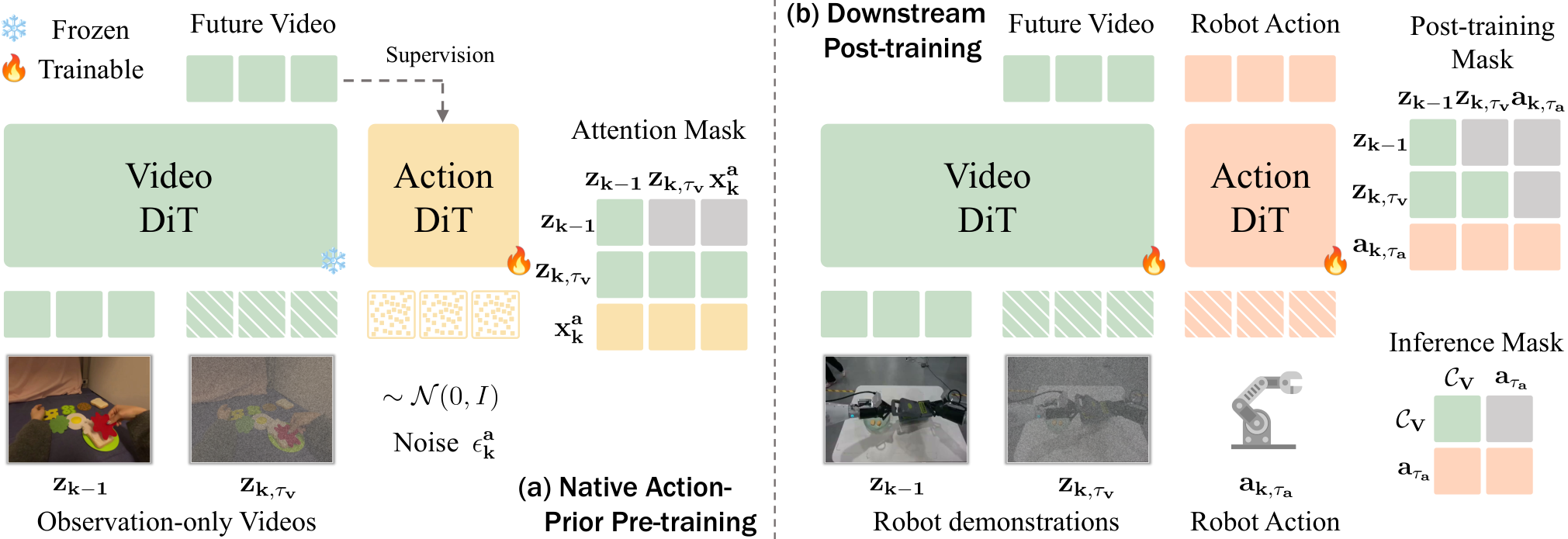
Figure 2 — NAVA-WAM 모델 개요
실험 결과, NAVA-WAM은 시뮬레이션 벤치마크인 LIBERO/LIBERO-Plus와 RoboTwin 2.0에서 일관되게 뛰어난 성능을 보였습니다. 특히, LIBERO에서 99.0%의 성공률을, LIBERO-Plus의 out-of-distribution (OOD) 세팅에서 83.5%의 성공률을 달성했습니다. RoboTwin 2.0에서는 Clean 도메인에서 88.5%, Random 도메인에서 73.6%의 성공률을 기록하여, 이전 접근 방식 대비 Random 도메인에서 17.9점의 성능 향상을 보였습니다. 실제 로봇(Franka FR3) 배포에서도 NAVA-WAM은 93.3%의 평균 성공률을 달성하여, DreamZero의 66.7% 및 π0.5의 53.3% 대비 우수한 실세계 일반화(real-world generalization) 능력을 입증했습니다 [Figure 3]. 또한, ablation study를 통해 NAVA-WAM이 기존의 representation-based 및 latent-action-based pre-training 방법론들보다 더 높은 action-label efficiency를 가지며, 적은 수의 데모 데이터(25 demonstrations per task)로도 모든 baseline을 능가하는 성능을 보여주었습니다.
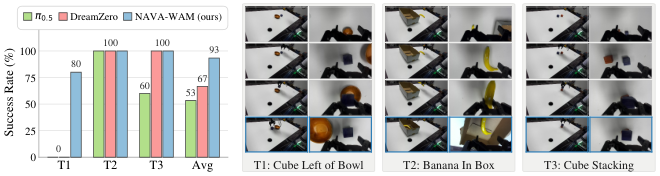
Figure 3 — Franka FR3 실제 로봇 평가 결과
4. Conclusion & Impact (결론 및 시사점)
본 논문은 Native Action-Prior Learning을 도입한 NAVA-WAM을 통해 오직 비디오 관찰(observation-only videos)로부터 로봇 액션 정책을 직접 사전 학습하는 새로운 패러다임을 제시합니다. 이 접근 방식은 기존의 간접적인 표현 학습(representation learning)이나 latent-action modeling의 복잡성을 회피하며, 액션-자유(action-free) 사전 학습과 실제 정책 학습(downstream policy learning)을 단일 모델 내에서 통합합니다. 실험 결과는 시뮬레이션 및 실제 로봇 환경에서 NAVA-WAM의 강력한 일반화 능력(generalization capability)과 효율적인 action-only inference를 명확히 보여줍니다. 이러한 연구는 값비싼 액션 레이블이 있는 로봇 데이터의 한계를 넘어, 확장 가능한 오직 비디오 관찰(observation-only videos)을 활용하여 World Action Models를 확장하는 효과적이고 직접적인 경로를 제공하며, 로봇 제어 분야의 발전에 크게 기여할 것입니다.
⚠️ 알림: 이 리뷰는 AI로 작성되었습니다.
관련 포스트
- [논문리뷰] GigaWorld-Policy-0.5: A Faster and Stronger WAM Empowered by AutoResearch
- [논문리뷰] UniWAM: Unified World-Action Model
- [논문리뷰] InternW0-Δ: A World Action Model Bridging Predictive Dynamics and Actions with 20K+ Hours of Open Data
- [논문리뷰] SenseNova-U1.5: Towards Native Unified Visual Intelligence
- [논문리뷰] ST-WAM: Semantic-Temporal World Action Model for Robust Manipulation under Visual Distribution Shifts
Review 의 다른글
- 이전글 [논문리뷰] Multilingual GSM-Symbolic: What determines capability transfer across languages?
- 현재글 : [논문리뷰] Native Action-Prior Learning from Videos for World Action Models
- 다음글 [논문리뷰] On-Policy Parameter Update Direction Underlies Generalization in LLM Post-Training
댓글