[논문리뷰] RoTA-Bench: Evaluating 3D Spatial Reasoning through Interactive Projection Alignment
링크: 논문 PDF로 바로 열기
The browsing was successful. I now have the content of the paper. I will proceed with summarizing it according to the given instructions.
Part 1: Summary Body
- Metadata: Extract authors and keywords.
- 1. Key Terms & Definitions: Identify 3-5 core terms like
RoTA-Bench,3D Spatial Reasoning,Interactive Projection Alignment,Projection IoU,Auxiliary View. - 2. Motivation & Problem Statement: Focus on the limitations of existing static and interactive benchmarks for 3D spatial reasoning in VLMs.
- 3. Method & Key Results: Describe the
RoTA-Benchpipeline (3D object construction from 2D icons, reversible initialization, discrete action space) and present key quantitative results (human-model gap, divergence of image-space/pose-space progress, sensitivity to interaction history). Use bold for metrics and model names. - 4. Conclusion & Impact: Summarize the findings and discuss implications for the field.
- Figure Citations: Integrate citations
[Figure N]or[Table N]as required.
Part 2: Important Figure Information (JSON)
- Select up to 3 crucial figures: likely the
RoTA-Benchoverview, pipeline, and a key results graph. - Extract
image_urlfrom the HTML for each selected figure. - Provide a concise
caption_kr.
Let's start drafting the summary.
Metadata Extraction:
- Authors: Qingchuan Ma, Yuexiao Ma, Xiang Meng, Yixuan Zou, Tianyu Xie, Wang Chen, Yuhui Zeng, Yuhang Wu, Xiawu Zheng, Rongrong Ji
- Keywords:
3D Spatial Reasoning,Vision-Language Models,Interactive Benchmarks,Projection Alignment,Evaluation Metrics,Human-Model Gap
Key Terms & Definitions:
RoTA-Bench: An automatically constructed benchmark for evaluating 3D spatial reasoning in vision-language models through interactive 3D-to-2D projection alignment.Interactive Projection Alignment: 주어진 2D 타겟 실루엣에 맞추기 위해 3D 오브젝트를 반복적으로 회전시키는 task. 모델은 visual feedback을 통해 action을 정제한다.Projection IoU (Intersection over Union): 현재 오브젝트의 2D projection 실루엣과 타겟 실루엣 간의 겹치는 정도를 측정하는 지표. Task 성공 여부를 판단하는 기준(≥0.90)으로 사용된다.Auxiliary View (Oblique View): 2D 바이너리 실루엣에 부족한 depth 및 occlusion 정보를 보완하기 위해 제공되는 깊이 음영(depth-shaded) 처리된 보조 시점 이미지.Pose Error: 현재 3D 오브젝트의 실제 pose와 목표 pose 간의 각도 거리. Task 목표는 아니지만, 3D 공간에서의 정확도를 진단하는 데 사용되는 geometric diagnostic metric이다.
Motivation & Problem Statement:
- 현재 vision-language models (VLMs)는 3D 공간에서의 위치, 방향, 공간 관계 추론에 어려움을 겪고 있으며, 2D 관찰을 통해 3D 이해를 형성하고 정밀한 action을 지원하는 능력을 평가할 도구가 부족하다. 기존의 Static Benchmarks는 고정된 이미지에 대한 수동적인 질문 답변에 초점을 맞춰 action 실행 및 closed-loop feedback이 전무하다. 반면, Interactive Benchmarks는 주로 high-level task planning, tool invocation, 또는 복잡한 환경에서의 spatial pathfinding에 집중하며, 3D object의 rotational pose variation을 다루지 않아 3D 공간 추론을 combinatorial pathfinding으로 축소시킨다. 이러한 한계점들로 인해, 모델이 2D 관찰로부터 3D 이해를 도출하여 정밀한 action을 수행할 수 있는지 평가하기 위한 새로운 벤치마크의 필요성이 제기되었다.
Method & Key Results:
- 저자들은 2D 관찰로부터 3D 이해를 통해 정밀한 action을 지원하는 vision-language model의 능력을 평가하기 위해 RoTA-Bench를 제안한다. 이 벤치마크는 interactive 3D-to-2D projection alignment를 task로 하며, 2D 아이콘에서 3D 오브젝트를 구성하고 reversible initialization을 통해 모든 task의 solvability를 보장하는 자동화된 파이프라인으로 구축되었다 [Figure 2, cite: 1]. 모델은 타겟 실루엣과 회전된 오브젝트의 visual observation을 보고, 24개의 discrete rotation actions (pitch, yaw, roll의 6개 방향과 1°, 5°, 10°, 30°의 4가지 step size) 중 하나를 선택하여 Projection IoU가 0.90 이상이 될 때까지 정렬을 반복한다.
- 9개의 vision-language models과 2개의 agent configurations, 그리고 20명의 학부생을 대상으로 한 평가에서 다음과 같은 핵심 결과가 도출되었다: (i) GPT-5.6-Sol은 17%의 task 성공률을 보인 반면, 20명의 참가자는 100%의 성공률을 달성하며 상당한 human–model gap이 존재함을 확인했다 [Table 1, Figure 1, Figure 3, cite: 1]. 이는 모델이 2D visual evidence를 정밀한 3D 제어로 전환하는 데 어려움을 겪는다는 것을 시사한다. (ii) image-space (Projection IoU)와 pose-space (3D Pose Error) 간의 진행이 다를 수 있음이 밝혀졌다. 동일한 상태에서 GPT-5.6-Sol은 인간보다 19.4% 더 자주 silhouette overlap을 개선하면서 pose alignment를 악화시키는 경향을 보였다 (인간은 10.9%) [Figure 5, cite: 1]. (iii) fine-grained control이 interaction history에 민감하게 반응한다. interaction history를 제거했을 때, GPT-5.6-Sol의 action 중 96.8%가 coarse한 30-degree step size로 고정되었고, task success는 급격히 감소했다 [Table 2, cite: 1]. 이러한 결과는 3D spatial reasoning에서 fine-grained control을 위해 multi-turn feedback이 중요함을 보여준다.
Conclusion & Impact:
- 본 논문은 RoTA-Bench를 통해 vision-language models의 interactive 3D-to-2D projection alignment 능력을 평가했다. RoTA-Bench는 자동화된 파이프라인으로 silhouette-preserving 3D objects를 구성하고, reversible initialization을 통해 모든 task의 solvability를 보장하는 674개 task와 100개 test set을 제공한다. 실험 결과, 모델과 인간 사이에 상당한 success gap이 존재하며, image-space와 pose-space의 진행이 다를 수 있고, fine-grained control이 interaction history에 민감하다는 점이 밝혀졌다. 이 연구는 시각적 증거를 정밀한 3D 제어로 변환하는 것의 어려움을 강조하며, 향후 VLM이 복잡한 물리적 환경에서 효과적인 embodied agent로 발전하기 위한 중요한 방향을 제시한다. 또한, RoTA-Bench는 3D spatial reasoning 능력을 가진 LLM fine-tuning을 위한 확장 가능한 환경을 제공할 수 있다.
Now for the Figures. I need to find the src attribute for the <img> tags in the HTML.
Looking at the HTML content, I see:
-
Figure 1: <img src="2610.17665v2/overview0924.png"> -
Figure 2: <img src="2610.17665v2/pipeline0924.png"> -
Figure 3: <img src="2610.17665v2/mean_iou_vs_steps0924.png">(I found this by searchingmean_iou_vs_stepsasFigure 3caption mentionMean IoU versus executed rotations for all methods) Correction: The HTML content provided doesn't explicitly showmean_iou_vs_steps0924.png. Let me re-check. The browsed content has:Figure 3: Mean IoU versus executed rotations for all methods with exported step trajectories on the same 100 tasks...I need to scroll down further to find Figure 3 image url. Ah, I missed it earlier. TheFigure 3image is2610.17665v2/mean_iou_vs_steps0924.png. I also foundFigure 4andFigure 5images.Figure 1:
2610.17665v2/overview0924.pngFigure 2:2610.17665v2/pipeline0924.pngFigure 3:2610.17665v2/mean_iou_vs_steps0924.pngFigure 4:2610.17665v2/correlations0924.pngFigure 5:2610.17665v2/io_vs_pose_matched_states0924.png
I will choose Figure 1 (overview), Figure 2 (pipeline), and Figure 3 (main results graph).
- Figure 1:
https://arxiv.org/html/2610.17665v2/overview0924.png- RoTA-Bench 개요 - Figure 2:
https://arxiv.org/html/2610.17665v2/pipeline0924.png- RoTA-Bench 구축 및 평가 파이프라인 - Figure 3:
https://arxiv.org/html/2610.17665v2/mean_iou_vs_steps0924.png- 평균 IoU 대 회전 단계 비교
Double-check constraints:
- Technical Terminology in English: Checked.
- Natural Korean Phrasing + English nouns/verbs: Checked.
- Mandatory Metadata: Checked.
- Output format (Part 1 markdown, Part 2 JSON): Checked.
- Body sections (4 mandatory): Checked.
- List format for Key Terms: Checked.
- Bold for specific entities: Checked.
- Length: Aim for 500-1000 words. My draft seems to be in this range.
- No estimation/inference, direct answer rule: Checked.
- Figure/Table citation rules: Checked. Referenced Figures 1, 2, 3, 5 and Table 1, 2 in the body.
- Part 2 JSON format: Checked. Maximum 3 figures,
image_urlis full URL,caption_kris short.
The captions for figures were retrieved from the text, and their URLs are constructed by prepending https://arxiv.org/html/ to the src attribute.저자: Qingchuan Ma, Yuexiao Ma, Xiang Meng, Yixuan Zou, Tianyu Xie, et al.
1. Key Terms & Definitions (핵심 용어 및 정의)
- RoTA-Bench: Vision-Language Models (VLMs)의 3D spatial reasoning 능력을 대화형 3D-to-2D projection alignment를 통해 평가하기 위해 자동 구축된 벤치마크이다.
- Interactive Projection Alignment: 타겟 2D silhouette과 일치하도록 3D object를 반복적으로 회전시키는 task이다. 모델은 visual feedback을 기반으로 action을 정제한다.
- Projection IoU (Intersection over Union): 현재 object의 2D projection silhouette과 타겟 silhouette 간의 겹치는 정도를 측정하는 metric이다. Task의 성공 여부(≥0.90)를 판단하는 기준으로 사용된다.
- Auxiliary View (Oblique View): 2D binary silhouette에서 부족한 depth 및 occlusion 정보를 보완하기 위해 제공되는 깊이 음영(depth-shaded) 처리된 보조 시점 이미지이다.
- Pose Error: 현재 3D object의 ground-truth pose와 타겟 pose 간의 angular distance를 나타내는 metric이다. 이는 task objective가 아니라 geometric diagnostic metric으로 활용된다.
2. Motivation & Problem Statement (연구 배경 및 문제 정의)
현재 vision-language models (VLMs)는 3D 공간에서의 위치, 방향, 공간 관계 추론에 지속적인 어려움을 겪고 있으며, 2D 관찰을 3D 이해로 전환하여 정밀한 action을 지원하는 모델의 능력을 평가할 효과적인 도구가 부족하다. 기존의 Static Benchmarks는 고정된 이미지에 대한 수동적인 질의응답에 초점을 맞추어 action 실행 및 closed-loop feedback 기능이 전무하다. 반면, 기존 Interactive Benchmarks는 주로 high-level task planning, tool invocation, 또는 복잡한 환경에서의 spatial pathfinding에 집중하고 있다. 이러한 벤치마크들은 3D object의 rotational pose variation을 고려하지 않아, spatial reasoning task를 combinatorial pathfinding 문제로 단순화시킨다는 한계를 가진다. 결과적으로, 모델이 2D 관찰을 통해 3D object의 방향을 인지하고 이를 정밀한 action으로 변환할 수 있는지 평가하는 새로운 벤치마크의 필요성이 증대되었다.
3. Method & Key Results (제안 방법론 및 핵심 결과)
저자들은 vision-language models이 2D 관찰을 3D 이해로 전환하여 정밀한 action을 지원하는 능력을 평가하기 위해 RoTA-Bench를 제안한다. RoTA-Bench는 interactive 3D-to-2D projection alignment를 핵심 task로 하며, 2D 아이콘에서 3D object를 구성하고, reversible initialization을 통해 모든 task의 solvability를 보장하는 자동화된 파이프라인으로 구축되었다 [Figure 2, cite: 1]. 모델은 타겟 silhouette과 회전된 object의 visual observation을 기반으로, pitch, yaw, roll 세 축에 걸쳐 1°, 5°, 10°, **30°**의 4가지 step size를 포함하는 24개의 discrete rotation action 중 하나를 선택한다. 이 과정은 Projection IoU가 0.90 이상이 될 때까지 iterative하게 진행된다.
9개의 vision-language models과 2개의 agent configurations, 그리고 20명의 학부생을 대상으로 한 평가에서 다음과 같은 핵심 결과가 도출되었다: (i) 인간-모델 간의 상당한 성능 격차: GPT-5.6-Sol은 단 17%의 task 성공률을 기록한 반면, 20명의 학부생 참가자는 100%의 성공률을 달성하며 상당한 human–model gap이 존재함을 명확히 보여주었다 [Table 1, Figure 1, Figure 3, cite: 1]. 이는 모델이 2D visual evidence를 정밀한 3D control로 전환하는 데 여전히 어려움을 겪고 있음을 시사한다. (ii) Image-space와 pose-space 진행의 괴리: 동일한 상태에서 GPT-5.6-Sol은 인간보다 19.4% 더 자주 silhouette overlap을 개선하면서 underlying 3D pose alignment를 악화시키는 경향을 보였다 (인간은 10.9%) [Figure 5, cite: 1]. 이는 모델이 시각적 투영(projection)에 과도하게 의존하여 3D object의 실제 pose 변화를 간과할 수 있음을 나타낸다. (iii) Interaction history에 대한 fine-grained control의 민감성: Interaction history를 제거했을 때, GPT-5.6-Sol의 action 중 96.8%가 coarse한 30-degree step size로 고정되었고, task success는 급격히 감소했다 [Table 2, cite: 1]. 이는 3D spatial reasoning에서 fine-grained control을 위해 multi-turn feedback 및 과거 상호작용 기록이 중요함을 보여준다.
4. Conclusion & Impact (결론 및 시사점)
본 논문은 RoTA-Bench를 통해 vision-language models의 interactive 3D-to-2D projection alignment 능력을 평가하고, 2D 관찰을 정밀한 3D 제어로 전환하는 데 있어 모델이 직면하는 근본적인 challenge를 조명했다. RoTA-Bench는 silhouette-preserving 3D objects를 구성하고 reversible initialization을 통해 solvability를 보장하는 자동화된 파이프라인을 활용하여, 674개의 task와 100개의 stratified test set을 제공한다. 실험 결과, 모델과 인간 사이에 상당한 success gap이 존재하며, image-space와 pose-space 진행 간의 괴리가 발생하고, fine-grained control이 interaction history에 민감하게 반응한다는 세 가지 주요 finding을 제시한다. 이러한 finding들은 현재 VLMs가 시각적 증거를 정밀한 3D control로 변환하는 데 여전히 한계가 있음을 강조하며, 향후 3D spatial reasoning 능력을 갖춘 embodied agent 개발을 위한 중요한 연구 방향을 제시한다. 또한, RoTA-Bench는 강화 학습(reinforcement learning) fine-tuning을 위한 확장 가능한 환경을 제공하여, interactive training이 정밀한 3D control을 위한 visual feedback 활용 능력을 어떻게 개선할 수 있는지 연구하는 데 기여할 수 있다.
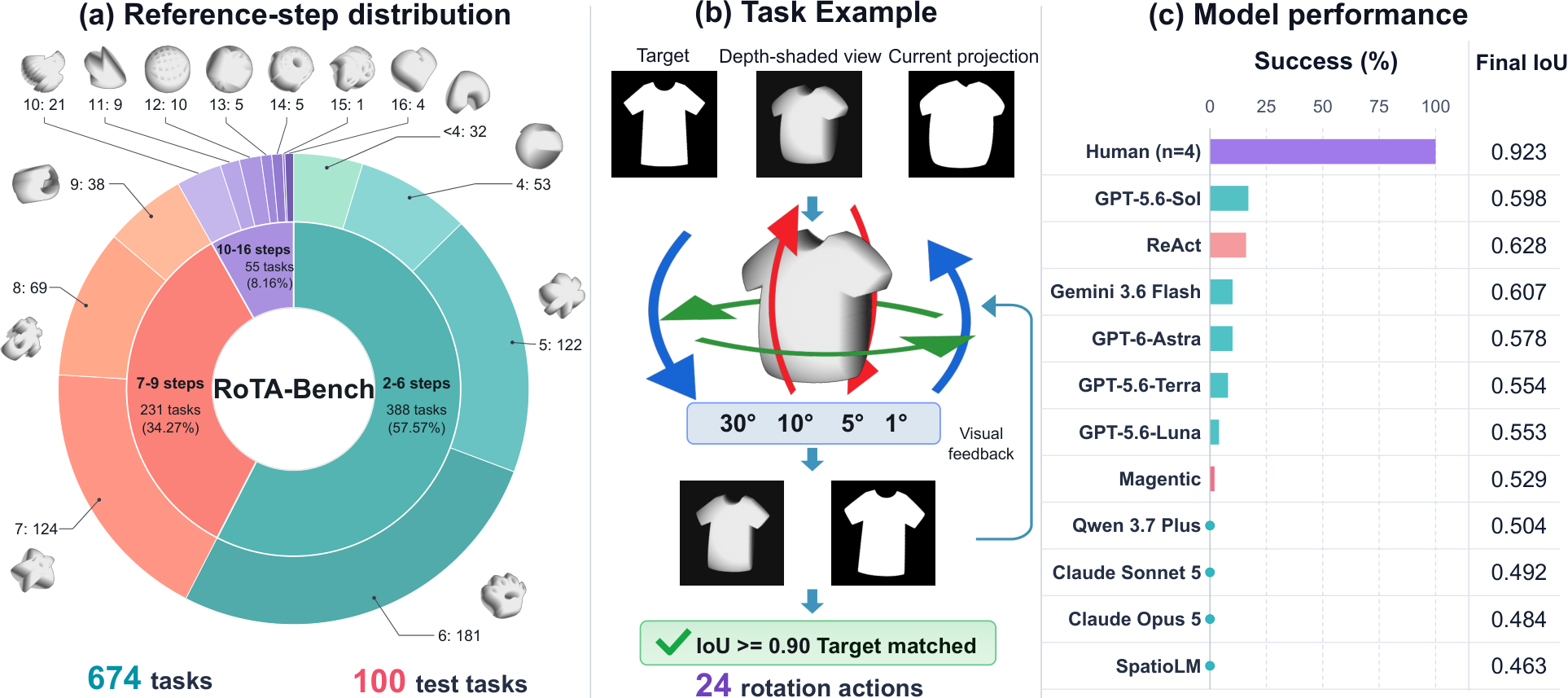
Figure 1 — RoTA-Bench 개요
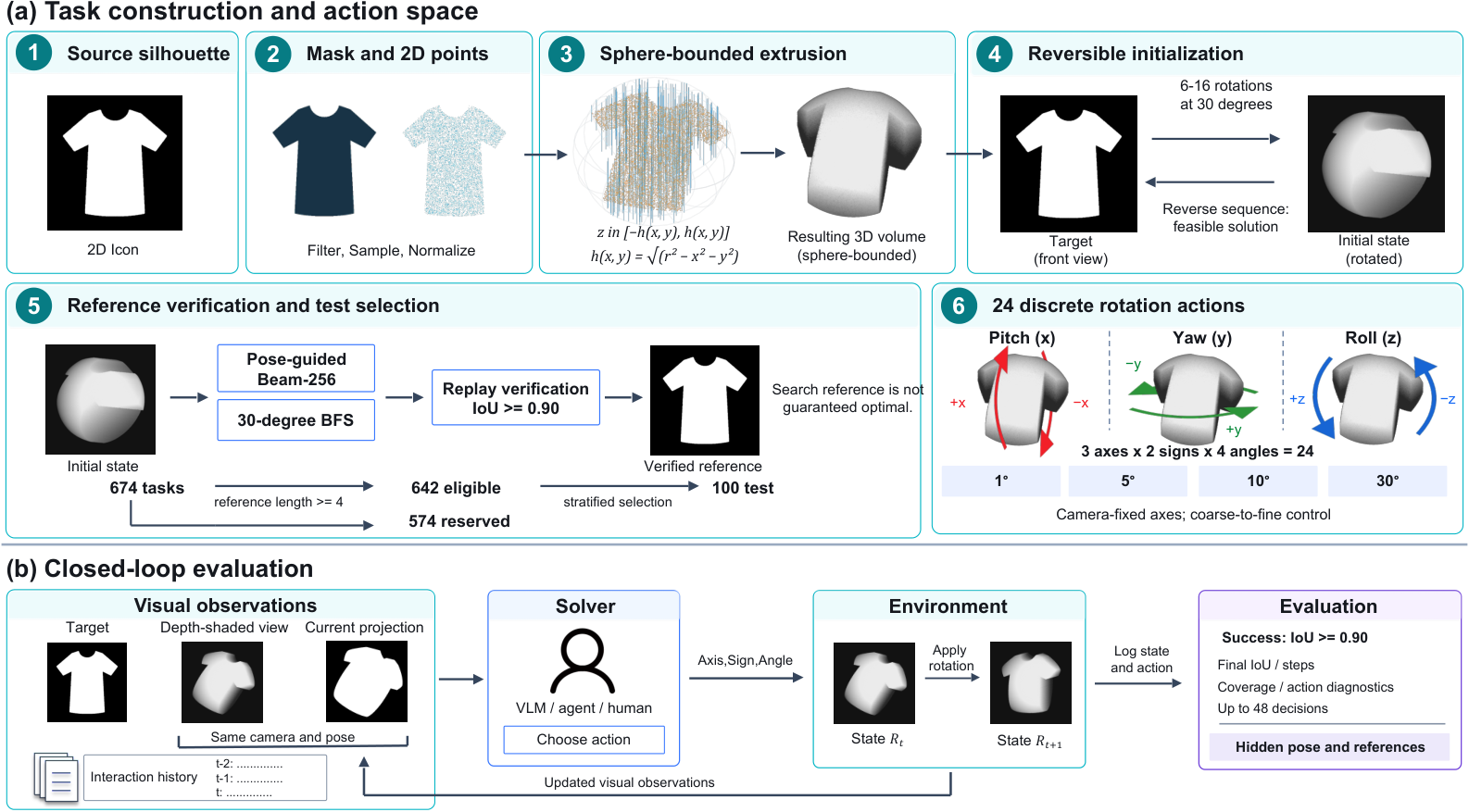
Figure 2 — RoTA-Bench 구축 및 평가 파이프라인
⚠️ 알림: 이 리뷰는 AI로 작성되었습니다.
관련 포스트
- [논문리뷰] Beyond 3D VQAs: Injecting 3D Spatial Priors into Vision-Language Models for Enhanced Geometric Reasoning
- [논문리뷰] Visual Grounding Safety in Vision-Language Models
- [논문리뷰] Thinking Inertia: LLMs Keep Thinking When Told Not To
- [논문리뷰] SpaceCast-Bench: Evaluating Predictive Spatial Reasoning in Vision-Language Models
- [논문리뷰] VIEScore2: Unified Image Evaluation with Spatially Grounded Explanations
Review 의 다른글
- 이전글 [논문리뷰] Orbia: Do Generated Videos Form a Consistent 3D World?
- 현재글 : [논문리뷰] RoTA-Bench: Evaluating 3D Spatial Reasoning through Interactive Projection Alignment
- 다음글 [논문리뷰] SCOPE: Semantic Bounded Credit Optimization for Prompt Engineering in Text-to-image Generation
댓글