[논문리뷰] Grouped Value Attention: Efficient KV Caching via On-Demand Key Reconstruction
링크: 논문 PDF로 바로 열기
The paper is "Grouped Value Attention: Efficient KV Caching via On-Demand Key Reconstruction" by Vishesh Tripathi, Abhay Kumar, and Ramsha Khan. It focuses on reducing the KV cache bottleneck in Transformer decoding.
Let's break down the summary structure and gather information.
Part 1: Markdown Summary
-
Metadata:
- 저자: Vishesh Tripathi, Abhay Kumar, Ramsha Khan
-
1. Key Terms & Definitions:
KV Cache: Transformer 디코딩 시 이전에 계산된 Key와 Value 벡터들을 저장하여 재사용하는 메모리 영역. 시퀀스 길이에 따라 선형적으로 증가하여 주요 병목이 됨.Grouped-query attention (GQA): Multi-head attention (MHA)와 Multi-query attention (MQA)의 절충안으로, Query 헤드들을 그룹으로 나누고 각 그룹이 하나의 Key-Value 헤드를 공유하여 KV Cache 크기를 줄이는 기법.Grouped Value Attention (GVA): 제안된 방법론으로, grouped values만 저장하고 content keys는 학습된 linear map을 통해 on-demand 방식으로 재구성하는 Attention 메커니즘.Decoupled RoPE: Rotational Positional Encoding (RoPE)를 content slice와 positional slice로 분리하여 적용하는 전략. GVA의 key reconstruction과 호환되도록 positional 정보를 유지하면서 key cache를 줄이는 데 기여.Absorption at decode: 추론 시 linear map (M)을 Query projection에 통합하여 content key를 명시적으로 생성할 필요 없이 Value cache에서 직접 스코어링이 가능하도록 하는 과정.
-
2. Motivation & Problem Statement:
- Problem: Transformer의 autoregressive decoding에서 KV Cache는 메모리 풋프린트와 캐시-읽기 트래픽 면에서 주요 병목 현상(bottleneck)을 야기한다. context length가 길어질수록 캐시 크기가 선형적으로 증가하며, 이는 Long-context serving에서 지배적인 비용이 된다.
- Existing Limitations:
Grouped-query attention (GQA)은 Key-Value 헤드를 공유하여 이 비용을 줄이지만, 여전히 매 스텝마다 Key와 Value를 모두 저장한다.Multi-head latent attention (MLA)는 Key와 Value를 joint latent로 압축하여 캐시를 더욱 축소하지만, 추가적인 projection과 더 복잡한 decode path를 필요로 한다. - Need for New Approach: 기존 방식들은 KV Cache의 비효율성을 완전히 해결하지 못하거나 추가적인 computational overhead를 발생시킨다. 따라서, 메모리 효율성을 극대화하면서도 성능 저하를 최소화하는 새로운 캐싱 전략이 필요하다. 본 논문은 Value가 이미 Attention output으로 전달될 content를 담고 있다는 가설을 바탕으로 Key를 Value로부터 재구성하는
Grouped Value Attention (GVA)을 제안한다.
-
3. Method & Key Results:
- Methodology:
Grouped Value Attention (GVA)은GQA의 grouping 전략을 기반으로 하며, H개의 query heads가 G개의 value heads를 공유한다.GVA는 오직 grouped values만 캐시하고, 각 query head h에 대해 학습된 linear mapMh를 사용하여 content keyKh = Vg(h)Mh를 재구성한다. 이 linear map은 inference 시 query에 흡수(absorb)될 수 있어, content key를 별도로 materialize할 필요 없이 저장된 value와 단일 inner product로 content score를 계산한다. - Decoupled RoPE:
GVA는 표준RoPE가absorption을 방해하는 문제를 해결하기 위해, DeepSeekMLA와 유사하게Decoupled RoPE채널을 사용한다. 이는 각 query 및 key head를 unrotatedcontent slice (dn)와 rotatedpositional slice (dr)로 분리하며,RoPE는positional slice에만 적용되고positional key는 헤드 간에 공유된다. 이는 완전한 key cache를 복원하지 않고도 positional 정보를 유지하며, per-token 당 몇 개의 추가적인 dimension만으로 구현된다. - Key Results:
GVA는 일치하는GQA대비 persistent cache scalars를 약 45–47% 감소시킨다. (Configurations studied) [Figure 1]- 350M-parameter 규모의 모델과 30B FineWeb-Edu 토큰으로 학습된 16-dimensional positional variant
GVA + DRoPE dr=16는 5개 벤치마크 태스크에서 평균 44.35%의 정확도를 달성했으며, 이는GQA의 44.36%와 매우 유사하고MLA의 43.88%보다 높다. [Table 2] GVA는scale-matched초기화를 통해GQA및MLA와 유사한 Training loss 궤적을 보인다. [Figure 2]K=V방식 (Shared KV)은 캐시 크기를 절반으로 줄이지만, 학습 손실이GQAbaseline을 회복하지 못한다. [Figure 3]
- Methodology:
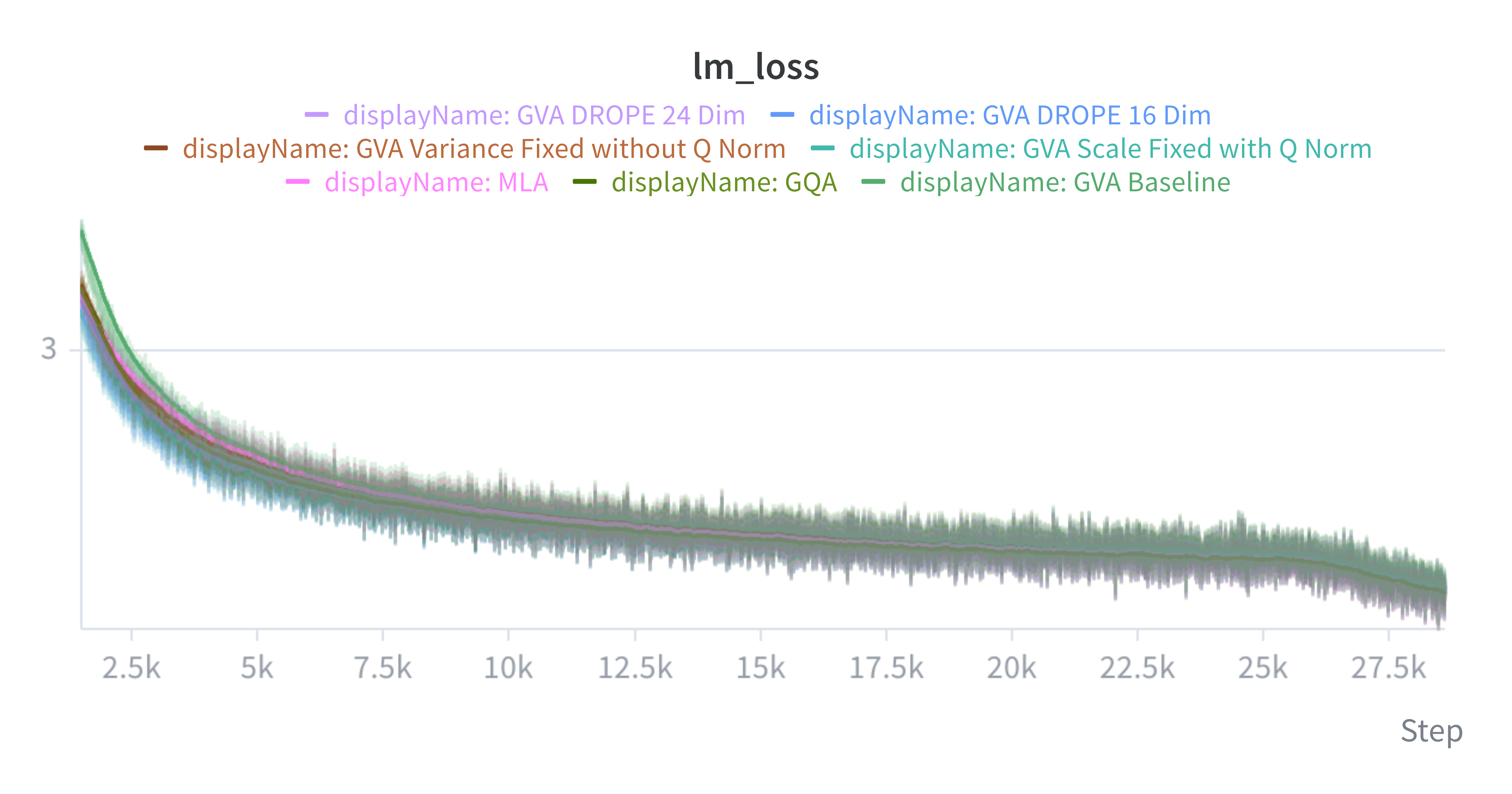
Figure 2 — 훈련 손실 곡선
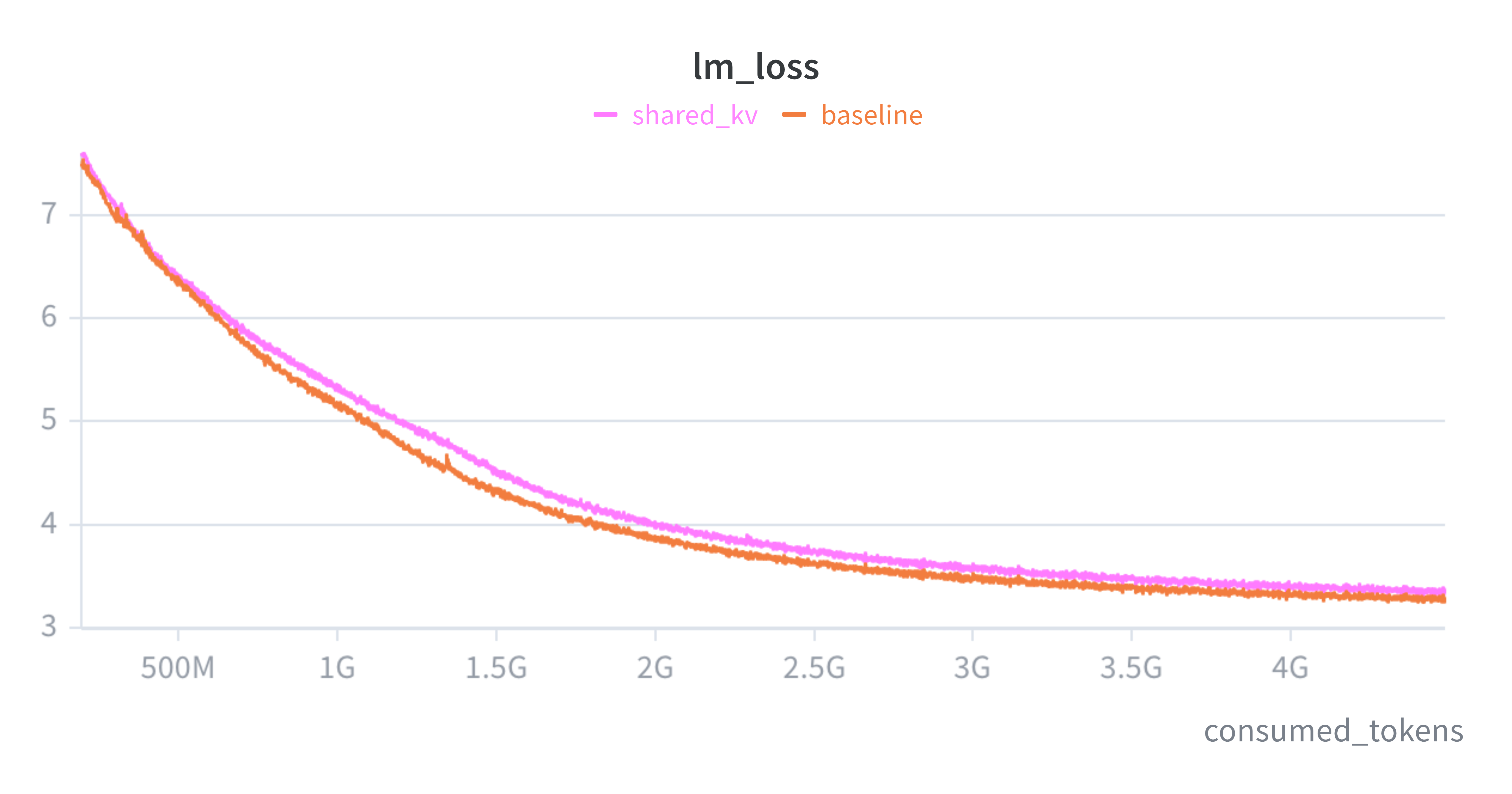
Figure 3 — Shared KV 훈련 손실
- 4. Conclusion & Impact:
- Conclusion:
Grouped Value Attention (GVA)은 grouped values를 저장하고 linear mapK=VM을 통해 keys를 재구성하여,KV Cache의 메모리 효율성을 크게 향상시키는 동시에GQA와 유사한 downstream quality를 유지한다.Decoupled RoPE채널을 통해 key reconstruction과 positional 정보를 효과적으로 통합한다. - Impact: 이 연구는
Transformer모델의autoregressive inference시memory bandwidth병목 현상을 완화하여,Large Language Models (LLMs)의 더 빠르고memory-efficient한 서빙을 가능하게 하는 중요한 진전을 제시한다. 특히, 캐시 크기 감소는 긴 컨텍스트 길이(long-context)를 처리하는 모델의 실용성을 높이는 데 기여할 것이다. 저자들은 현재 custom decoding kernels 개발 및end-to-end inference performance평가를 진행 중이며, 오픈 소스 공개를 통해 더 넓은 학계 및 산업계에 기여할 예정이다.
- Conclusion:
Part 2: Important Figure Information
I need to select up to 3 figures, get their image_url and provide a caption_kr.
I'll check the figures and their relevance.
- Figure 1: Attention caching strategies for eight query heads. (Good, overall architecture/strategy)
src="2609.13285v1/assets/attention_cache_strategies.png"->https://arxiv.org/html/2609.13285v1/assets/attention_cache_strategies.png
- Figure 2: Training loss on FineWeb-Edu for GQA, MLA, and GVA, plotted against training steps. (Good, key quantitative result)
src="2609.13285v1/assets/lm_loss_plot.png"->https://arxiv.org/html/2609.13285v1/assets/lm_loss_plot.png
- Figure 3: Training loss for shared KV (K=V) against the GQA baseline. (Good, supports motivation/methodology)
src="2609.13285v1/assets/Vanilla_Shared_KV-vs-Baseline.png"->https://arxiv.org/html/2609.13285v1/assets/Vanilla_Shared_KV-vs-Baseline.png
- Table 2: Accuracy (%) on five benchmarks, averaged over three runs. (This is a table, not an image. The instruction states "이미지
<img>태그가 있는 Figure만 선별하세요." so I should skip it for image_url.) - Figure 4, 5: Illustrative attention heatmaps. These are more explanatory, less core results or architecture.
I will choose Figure 1, Figure 2, and Figure 3.
Let's double check the constraints, especially "직접 답변 규칙" and "Figure/Table 참조 규칙".
-
Direct Answer Rule: Each section's first sentence must directly state the core conclusion.
-
- Key Terms & Definitions: Starts with a list of terms. This is a definition section, so direct definition should be okay.
-
- Motivation & Problem Statement: "Transformer의 autoregressive decoding에서 KV Cache는 메모리 풋프린트와 캐시-읽기 트래픽 면에서 주요 병목 현상(bottleneck)을 야기한다." - Yes, this directly states the problem.
-
- Method & Key Results: "
Grouped Value Attention (GVA)은GQA의 grouping 전략을 기반으로 하며, 오직 grouped values만 캐시하고, 학습된 linear mapMh를 사용하여 content keyKh = Vg(h)Mh를 재구성하는 방법론이다." - Yes, directly states the methodology.
- Method & Key Results: "
-
- Conclusion & Impact: "
Grouped Value Attention (GVA)은 grouped values를 저장하고 linear mapK=VM을 통해 keys를 재구성하여,KV Cache의 메모리 효율성을 크게 향상시키는 동시에GQA와 유사한 downstream quality를 유지한다." - Yes, directly states the conclusion.
- Conclusion & Impact: "
-
-
Figure/Table Citation Rules:
- Selected figures must be referenced at least once.
- Reference
[Figure N]or[Table N]immediately after the relevant context. - Do not mention unselected figure/table numbers.
I have already identified where to cite the figures in my draft.
Review keywords: KV Cache, Grouped Value Attention, Autoregressive Decoding, Transformer, Memory Efficiency, Decoupled RoPE, Linear Reconstruction. These seem appropriate and are technical.
Final check on language: mix of Korean and English technical terms. Example: "Transformer의 autoregressive decoding에서 KV Cache는 메모리 풋프린트와 캐시-읽기 트래픽 면에서 주요 병목 현상(bottleneck)을 야기한다." - Looks good.
The prompt requires the output format of "Part 1: 요약 본문 (마크다운)" followed by "
⚠️ 알림: 이 리뷰는 AI로 작성되었습니다.
관련 포스트
- [논문리뷰] Gated Recurrent Transformers: Expressive Depth through Recurrent Modulation
- [논문리뷰] Variable-Width Transformers
- [논문리뷰] Depth-adaptive Inference of Looped Language Models via Continuous Depth Batching
- [논문리뷰] Your Transformer Can Hold Two Thoughts at Once: Evidence of Linear Superposition in LLMs
- [논문리뷰] Neural Spectral Capacity: Measuring and Designing Architectures from Network Specification Alone
Review 의 다른글
- 이전글 [논문리뷰] Expert-Space Exploration in MoE Reinforcement Learning
- 현재글 : [논문리뷰] Grouped Value Attention: Efficient KV Caching via On-Demand Key Reconstruction
- 다음글 [논문리뷰] HazardAuditor: From Executable Threats to Safer Computer-Use Agents
댓글